Light Energy — Practice Quiz
ICSE · Class 7 · Physics
Try a 4-question quiz on Light Energy for ICSE Class 7 Physics: tap an answer to check it and see why. 45 questions in the full chapter test.
Interactive on Super Tutor
Studying Light Energy? Get the full interactive chapter.
Quizzes, flashcards, AI doubt-solver and a step-by-step study plan — built for practice quiz and more.
Free trial, no card needed.
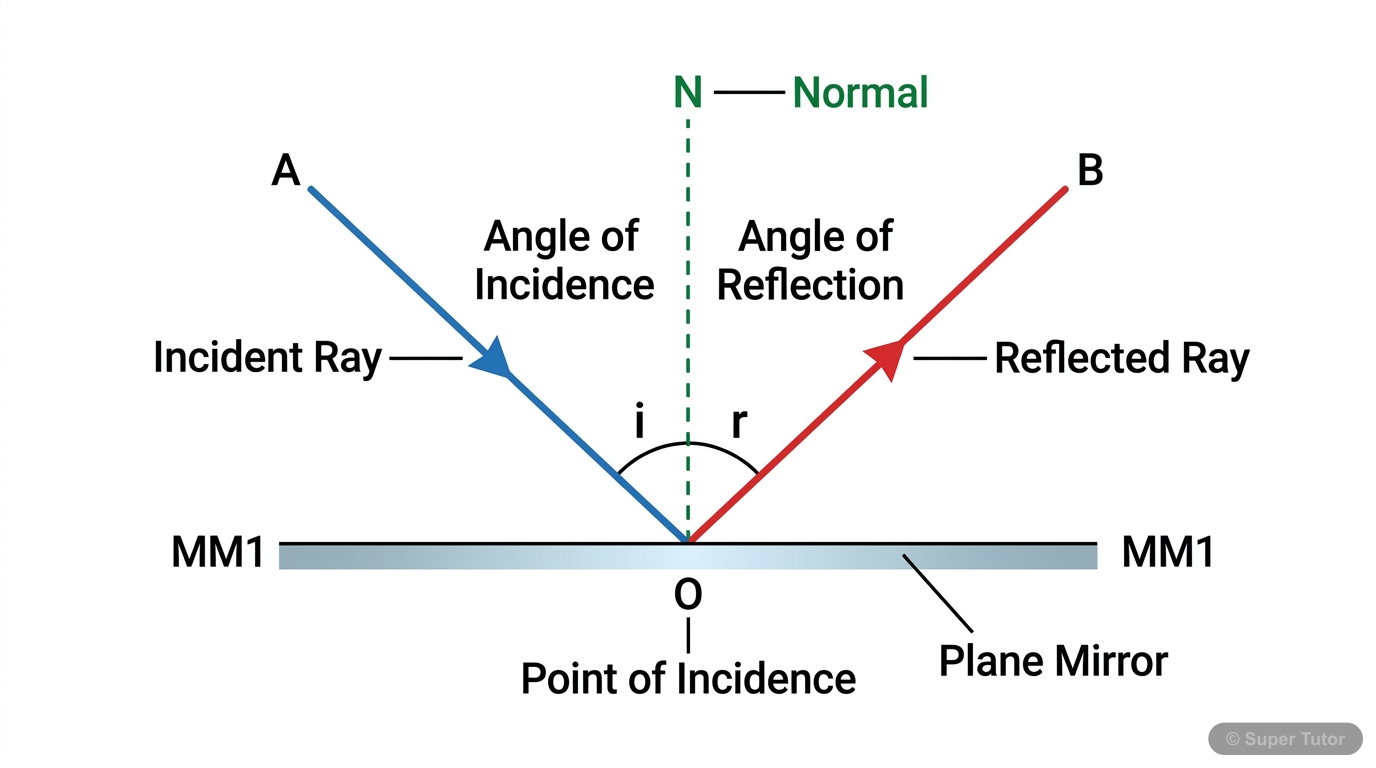
Learn better with visuals Super Tutor pairs illustrations like this with notes and quizzes for Light Energy.
Quick Quiz: Light Energy
0/4Tap an answer to check it instantly. No sign-up needed for these 4.
What is reflection of light?
The angle between the incident ray and the normal at the point of incidence is called the:
According to the first law of reflection, which of the following is correct?
A ray of light is incident on a plane mirror at an angle of incidence of 35°. What is the angle of reflection?
Sample Questions
A ray of light falls normally on a plane mirror. What is the angle of incidence?
Show answer
0°
Step 1: When a ray falls normally on a mirror, it means the ray is perpendicular to the mirror surface. Step 2: The angle of incidence is measured between the ray and the normal. Step 3: Since the ray itself travels along the direction of the normal, the angle between them is 0°. Step 4: By the law of reflection, the angle of reflection is also 0°, so the ray retraces its own path. Option A (90°) is the angle the ray makes with the mirror surface, not with the normal.
An object is placed 10 cm in front of a plane mirror. How far is the image from the mirror?
Show answer
10 cm
Step 1: One key characteristic of a plane mirror is that the image is as far behind the mirror as the object is in front of it. Step 2: Object distance from mirror = 10 cm. Step 3: Therefore, image distance from mirror = 10 cm. The image is formed 10 cm behind the mirror. Option A (5 cm) is half the object distance — incorrect. Option B (20 cm) is double the distance — also incorrect. Option D (0 cm) would mean the image is at the mirror surface, which is wrong.
Which of the following correctly describes the image formed by a plane mirror?
Show answer
Virtual, erect, and same size as the object
A plane mirror forms an image with these characteristics: (1) Virtual — the image cannot be obtained on a screen because the reflected rays diverge and only appear to meet behind the mirror. (2) Erect — the image is upright, not upside down. (3) Same size — the image is neither magnified nor diminished. Option A is wrong because the image is not real or inverted. Options C and D mix up the correct properties. Real images are formed by actual convergence of rays, which does not happen in a plane mirror.
When you look at yourself in a plane mirror and raise your RIGHT hand, which hand does your image appear to raise?
Show answer
Left hand
This question tests the concept of lateral inversion. A plane mirror swaps the left and right sides of the image. So when you raise your right hand, the image appears to raise its left hand. This is why letters like 'b' look like 'd' in a mirror. This is called lateral inversion — the interchange of left and right sides in the image formed by a plane mirror. The top and bottom are NOT swapped — only the left and right sides are interchanged.
+41 more questions on Light Energy (ICSE Class 7 Physics)
Practise AllFrequently Asked Questions
What are the important topics in Light Energy for ICSE Class 7 Physics?
How many practice questions are there for Light Energy?
Sources & Official References
Content is aligned to the official syllabus. Refer to the board website for the latest curriculum.
More resources for Light Energy
Important Questions
Exam-style questions with answers
Revision Notes
Key points for last-minute revision
Formula Sheet
The chapter's formulas in one place
Chapter Summary
Understand the chapter at a glance
Concept Maps
See how topics connect
Study Plan
Step-by-step plan for this chapter
Flashcards
Quick-fire cards for active recall
Syllabus
What topics to cover
For serious students
Get the full Light Energy chapter — start free.
Quizzes, flashcards, an AI doubt solver and a study plan for ICSE Class 7 Physics. Free to start, no card needed.