A Period of Transition — Concept Maps
ICSE · Class 8 · History & Civics
4 concept maps of A Period of Transition for ICSE Class 8 History & Civics, each also written out as a text outline.
Interactive on Super Tutor
Studying A Period of Transition? Get the full interactive chapter.
Quizzes, flashcards, AI doubt-solver and a step-by-step study plan — built for concept maps and more.
Free trial, no card needed.
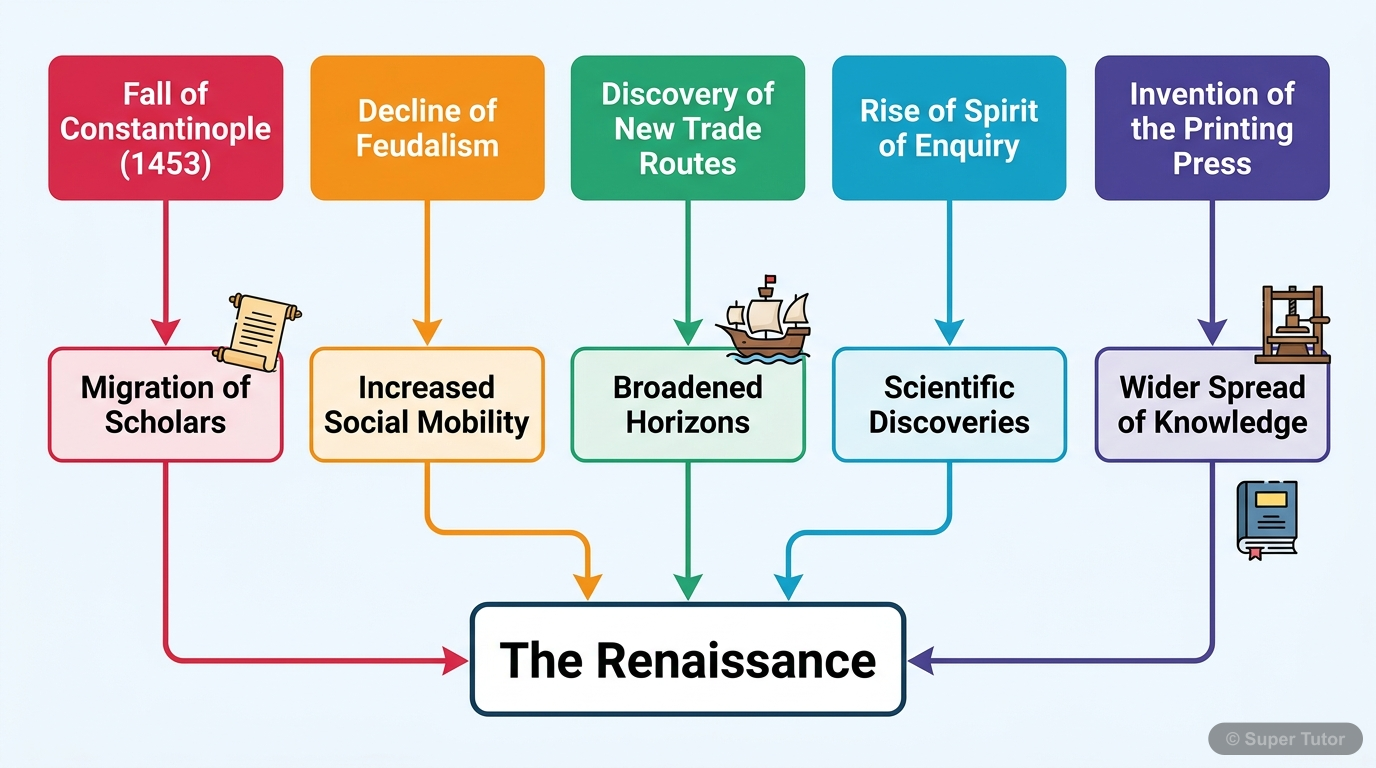
Learn better with visuals Super Tutor pairs illustrations like this with notes and quizzes for A Period of Transition.
Timeline of A Period of Transition (1300-1900 CE)
The map in words
- 1300
- Renaissance begins - Revival of Greek and Roman learning
- 1453
- Fall of Constantinople - Greek scholars flee with manuscripts
- 1492
- Columbus reaches America - New continent discovered
- 1498
- Vasco-da-Gama reaches India - New sea route established
- 1517
- Martin Luther starts Reformation - Challenges Catholic Church
- 1540
- Counter Reformation begins - Catholic Church responds
- 1750
- Industrial Revolution starts in England - Machine Age begins
- 1793
- Eli Whitney invents Cotton Gin - Increases raw cotton supply
- 1814
- George Stephenson develops steam railway - Transportation revolution
- 1830
- First passenger railway opens - Liverpool to Manchester
- 1870s
- Germany and Italy industrialize - Industrial Revolution spreads
- 1890s
- Peak of European Imperialism - Colonies divide Asia and Africa
- 1914
- World War I begins - Result of imperial rivalries
Key Events: A Period of Transition (14th to 19th Century)
The map in words
- 1300
- Renaissance begins in Italy
- 1453
- Fall of Constantinople - Greek scholars flee to Italy
- 1492
- Columbus reaches the Americas
- 1498
- Vasco da Gama reaches Calicut India
- 1517
- Martin Luther starts Protestant Reformation
- 1519
- Magellan begins circumnavigation of Earth
- 1750
- Industrial Revolution begins in England
- 1793
- Eli Whitney invents Cotton Gin
- 1814
- Stephenson develops Steam Locomotive
- 1830
- First passenger railway Liverpool to Manchester
- 1886
- Burma annexed into British India
Timeline of A Period of Transition (1300-1830 CE)
The map in words
- 1300
- Renaissance begins - revival of ancient learning
- 1453
- Fall of Constantinople - Greek scholars flee to Italy
- 1492
- Columbus reaches Americas
- 1498
- Vasco-da-Gama discovers sea route to India
- 1500
- Reformation begins - questioning of Church authority
- 1519
- Magellan begins circumnavigation voyage
- 1600
- Rise of Nation-states in Europe
- 1750
- Industrial Revolution begins in England
- 1793
- Eli Whitney invents Cotton Gin
- 1814
- George Stephenson develops railway steam engine
- 1830
- First passenger railway Liverpool to Manchester
- 1850-1900
- Age of Imperialism - European colonies in Asia and Africa
Transition from the Medieval Age to the Modern Age in Europe and India
The map in words
- Transition from the Medieval Age to the Modern Age in Europe and India
- Introduction
- Sources
- Renaissance
- Reformation
- Voyages and Discoveries
- The Industrial Revolution
- Why Industrial Revolution Began in England
- Major Inventions
Explore these maps interactively
Explore DiagramsFrequently Asked Questions
What are the important topics in A Period of Transition for ICSE Class 8 History & Civics?
What do the concept maps for A Period of Transition show?
How should I revise A Period of Transition for Class 8 exams?
Sources & Official References
Content is aligned to the official syllabus. Refer to the board website for the latest curriculum.
More resources for A Period of Transition
Practice Quiz
Test yourself with a quick quiz
Important Questions
Exam-style questions with answers
Revision Notes
Key points for last-minute revision
Chapter Summary
Understand the chapter at a glance
Study Plan
Step-by-step plan for this chapter
Flashcards
Quick-fire cards for active recall
Syllabus
What topics to cover
For serious students
Get the full A Period of Transition chapter — start free.
Quizzes, flashcards, an AI doubt solver and a study plan for ICSE Class 8 History & Civics. Free to start, no card needed.