A Period of Transition — Practice Quiz
ICSE · Class 8 · History & Civics
Try a 4-question quiz on A Period of Transition for ICSE Class 8 History & Civics: tap an answer to check it and see why.
Interactive on Super Tutor
Studying A Period of Transition? Get the full interactive chapter.
Quizzes, flashcards, AI doubt-solver and a step-by-step study plan — built for practice quiz and more.
Free trial, no card needed.
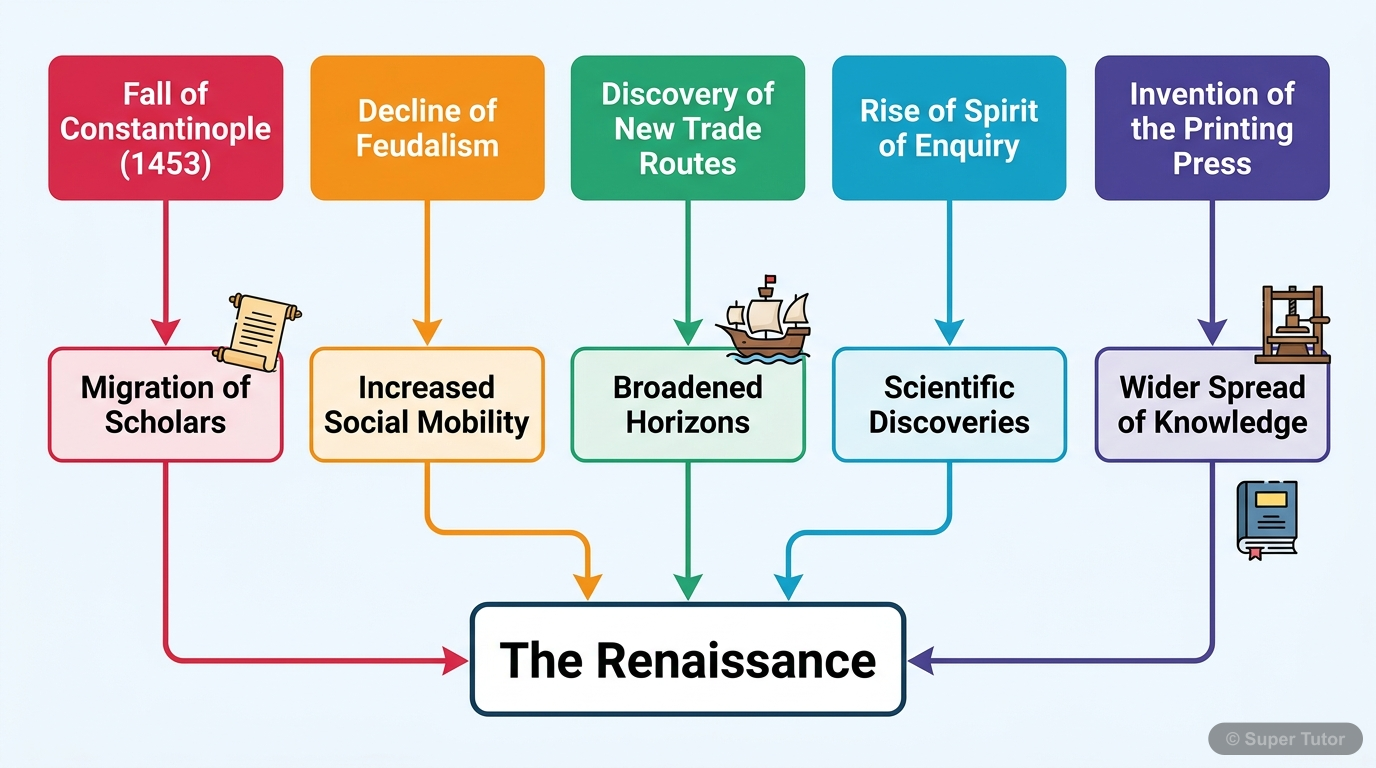
Learn better with visuals Super Tutor pairs illustrations like this with notes and quizzes for A Period of Transition.
Quick Quiz: A Period of Transition
0/4Tap an answer to check it instantly. No sign-up needed for these 4.
Which of the following best explains why the fall of Constantinople in 1453 CE was a significant factor in triggering the Renaissance in Italy?
The concept of 'Humanism' during the Renaissance represented a major shift in thinking. Which statement most accurately describes this shift?
Martin Luther's Reformation Movement is best described as which of the following?
What distinguished the Counter Reformation from the Protestant Reformation?
Sample Questions
Vasco da Gama's voyage in 1498 CE was historically significant primarily because it:
Show answer
Established a direct sea route from Europe to India by sailing around Africa.
Step 1: Before Vasco da Gama's voyage, Europeans had no direct sea route to India and Asia. Step 2: Bartholomew Diaz had already reached the Cape of Good Hope (southern tip of Africa) earlier — so Option D is wrong. Step 3: Vasco da Gama successfully sailed around the entire African continent and arrived at Calicut on India's west coast in 1498 CE. Step 4: This discovery of a new sea route to India allowed Portugal to establish direct trade with India, Sri Lanka, China, Japan, and the East Indies. Step 5: Option A is wrong — it was Ferdinand Magellan who circumnavigated the globe. Option B is
Christopher Columbus is historically remembered for reaching America in 1492 CE. However, he made a significant error in his understanding of his discovery. What was this error?
Show answer
He believed he had reached Asia (the East Indies) and called the local people 'Indians'.
Step 1: Columbus set out westward across the Atlantic Ocean with the goal of reaching Asia (the East Indies) to establish a trade route. Step 2: When he arrived in the Americas in 1492 CE, he genuinely believed he had reached the outskirts of Asia. Step 3: Because of this mistake, he called the native people of the Americas 'Indians' — a name that stuck for centuries. Step 4: He never realized he had discovered an entirely new continent. Step 5: Option A is wrong — that was Bartholomew Diaz's achievement. Option C is wrong — that describes Vasco da Gama's voyage. Option D is wrong — Columbus a
Which combination of factors MOST directly explains why the Industrial Revolution began in England rather than in France or Germany?
Show answer
England had large colonies, abundant coal and iron, accumulated capital, and a stable government free from feudal dominance.
Step 1: The textbook lists several specific reasons why England was uniquely positioned for an industrial revolution. Step 2: England had accumulated vast capital through overseas trade and had numerous colonies supplying raw materials. Step 3: Abundant natural resources (iron and coal) existed side by side in England, which no other country enjoyed to the same extent. Step 4: After the 17th-century revolution, England had a stable government where commercial classes held more power and there was no risk of feudal or government interference in trade. Step 5: The enclosure movement also created
The 'enclosure movement' in 18th century England contributed to the Industrial Revolution in which specific way?
Show answer
It led to large landowners consolidating land, displacing small peasants who then became factory workers.
Step 1: The enclosure movement involved big landowners taking over and consolidating large landholdings, including the small plots held by peasant farmers. Step 2: Small peasants who depended on this land were ousted or displaced, leaving them without land or livelihood. Step 3: This created a large 'army' of landless, unemployed people who had no choice but to look for work elsewhere. Step 4: These displaced peasants moved to newly emerging factory towns and cities, providing cheap and abundant labour for the Industrial Revolution's factories. Step 5: Option A is partially related but does no
+41 more questions on A Period of Transition (ICSE Class 8 History & Civics)
Practise AllFrequently Asked Questions
What are the important topics in A Period of Transition for ICSE Class 8 History & Civics?
How many practice questions are there for A Period of Transition?
Sources & Official References
Content is aligned to the official syllabus. Refer to the board website for the latest curriculum.
More resources for A Period of Transition
Important Questions
Exam-style questions with answers
Revision Notes
Key points for last-minute revision
Chapter Summary
Understand the chapter at a glance
Concept Maps
See how topics connect
Study Plan
Step-by-step plan for this chapter
Flashcards
Quick-fire cards for active recall
Syllabus
What topics to cover
For serious students
Get the full A Period of Transition chapter — start free.
Quizzes, flashcards, an AI doubt solver and a study plan for ICSE Class 8 History & Civics. Free to start, no card needed.