The Nature and The Classification of an Economy — Important Questions
ICSE · Class 9 · Economic Applications
45 important questions from The Nature and The Classification of an Economy for ICSE Class 9 Economic Applications, with answers.
Interactive on Super Tutor
Studying The Nature and The Classification of an Economy? Get the full interactive chapter.
Quizzes, flashcards, AI doubt-solver and a step-by-step study plan — built for important questions and more.
Free trial, no card needed.
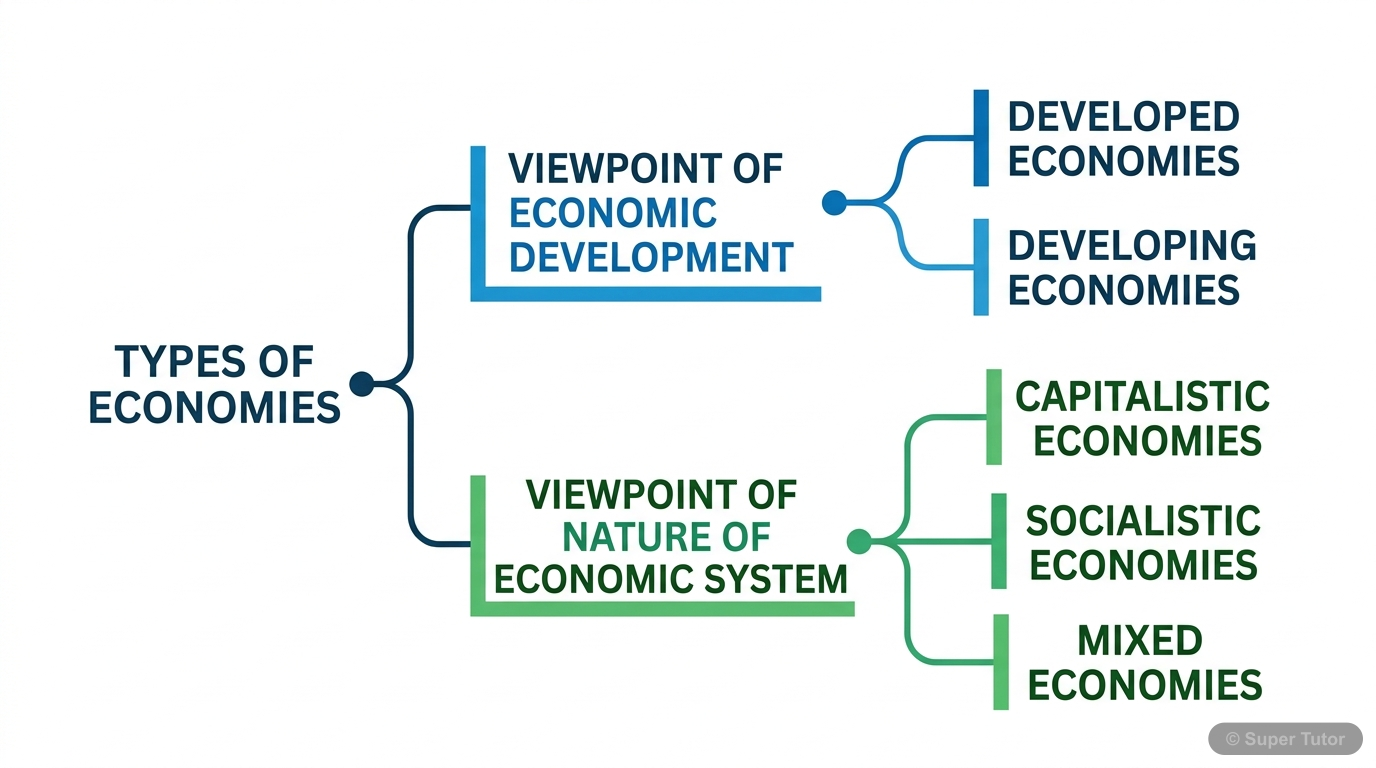
Learn better with visuals Super Tutor pairs illustrations like this with notes and quizzes for The Nature and The Classification of an Economy.
Important Questions from The Nature and The Classification of an Economy
Which economist is known for his work on national income and received the Nobel Prize in Economics in 1971?
Show answer
Simon Kuznets
Step 1: Simon Kuznets was a Russian-American economist at Harvard University. Step 2: He was one of the earliest writers on development economics. Step 3: He analyzed the empirical characteristics of developed and developing countries. Step 4: He received the Nobel Prize in Economics in 1971 for his work on national income and economic growth. Step 5: Karl Marx focused on socialism and class struggle, while Adam Smith wrote about capitalism and the 'invisible hand,' making Kuznets the correct answer for national income studies.
What does 'laissez-faire' mean in the context of a capitalistic economy?
Show answer
Minimum government interference
Step 1: 'Laissez-faire' is a French term meaning 'let it be' or 'leave it alone.' Step 2: In economic context, it refers to minimal government intervention in economic activities. Step 3: Capitalistic economies operate on laissez-faire principles with market forces determining economic outcomes. Step 4: Consumers and producers are free to make independent decisions without government interference. Step 5: Maximum government control or ownership would be characteristic of socialist economies, not capitalist laissez-faire systems.
Which feature is common to both capitalistic and mixed economies?
Show answer
Private property rights
Step 1: Mixed economies combine features of both capitalistic and socialistic systems. Step 2: Private property rights exist in both capitalistic and mixed economies, allowing individuals to own productive resources. Step 3: Mixed economies maintain private ownership alongside public sector participation. Step 4: Central planning is more characteristic of socialist economies. Step 5: Complete government ownership and elimination of competition are features of pure socialist systems, not found in capitalistic or mixed economies.
What is a major characteristic of developing economies regarding employment?
Show answer
Predominance of agricultural employment
Step 1: Developing economies are characterized by agriculture as the main source of income and employment. Step 2: A large portion of the population depends on agricultural activities for their livelihood. Step 3: This is different from developed economies where industrial and service sectors employ more people. Step 4: The occupational structure in developing countries is slowly shifting from agricultural to industrial and service activities. Step 5: Service and industrial sectors become predominant only as countries develop and modernize their economies.
+41 more questions on The Nature and The Classification of an Economy (ICSE Class 9 Economic Applications)
Practise AllFrequently Asked Questions
What are the important topics in The Nature and The Classification of an Economy for ICSE Class 9 Economic Applications?
How many important questions are there in The Nature and The Classification of an Economy?
Sources & Official References
Content is aligned to the official syllabus. Refer to the board website for the latest curriculum.
More resources for The Nature and The Classification of an Economy
For serious students
Get the full The Nature and The Classification of an Economy chapter — start free.
Quizzes, flashcards, an AI doubt solver and a study plan for ICSE Class 9 Economic Applications. Free to start, no card needed.