The Nature of Indian Economy — Important Questions
ICSE · Class 9 · Economic Applications
43 important questions from The Nature of Indian Economy for ICSE Class 9 Economic Applications, with answers.
Interactive on Super Tutor
Studying The Nature of Indian Economy? Get the full interactive chapter.
Quizzes, flashcards, AI doubt-solver and a step-by-step study plan — built for important questions and more.
Free trial, no card needed.
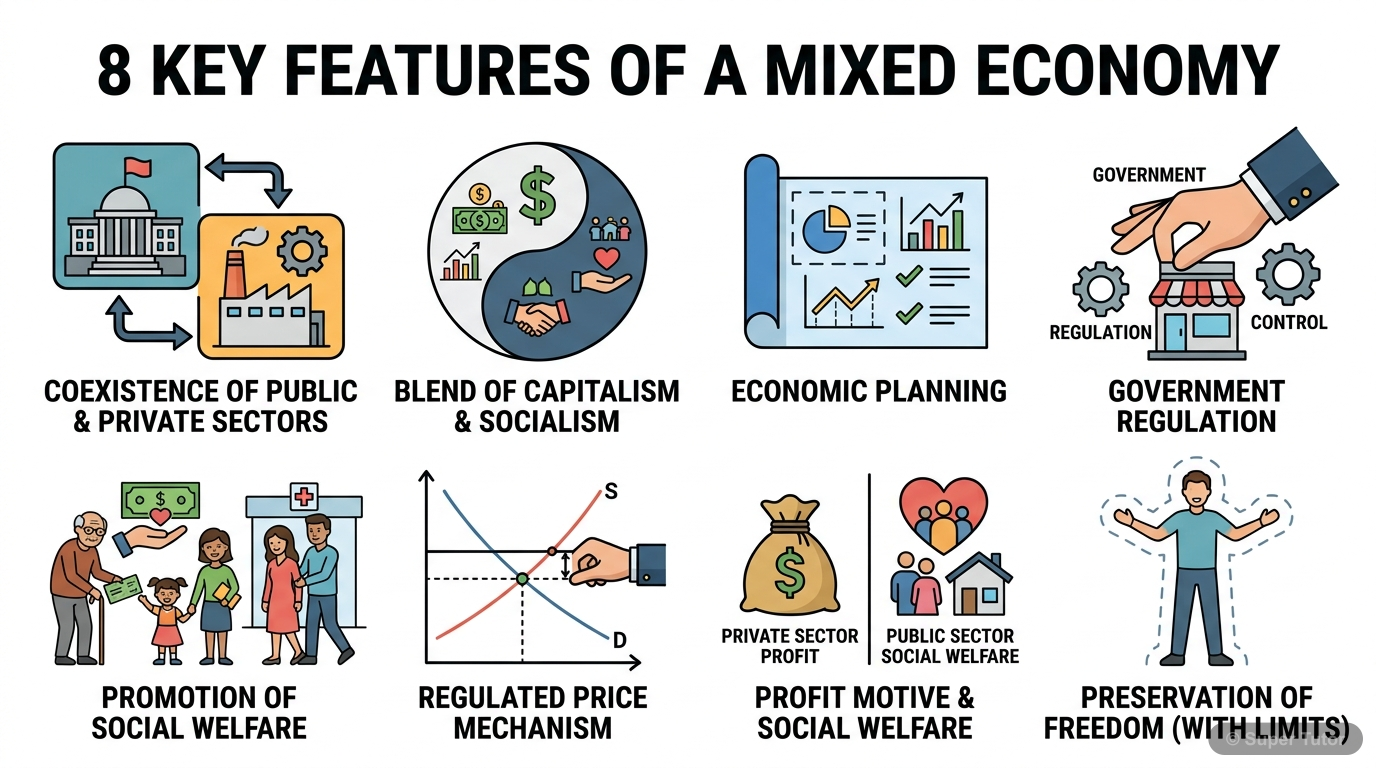
Learn better with visuals Super Tutor pairs illustrations like this with notes and quizzes for The Nature of Indian Economy.
Important Questions from The Nature of Indian Economy
Food grain production in India increased from 50.8 million tonnes in 1950-51 to how much in 2022-23?
Show answer
328.8 million tonnes
The correct answer is 328.8 million tonnes. Step 1: Food grain production increased dramatically from 50.8 million tonnes in 1950-51 to 328.8 million tonnes in 2022-23. Step 2: This represents more than a 6-fold increase, showing remarkable agricultural progress. Step 3: This achievement helped India become self-sufficient in food grains and eliminate famines. Step 4: The Green Revolution in wheat and rice contributed significantly to this growth. Step 5: This transformation moved India from food scarcity to food security, a major developmental milestone.
The literacy rate in India increased from 18% in 1951 to what percentage in 2020-21?
Show answer
77.7%
The correct answer is 77.7%. Step 1: Literacy rate improved significantly from just 18% in 1951 to 77.7% in 2020-21. Step 2: This represents more than a 4-fold increase in literacy, showing major progress in education. Step 3: This improvement reflects expansion of educational infrastructure and government focus on education. Step 4: Higher literacy contributes to better quality of human capital and economic development. Step 5: However, India still needs to achieve universal literacy to match developed nations.
What type of economic system does India follow?
Show answer
Mixed economy
The correct answer is Mixed economy. Step 1: India adopted a mixed economic system in 1951 with coexistence of public and private sectors. Step 2: The government plays a significant role through public sector enterprises while private sector also operates freely. Step 3: Option (a) Pure capitalist system has minimal government role, unlike India. Step 4: Option (b) Socialist economy would have complete government control, which India doesn't have. Step 5: Option (d) Command economy has total state control. India's mixed approach allows both market forces and government intervention to guide ec
Life expectancy at birth in India increased from 32 years in 1951 to how many years in 2021?
Show answer
69.7 years
The correct answer is 69.7 years. Step 1: Life expectancy more than doubled from 32 years in 1951 to 69.7 years in 2021. Step 2: This dramatic improvement reflects better healthcare facilities and medical services. Step 3: Reduced death rates and infant mortality contributed to increased life expectancy. Step 4: Better nutrition, disease control, and healthcare infrastructure helped achieve this progress. Step 5: However, India's life expectancy is still lower than many developed countries, indicating scope for further improvement in healthcare quality.
+39 more questions on The Nature of Indian Economy (ICSE Class 9 Economic Applications)
Practise AllFrequently Asked Questions
What are the important topics in The Nature of Indian Economy for ICSE Class 9 Economic Applications?
How many important questions are there in The Nature of Indian Economy?
Sources & Official References
Content is aligned to the official syllabus. Refer to the board website for the latest curriculum.
More resources for The Nature of Indian Economy
For serious students
Get the full The Nature of Indian Economy chapter — start free.
Quizzes, flashcards, an AI doubt solver and a study plan for ICSE Class 9 Economic Applications. Free to start, no card needed.