Solutions to The Basic* Economic Problems in Different Economies — Practice Quiz
ICSE · Class 9 · Economic Applications
Try a 4-question quiz on Solutions to The Basic* Economic Problems in Different Economies for ICSE Class 9 Economic Applications: tap an answer to check.
Interactive on Super Tutor
Studying Solutions to The Basic* Economic Problems in Different Economies? Get the full interactive chapter.
Quizzes, flashcards, AI doubt-solver and a step-by-step study plan — built for practice quiz and more.
Free trial, no card needed.
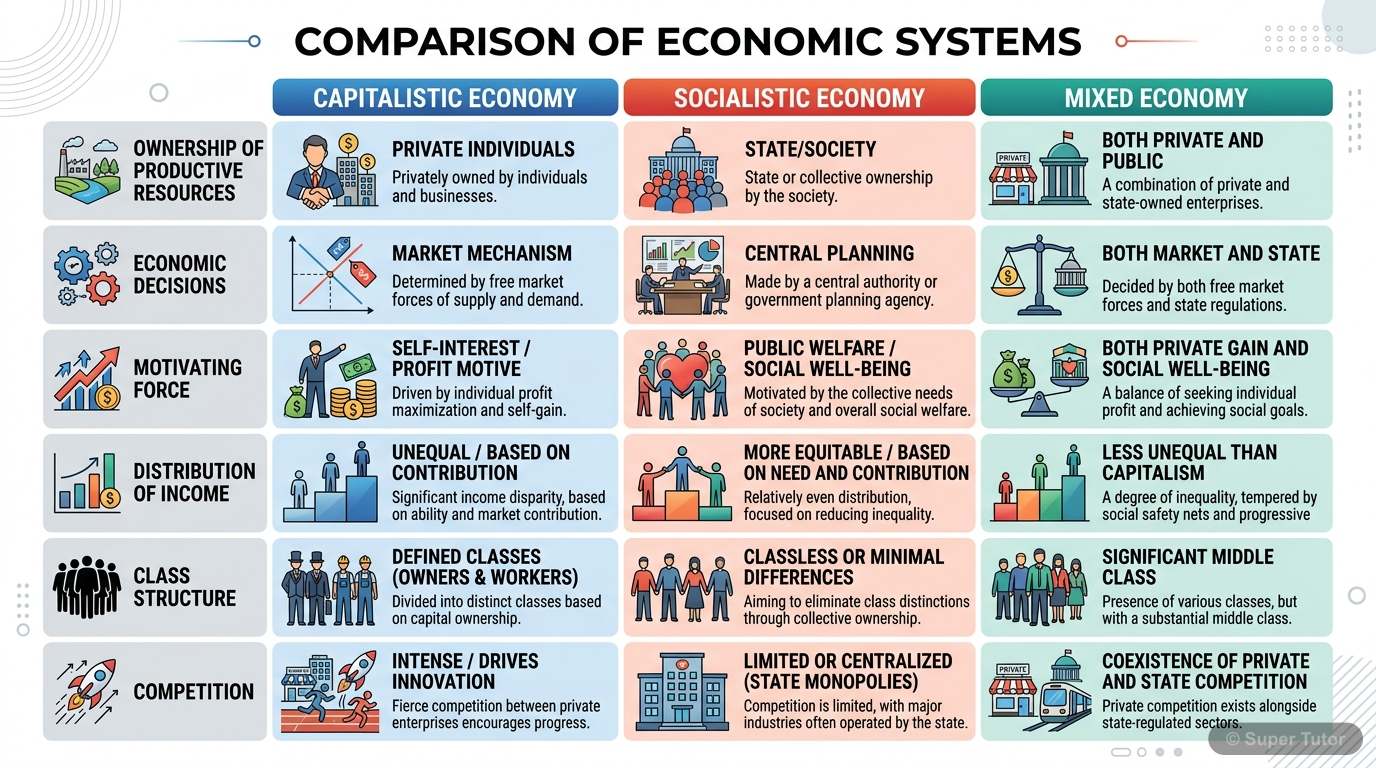
One of 5 illustrations for Solutions to The Basic* Economic Problems in Different Economies in Super Tutor — alongside flashcards, concept maps and practice questions.
Quick Quiz: Solutions to The Basic* Economic Problems in Different Economies
0/4Tap an answer to check it instantly. No sign-up needed for these 4.
Which mechanism is primarily used to solve basic economic problems in a capitalistic economy?
Who is considered the 'sovereign' or 'king' in a capitalistic economy?
In a socialistic economy, who takes decisions about what to produce and how much to produce?
What are the two important elements of price mechanism?
Sample Questions
Which principle guides distribution in a socialist economy?
Show answer
From each according to his capacity, to each according to his work
Socialist distribution follows the principle of 'from each according to capacity, to each according to work'. Step 1: This means people contribute based on their abilities and skills. Step 2: In return, they receive income based on the quantity and quality of work done. Step 3: Skilled workers earn more than unskilled workers based on their contribution. Step 4: Wealth-based distribution contradicts socialist equality principles. Step 5: Complete equal distribution ignores work quality, and market demand doesn't apply in planned economies.
In a mixed economy, which sectors coexist?
Show answer
Private and public
Private and public sectors coexist in a mixed economy. Step 1: Mixed economies combine features of both capitalist and socialist systems. Step 2: Private sector operates based on profit motive and market forces. Step 3: Public sector focuses on national priorities and economic infrastructure. Step 4: Government regulates private sector through economic policies. Step 5: Agricultural/industrial and primary/secondary refer to economic activities, not ownership patterns, while urban/rural are geographical divisions.
What determines equilibrium price in a capitalistic economy?
Show answer
Interaction of demand and supply
Equilibrium price is determined by the interaction of demand and supply forces. Step 1: Buyers create demand for goods and services in the market. Step 2: Sellers offer supply to meet this demand. Step 3: Competition among buyers and sellers leads to price determination. Step 4: Equilibrium occurs where quantity demanded equals quantity supplied. Step 5: Government regulations, producer costs alone, or consumer income alone cannot determine market prices without considering both demand and supply sides.
Which technique of production will a profit-maximizing producer choose?
Show answer
Least costly technique
A profit-maximizing producer will choose the least costly technique. Step 1: Profit = Revenue - Cost, so minimizing cost maximizes profit. Step 2: Producers compare costs of different production methods. Step 3: The technique with lowest input costs will be selected. Step 4: Choice between labor or capital intensive depends on relative prices of these inputs. Step 5: Most expensive technique reduces profits, while the specific intensity (labor or capital) depends on which input is cheaper.
+41 more questions on Solutions to The Basic* Economic Problems in Different Economies (ICSE Class 9 Economic Applications)
Practise AllFrequently Asked Questions
What are the important topics in Solutions to The Basic* Economic Problems in Different Economies for ICSE Class 9 Economic Applications?
How many practice questions are there for Solutions to The Basic* Economic Problems in Different Economies?
Sources & Official References
Content is aligned to the official syllabus. Refer to the board website for the latest curriculum.
More resources for Solutions to The Basic* Economic Problems in Different Economies
Important Questions
Exam-style questions with answers
Revision Notes
Key points for last-minute revision
Chapter Summary
Understand the chapter at a glance
Concept Maps
See how topics connect
Study Plan
Step-by-step plan for this chapter
Flashcards
Quick-fire cards for active recall
Syllabus
What topics to cover
For serious students
Get the full Solutions to The Basic* Economic Problems in Different Economies chapter — start free.
Quizzes, flashcards, an AI doubt solver and a study plan for ICSE Class 9 Economic Applications. Free to start, no card needed.