Speaking Skills — Practice Quiz
ICSE · Class 9 · English Language - Archer
Try a 4-question quiz on Speaking Skills for ICSE Class 9 English Language - Archer: tap an answer to check it and see why.
Interactive on Super Tutor
Studying Speaking Skills? Get the full interactive chapter.
Quizzes, flashcards, AI doubt-solver and a step-by-step study plan — built for practice quiz and more.
Free trial, no card needed.
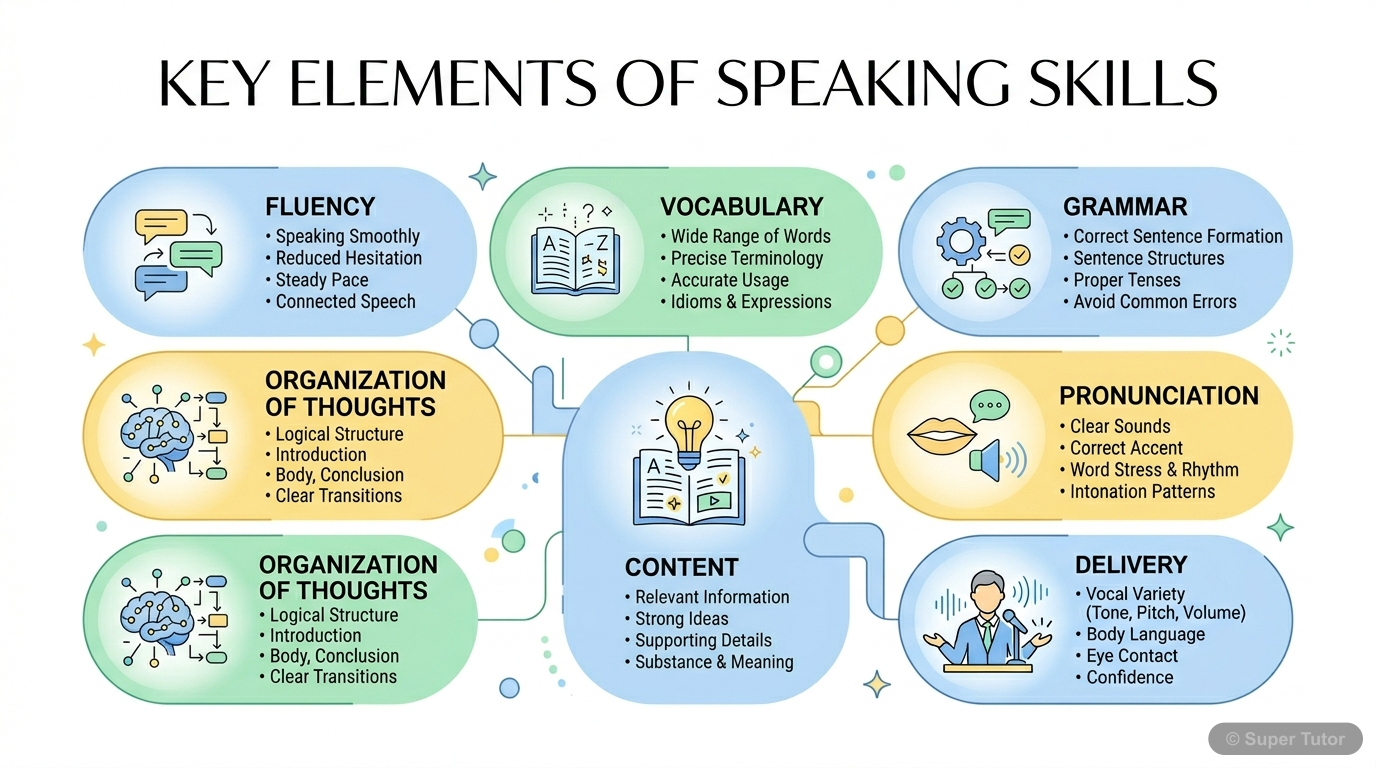
One of 5 illustrations for Speaking Skills in Super Tutor — alongside flashcards, concept maps and practice questions.
Quick Quiz: Speaking Skills
0/4Tap an answer to check it instantly. No sign-up needed for these 4.
What are the four key elements of speaking skills mentioned in the chapter?
How long is the presentation time allowed in the English Paper-1 speaking test?
What should be the first step in improving your speaking skills?
Which of the following is NOT mentioned as a broad category of speech?
Sample Questions
What should you do to make your speech interesting according to the chapter?
Show answer
Give examples, provide anecdotes, use figures of speech, and add humour
The chapter specifically recommends: 'Make your speech interesting. Give examples, provide anecdotes, use different figures of speech, and add humour.' This works because: 1) Examples make abstract concepts concrete, 2) Anecdotes create personal connections with the audience, 3) Figures of speech add color and imagery, 4) Appropriate humour keeps the audience engaged. Speaking loudly, using complex vocabulary, or speaking fast can actually make speeches less interesting and harder to follow, going against the chapter's advice for clear, engaging communication.
How should you structure the content of your speech?
Show answer
Introduction (hook your audience), Body (develop the main idea), Conclusion (sum up)
The chapter clearly outlines the proper speech structure: 'Divide the topic into: a. introduction (hook your audience) b. body (develop the main idea) c. conclusion (sum up).' This structure works because: 1) Introduction grabs attention and sets the context, 2) Body develops and explains the main ideas with supporting details, 3) Conclusion reinforces key points and provides closure. This logical flow helps listeners follow and understand the speech. The other options either reverse the order, lack structure, or ignore the importance of organized presentation.
What type of sentences should you use in your speech?
Show answer
Short and simple sentences
The chapter advises: 'Keep the sentences short and simple. Use words appropriate for the context.' This is important because: 1) Short sentences are easier to understand and follow, 2) Simple sentences reduce confusion and miscommunication, 3) Clear sentences help maintain audience attention, 4) Simple language ensures your message reaches everyone. Long, complex, technical, or question-only formats can confuse listeners, make the speech hard to follow, and reduce the effectiveness of communication. The goal is clarity and understanding, not complexity.
Why should you choose a topic you are confident about?
Show answer
Because the examiner will ask you questions about it
The chapter specifically states: 'Choose the topic you are confident about. Remember, the examiner will ask you questions about it.' This is crucial because: 1) After the 2-minute presentation, there's a 3-minute discussion phase, 2) Examiners will probe deeper into your topic, 3) Confidence in your topic helps you answer follow-up questions effectively, 4) Knowledge about your chosen topic shows preparation and understanding. While familiarity might make memorization easier, the primary reason is handling the question-answer session. Speed or complex vocabulary are not the goals of topic sele
+38 more questions on Speaking Skills (ICSE Class 9 English Language - Archer)
Practise AllFrequently Asked Questions
What are the important topics in Speaking Skills for ICSE Class 9 English Language - Archer?
How many practice questions are there for Speaking Skills?
Sources & Official References
Content is aligned to the official syllabus. Refer to the board website for the latest curriculum.
More resources for Speaking Skills
Important Questions
Exam-style questions with answers
Revision Notes
Key points for last-minute revision
Chapter Summary
Understand the chapter at a glance
Concept Maps
See how topics connect
Study Plan
Step-by-step plan for this chapter
Flashcards
Quick-fire cards for active recall
Syllabus
What topics to cover
For serious students
Get the full Speaking Skills chapter — start free.
Quizzes, flashcards, an AI doubt solver and a study plan for ICSE Class 9 English Language - Archer. Free to start, no card needed.