Conditionals — Practice Quiz
ICSE · Class 9 · English Language - Archer
Try a 4-question quiz on Conditionals for ICSE Class 9 English Language - Archer: tap an answer to check it and see why.
Interactive on Super Tutor
Studying Conditionals? Get the full interactive chapter.
Quizzes, flashcards, AI doubt-solver and a step-by-step study plan — built for practice quiz and more.
Free trial, no card needed.
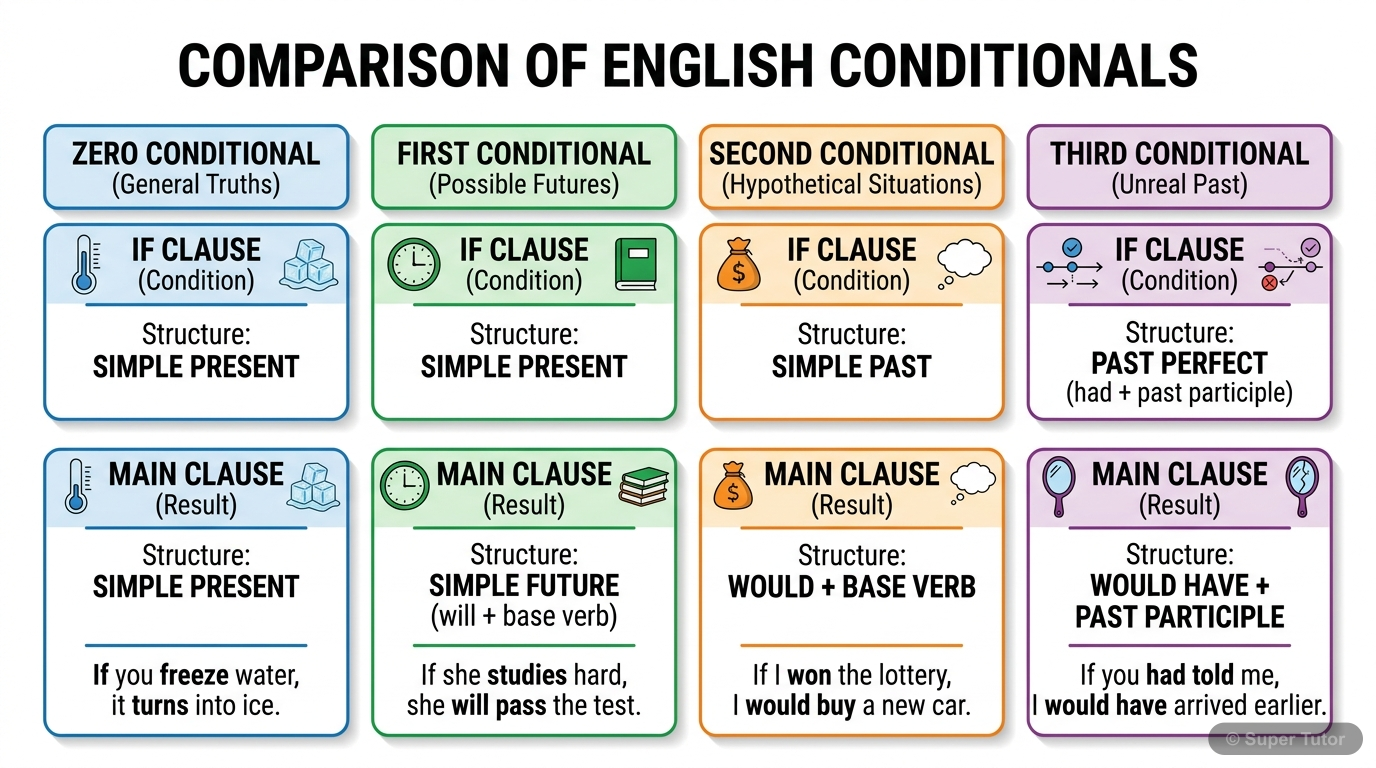
One of 2 illustrations for Conditionals in Super Tutor — alongside flashcards, concept maps and practice questions.
Quick Quiz: Conditionals
0/4Tap an answer to check it instantly. No sign-up needed for these 4.
What type of conditional is used in the sentence: 'If water reaches 100°C, it boils'?
Which sentence correctly uses the first conditional?
In the sentence 'If I were a bird, I would fly everywhere', what type of conditional is used?
What does the third conditional express?
Sample Questions
Which word can replace 'if' in conditional sentences?
Show answer
Unless
'Unless' is commonly used to replace 'if not' in conditional sentences. For example, 'If you don't study, you will fail' can be rewritten as 'Unless you study, you will fail.' Other words that can replace 'if' include 'provided that', 'as long as', 'supposing', and 'on condition that'. 'Because' shows cause and effect, 'although' shows contrast, and 'since' can show time or reason, but none of these express conditional meaning like 'unless' does. 'Unless' specifically means 'if not' or 'except if'.
In the sentence 'If the weather is nice, we go for a walk', what tense is used in both clauses?
Show answer
Simple present
Both clauses use simple present tense: 'is' (present tense of 'be') and 'go' (present tense). This makes it a zero conditional sentence, which uses simple present tense in both the if clause and the main clause. Zero conditionals express general truths, habits, or situations that always happen under certain conditions. If it used future tense ('will go') in the main clause, it would be a first conditional. Simple past would be used in second conditionals, and present perfect or past perfect in more complex conditional forms.
Which sentence shows an inverted conditional?
Show answer
Had I known, I would have helped.
This is an inverted conditional where 'had' is moved to the beginning and 'if' is omitted. In formal English, we can invert conditionals by putting the auxiliary verb (had, were, should) before the subject and dropping 'if'. The original sentence 'If I had known, I would have helped' becomes 'Had I known, I would have helped.' This inversion makes the sentence more formal and is commonly used in written English. The other options don't show this inversion pattern - they either use normal word order or are not proper conditional structures.
What is the main clause in the sentence 'If it snows heavily, school will be cancelled'?
Show answer
school will be cancelled
The main clause is 'school will be cancelled' because it contains the main result or consequence of the condition. In conditional sentences, the main clause tells you what happens if the condition is met, while the if clause states the condition. 'If it snows heavily' is the if clause (condition), not the main clause. 'It snows heavily' is just part of the if clause without 'if', and 'will be cancelled' is only part of the main clause. The complete main clause includes the subject 'school' and the complete predicate 'will be cancelled'.
+40 more questions on Conditionals (ICSE Class 9 English Language - Archer)
Practise AllFrequently Asked Questions
What are the important topics in Conditionals for ICSE Class 9 English Language - Archer?
How many practice questions are there for Conditionals?
Sources & Official References
Content is aligned to the official syllabus. Refer to the board website for the latest curriculum.
More resources for Conditionals
Important Questions
Exam-style questions with answers
Revision Notes
Key points for last-minute revision
Formula Sheet
The chapter's formulas in one place
Chapter Summary
Understand the chapter at a glance
Concept Maps
See how topics connect
Study Plan
Step-by-step plan for this chapter
Flashcards
Quick-fire cards for active recall
Syllabus
What topics to cover
For serious students
Get the full Conditionals chapter — start free.
Quizzes, flashcards, an AI doubt solver and a study plan for ICSE Class 9 English Language - Archer. Free to start, no card needed.