Ecosystem
Jharkhand Board · Class 12 · Biology
NCERT Solutions for Ecosystem — Jharkhand Board Class 12 Biology.
Interactive on Super Tutor
Studying Ecosystem? Get the full interactive chapter.
Quizzes, flashcards, AI doubt-solver and a step-by-step study plan — built for ncert solutions and more.
1,000+ Class 12 students started this chapter today

This is just one of 18+ visuals inside Super Tutor's Ecosystem chapter
Explore the full setEXERCISES — Chapter: Ecosystem (Class 12 Biology)
1Fill in the blanks.
(a) Plants are called as ______ because they fix carbon dioxide.
(b) In an ecosystem dominated by trees, the pyramid (of numbers) is ______ type.
(c) In aquatic ecosystems, the limiting factor for the productivity is _______.
(d) Common detritivores in our ecosystem are _______.
(e) The major reservoir of carbon on earth is _______.Show solution
(b) In an ecosystem dominated by trees, the pyramid of numbers is of inverted type. This is because a single large tree (one producer) supports a very large number of herbivorous insects (primary consumers), which in turn support fewer secondary consumers, making the base narrow and the middle wide — giving an inverted shape.
(c) In aquatic ecosystems, the limiting factor for productivity is light (and sometimes nutrients like nitrogen and phosphorus). Light penetration decreases rapidly with depth, restricting photosynthesis to the photic zone.
(d) Common detritivores in our ecosystem are earthworms, millipedes, woodlice (isopods), and certain insects (e.g., beetles). They fragment dead organic matter (detritus) into smaller particles.
(e) The major reservoir of carbon on earth is the ocean (hydrosphere) / sedimentary rocks (fossil fuels and limestone). Among these, the oceans hold the largest active reservoir of carbon, while sedimentary rocks hold the largest overall geological reservoir.
2Which one of the following has the largest population in a food chain?
(a) Producers
(b) Primary consumers
(c) Secondary consumers
(d) DecomposersShow solution
Justification: Decomposers (bacteria and fungi) are present at every trophic level, breaking down dead organic matter from all organisms in the food chain. Their population is therefore the largest in any ecosystem. Although producers form the base of the food chain and are numerous, decomposers, being ubiquitous and acting on all levels, have the largest total population.
3The second trophic level in a lake is
(a) Phytoplankton
(b) Zooplankton
(c) Benthos
(d) FishesShow solution
Justification: In a lake ecosystem, phytoplankton are the primary producers occupying the first trophic level. Zooplankton feed on phytoplankton and hence occupy the second trophic level (primary consumers). Fishes occupy higher trophic levels, and benthos are bottom-dwelling organisms.
4Secondary producers are
(a) Herbivores
(b) Producers
(c) Carnivores
(d) None of the aboveShow solution
Justification: The term 'secondary producers' is not a standard ecological term. In ecology, only green plants/autotrophs are called producers (primary producers). Herbivores are primary consumers and carnivores are secondary/tertiary consumers. There is no recognised category called 'secondary producers,' hence the answer is none of the above.
5What is the percentage of photosynthetically active radiation (PAR) in the incident solar radiation?
(a) 100%
(b) 50%
(c) 1-5%
(d) 2-10%Show solution
Justification: Of the total incident solar radiation reaching the earth's surface, approximately 50% constitutes Photosynthetically Active Radiation (PAR), which falls in the wavelength range of 400–700 nm. The remaining 50% is in the form of infrared, ultraviolet, and other wavelengths that cannot be used for photosynthesis.
6(a)Distinguish between Grazing food chain and Detritus food chain.Show solution
|---|---|---|
| Starting point | Begins with living green plants (producers) | Begins with dead organic matter (detritus/litter) |
| Energy source | Solar energy fixed by photosynthesis | Chemical energy stored in dead organic matter |
| First trophic level | Green plants / phytoplankton | Dead plant and animal remains (detritus) |
| Organisms involved | Herbivores → Carnivores | Detritivores (earthworms, millipedes) → their predators |
| Dependency on sunlight | Directly dependent on sunlight | Not directly dependent on sunlight |
| Example | Grass → Grasshopper → Frog → Snake → Hawk | Leaf litter → Earthworm → Robin → Hawk |
| Significance | Major energy pathway in most terrestrial ecosystems | Major energy pathway in aquatic and forest floor ecosystems |
Key point: In most ecosystems, the DFC accounts for a greater fraction of energy flow than the GFC, especially in forests.
6(b)Distinguish between Production and Decomposition.Show solution
|---|---|---|
| Definition | Rate of synthesis/accumulation of organic matter (biomass) by producers | Breakdown of complex organic matter (detritus) into simpler inorganic substances |
| Carried out by | Producers (autotrophs/green plants) | Decomposers (bacteria, fungi) and detritivores |
| Process | Anabolic — building up of complex molecules from simple inorganic substances | Catabolic — breaking down of complex organic molecules |
| Energy | Solar energy is fixed/stored | Energy is released |
| Products | Organic compounds (glucose, proteins, etc.) | , , inorganic nutrients (mineralisation) |
| Types | Primary productivity (GPP, NPP) and Secondary productivity | Fragmentation, leaching, catabolism, humification, mineralisation |
| Role in ecosystem | Builds up biomass; entry point of energy into ecosystem | Recycles nutrients; returns minerals to the abiotic environment |
6(c)Distinguish between Upright and Inverted pyramid.Show solution
|---|---|---|
| Shape | Base is broad and apex is narrow (triangular, upright) | Base is narrow and apex is broad (inverted triangle) |
| Representation | Number/biomass/energy decreases from lower to higher trophic levels | Number/biomass increases from lower to higher trophic levels |
| Example (Numbers) | Grassland ecosystem: Grass (millions) → Insects → Frogs → Snakes | Tree ecosystem: 1 tree → thousands of insects → fewer birds |
| Example (Biomass) | Terrestrial ecosystem: Producers have maximum biomass | Aquatic ecosystem: Phytoplankton (less biomass) → Zooplankton (more biomass) |
| Example (Energy) | Always upright — energy decreases at each successive trophic level | Never inverted — pyramid of energy is always upright |
| Significance | Indicates normal decrease in number/biomass/energy up the food chain | Indicates a situation where consumers outweigh producers at a given time |
Important note: The pyramid of energy is always upright and can never be inverted, as energy is always lost at each trophic level (10% law).
6(d)Distinguish between Food chain and Food web.Show solution
|---|---|---|
| Definition | A linear sequence showing the transfer of energy/food from one organism to the next | A network of interconnected food chains in an ecosystem |
| Structure | Simple, linear, unbranched | Complex, branched, interconnected |
| Stability | Less stable — removal of one organism disrupts the entire chain | More stable — alternative pathways exist if one organism is removed |
| Representation of nature | Artificial/simplified; rarely exists in nature | More realistic representation of feeding relationships in nature |
| Example | Grass → Grasshopper → Frog → Snake → Hawk | Multiple food chains linked: grass is eaten by grasshopper AND rabbit; frog is eaten by snake AND heron, etc. |
| Trophic levels | Each organism occupies a fixed trophic level | An organism may occupy more than one trophic level |
Conclusion: A food web is a more accurate and realistic depiction of energy flow in an ecosystem compared to a simple food chain.
6(e)Distinguish between Litter and Detritus.Show solution
|---|---|---|
| Definition | Dead plant material (leaves, twigs, bark, flowers, fruits) that has recently fallen on the ground | All dead organic matter including plant litter, dead animals, fecal matter, and partially decomposed material |
| Composition | Primarily plant-derived material | Includes plant material, animal remains, excreta, and partially decomposed organic matter |
| Stage | Fresh/recently shed material; early stage | Broader term; includes litter at various stages of decomposition |
| Scope | Narrower term — a component of detritus | Broader term — includes litter and all other dead organic matter |
| Example | Fallen leaves in autumn | Fallen leaves + dead insects + animal dung + partially decomposed matter |
In summary: All litter is detritus, but not all detritus is litter. Detritus is the broader category.
6(f)Distinguish between Primary and Secondary productivity.Show solution
|---|---|---|
| Definition | Rate of capture of solar energy or production of organic matter by producers (autotrophs) | Rate of assimilation of food energy by consumers (heterotrophs) |
| Carried out by | Producers — green plants, phytoplankton, chemosynthetic bacteria | Consumers — herbivores, carnivores |
| Energy source | Solar energy (photosynthesis) or chemical energy (chemosynthesis) | Chemical energy stored in food (organic matter) |
| Types | Gross Primary Productivity (GPP) and Net Primary Productivity (NPP) | Not further subdivided in the same way |
| Formula | (where R = respiration loss) | Energy assimilated = Energy ingested − Energy lost in faeces |
| Significance | Determines the total energy available to all other trophic levels | Determines the energy available to the next higher trophic level |
| Example | Rate of photosynthesis in a forest | Rate of growth/energy storage in deer feeding on grass |
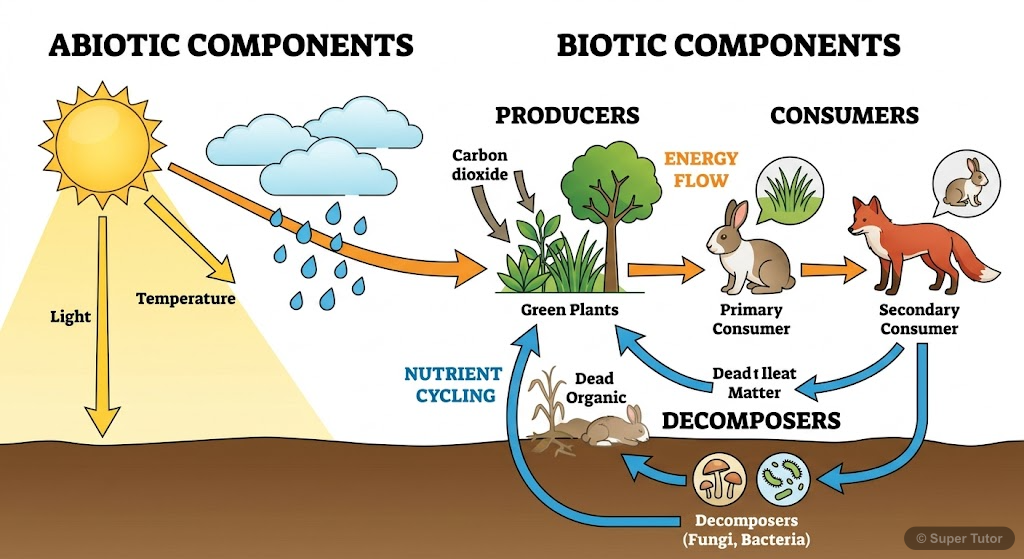
7Describe the components of an ecosystem.Show solution
## Components of an Ecosystem
An ecosystem has two main components:
---
### A. Abiotic Components (Non-living)
These are the physical and chemical factors of the environment:
1. Climatic factors: Temperature, light, humidity, rainfall, wind.
2. Edaphic factors: Soil — its texture, mineral content, pH, water-holding capacity.
3. Inorganic substances: , , , water, minerals (phosphorus, sulphur, etc.).
4. Organic substances: Proteins, carbohydrates, lipids, humus — these link biotic and abiotic components.
---
### B. Biotic Components (Living)
These are all the living organisms in the ecosystem, classified based on their nutritional relationships:
#### 1. Producers (Autotrophs)
- Green plants, algae, phytoplankton, and chemosynthetic bacteria.
- They fix solar energy through photosynthesis and produce organic matter from inorganic substances.
- They form the first trophic level and are the base of all food chains.
- Example: Grasses in a grassland, phytoplankton in a lake.
#### 2. Consumers (Heterotrophs / Phagotrophs)
Organisms that obtain energy by consuming other organisms:
- Primary consumers (Herbivores): Feed directly on producers. Example: Grasshopper, deer, rabbit.
- Secondary consumers (Primary carnivores): Feed on herbivores. Example: Frog, small fish.
- Tertiary consumers (Secondary carnivores): Feed on primary carnivores. Example: Snake, large fish.
- Omnivores: Feed on both plants and animals. Example: Humans, cockroach.
#### 3. Decomposers (Saprotrophs / Reducers)
- Bacteria and fungi that break down dead organic matter (detritus) into simple inorganic substances.
- They release nutrients back into the soil/water, making them available to producers again.
- They play a crucial role in nutrient cycling and are sometimes called reducers.
- Example: *Bacillus*, *Aspergillus*, mushrooms.
---
### Interaction between Components
The abiotic and biotic components interact continuously:
- Producers absorb inorganic nutrients and solar energy → convert to organic matter.
- Consumers obtain energy by eating producers/other consumers.
- Decomposers break down dead matter → release inorganic nutrients back to the environment.
This interaction results in the four key processes of an ecosystem: productivity, decomposition, energy flow, and nutrient cycling.
8Define ecological pyramids and describe with examples, pyramids of number and biomass.Show solution
Definition: An ecological pyramid is a graphical representation of the relationship between different trophic levels in an ecosystem in terms of number, biomass, or energy. The base of the pyramid represents the producers (first trophic level) and the successive tiers represent higher trophic levels.
Ecological pyramids were first described by Charles Elton (1927) and are also called Eltonian pyramids.
Types of Ecological Pyramids:
1. Pyramid of Numbers
2. Pyramid of Biomass
3. Pyramid of Energy
---
## 1. Pyramid of Numbers
Definition: It represents the number of individual organisms at each trophic level in an ecosystem.
### (a) Upright Pyramid of Numbers — Grassland Ecosystem
In a grassland ecosystem:
- The number of producers (grasses) is maximum.
- The number decreases at each successive trophic level.
- The pyramid is upright (broad base, narrow apex).
### (b) Inverted Pyramid of Numbers — Tree Ecosystem
In a forest ecosystem dominated by trees:
- A single large tree supports thousands of insects.
- The pyramid is inverted (narrow base, broad middle).
### (c) Spindle-shaped Pyramid — Parasitic Food Chain
In a parasitic food chain:
- The number of parasites exceeds the number of hosts.
- The pyramid has an irregular/spindle shape.
Limitation: The pyramid of numbers does not account for the size of organisms, so it can be misleading.
---
## 2. Pyramid of Biomass
Definition: It represents the total dry weight (biomass) of organisms at each trophic level at a given time. Biomass is expressed in or .
### (a) Upright Pyramid of Biomass — Terrestrial Ecosystem
In a grassland/forest ecosystem:
- Producers (grasses/trees) have the maximum biomass.
- Biomass decreases at each successive trophic level.
- The pyramid is upright.
\text{Producers} > \text{Herbivores} > \text{Carnivores}
Example values (approximate, ):
| Trophic Level | Biomass |
|---|---|
| Producers | 500 |
| Primary consumers | 50 |
| Secondary consumers | 5 |
| Tertiary consumers | 0.5 |
### (b) Inverted Pyramid of Biomass — Aquatic Ecosystem
In an aquatic (ocean/lake) ecosystem:
- Phytoplankton (producers) have a very small biomass at any given time because they reproduce very rapidly and are consumed quickly.
- Zooplankton (primary consumers) have a larger biomass than phytoplankton at any given time.
- The pyramid is inverted.
This is because phytoplankton have a very high turnover rate (rapid reproduction and consumption), so their standing crop biomass is low even though their productivity is high.
---
## Limitations of Ecological Pyramids
1. They do not account for the same species belonging to two or more trophic levels.
2. They assume a simple food chain and cannot accommodate a food web.
3. Saprophytes (decomposers) are not given any place despite their vital role.
4. The pyramid of biomass does not consider the rate of production (productivity).
9What is primary productivity? Give brief description of factors that affect primary productivity.Show solution
Definition: Primary productivity is defined as the rate of capture of solar energy (or the amount of organic matter/biomass produced per unit area per unit time) by the producers (autotrophs) through photosynthesis.
It is expressed in terms of weight () or energy ().
### Types of Primary Productivity
1. Gross Primary Productivity (GPP):
- The total rate of photosynthesis including the organic matter used up in respiration during the measurement period.
- It is the total amount of organic matter produced by producers.
2. Net Primary Productivity (NPP):
- The organic matter that remains after the producers have used some for their own respiration ().
- It is the biomass available for consumption by heterotrophs (herbivores and decomposers).
where = respiratory losses.
Note: The annual net primary productivity of the whole biosphere is approximately 170 × 10⁹ tonnes (dry weight) of organic matter.
---
## Factors Affecting Primary Productivity
### 1. Light (Solar Radiation / PAR)
- Only about 50% of incident solar radiation is Photosynthetically Active Radiation (PAR).
- Of PAR, plants use only 2–10% for net primary production.
- Light intensity and duration (photoperiod) directly affect the rate of photosynthesis.
- In aquatic ecosystems, light penetration decreases with depth, limiting productivity to the photic zone.
### 2. Temperature
- Photosynthesis is an enzyme-mediated process; it increases with temperature up to an optimum (usually 25–35°C) and then decreases.
- Tropical regions with high temperatures and sunlight generally have higher productivity.
### 3. Water Availability
- Water is a raw material for photosynthesis.
- In terrestrial ecosystems, water availability (rainfall) is a major limiting factor.
- Deserts have very low productivity due to water scarcity.
### 4. Availability of Nutrients (Minerals)
- Macronutrients (N, P, K, S) and micronutrients are essential for plant growth.
- In aquatic ecosystems, nutrients (especially nitrogen and phosphorus) are often the limiting factors.
- Nutrient-rich (eutrophic) water bodies have higher productivity.
### 5. Carbon Dioxide Concentration
- is the raw material for photosynthesis.
- Increased concentration (up to a point) enhances the rate of photosynthesis and productivity.
### 6. Species Composition and Adaptations
- plants (e.g., sugarcane, maize) are more productive than plants under high light and temperature conditions.
- The type and diversity of plant species influence overall ecosystem productivity.
---
Conclusion: Primary productivity varies greatly across ecosystems — tropical rainforests and estuaries have the highest productivity, while deserts and deep oceans have the lowest. The interplay of light, temperature, water, and nutrients determines the productivity of any given ecosystem.
10Define decomposition and describe the processes and products of decomposition.Show solution
Definition: Decomposition is the process by which decomposers (bacteria and fungi) break down complex organic matter (detritus) into simpler inorganic substances such as carbon dioxide (), water (), and inorganic nutrients. It is essentially a catabolic process.
Substrate for decomposition: Dead plant remains (leaves, bark, flowers), dead animal remains, and fecal matter — collectively called detritus.
---
## Steps/Processes of Decomposition
### 1. Fragmentation
- Detritivores (earthworms, millipedes, woodlice, certain insects) break down detritus into smaller particles, increasing the surface area available for microbial action.
- This is a physical process.
### 2. Leaching
- Water-soluble inorganic nutrients from the detritus percolate (leach) down into the soil and are deposited as unavailable salts in the soil horizon.
- This is a physical/chemical process.
### 3. Catabolism
- Bacterial and fungal enzymes degrade detritus biochemically into simpler organic and inorganic substances.
- This is the core biochemical step of decomposition.
### 4. Humification
- Leads to the accumulation of a dark-coloured amorphous substance called humus.
- Humus is highly resistant to microbial action and decomposes very slowly.
- It serves as a reservoir of nutrients and improves soil water-holding capacity.
- Humus is further degraded by microbes.
### 5. Mineralisation
- The humus is further degraded by microbes to release inorganic nutrients (minerals) into the soil.
- This process of release of inorganic nutrients from organic matter is called mineralisation.
- Products: , , and inorganic salts (nitrates, phosphates, sulphates, etc.).
---
## Products of Decomposition
| Product | Description |
|---|---|
| | Released into the atmosphere; used by producers in photosynthesis |
| | Released into the soil/atmosphere |
| Inorganic nutrients | , , , etc. — returned to soil for plant uptake |
| Humus | Dark, stable organic matter; improves soil fertility |
---
## Factors Affecting Decomposition
1. Temperature: Warm, moist conditions favour decomposition. Decomposition is slow in cold or dry conditions.
2. Moisture/Water: Adequate moisture is essential for microbial activity.
3. Oxygen: Aerobic decomposition is faster than anaerobic decomposition.
4. Chemical nature of detritus:
- Detritus rich in lignin and chitin decomposes slowly.
- Detritus rich in nitrogen and sugars decomposes quickly.
Conclusion: Decomposition is a vital ecosystem process that recycles nutrients, maintains soil fertility, and ensures the continuous availability of inorganic nutrients to producers, thereby sustaining the nutrient cycles of the ecosystem.
11Give an account of energy flow in an ecosystem.Show solution
### Introduction
Energy flow is one of the most fundamental processes in an ecosystem. The sun is the ultimate source of energy for all ecosystems (except chemosynthetic ecosystems). Energy flows through the ecosystem in a unidirectional manner — from producers to consumers — and is non-cyclic (unlike nutrients).
---
### Entry of Energy into the Ecosystem
- Of the total incident solar radiation, only about 50% is Photosynthetically Active Radiation (PAR).
- Of PAR, plants capture only 2–10% for net primary production through photosynthesis.
- This fixed energy enters the biotic component of the ecosystem.
---
### Trophic Levels and Energy Transfer
Organisms are grouped into trophic levels based on their source of nutrition:
| Trophic Level | Organisms | Example |
|---|---|---|
| T₁ — Producers | Green plants, phytoplankton | Grass, algae |
| T₂ — Primary consumers | Herbivores | Grasshopper, deer |
| T₃ — Secondary consumers | Primary carnivores | Frog, small fish |
| T₄ — Tertiary consumers | Secondary carnivores | Snake, large fish |
| Decomposers | Bacteria, fungi | Act on all levels |
Energy is transferred from one trophic level to the next through feeding (predation).
---
### The 10% Law (Lindeman's Law)
Proposed by R.L. Lindeman (1942), the 10% law states that:
> Only about 10% of the energy of any trophic level is transferred to the next trophic level.
The remaining 90% is lost as:
- Heat during metabolic activities (respiration)
- Incomplete digestion (fecal matter)
- Energy used for maintenance and movement
Example:
This is why food chains are generally limited to 4–5 trophic levels — very little energy remains at higher levels.
---
### Two Pathways of Energy Flow
1. Grazing Food Chain (GFC):
- Begins with living green plants.
- Dominant in most terrestrial ecosystems during the day.
2. Detritus Food Chain (DFC):
- Begins with dead organic matter.
- Dominant in forest floor and aquatic ecosystems.
- In most ecosystems, more energy flows through the DFC than the GFC.
Both food chains are interconnected and together form the food web.
---
### Key Features of Energy Flow
1. Unidirectional: Energy flows only from producers → consumers; it cannot flow back.
2. Non-cyclic: Unlike nutrients, energy is not recycled. Once used, it is lost as heat.
3. Decreasing availability: Energy decreases at each successive trophic level (10% law).
4. Two laws of thermodynamics apply:
- First Law: Energy is neither created nor destroyed; it is converted from one form to another (solar → chemical → heat).
- Second Law: At every energy transformation, some energy is lost as heat (entropy increases).
---
### Conclusion
Energy flow in an ecosystem is a one-way process driven by solar energy. The progressive decrease in available energy at higher trophic levels (due to the 10% law) limits the length of food chains and determines the structure of ecosystems. Decomposers play a crucial role by releasing energy locked in dead organic matter and recycling nutrients back to the producers.
Stuck on a step?
Ask Super Tutor AI to explain any solution on this page in a simpler way — free, 24x7.
Ask a Doubt FreeFrequently Asked Questions
What are the important topics in Ecosystem for Jharkhand Board Class 12 Biology?
How to score full marks in Ecosystem — Jharkhand Board Class 12 Biology?
Where can I get free NCERT Solutions for Ecosystem Class 12 Biology?
Sources & Official References
Content is aligned to the official syllabus. Refer to the board website for the latest curriculum.
More resources for Ecosystem
Important Questions
Practice with board exam-style questions
Syllabus
What topics to cover
Revision Notes
Key points for last-minute revision
Study Plan
Step-by-step plan to ace this chapter
Flashcards
Quick-fire cards for active recall
Formula Sheet
All formulas in one place
Chapter Summary
Understand the chapter at a glance
Practice Quiz
Test yourself with a quick quiz
Concept Maps
See how topics connect visually
For serious students
Get the full Ecosystem chapter — for free.
Quizzes, flashcards, AI doubt-solver and a step-by-step study plan for Jharkhand Board Class 12 Biology.