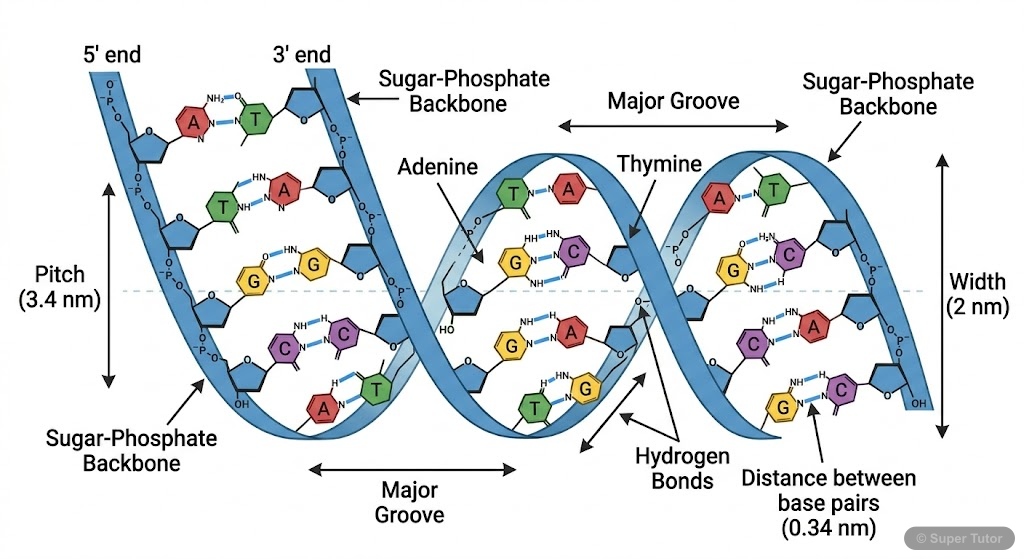
Molecular Basis of Inheritance
Jharkhand Board · Class 12 · Biology
NCERT Solutions for Molecular Basis of Inheritance — Jharkhand Board Class 12 Biology.
Interactive on Super Tutor
Studying Molecular Basis of Inheritance? Get the full interactive chapter.
Quizzes, flashcards, AI doubt-solver and a step-by-step study plan — built for ncert solutions and more.
1,000+ Class 12 students started this chapter today

This is just one of 22+ visuals inside Super Tutor's Molecular Basis of Inheritance chapter
Explore the full setEXERCISES — Molecular Basis of Inheritance
1Group the following as nitrogenous bases and nucleosides: Adenine, Cytidine, Thymine, Guanosine, Uracil and Cytosine.Show solution
Concept: A nitrogenous base is a nitrogen-containing ring compound (purine or pyrimidine) that is NOT attached to a sugar. A nucleoside = nitrogenous base + pentose sugar (no phosphate group).
Classification:
Nitrogenous Bases:
- Adenine (purine)
- Thymine (pyrimidine)
- Uracil (pyrimidine)
- Cytosine (pyrimidine)
Nucleosides:
- Cytidine (Cytosine + Ribose sugar)
- Guanosine (Guanine + Ribose sugar)
Summary Table:
| Category | Compounds |
|---|---|
| Nitrogenous Bases | Adenine, Thymine, Uracil, Cytosine |
| Nucleosides | Cytidine, Guanosine |
2If a double stranded DNA has 20 per cent of cytosine, calculate the per cent of adenine in the DNA.Show solution
Concept Used — Chargaff's Rules:
In a double-stranded DNA:
- and (complementary base pairing)
-
Step 1: Since ,
Step 2: Total percentage of G + C:
Step 3: Therefore, percentage of A + T:
Step 4: Since :
Answer: The percentage of Adenine in the DNA = 30%
3If the sequence of one strand of DNA is written as follows: 5'-ATGCATGCATGCATGCATGCATGCATGC-3'. Write down the sequence of complementary strand in 5'→3' direction.Show solution
Concept: The complementary strand is antiparallel and follows base-pairing rules:
- A pairs with T
- T pairs with A
- G pairs with C
- C pairs with G
Step 1: Write the complementary strand in 3'→5' direction (antiparallel to the given strand):
Step 2: Reverse it to write in 5'→3' direction:
Answer: The complementary strand in 5'→3' direction is:
4If the sequence of the coding strand in a transcription unit is written as follows: 5'-ATGCATGCATGCATGCATGCATGCATGC-3'. Write down the sequence of mRNA.Show solution
Concept:
- The coding strand (non-template strand) has the same sequence as the mRNA, except that in mRNA, Thymine (T) is replaced by Uracil (U).
- The template strand is complementary and antiparallel to the coding strand.
- mRNA is synthesised in the 5'→3' direction and is complementary to the template strand (= same as coding strand with T replaced by U).
Step 1: Replace every T with U in the coding strand sequence:
Coding strand: -ATGCATGCATGCATGCATGCATGCATGC-
mRNA sequence: -AUGCAUGCAUGCAUGCAUGCAUGCAUGC-
Answer: The mRNA sequence is:
5Which property of DNA double helix led Watson and Crick to hypothesise semi-conservative mode of DNA replication? Explain.Show solution
The complementary base pairing between the two strands of the DNA double helix (A pairs with T via 2 H-bonds; G pairs with C via 3 H-bonds) led Watson and Crick to propose the semi-conservative mode of replication.
Explanation:
1. Watson and Crick observed that the two strands of the DNA double helix are complementary to each other — the sequence of one strand automatically determines the sequence of the other strand.
2. They reasoned that if the two strands were to separate (unwind), each strand could serve as a template for the synthesis of a new complementary strand.
3. Free deoxyribonucleoside triphosphates (dNTPs) present in the cell would align opposite to their complementary bases on each template strand, following the base-pairing rules.
4. This would result in the formation of two daughter DNA molecules, each consisting of:
- One original (parental) strand, and
- One newly synthesised complementary strand.
5. Since each daughter DNA retains (conserves) one parental strand, this mode is called semi-conservative replication.
This hypothesis was later experimentally proved by Meselson and Stahl (1958) using N and N isotopes of nitrogen.
6Depending upon the chemical nature of the template (DNA or RNA) and the nature of nucleic acids synthesised from it (DNA or RNA), list the types of nucleic acid polymerases.Show solution
Types of Nucleic Acid Polymerases:
| Type | Template | Product Synthesised | Example/Occurrence |
|---|---|---|---|
| DNA-dependent DNA Polymerase | DNA | DNA | DNA replication in all organisms |
| DNA-dependent RNA Polymerase | DNA | RNA | Transcription in all organisms |
| RNA-dependent RNA Polymerase (RdRp / Replicase) | RNA | RNA | RNA replication in RNA viruses |
| RNA-dependent DNA Polymerase (Reverse Transcriptase) | RNA | DNA | Retroviruses (e.g., HIV) |
Summary:
- DNA → DNA: DNA-dependent DNA Polymerase (during replication)
- DNA → RNA: DNA-dependent RNA Polymerase (during transcription)
- RNA → RNA: RNA-dependent RNA Polymerase (in RNA viruses)
- RNA → DNA: Reverse Transcriptase (in retroviruses)
7How did Hershey and Chase differentiate between DNA and protein in their experiment while proving that DNA is the genetic material?Show solution
Aim: To prove that DNA (and not protein) is the genetic material.
Organism used: Bacteriophage T2 (a virus that infects *E. coli*)
Method of Differentiation — Use of Radioactive Isotopes:
Hershey and Chase used two different radioactive isotopes to label DNA and protein separately:
1. Labelling DNA: They grew bacteriophages in a medium containing radioactive P (phosphorus). Since DNA contains phosphorus (in the phosphate backbone) but protein does not, only the DNA of the phage was labelled with P.
2. Labelling Protein: They grew bacteriophages in a medium containing radioactive S (sulphur). Since proteins contain sulphur (in amino acids like cysteine and methionine) but DNA does not, only the protein coat of the phage was labelled with S.
Experimental Steps:
- Both sets of labelled phages were allowed to infect *E. coli* bacteria separately.
- After infection, the mixture was agitated in a blender to separate phage coats from bacteria, then centrifuged.
- The bacteria (heavier) settled as a pellet; the phage coats remained in the supernatant.
Observations:
- In the P experiment: Radioactivity was found in the bacterial pellet (inside the bacteria), indicating that DNA was injected into the bacteria.
- In the S experiment: Radioactivity was found in the supernatant (phage coats outside), indicating that protein did NOT enter the bacteria.
Conclusion: Since only DNA entered the bacterial cell and directed the production of new phages, DNA is the genetic material, not protein.
This experiment elegantly differentiated DNA from protein using the unique chemical property that DNA contains phosphorus (P) and proteins contain sulphur (S).
8Differentiate between the followings: (a) Repetitive DNA and Satellite DNA (b) mRNA and tRNA (c) Template strand and Coding strandShow solution
| Feature | Repetitive DNA | Satellite DNA |
|---|---|---|
| Definition | DNA sequences that are present in multiple copies (repeated many times) in the genome | A fraction of repetitive DNA with a different buoyant density from the bulk DNA |
| Detection | Identified by reassociation kinetics (Cot analysis) | Detected by density gradient centrifugation (CsCl); forms a separate 'satellite' band |
| Location | Scattered throughout the genome | Often found in heterochromatin regions (e.g., centromeres, telomeres) |
| Coding | Generally non-coding | Non-coding |
| Relationship | Broader category that includes satellite DNA | A subset/type of repetitive DNA |
(b) mRNA vs. tRNA:
| Feature | mRNA (Messenger RNA) | tRNA (Transfer RNA) |
|---|---|---|
| Full form | Messenger RNA | Transfer RNA |
| Function | Carries genetic information from DNA to ribosomes; acts as a template for protein synthesis | Acts as an adapter molecule; carries specific amino acids to the ribosome during translation |
| Structure | Linear, single-stranded; contains codons (triplet sequences) | Clover-leaf secondary structure; contains anticodon loop and amino acid attachment site |
| Size | Relatively large (varies widely) | Small (~70–90 nucleotides) |
| Key feature | Contains codons (5'→3') | Contains anticodon complementary to mRNA codon; has CCA-3' end for amino acid attachment |
| Number of types | One type per gene (many varieties) | At least one for each of the 20 amino acids |
(c) Template Strand vs. Coding Strand:
| Feature | Template Strand | Coding Strand |
|---|---|---|
| Also called | Antisense strand / Non-coding strand / Minus strand | Sense strand / Non-template strand / Plus strand |
| Role in transcription | Acts as the template; RNA polymerase reads this strand in 3'→5' direction to synthesise mRNA | Does NOT serve as template; has the same sequence as mRNA (with T instead of U) |
| Direction read | 3' → 5' (by RNA polymerase) | 5' → 3' |
| Sequence relation to mRNA | Complementary and antiparallel to mRNA | Same as mRNA sequence (T in place of U) |
| Polarity | | |
9List two essential roles of ribosome during translation.Show solution
1. Providing a platform for mRNA binding and decoding: The ribosome binds to the mRNA and holds it in the correct position so that the codons can be read sequentially in the 5'→3' direction. It provides the A site (aminoacyl site) for incoming aminoacyl-tRNA and the P site (peptidyl site) for the growing polypeptide chain, facilitating accurate decoding of the genetic message.
2. Catalysing peptide bond formation (Peptidyl transferase activity): The large subunit of the ribosome contains a ribosomal RNA (rRNA) that acts as a ribozyme (RNA enzyme). It catalyses the formation of peptide bonds between successive amino acids, thereby facilitating the elongation of the polypeptide chain. This is an example of RNA acting as an enzyme (ribozyme).
10In the medium where E. coli was growing, lactose was added, which induced the lac operon. Then, why does lac operon shut down some time after addition of lactose in the medium?Show solution
Explanation:
1. When lactose is added to the medium, it acts as an inducer. Lactose (or its isomer allolactose) binds to the repressor protein, causing a conformational change that prevents the repressor from binding to the operator region.
2. With the operator free, RNA polymerase can transcribe the structural genes (, , ) of the lac operon, producing enzymes: β-galactosidase, permease, and transacetylase.
3. These enzymes metabolise (break down) the lactose present in the medium.
4. As lactose is gradually consumed and its concentration falls to zero, there is no more inducer (allolactose) available to bind to the repressor.
5. The repressor protein (which is continuously produced from the gene) is now free and in its active form. It binds back to the operator region.
6. This blocks the binding of RNA polymerase to the promoter, thereby stopping transcription of the structural genes.
Conclusion: The lac operon shuts down because the lactose (inducer) has been completely metabolised by the bacterial enzymes. With no inducer present, the repressor regains its ability to bind the operator and switches off the operon. This is an example of negative regulation — the operon is regulated by the availability of its substrate (lactose).
11Explain (in one or two lines) the function of the followings: (a) Promoter (b) tRNA (c) ExonsShow solution
A promoter is a specific DNA sequence located upstream (at the 5' end) of a gene to which RNA polymerase binds to initiate transcription. It determines the start point and the direction of transcription, thereby regulating gene expression.
(b) tRNA (Transfer RNA):
tRNA acts as an adapter molecule during translation. It carries a specific amino acid at its 3'-CCA end and recognises the corresponding codon on the mRNA through its anticodon loop, thereby ensuring the correct amino acid is incorporated into the growing polypeptide chain.
(c) Exons:
Exons are the coding sequences of a split gene (in eukaryotes) that are retained in the mature mRNA after post-transcriptional processing (splicing). They are ultimately translated into the amino acid sequence of the protein.
12Why is the Human Genome project called a mega project?Show solution
1. Enormous scale of work: The human genome contains approximately 3 × 10⁹ (3 billion) base pairs of DNA distributed across 24 different chromosomes. Sequencing all these base pairs was an extraordinarily large task.
2. Time and resources: The project took about 13 years (1990–2003) to complete and involved the collaborative effort of scientists from 18 countries across multiple research institutions.
3. Technological challenge: It required the development of new, high-throughput automated DNA sequencing technologies and advanced bioinformatics tools to store, retrieve, and analyse the massive amount of sequence data generated.
4. Data generated: The project generated sequence data that, if printed, would fill approximately 3,300 books of 1,000 pages each (with each page containing 1,000 letters).
5. Cost: The project cost approximately 3 billion US dollars — roughly one dollar per base pair.
6. Multidisciplinary approach: It required expertise in biology, chemistry, physics, mathematics, computer science, and engineering, making it truly a mega, multidisciplinary scientific endeavour.
Conclusion: Due to its unprecedented scale, cost, time, international collaboration, and technological demands, the Human Genome Project is rightly called a mega project.
13What is DNA fingerprinting? Mention its application.Show solution
DNA fingerprinting (also called DNA profiling or DNA typing) is a technique used to identify individuals based on unique patterns in their DNA. It works on the principle of polymorphism in DNA sequences — specifically, the variation in the number of tandemly repeated sequences called VNTRs (Variable Number of Tandem Repeats) or satellite DNA at specific loci in the genome.
Principle:
- Every individual (except identical twins) has a unique pattern of repetitive DNA sequences.
- DNA is extracted, cut with restriction enzymes, separated by gel electrophoresis, transferred to a membrane (Southern blotting), and hybridised with a labelled probe that detects VNTRs.
- The resulting banding pattern (like a barcode) is unique to each individual — this is the DNA fingerprint.
Applications of DNA Fingerprinting:
1. Forensic Science: Used to identify criminals or victims in criminal investigations (e.g., matching DNA from crime scene samples — blood, hair, semen — with suspects).
2. Paternity/Maternity Testing: Used to establish biological relationships between individuals (e.g., disputed parentage cases).
3. Identification of victims: Used to identify victims of accidents, disasters, or wars when other means of identification are not possible.
4. Study of Genetic Diversity: Used to study genetic variation within and between populations, which is important in evolutionary biology and conservation genetics.
5. Immigration disputes: Used to verify claimed family relationships in immigration cases.
6. Breeding programmes: Used in animal and plant breeding to confirm genetic identity and purity of breeds/varieties.
14Briefly describe the following: (a) Transcription (b) Polymorphism (c) Translation (d) BioinformaticsShow solution
Transcription is the process of synthesis of RNA from a DNA template. It is the first step in gene expression.
- Enzyme involved: RNA polymerase
- Template: The template (antisense) strand of DNA is read in the 3'→5' direction.
- Product: A complementary RNA strand is synthesised in the 5'→3' direction.
- Base pairing: A pairs with U (in RNA), T pairs with A, G pairs with C, C pairs with G.
- Steps: Initiation (RNA polymerase binds to promoter) → Elongation (RNA chain grows) → Termination (at terminator sequence).
- In prokaryotes, transcription and translation are coupled. In eukaryotes, the primary transcript (hnRNA) undergoes processing (5' capping, 3' polyadenylation, splicing to remove introns) to form mature mRNA before being exported from the nucleus.
(b) Polymorphism:
Polymorphism refers to the occurrence of two or more variants (alleles) of a DNA sequence at a particular locus in a population, with the rarest allele having a frequency of at least 1%.
- It arises due to mutations that accumulate over generations.
- If a mutation occurs in the germline, it is heritable and can spread in the population, leading to polymorphism.
- Polymorphism can be in coding or non-coding regions of DNA.
- Examples include SNPs (Single Nucleotide Polymorphisms) and VNTRs (Variable Number of Tandem Repeats).
- It forms the basis of DNA fingerprinting and is used to study genetic diversity, evolutionary relationships, and disease associations.
(c) Translation:
Translation is the process of synthesis of a polypeptide (protein) from the information encoded in mRNA. It is the second step in gene expression.
- Site: Ribosomes (in the cytoplasm)
- Key molecules involved: mRNA (template), tRNA (adapter/carrier of amino acids), ribosomes, aminoacyl-tRNA synthetases, and various initiation, elongation, and release factors.
- Genetic code: The mRNA sequence is read as triplet codons (each codon specifies one amino acid). The start codon is AUG (methionine) and stop codons are UAA, UAG, UGA.
- Steps:
1. Initiation: Ribosome assembles on mRNA at the start codon (AUG).
2. Elongation: Aminoacyl-tRNAs bring amino acids to the ribosome; peptide bonds are formed between successive amino acids (catalysed by rRNA — ribozyme activity).
3. Termination: When a stop codon is reached, release factors cause the polypeptide to be released.
- The polypeptide then folds into a functional protein.
(d) Bioinformatics:
Bioinformatics is an interdisciplinary field that uses tools and techniques from computer science, mathematics, statistics, and information technology to store, retrieve, organise, and analyse biological data, especially large-scale genomic and proteomic data.
- It emerged as a necessity after the generation of enormous amounts of data from projects like the Human Genome Project.
- Key activities include:
- Development of databases (e.g., GenBank, EMBL) to store DNA and protein sequences.
- Development of algorithms and software for sequence alignment (e.g., BLAST), gene prediction, and structural analysis.
- Comparative genomics — comparing genomes of different organisms to understand evolutionary relationships and gene function.
- Proteomics — analysis of the complete set of proteins expressed by a genome.
- Bioinformatics has opened new avenues in drug discovery, disease diagnosis, and understanding of biological processes at the molecular level.
Stuck on a step?
Ask Super Tutor AI to explain any solution on this page in a simpler way — free, 24x7.
Ask a Doubt FreeFrequently Asked Questions
What are the important topics in Molecular Basis of Inheritance for Jharkhand Board Class 12 Biology?
How to score full marks in Molecular Basis of Inheritance — Jharkhand Board Class 12 Biology?
Where can I get free NCERT Solutions for Molecular Basis of Inheritance Class 12 Biology?
Sources & Official References
Content is aligned to the official syllabus. Refer to the board website for the latest curriculum.
More resources for Molecular Basis of Inheritance
Important Questions
Practice with board exam-style questions
Syllabus
What topics to cover
Revision Notes
Key points for last-minute revision
Study Plan
Step-by-step plan to ace this chapter
Flashcards
Quick-fire cards for active recall
Formula Sheet
All formulas in one place
Chapter Summary
Understand the chapter at a glance
Practice Quiz
Test yourself with a quick quiz
Concept Maps
See how topics connect visually
For serious students
Get the full Molecular Basis of Inheritance chapter — for free.
Quizzes, flashcards, AI doubt-solver and a step-by-step study plan for Jharkhand Board Class 12 Biology.