Chapter 2 of 10
NCERT Solutions

Haloalkanes and Haloarenes

Jharkhand Board · Class 12 · Chemistry

NCERT Solutions for Haloalkanes and Haloarenes — Jharkhand Board Class 12 Chemistry.

29 questions22 flashcards5 concepts

Interactive on Super Tutor

Studying Haloalkanes and Haloarenes? Get the full interactive chapter.

Quizzes, flashcards, AI doubt-solver and a step-by-step study plan — built for ncert solutions and more.

1,000+ Class 12 students started this chapter today

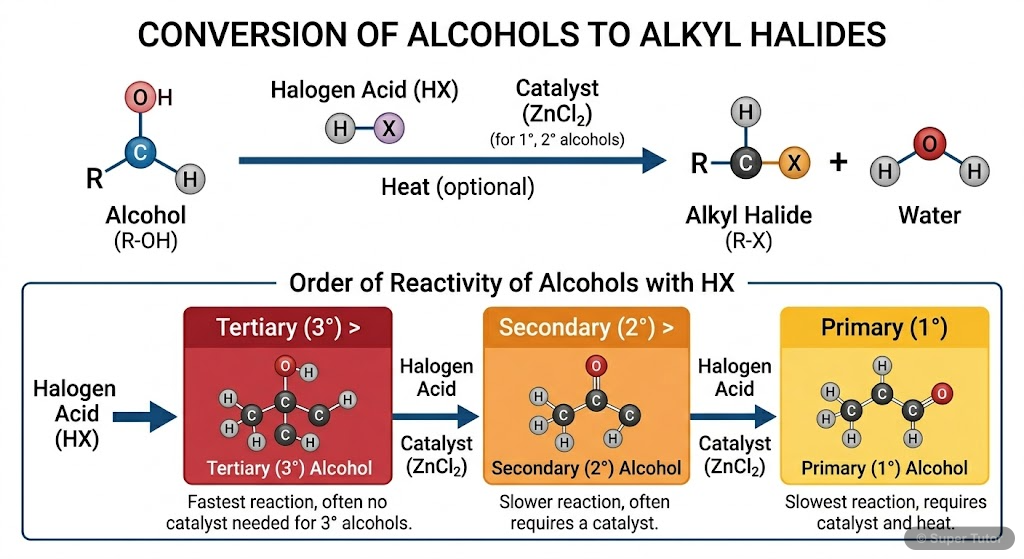
A flowchart illustrating the general reaction of alcohols with halogen acids (HX) to form alkyl halides, showing the reactivity order of primary, secondary, and tertiary alcohols.
Super Tutor

Learn better with visuals Super Tutor has hundreds of illustrations like this across every chapter — all free to try.

Get started
29 Questions Solved · 23 Sections

Intext Questions

6.2Why is sulphuric acid not used during the reaction of alcohols with KI?Show solution
Given: Reaction of alcohols with KI to prepare alkyl iodides.

Concept: KI is used with phosphoric acid (H₃PO₄) and not H₂SO₄ for the conversion of alcohols to alkyl iodides.

Explanation:

H₂SO₄ is an oxidising acid. If H₂SO₄ is used along with KI, the following side reactions occur:

H2SO4+2KIK2SO4+2HI\text{H}_2\text{SO}_4 + 2\text{KI} \rightarrow \text{K}_2\text{SO}_4 + 2\text{HI}

The HI formed is then oxidised by H₂SO₄:

H2SO4+2HISO2+I2+2H2O\text{H}_2\text{SO}_4 + 2\text{HI} \rightarrow \text{SO}_2 + \text{I}_2 + 2\text{H}_2\text{O}

Thus H₂SO₄ oxidises HI (and KI) to I₂, which cannot act as a nucleophile for the substitution reaction. Hence H₂SO₄ is not used; instead, non-oxidising acids like H₃PO₄ are used.
6.3Write structures of different dihalogen derivatives of propane.Show solution
Given: Propane, C3H8\text{C}_3\text{H}_8; dihalogen derivatives (using Cl as representative halogen).

Concept: Replace two hydrogen atoms of propane with halogen atoms in all possible ways.

The different dihalogen derivatives of propane are:

(i) 1,1-Dichloropropane:
CH3CH2CHCl2\text{CH}_3\text{CH}_2\text{CHCl}_2

(ii) 1,2-Dichloropropane:
CH3CHClCH2Cl\text{CH}_3\text{CHClCH}_2\text{Cl}

(iii) 1,3-Dichloropropane:
ClCH2CH2CH2Cl\text{ClCH}_2\text{CH}_2\text{CH}_2\text{Cl}

(iv) 2,2-Dichloropropane:
CH3CCl2CH3\text{CH}_3\text{CCl}_2\text{CH}_3

(v) 1,1-Dichloropropane (gem on C1) is listed above; additionally:

ClCH2CHClCH3(1,2-dichloropropane)\text{ClCH}_2\text{CHClCH}_3 \quad \text{(1,2-dichloropropane)}

All four structural isomers:
1. ClCH2CH2CH2Cl\text{ClCH}_2\text{CH}_2\text{CH}_2\text{Cl} — 1,3-dichloropropane
2. ClCH2CHClCH3\text{ClCH}_2\text{CHClCH}_3 — 1,2-dichloropropane
3. CH3CCl2CH3\text{CH}_3\text{CCl}_2\text{CH}_3 — 2,2-dichloropropane
4. CH3CH2CHCl2\text{CH}_3\text{CH}_2\text{CHCl}_2 — 1,1-dichloropropane
6.4Among the isomeric alkanes of molecular formula C5H12\mathrm{C_5H_{12}}, identify the one that on photochemical chlorination yields (i) A single monochloride. (ii) Three isomeric monochlorides. (iii) Four isomeric monochlorides.Show solution
Note: The molecular formula given in the text appears as C9H12C_9H_{12} but in context of isomeric alkanes yielding mono-chloro products, the correct formula should be C5H12C_5H_{12} (pentane isomers). Solutions are given accordingly.

Given: Isomers of C5H12C_5H_{12}: n-pentane, isopentane (2-methylbutane), neopentane (2,2-dimethylpropane).

Concept: Photochemical chlorination replaces H atoms. The number of monochloride products equals the number of sets of equivalent (chemically distinct) hydrogen atoms.

---

(i) Single monochloride:

2,2-Dimethylpropane (Neopentane): (CH3)4C(\text{CH}_3)_4\text{C}

All 12 hydrogen atoms are equivalent (all are on methyl groups attached to the central carbon). Hence only one monochloride is formed:
(CH3)3CCH2Cl(1-chloro-2,2-dimethylpropane)(\text{CH}_3)_3\text{CCH}_2\text{Cl} \quad \text{(1-chloro-2,2-dimethylpropane)}

---

(ii) Three isomeric monochlorides:

2-Methylbutane (Isopentane): CH3CH(CH3)CH2CH3\text{CH}_3\text{CH}(\text{CH}_3)\text{CH}_2\text{CH}_3

Distinct types of H atoms:
- CH3-\text{CH}_3 groups at C-1 and C-4 (equivalent, 6H)
- CH3-\text{CH}_3 at C-2 (3H)
- CH-\text{CH}- at C-2 (1H)
- CH2-\text{CH}_2- at C-3 (2H)

Wait — this gives 4 types. Let us recount:
- C1: (CH3)2(\text{CH}_3)_2 — the two methyl groups on C2 are equivalent (6H)
- C2: tertiary H (1H)
- C3: CH2-\text{CH}_2- (2H)
- C4: terminal CH3\text{CH}_3 (3H)

This gives 4 types. So isopentane gives 4 monochlorides.

n-Pentane: CH3CH2CH2CH2CH3\text{CH}_3\text{CH}_2\text{CH}_2\text{CH}_2\text{CH}_3

Distinct H types:
- C1 (and C5): CH3\text{CH}_3 (6H equivalent)
- C2 (and C4): CH2\text{CH}_2 (4H equivalent)
- C3: CH2\text{CH}_2 (2H)

This gives 3 types → 3 isomeric monochlorides.

Answer: n-Pentane gives three isomeric monochlorides.\text{Answer: n-Pentane gives three isomeric monochlorides.}

---

(iii) Four isomeric monochlorides:

2-Methylbutane (Isopentane): (CH3)2CHCH2CH3(\text{CH}_3)_2\text{CHCH}_2\text{CH}_3

Four distinct H environments → 4 isomeric monochlorides.

Answer: 2-Methylbutane (isopentane) gives four isomeric monochlorides.\text{Answer: 2-Methylbutane (isopentane) gives four isomeric monochlorides.}
6.5Draw the structures of major monohalo products in each of the following reactions:
(i) Isobutane + Cl₂ (hν)
(ii) 2-Methylbutane + Cl₂ (hν)
(iii) Cyclopentane + Br₂ (hν)
(iv) Methylcyclohexane + Cl₂ (hν)
(v) CH₃CH₂Br + NaI →
(vi) CH₄ + Br₂ (heat/UV light)
Show solution
Note: Structures (i)–(iv) are given as images in the source. The reactions are interpreted from context.

(i) Isobutane + Cl₂ (hν):

Isobutane: (CH3)3CH(\text{CH}_3)_3\text{CH}

Tertiary C–H bond is weaker and more reactive toward free radical halogenation. The major product is the tertiary chloride:

Major product: (CH3)3CCl(2-chloro-2-methylpropane, tert-butyl chloride)\text{Major product: } (\text{CH}_3)_3\text{CCl} \quad \text{(2-chloro-2-methylpropane, tert-butyl chloride)}

(ii) 2-Methylbutane + Cl₂ (hν):

2-Methylbutane: (CH3)2CHCH2CH3(\text{CH}_3)_2\text{CHCH}_2\text{CH}_3

The tertiary H at C-2 is most reactive. Major product:

Major product: (CH3)2CClCH2CH3(2-chloro-2-methylbutane)\text{Major product: } (\text{CH}_3)_2\text{CClCH}_2\text{CH}_3 \quad \text{(2-chloro-2-methylbutane)}

(iii) Cyclopentane + Br₂ (hν):

All H atoms in cyclopentane are equivalent. Only one monobromo product is possible:

Major product: Bromocyclopentane\text{Major product: Bromocyclopentane}

(iv) Methylcyclohexane + Cl₂ (hν):

The tertiary C–H (at C-1, bearing the methyl group) is most reactive. Major product:

Major product: 1-Chloro-1-methylcyclohexane\text{Major product: 1-Chloro-1-methylcyclohexane}

(v) CH3CH2Br+NaIacetone\text{CH}_3\text{CH}_2\text{Br} + \text{NaI} \xrightarrow{\text{acetone}}

This is a Finkelstein reaction (halogen exchange, SN2S_N2):

CH3CH2Br+NaIacetoneCH3CH2I+NaBr\text{CH}_3\text{CH}_2\text{Br} + \text{NaI} \xrightarrow{\text{acetone}} \text{CH}_3\text{CH}_2\text{I} + \text{NaBr}

Major product: Iodoethane (ethyl iodide)

(vi) CH4+Br2heat/UV light\text{CH}_4 + \text{Br}_2 \xrightarrow{\text{heat/UV light}}

Free radical bromination of methane:

CH4+Br2hνCH3Br+HBr\text{CH}_4 + \text{Br}_2 \xrightarrow{h\nu} \text{CH}_3\text{Br} + \text{HBr}

Major product: Bromomethane (methyl bromide)
6.7Which alkyl halide from the following pairs would you expect to react more rapidly by an SN2S_N2 mechanism? Explain your answer.
(i) CH3CH2CH2CH2Br\mathrm{CH_3CH_2CH_2CH_2Br} or CH3CH2CHCH3\mathrm{CH_3CH_2CHCH_3} (with Br)
(ii) CH3CH2CHCH3\mathrm{CH_3CH_2CHCH_3} (with Br) or H3CCBr\mathrm{H_3C-CBr} (tertiary)
(iii) CH3CHCH2CH2Br\mathrm{CH_3CHCH_2CH_2Br} or CH3CH2CHCH2Br\mathrm{CH_3CH_2CHCH_2Br} (with CH₃ branch)
Show solution
Concept: SN2S_N2 reaction rate depends on steric hindrance at the carbon bearing the leaving group. Less hindered (less substituted) carbon reacts faster in SN2S_N2.

---

(i) CH3CH2CH2CH2Br\text{CH}_3\text{CH}_2\text{CH}_2\text{CH}_2\text{Br} (1° — n-butyl bromide) vs. CH3CH2CH(Br)CH3\text{CH}_3\text{CH}_2\text{CH}(\text{Br})\text{CH}_3 (2° — sec-butyl bromide)

n-Butyl bromide (1°) reacts faster by SN2S_N2 because the carbon bearing Br has less steric hindrance (only one alkyl group) compared to the secondary carbon (two alkyl groups) in sec-butyl bromide.

Faster: CH3CH2CH2CH2Br\text{Faster: } \text{CH}_3\text{CH}_2\text{CH}_2\text{CH}_2\text{Br}

---

(ii) CH3CH2CH(Br)CH3\text{CH}_3\text{CH}_2\text{CH}(\text{Br})\text{CH}_3 (2° — sec-butyl bromide) vs. (CH3)3CBr(\text{CH}_3)_3\text{CBr} (3° — tert-butyl bromide)

sec-Butyl bromide (2°) reacts faster by SN2S_N2 because tertiary carbon is highly hindered (three alkyl groups), making backside attack by nucleophile very difficult.

Faster: CH3CH2CH(Br)CH3\text{Faster: } \text{CH}_3\text{CH}_2\text{CH}(\text{Br})\text{CH}_3

---

(iii) CH3CH(CH3)CH2CH2Br\text{CH}_3\text{CH}(\text{CH}_3)\text{CH}_2\text{CH}_2\text{Br} (1°, but with branching at C-3) vs. CH3CH2CH(CH3)CH2Br\text{CH}_3\text{CH}_2\text{CH}(\text{CH}_3)\text{CH}_2\text{Br} (1°, branching at C-2)

Both are primary halides, but branching closer to the reaction centre causes more steric hindrance. In CH3CH2CH(CH3)CH2Br\text{CH}_3\text{CH}_2\text{CH}(\text{CH}_3)\text{CH}_2\text{Br}, the branch is at the β\beta-carbon (C-2), causing more hindrance to backside attack than in CH3CH(CH3)CH2CH2Br\text{CH}_3\text{CH}(\text{CH}_3)\text{CH}_2\text{CH}_2\text{Br} where the branch is at the γ\gamma-carbon (C-3).

Faster: CH3CH(CH3)CH2CH2Br(branching at C-3, less hindrance)\text{Faster: } \text{CH}_3\text{CH}(\text{CH}_3)\text{CH}_2\text{CH}_2\text{Br} \quad \text{(branching at C-3, less hindrance)}
6.8In the following pairs of halogen compounds, which compound undergoes faster SN1S_N1 reaction?
(i) Two compounds (structures given as images)
(ii) Two compounds (structures given as images)
Show solution
Concept: SN1S_N1 reaction rate depends on the stability of the carbocation intermediate formed. More stable carbocation → faster SN1S_N1 reaction. Stability order: 3° > 2° > 1° > methyl. Benzylic and allylic carbocations are also stabilised by resonance.

(i) Since the structures are given as images (not visible), the general principle is:

The compound that forms the more stable carbocation upon ionisation will undergo SN1S_N1 faster. A tertiary or benzylic/allylic halide will react faster than a primary or secondary halide.

(ii) Similarly, the compound forming the more stable (higher substituted or resonance-stabilised) carbocation reacts faster by SN1S_N1.

General Answer: In each pair, the compound with the more substituted carbon bearing the halogen (tertiary > secondary > primary) or with resonance stabilisation of the carbocation (benzylic, allylic) undergoes faster SN1S_N1 reaction.
6.9Identify A, B, C, D, E, R and R\mathbf{R'} in the following:
RX+Mgdry etherAH2OB\mathrm{R-X} + \mathrm{Mg} \xrightarrow{\text{dry ether}} \mathrm{A} \xrightarrow{\mathrm{H_2O}} \mathrm{B}
RX+Mgdry etherCD2OCH2DCHCH3\mathrm{R-X} + \mathrm{Mg} \xrightarrow{\text{dry ether}} \mathrm{C} \xrightarrow{\mathrm{D_2O}} \mathrm{CH_2DCHCH_3}
(CH3)3CXNa/etherRXMgDH2OE\mathrm{(CH_3)_3C-X} \xrightarrow{\mathrm{Na/ether}} \mathrm{R'-X} \xrightarrow{\mathrm{Mg}} \mathrm{D} \xrightarrow{\mathrm{H_2O}} \mathrm{E}
Show solution
Concept: Grignard reagent formation: R-X+Mgdry etherR-MgX\text{R-X} + \text{Mg} \xrightarrow{\text{dry ether}} \text{R-MgX} (Grignard reagent). Hydrolysis with H₂O gives R-H; with D₂O gives R-D.

---

Reaction 1: R-X+Mgdry etherAH2OB\text{R-X} + \text{Mg} \xrightarrow{\text{dry ether}} \text{A} \xrightarrow{\text{H}_2\text{O}} \text{B}

- A = R-MgX (Grignard reagent)
- B = R-H (hydrocarbon)

---

Reaction 2: R-X+Mgdry etherCD2OCH2D-CH(CH3)\text{R-X} + \text{Mg} \xrightarrow{\text{dry ether}} \text{C} \xrightarrow{\text{D}_2\text{O}} \text{CH}_2\text{D-CH(CH}_3\text{)}

Product with D₂O is CH2D-CHCH3\text{CH}_2\text{D-CHCH}_3 which is CH3CHDCH3\text{CH}_3\text{CHDCH}_3 — actually the product is propane with one D: CH3CHDCH3\text{CH}_3\text{CHDCH}_3 (2-deuteropropane) or CH2DCH2CH3\text{CH}_2\text{DCH}_2\text{CH}_3 (1-deuteropropane).

From the formula CH2DCHCH3\text{CH}_2\text{DCHCH}_3: this suggests the Grignard reagent C is CH3CH(MgX)CH3\text{CH}_3\text{CH}(\text{MgX})\text{CH}_3 — isopropyl magnesium halide, formed from isopropyl halide.

So: R-X=(CH3)2CHX\text{R-X} = (\text{CH}_3)_2\text{CHX} (isopropyl halide)
- C = (CH3)2CHMgX(\text{CH}_3)_2\text{CHMgX} (isopropyl magnesium halide)
- Product with D₂O: (CH3)2CHD(\text{CH}_3)_2\text{CHD} (2-deuteropropane)

---

Reaction 3: (CH3)3C-XNa/etherR’-XMgDH2OE(\text{CH}_3)_3\text{C-X} \xrightarrow{\text{Na/ether}} \text{R'-X} \xrightarrow{\text{Mg}} \text{D} \xrightarrow{\text{H}_2\text{O}} \text{E}

Wurtz reaction of (CH3)3CX(\text{CH}_3)_3\text{CX} with Na gives (CH3)3C-C(CH3)3(\text{CH}_3)_3\text{C-C(CH}_3)_3 — but this is the Wurtz product. However, the sequence shows R'-X is formed first, then Grignard D, then hydrolysis gives E.

Actually, re-reading: (CH3)3C-X(\text{CH}_3)_3\text{C-X} with Na in ether undergoes Wurtz reaction with another molecule R'-X. If R' = (CH3)3C(\text{CH}_3)_3\text{C}, then:
- R'-X = (CH3)3CX(\text{CH}_3)_3\text{CX} (tert-butyl halide)
- D = (CH3)3CMgX(\text{CH}_3)_3\text{CMgX} (tert-butyl magnesium halide, Grignard reagent)
- E = (CH3)3CH(\text{CH}_3)_3\text{CH} (2-methylpropane / isobutane)

Summary:
- R = isopropyl group, R-X\text{R-X} = isopropyl halide (e.g., (CH3)2CHBr(\text{CH}_3)_2\text{CHBr})
- A = (CH3)2CHMgBr(\text{CH}_3)_2\text{CHMgBr}
- B = (CH3)2CH2(\text{CH}_3)_2\text{CH}_2 (propane)
- C = (CH3)2CHMgBr(\text{CH}_3)_2\text{CHMgBr}
- R' = tert-butyl, R’-X\text{R'-X} = (CH3)3CBr(\text{CH}_3)_3\text{CBr}
- D = (CH3)3CMgBr(\text{CH}_3)_3\text{CMgBr}
- E = (CH3)3CH(\text{CH}_3)_3\text{CH} (isobutane)

Exercise 6.1

6.1Name the following halides according to IUPAC system and classify them as alkyl, allyl, benzyl (primary, secondary, tertiary), vinyl or aryl halides:
(i) (CH3)2CHCH(Cl)CH3(\mathrm{CH_3})_2\mathrm{CHCH(Cl)CH_3}
(ii) CH3CH2CH(CH3)CH(C2H5)Cl\mathrm{CH_3CH_2CH(CH_3)CH(C_2H_5)Cl}
(iii) CH3CH2C(CH3)2CH2I\mathrm{CH_3CH_2C(CH_3)_2CH_2I}
(iv) (CH3)3CCH2CH(Br)C6H5(\mathrm{CH_3})_3\mathrm{CCH_2CH(Br)C_6H_5}
(v) CH3CH(CH3)CH(Br)CH3\mathrm{CH_3CH(CH_3)CH(Br)CH_3}
(vi) CH3C(C2H5)2CH2Br\mathrm{CH_3C(C_2H_5)_2CH_2Br}
(vii) CH3C(Cl)(C2H5)CH2CH3\mathrm{CH_3C(Cl)(C_2H_5)CH_2CH_3} (Note: likely CH3C(Cl)(C2H5)2\mathrm{CH_3C(Cl)(C_2H_5)_2})
(viii) CH3CH=C(Cl)CH2CH(CH3)2\mathrm{CH_3CH=C(Cl)CH_2CH(CH_3)_2}
(ix) CH3CH=CHC(Br)(CH3)2\mathrm{CH_3CH=CHC(Br)(CH_3)_2}
(x) p-ClC6H4CH2CH(CH3)2p\text{-ClC}_6\mathrm{H_4CH_2CH(CH_3)_2}
(xi) m-ClCH2C6H4CH2C(CH3)3m\text{-ClCH}_2\mathrm{C_6H_4CH_2C(CH_3)_3}
(xii) o-Br-C6H4CH(CH3)CH2CH3o\text{-Br-C}_6\mathrm{H_4CH(CH_3)CH_2CH_3}
Show solution
(i) (CH3)2CHCH(Cl)CH3(\text{CH}_3)_2\text{CHCH(Cl)CH}_3

Longest chain containing C–Cl: 4 carbons (butane). Cl is on C-2, methyl branch on C-3.

IUPAC Name: 2-Chloro-3-methylbutane

Classification: Secondary (2°) alkyl halide (Cl on secondary carbon)

---

(ii) CH3CH2CH(CH3)CH(C2H5)Cl\text{CH}_3\text{CH}_2\text{CH(CH}_3)\text{CH(C}_2\text{H}_5)\text{Cl}

Expand: CH3CH2CH(CH3)CH(Cl)CH2CH3\text{CH}_3\text{CH}_2\text{CH(CH}_3)\text{CH(Cl)CH}_2\text{CH}_3

Longest chain: 6 carbons (hexane). Cl on C-3, methyl on C-4.

IUPAC Name: 3-Chloro-4-methylhexane

Classification: Secondary (2°) alkyl halide

---

(iii) CH3CH2C(CH3)2CH2I\text{CH}_3\text{CH}_2\text{C(CH}_3)_2\text{CH}_2\text{I}

Longest chain: 4 carbons. I on C-1, two methyl groups on C-2, ethyl on C-2.

Actually: ICH2C(CH3)2CH2CH3\text{ICH}_2\text{C(CH}_3)_2\text{CH}_2\text{CH}_3

Longest chain including I-bearing carbon: C1(CH₂I)–C2(C(CH₃)₂)–C3(CH₂)–C4(CH₃) = 4C with two methyls at C2.

IUPAC Name: 1-Iodo-2,2-dimethylbutane

Classification: Primary (1°) alkyl halide

---

(iv) (CH3)3CCH2CH(Br)C6H5(\text{CH}_3)_3\text{CCH}_2\text{CH(Br)C}_6\text{H}_5

The carbon bearing Br is also attached to C6H5\text{C}_6\text{H}_5 (phenyl group) and two other carbons → benzylic position.

Longest chain: C1(CH(Br))–C2(CH₂)–C3(C(CH₃)₃) = 3 carbons with tert-butyl at C2 and phenyl at C1.

Name as: 1-Bromo-1-phenyl-3,3-dimethylbutane

Classification: Benzyl halide, secondary (2°)

---

(v) CH3CH(CH3)CH(Br)CH3\text{CH}_3\text{CH(CH}_3)\text{CH(Br)CH}_3

This is: CH3CH(CH3)CHBrCH3\text{CH}_3\text{CH(CH}_3)\text{CHBrCH}_3

Longest chain: 4 carbons. Br on C-2, methyl on C-3.

IUPAC Name: 2-Bromo-3-methylbutane

Classification: Secondary (2°) alkyl halide

---

(vi) CH3C(C2H5)2CH2Br\text{CH}_3\text{C(C}_2\text{H}_5)_2\text{CH}_2\text{Br}

Expand: BrCH2C(CH3)(C2H5)2\text{BrCH}_2\text{C(CH}_3)(\text{C}_2\text{H}_5)_2

Longest chain: C1(CH₂Br)–C2(C)–C3(CH₂)–C4(CH₃) = 4C, with methyl and ethyl at C2.

Actually longest chain through C2: C4H chain with two ethyl groups? Let's count: CH3-C(C2H5)2-CH2Br\text{CH}_3\text{-C(C}_2\text{H}_5)_2\text{-CH}_2\text{Br}

Longest chain: 5 carbons (including one ethyl): C1(CH₂Br)–C2(C)–C3(CH₂)–C4(CH₂)–C5(CH₃), with methyl and ethyl substituents at C2.

IUPAC Name: 1-Bromo-2-ethyl-2-methylbutane

Classification: Primary (1°) alkyl halide

---

(vii) CH3C(Cl)(C2H5)CH2CH3\text{CH}_3\text{C(Cl)(C}_2\text{H}_5)\text{CH}_2\text{CH}_3

This is: central C bearing Cl, CH₃, C₂H₅, and CH₂CH₃.

Longest chain: C1(CH₃)–C2(CCl)–C3(CH₂)–C4(CH₃) = 4C with ethyl at C2.

IUPAC Name: 2-Chloro-2-methylbutane

Classification: Tertiary (3°) alkyl halide

---

(viii) CH3CH=C(Cl)CH2CH(CH3)2\text{CH}_3\text{CH=C(Cl)CH}_2\text{CH(CH}_3)_2

Longest chain containing double bond and Cl: C1(CH₃)–C2(CH=)–C3(=CCl)–C4(CH₂)–C5(CH)–C6(CH₃) with methyl at C5.

IUPAC Name: 3-Chloro-5-methylhex-2-ene

Classification: Vinyl halide (Cl on sp² carbon of double bond)

---

(ix) CH3CH=CHC(Br)(CH3)2\text{CH}_3\text{CH=CHC(Br)(CH}_3)_2

Longest chain: C1(CH₃)–C2(CH=)–C3(=CH)–C4(CBr(CH₃)₂) = 4C with two methyls at C4 and Br at C4.

Numbering from Br end: C1(C(Br)(CH₃)₂)–C2(CH=)–C3(=CH)–C4(CH₃)

Give lower locant to double bond: but-2-ene with Br at C1 and two methyls at C1.

IUPAC Name: 1-Bromo-1-methylbut-2-ene (or 3-Bromo-3-methylbut-1-ene)

Using lowest locant rule for double bond: 3-Bromo-3-methylbut-1-ene

Classification: Allylic halide (Br on carbon adjacent to C=C), tertiary (3°)

---

(x) p-ClC6H4CH2CH(CH3)2p\text{-ClC}_6\text{H}_4\text{CH}_2\text{CH(CH}_3)_2

Cl is directly on benzene ring (aryl Cl). The side chain is isobutyl.

IUPAC Name: 1-Chloro-4-(2-methylpropyl)benzene

Classification: Aryl halide

---

(xi) m-ClCH2C6H4CH2C(CH3)3m\text{-ClCH}_2\text{C}_6\text{H}_4\text{CH}_2\text{C(CH}_3)_3

Here ClCH2\text{ClCH}_2 is a chloromethyl group attached to benzene ring at meta position. The Cl is on the benzylic carbon (CH₂ attached to ring).

IUPAC Name: 1-(Chloromethyl)-3-(2,2-dimethylpropyl)benzene

Classification: Benzyl halide, primary (1°)

---

(xii) o-Br-C6H4CH(CH3)CH2CH3o\text{-Br-C}_6\text{H}_4\text{CH(CH}_3)\text{CH}_2\text{CH}_3

Br is directly on benzene ring. The substituent at ortho position is sec-butyl: CH(CH3)CH2CH3\text{CH(CH}_3)\text{CH}_2\text{CH}_3.

IUPAC Name: 1-Bromo-2-(1-methylpropyl)benzene or 1-Bromo-2-sec-butylbenzene

Classification: Aryl halide

Exercise 6.2

6.2Give the IUPAC names of the following compounds:
(i) CH3CH(Cl)CH(Br)CH3\mathrm{CH_3CH(Cl)CH(Br)CH_3}
(ii) CHF2CBrClF\mathrm{CHF_2CBrClF}
(iii) ClCH2CCCH2Br\mathrm{ClCH_2C\equiv CCH_2Br}
(iv) (CCl3)3CCl(\mathrm{CCl_3})_3\mathrm{CCl}
(v) CH3C(p-ClC6H4)2CH(Br)CH3\mathrm{CH_3C}(p\text{-ClC}_6\mathrm{H_4})_2\mathrm{CH(Br)CH_3}
(vi) (CH3)3CCH=CClC6H4I(\mathrm{CH_3})_3\mathrm{CCH=CClC_6H_4I}-pp
Show solution
(i) CH3CH(Cl)CH(Br)CH3\text{CH}_3\text{CH(Cl)CH(Br)CH}_3

Chain: 4 carbons (butane). Cl on C-2, Br on C-3.

Number to give lower locants: Cl at C-2, Br at C-3.

IUPAC Name: 2-Bromo-3-chlorobutane

(Alphabetical order: bromo before chloro; numbering gives 2,3 from either end — choose end giving lower locant to first-cited substituent alphabetically: Br gets 3, Cl gets 2 → set {2,3}; from other end Br gets 2, Cl gets 3 → set {2,3}. Same. Use alphabetical: bromo cited first, so give Br lower number → 2-Bromo-3-chlorobutane.)

---

(ii) CHF2CBrClF\text{CHF}_2\text{CBrClF}

Two-carbon chain (ethane). C1: CHF₂; C2: CBrClF.

Substituents: Br, Cl, F, F, F → on C1: 2F, 1H; on C2: Br, Cl, F.

Number to give lower locants: C1 has F,F; C2 has Br,Cl,F.

IUPAC Name: 2-Bromo-2-chloro-1,1,2-trifluoroethane

(Halothane is a common name for this compound.)

---

(iii) ClCH2CCCH2Br\text{ClCH}_2\text{C}\equiv\text{CCH}_2\text{Br}

Four-carbon chain with triple bond between C2 and C3 (but-2-yne). Cl on C1, Br on C4.

IUPAC Name: 1-Bromo-4-chlorobut-2-yne

(Number from Br end to give lower locant to triple bond: Br at C1, Cl at C4, triple bond at C2–C3.)

---

(iv) (CCl3)3CCl(\text{CCl}_3)_3\text{CCl}

Central carbon bears Cl and three CCl₃ groups. Total carbons = 4 (neopentane skeleton). Central C: C with Cl; three terminal C: each with 3 Cl.

This is 2-carbon? No: (CCl3)3CCl(\text{CCl}_3)_3\text{CCl} = C(CCl₃)₃Cl.

Longest chain: 2 carbons. But with three CCl₃ branches on one carbon:

Actually this is a 4-carbon compound: central C + 3 × CCl₃. Longest chain = 2C (one CCl₃ + central C). Substituents: 2 × CCl₃ (as trichloromethyl) on C2, Cl on C2.

IUPAC Name: 1,1,1-Trichloro-2,2,2-tris(trichloromethyl)ethane

Alternatively treating as methane derivative: 2-(trichloromethyl)-1,1,1,3,3,3-hexachloropropane...

Simplest: The compound is 2-carbon: CCl3-CCl3\text{CCl}_3\text{-CCl}_3 is hexachloroethane; here we have (CCl3)3CCl(\text{CCl}_3)_3\text{CCl}.

Longest chain = 2C: CCl3\text{CCl}_3 (C1) — C(CCl3)2Cl\text{C(CCl}_3)_2\text{Cl} (C2).

IUPAC Name: 1,1,1,2-Tetrachloro-2,2-bis(trichloromethyl)ethane

*(Note: This is a complex polychlorinated compound; the systematic name reflects all substituents.)*

---

(v) CH3C(p-ClC6H4)2CH(Br)CH3\text{CH}_3\text{C}(p\text{-ClC}_6\text{H}_4)_2\text{CH(Br)CH}_3

Chain: C1(CH₃)–C2(C(Ar)₂)–C3(CHBr)–C4(CH₃) = 4 carbons (butane). Br on C3, two (4-chlorophenyl) groups on C2.

IUPAC Name: 3-Bromo-2,2-bis(4-chlorophenyl)butane

---

(vi) (CH3)3CCH=CClC6H4I-p(\text{CH}_3)_3\text{CCH=CClC}_6\text{H}_4\text{I-}p

Chain: C1(C(CH₃)₃)–C2(CH=)–C3(=CCl)–C6H4I(p) attached to C3.

Longest chain including double bond: C1(tBu carbon)... actually the tert-butyl is a substituent.

Longest chain: C1–C2=C3 with (4-iodophenyl) on C3 and Cl on C3, tert-butyl on C1.

As a 3-carbon chain (prop-1-ene): C1(=CH–C(CH₃)₃)–C2...

Renumber: C1(CCl(Ar)=)–C2(=CH)–C3(C(CH₃)₃)

IUPAC Name: 1-Chloro-1-(4-iodophenyl)-3,3-dimethylbut-1-ene

Exercise 6.3

6.3Write the structures of the following organic halogen compounds:
(i) 2-Chloro-3-methylpentane
(ii) pp-Bromochlorobenzene
(iii) 1-Chloro-4-ethylcyclohexane
(iv) 2-(2-Chlorophenyl)-1-iodooctane
(v) 2-Bromobutane
(vi) 4-tert-Butyl-3-iodoheptane
(vii) 1-Bromo-4-sec-butyl-2-methylbenzene
(viii) 1,4-Dibromobut-2-ene
Show solution
(i) 2-Chloro-3-methylpentane:

CH3-CHCl-CH(CH3)-CH2-CH3\text{CH}_3\text{-CHCl-CH(CH}_3)\text{-CH}_2\text{-CH}_3

---

(ii) pp-Bromochlorobenzene:

Benzene ring with Br and Cl at para positions (1,4):

4-BrC6H4Cl\text{4-BrC}_6\text{H}_4\text{Cl}

(Cl at C-1, Br at C-4 of benzene ring)

---

(iii) 1-Chloro-4-ethylcyclohexane:

Cyclohexane ring with Cl at C-1 and ethyl group (-CH2CH3\text{-CH}_2\text{CH}_3) at C-4.

---

(iv) 2-(2-Chlorophenyl)-1-iodooctane:

ICH2-CH(2-ClC6H4)-CH2CH2CH2CH2CH2CH3\text{ICH}_2\text{-CH(2-ClC}_6\text{H}_4)\text{-CH}_2\text{CH}_2\text{CH}_2\text{CH}_2\text{CH}_2\text{CH}_3

(8-carbon chain, I at C-1, 2-chlorophenyl group at C-2)

---

(v) 2-Bromobutane:

CH3-CHBr-CH2-CH3\text{CH}_3\text{-CHBr-CH}_2\text{-CH}_3

---

(vi) 4-tert-Butyl-3-iodoheptane:

CH3CH2CHI-CH(C(CH3)3)-CH2CH2CH3\text{CH}_3\text{CH}_2\text{CHI-CH(C(CH}_3)_3)\text{-CH}_2\text{CH}_2\text{CH}_3

(7-carbon chain, I at C-3, tert-butyl at C-4)

---

(vii) 1-Bromo-4-sec-butyl-2-methylbenzene:

Benzene ring with:
- Br at C-1
- Methyl (-CH3\text{-CH}_3) at C-2
- sec-Butyl (-CH(CH3)CH2CH3\text{-CH(CH}_3)\text{CH}_2\text{CH}_3) at C-4

---

(viii) 1,4-Dibromobut-2-ene:

BrCH2-CH=CH-CH2Br\text{BrCH}_2\text{-CH=CH-CH}_2\text{Br}

Exercise 6.4

6.4Which one of the following has the highest dipole moment?
(i) CH2Cl2\mathrm{CH_2Cl_2}
(ii) CHCl3\mathrm{CHCl_3}
(iii) CCl4\mathrm{CCl_4}
Show solution
Given: Three chloromethane derivatives.

Concept: Dipole moment depends on the vector sum of individual bond dipoles. In a symmetric molecule, bond dipoles cancel.

- CCl4\text{CCl}_4: Tetrahedral, perfectly symmetric. All four C–Cl bond dipoles cancel completely. Dipole moment = 0.

- CHCl3\text{CHCl}_3 (Chloroform): Three C–Cl bonds point in similar directions; the C–H bond dipole is small and in the opposite direction. The net dipole moment is significant but partial cancellation occurs. μ1.87\mu \approx 1.87 D.

- CH2Cl2\text{CH}_2\text{Cl}_2 (Dichloromethane): Two C–Cl bonds and two C–H bonds. The two C–Cl dipoles add up (they are on the same side), and the two C–H dipoles also add up (opposite side). The resultant is the largest among the three. μ1.60\mu \approx 1.60 D.

Wait — comparing values: CH2Cl2\text{CH}_2\text{Cl}_2: 1.60 D; CHCl3\text{CHCl}_3: 1.87 D.

CHCl3\text{CHCl}_3 has the highest dipole moment among the three because in CH2Cl2\text{CH}_2\text{Cl}_2 there is more cancellation between the two Cl–C–Cl vectors, while in CHCl3\text{CHCl}_3 the three C–Cl dipoles reinforce each other more effectively.

Answer: (ii) CHCl3\text{CHCl}_3 has the highest dipole moment.

*Justification:* In CCl4\text{CCl}_4, all dipoles cancel (μ = 0). In CH2Cl2\text{CH}_2\text{Cl}_2, partial cancellation gives μ ≈ 1.60 D. In CHCl3\text{CHCl}_3, three C–Cl dipoles point in nearly the same direction with only one C–H dipole opposing, giving μ ≈ 1.87 D (highest).

Exercise 6.5

6.5A hydrocarbon C5H10\mathrm{C_5H_{10}} does not react with chlorine in dark but gives a single monochloro compound C5H9Cl\mathrm{C_5H_9Cl} in bright sunlight. Identify the hydrocarbon.Show solution
Given: Molecular formula C5H10\text{C}_5\text{H}_{10}; no reaction with Cl2\text{Cl}_2 in dark; single monochloro product in sunlight.

Analysis:

- C5H10\text{C}_5\text{H}_{10} with degree of unsaturation = 2(5)+2102=1\frac{2(5)+2-10}{2} = 1. So it has one degree of unsaturation — either a ring or a double bond.

- No reaction with Cl2\text{Cl}_2 in dark rules out alkenes (which undergo addition with Cl2\text{Cl}_2 in dark). So it must be a cycloalkane.

- Single monochloro product in sunlight (free radical substitution) means all hydrogen atoms in the molecule are equivalent.

- Among C5H10\text{C}_5\text{H}_{10} cycloalkanes: Cyclopentane has all 10 H atoms equivalent (all are CH2\text{CH}_2 groups in a symmetric ring). Substitution of any H gives the same product: chlorocyclopentane.

The hydrocarbon is Cyclopentane.

Cyclopentane+Cl2hνChlorocyclopentane+HCl\text{Cyclopentane} + \text{Cl}_2 \xrightarrow{h\nu} \text{Chlorocyclopentane} + \text{HCl}

All 10 hydrogen atoms in cyclopentane are equivalent, so only one monochloro product (chlorocyclopentane) is formed.

Exercise 6.6

6.6Write the isomers of the compound having formula C4H9Br\mathrm{C_4H_9Br}.Show solution
Given: Molecular formula C4H9Br\text{C}_4\text{H}_9\text{Br} (monobromo derivatives of butane).

Concept: Write all possible structural isomers by placing Br at different positions on the butane skeleton.

The four isomers are:

(i) 1-Bromobutane (n-butyl bromide):
CH3CH2CH2CH2Br\text{CH}_3\text{CH}_2\text{CH}_2\text{CH}_2\text{Br}

(ii) 2-Bromobutane (sec-butyl bromide):
CH3CH2CHBrCH3\text{CH}_3\text{CH}_2\text{CHBrCH}_3

(iii) 1-Bromo-2-methylpropane (isobutyl bromide):
(CH3)2CHCH2Br\text{(CH}_3)_2\text{CHCH}_2\text{Br}

(iv) 2-Bromo-2-methylpropane (tert-butyl bromide):
(CH3)3CBr(\text{CH}_3)_3\text{CBr}

These are all four structural isomers of C4H9Br\text{C}_4\text{H}_9\text{Br}.

Exercise 6.7

6.7Write the equations for the preparation of 1-iodobutane from
(i) 1-butanol
(ii) 1-chlorobutane
(iii) but-1-ene.
Show solution
(i) From 1-butanol:

Reaction of 1-butanol with HI (or KI + H₃PO₄):

CH3CH2CH2CH2OH+HIΔCH3CH2CH2CH2I+H2O\text{CH}_3\text{CH}_2\text{CH}_2\text{CH}_2\text{OH} + \text{HI} \xrightarrow{\Delta} \text{CH}_3\text{CH}_2\text{CH}_2\text{CH}_2\text{I} + \text{H}_2\text{O}

Alternatively using red phosphorus and iodine:
3CH3CH2CH2CH2OH+PI33CH3CH2CH2CH2I+H3PO33\text{CH}_3\text{CH}_2\text{CH}_2\text{CH}_2\text{OH} + \text{PI}_3 \rightarrow 3\text{CH}_3\text{CH}_2\text{CH}_2\text{CH}_2\text{I} + \text{H}_3\text{PO}_3

---

(ii) From 1-chlorobutane (Finkelstein reaction):

Halogen exchange using NaI in dry acetone:

CH3CH2CH2CH2Cl+NaIdry acetoneCH3CH2CH2CH2I+NaCl\text{CH}_3\text{CH}_2\text{CH}_2\text{CH}_2\text{Cl} + \text{NaI} \xrightarrow{\text{dry acetone}} \text{CH}_3\text{CH}_2\text{CH}_2\text{CH}_2\text{I} + \text{NaCl}\downarrow

NaCl precipitates out of acetone, driving the equilibrium forward.

---

(iii) From but-1-ene:

Addition of HI to but-1-ene. By Markovnikov's rule, H adds to C-1 and I adds to C-2, giving 2-iodobutane. To get 1-iodobutane, anti-Markovnikov addition is needed using HI in the presence of peroxides:

CH3CH2CH=CH2+HIperoxideCH3CH2CH2CH2I\text{CH}_3\text{CH}_2\text{CH=CH}_2 + \text{HI} \xrightarrow{\text{peroxide}} \text{CH}_3\text{CH}_2\text{CH}_2\text{CH}_2\text{I}

*(Note: Peroxide effect/anti-Markovnikov addition works well for HBr but not for HI. An alternative route: add HBr with peroxide to get 1-bromobutane, then Finkelstein reaction with NaI to get 1-iodobutane.)*

CH3CH2CH=CH2+HBrperoxideCH3CH2CH2CH2BrNaI/acetoneCH3CH2CH2CH2I\text{CH}_3\text{CH}_2\text{CH=CH}_2 + \text{HBr} \xrightarrow{\text{peroxide}} \text{CH}_3\text{CH}_2\text{CH}_2\text{CH}_2\text{Br} \xrightarrow{\text{NaI/acetone}} \text{CH}_3\text{CH}_2\text{CH}_2\text{CH}_2\text{I}

Exercise 6.8

6.8What are ambident nucleophiles? Explain with an example.Show solution
Definition: Ambident nucleophiles are nucleophiles that have two different nucleophilic sites (two atoms through which they can attack an electrophile), and can form two different products depending on which site attacks.

Example: Cyanide ion (CN\text{CN}^-)

The cyanide ion has two nucleophilic sites:
- Through carbon (C) → forms nitrile (alkyl cyanide, R–C≡N)
- Through nitrogen (N) → forms isonitrile (isocyanide, R–N≡C)

R-X+KCNR-CN+KX(nitrile, major product)\text{R-X} + \text{KCN} \rightarrow \text{R-CN} + \text{KX} \quad \text{(nitrile, major product)}
R-X+KCNR-NC+KX(isocyanide, minor product)\text{R-X} + \text{KCN} \rightarrow \text{R-NC} + \text{KX} \quad \text{(isocyanide, minor product)}

Another example: Nitrite ion (NO2\text{NO}_2^-)

- Attack through oxygen → forms nitrite ester (R–O–N=O)
- Attack through nitrogen → forms nitroalkane (R–NO₂)

R-X+AgNO2R-ONO(alkyl nitrite)\text{R-X} + \text{AgNO}_2 \rightarrow \text{R-ONO} \quad \text{(alkyl nitrite)}
R-X+KNO2R-NO2(nitroalkane)\text{R-X} + \text{KNO}_2 \rightarrow \text{R-NO}_2 \quad \text{(nitroalkane)}

Such nucleophiles are called ambident nucleophiles because they can donate electrons from either of two sites.

Exercise 6.9

6.9Which compound in each of the following pairs will react faster in SN2S_N2 reaction with OH\mathrm{OH^-}?
(i) CH3Br\mathrm{CH_3Br} or CH3I\mathrm{CH_3I}
(ii) (CH3)2CHCl(\mathrm{CH_3})_2\mathrm{CHCl} or CH3Cl\mathrm{CH_3Cl}
Show solution
Concept: In SN2S_N2 reactions, the rate depends on:
1. Steric hindrance at the carbon bearing the leaving group (less hindered = faster)
2. Nature of leaving group (better leaving group = faster; I⁻ > Br⁻ > Cl⁻ as leaving groups)

---

(i) CH3Br\text{CH}_3\text{Br} vs CH3I\text{CH}_3\text{I}

Both are methyl halides (no steric difference). The difference is the leaving group:
- I⁻ is a better leaving group than Br⁻ (weaker base, more stable, C–I bond is weaker and longer).

CH3I\text{CH}_3\text{I} reacts faster in SN2S_N2 because iodide is a better leaving group.

---

(ii) (CH3)2CHCl(\text{CH}_3)_2\text{CHCl} (isopropyl chloride, 2°) vs CH3Cl\text{CH}_3\text{Cl} (methyl chloride, 1°)

Both have the same leaving group (Cl⁻). The difference is steric hindrance:
- Methyl chloride has no steric hindrance (no alkyl groups on the carbon bearing Cl).
- Isopropyl chloride has two methyl groups causing steric hindrance.

CH3Cl\text{CH}_3\text{Cl} reacts faster in SN2S_N2 because it has less steric hindrance, allowing easier backside attack by the nucleophile OH⁻.

Exercise 6.10

6.10Predict all the alkenes that would be formed by dehydrohalogenation of the following halides with sodium ethoxide in ethanol and identify the major alkene:
(i) 1-Bromo-1-methylcyclohexane
(ii) 2-Chloro-2-methylbutane
(iii) 2,2,3-Trimethyl-3-bromopentane
Show solution
Concept: Dehydrohalogenation (E2 elimination) with NaOEt/EtOH follows Saytzeff's rule: the major product is the more substituted (more stable) alkene.

---

(i) 1-Bromo-1-methylcyclohexane:

Structure: Cyclohexane ring with Br and CH₃ at C-1.

β-hydrogens available: at C-2 (ring) and at the methyl group (exocyclic).

Elimination towards ring (C-2): gives 1-methylcyclohex-1-ene (endocyclic double bond, trisubstituted)

Elimination towards methyl: gives methylenecyclohexane (exocyclic double bond, disubstituted)

Products:
- 1-Methylcyclohex-1-ene (major — more substituted, endocyclic)
- Methylenecyclohexane (minor)

Major alkene: 1-Methylcyclohex-1-ene

---

(ii) 2-Chloro-2-methylbutane:

CH3-C(Cl)(CH3)-CH2-CH3\text{CH}_3\text{-C(Cl)(CH}_3)\text{-CH}_2\text{-CH}_3

β-hydrogens: at C-1 (methyl, 3H) and at C-3 (CH₂, 2H).

Elimination towards C-3: gives 2-methylbut-2-ene (CH₃C(CH₃)=CHCH₃) — trisubstituted

Elimination towards C-1: gives 2-methylbut-1-ene (CH₂=C(CH₃)CH₂CH₃) — disubstituted

Products:
- 2-Methylbut-2-ene (major — more substituted)
- 2-Methylbut-1-ene (minor)

Major alkene: 2-Methylbut-2-ene

---

(iii) 2,2,3-Trimethyl-3-bromopentane:

CH3-C(CH3)2-C(Br)(CH3)-CH2-CH3\text{CH}_3\text{-C(CH}_3)_2\text{-C(Br)(CH}_3)\text{-CH}_2\text{-CH}_3

Br is at C-3. β-hydrogens: at C-2 (no H, quaternary carbon — no β-H here) and at C-4 (CH₂, 2H).

Wait: C-2 is C(CH3)2\text{C(CH}_3)_2 — quaternary, no H. C-4 is CH2\text{CH}_2.

Also β-H from the methyl at C-3: the methyl group on C-3 has 3H.

Elimination towards C-4: gives 2,3,3-trimethylpent-4-ene ... let me re-examine.

Structure: C1(CH₃)–C2(C(CH₃)₂)–C3(CBr(CH₃))–C4(CH₂)–C5(CH₃)

β-carbons to C3 (bearing Br): C2 and C4.
- C2 has no H (quaternary: bonded to C1, C3, CH₃, CH₃)
- C4 has 2H
- The CH₃ on C3 has 3H (β-H from methyl)

Elimination using C4-H: double bond between C3–C4 → 2,3,3-trimethylpent-1-ene? No:

Double bond C3=C4: CH3C(CH3)2-C(CH3)=CHCH3\text{CH}_3\text{C(CH}_3)_2\text{-C(CH}_3)=\text{CHCH}_3 → 2,3,3-trimethylpent-2-ene...

Let me number properly: 2,2,3-trimethyl-3-bromopentane:
C1–C2(2,2-dimethyl)–C3(3-methyl, Br)–C4–C5
= CH3C(CH3)2CBr(CH3)CH2CH3\text{CH}_3\text{C(CH}_3)_2\text{CBr(CH}_3)\text{CH}_2\text{CH}_3

Elimination (C3–C4 double bond): CH3C(CH3)2C(CH3)=CHCH3\text{CH}_3\text{C(CH}_3)_2\text{C(CH}_3)=\text{CHCH}_32,3,3-trimethylpent-2-ene (tetrasubstituted — major)

Elimination using CH₃ on C3 (C3–CH₃ bond): gives exocyclic-type: CH3C(CH3)2C(=CH2)CH2CH3\text{CH}_3\text{C(CH}_3)_2\text{C(=CH}_2)\text{CH}_2\text{CH}_33,3-dimethyl-2-methylenepentane (minor)

Major alkene: 2,3,3-Trimethylpent-2-ene (more substituted, tetrasubstituted double bond)

Exercise 6.11

6.11How will you bring about the following conversions?
(i) Ethanol to but-1-yne
(ii) Ethane to bromoethene
(iii) Propene to 1-nitropropane
(iv) Toluene to benzyl alcohol
(v) Propene to propyne
(vi) Ethanol to ethyl fluoride
(vii) Bromomethane to propanone
(viii) But-1-ene to but-2-ene
(ix) 1-Chlorobutane to n-octane
(x) Benzene to biphenyl
Show solution
(i) Ethanol to but-1-yne:

Step 1: Ethanol → Bromoethane
CH3CH2OH+HBrCH3CH2Br+H2O\text{CH}_3\text{CH}_2\text{OH} + \text{HBr} \rightarrow \text{CH}_3\text{CH}_2\text{Br} + \text{H}_2\text{O}

Step 2: Bromoethane → Acetylide (using NaNH₂)
CH3CH2Br+NaNH2CH2=CH2+NaBr+NH3\text{CH}_3\text{CH}_2\text{Br} + \text{NaNH}_2 \rightarrow \text{CH}_2=\text{CH}_2 + \text{NaBr} + \text{NH}_3

Actually, better route:
Step 1: Ethanol → Ethyl bromide → Vinyl bromide (by dehydrohalogenation) → Acetylene

Alternative standard route:
CH3CH2OHHBrCH3CH2Bralc. KOHCH2=CH2Br2CH2BrCH2Br2KOH(alc.)HCCH\text{CH}_3\text{CH}_2\text{OH} \xrightarrow{\text{HBr}} \text{CH}_3\text{CH}_2\text{Br} \xrightarrow{\text{alc. KOH}} \text{CH}_2=\text{CH}_2 \xrightarrow{\text{Br}_2} \text{CH}_2\text{BrCH}_2\text{Br} \xrightarrow{2\text{KOH(alc.)}} \text{HC}\equiv\text{CH}

HCCHNaNH2HCCNaCH3CH2BrHCC-CH2CH3 (but-1-yne)\text{HC}\equiv\text{CH} \xrightarrow{\text{NaNH}_2} \text{HC}\equiv\text{CNa} \xrightarrow{\text{CH}_3\text{CH}_2\text{Br}} \text{HC}\equiv\text{C-CH}_2\text{CH}_3 \text{ (but-1-yne)}

---

(ii) Ethane to bromoethene:

Step 1: Free radical bromination of ethane
CH3CH3+Br2hνCH3CH2Br+HBr\text{CH}_3\text{CH}_3 + \text{Br}_2 \xrightarrow{h\nu} \text{CH}_3\text{CH}_2\text{Br} + \text{HBr}

Step 2: Dehydrohalogenation
CH3CH2Bralc. KOH,ΔCH2=CH2\text{CH}_3\text{CH}_2\text{Br} \xrightarrow{\text{alc. KOH}, \Delta} \text{CH}_2=\text{CH}_2

Step 3: Addition of Br₂
CH2=CH2+Br2CH2BrCH2Br\text{CH}_2=\text{CH}_2 + \text{Br}_2 \rightarrow \text{CH}_2\text{BrCH}_2\text{Br}

Step 4: Dehydrohalogenation
CH2BrCH2Bralc. KOHCH2=CHBr (bromoethene/vinyl bromide)\text{CH}_2\text{BrCH}_2\text{Br} \xrightarrow{\text{alc. KOH}} \text{CH}_2=\text{CHBr} \text{ (bromoethene/vinyl bromide)}

---

(iii) Propene to 1-nitropropane:

Step 1: Anti-Markovnikov addition of HBr (peroxide effect)
CH3CH=CH2+HBrperoxideCH3CH2CH2Br\text{CH}_3\text{CH=CH}_2 + \text{HBr} \xrightarrow{\text{peroxide}} \text{CH}_3\text{CH}_2\text{CH}_2\text{Br}

Step 2: Nucleophilic substitution with AgNO₂
CH3CH2CH2Br+AgNO2CH3CH2CH2NO2+AgBr\text{CH}_3\text{CH}_2\text{CH}_2\text{Br} + \text{AgNO}_2 \rightarrow \text{CH}_3\text{CH}_2\text{CH}_2\text{NO}_2 + \text{AgBr}

---

(iv) Toluene to benzyl alcohol:

Step 1: Free radical bromination at benzylic position
C6H5CH3+Br2hνC6H5CH2Br+HBr\text{C}_6\text{H}_5\text{CH}_3 + \text{Br}_2 \xrightarrow{h\nu} \text{C}_6\text{H}_5\text{CH}_2\text{Br} + \text{HBr}

Step 2: Hydrolysis
C6H5CH2Br+NaOH(aq)C6H5CH2OH+NaBr\text{C}_6\text{H}_5\text{CH}_2\text{Br} + \text{NaOH(aq)} \rightarrow \text{C}_6\text{H}_5\text{CH}_2\text{OH} + \text{NaBr}

---

(v) Propene to propyne:

Step 1: Addition of Br₂
CH3CH=CH2+Br2CH3CHBrCH2Br\text{CH}_3\text{CH=CH}_2 + \text{Br}_2 \rightarrow \text{CH}_3\text{CHBrCH}_2\text{Br}

Step 2: Double dehydrohalogenation with excess alcoholic KOH
CH3CHBrCH2Br2KOH(alc.)CH3CCH+2KBr+2H2O\text{CH}_3\text{CHBrCH}_2\text{Br} \xrightarrow{2\text{KOH(alc.)}} \text{CH}_3\text{C}\equiv\text{CH} + 2\text{KBr} + 2\text{H}_2\text{O}

---

(vi) Ethanol to ethyl fluoride:

Step 1: Ethanol → Ethyl chloride
CH3CH2OH+SOCl2CH3CH2Cl+SO2+HCl\text{CH}_3\text{CH}_2\text{OH} + \text{SOCl}_2 \rightarrow \text{CH}_3\text{CH}_2\text{Cl} + \text{SO}_2 + \text{HCl}

Step 2: Halogen exchange (Swarts reaction)
CH3CH2Cl+AgFCH3CH2F+AgCl\text{CH}_3\text{CH}_2\text{Cl} + \text{AgF} \rightarrow \text{CH}_3\text{CH}_2\text{F} + \text{AgCl}

---

(vii) Bromomethane to propanone:

Step 1: Bromomethane → Methanol (or use Grignard)
CH3Br+KCNCH3CNH3O+CH3COOH\text{CH}_3\text{Br} + \text{KCN} \rightarrow \text{CH}_3\text{CN} \xrightarrow{\text{H}_3\text{O}^+} \text{CH}_3\text{COOH}

Alternative route:
CH3BrMg/dry etherCH3MgBrCH3COCl(CH3)2CO (propanone)\text{CH}_3\text{Br} \xrightarrow{\text{Mg/dry ether}} \text{CH}_3\text{MgBr} \xrightarrow{\text{CH}_3\text{COCl}} \text{(CH}_3)_2\text{CO} \text{ (propanone)}

Or: CH3Br+NaOH(aq)CH3OH\text{CH}_3\text{Br} + \text{NaOH(aq)} \rightarrow \text{CH}_3\text{OH}; then oxidise to HCHO; then react with CH₃MgBr to get CH₃CH(OH)CH₃; oxidise to propanone.

Simpler: Two molecules of CH₃Br:
2CH3BrMgCH3MgBr1. CH3COCl; 2. H3O+(CH3)2CO2\text{CH}_3\text{Br} \xrightarrow{\text{Mg}} \text{CH}_3\text{MgBr} \xrightarrow{\text{1. CH}_3\text{COCl; 2. H}_3\text{O}^+} (\text{CH}_3)_2\text{CO}

---

(viii) But-1-ene to but-2-ene:

Step 1: Addition of HBr (Markovnikov)
CH3CH2CH=CH2+HBrCH3CH2CHBrCH3 (2-bromobutane)\text{CH}_3\text{CH}_2\text{CH=CH}_2 + \text{HBr} \rightarrow \text{CH}_3\text{CH}_2\text{CHBrCH}_3 \text{ (2-bromobutane)}

Step 2: Dehydrohalogenation (Saytzeff)
CH3CH2CHBrCH3alc. KOHCH3CH=CHCH3 (but-2-ene, major)\text{CH}_3\text{CH}_2\text{CHBrCH}_3 \xrightarrow{\text{alc. KOH}} \text{CH}_3\text{CH=CHCH}_3 \text{ (but-2-ene, major)}

---

(ix) 1-Chlorobutane to n-octane:

Wurtz reaction:
2CH3CH2CH2CH2Cl+2Nadry etherCH3(CH2)6CH3+2NaCl2\text{CH}_3\text{CH}_2\text{CH}_2\text{CH}_2\text{Cl} + 2\text{Na} \xrightarrow{\text{dry ether}} \text{CH}_3(\text{CH}_2)_6\text{CH}_3 + 2\text{NaCl}

(n-octane)

---

(x) Benzene to biphenyl:

Step 1: Bromination of benzene
C6H6+Br2FeBr3C6H5Br+HBr\text{C}_6\text{H}_6 + \text{Br}_2 \xrightarrow{\text{FeBr}_3} \text{C}_6\text{H}_5\text{Br} + \text{HBr}

Step 2: Fittig reaction (Ullmann reaction)
2C6H5Br+2Nadry etherC6H5-C6H5+2NaBr2\text{C}_6\text{H}_5\text{Br} + 2\text{Na} \xrightarrow{\text{dry ether}} \text{C}_6\text{H}_5\text{-C}_6\text{H}_5 + 2\text{NaBr}

(biphenyl)

Exercise 6.12

6.12Explain why
(i) the dipole moment of chlorobenzene is lower than that of cyclohexyl chloride?
(ii) alkyl halides, though polar, are immiscible with water?
(iii) Grignard reagents should be prepared under anhydrous conditions?
Show solution
(i) Dipole moment of chlorobenzene < cyclohexyl chloride:

In chlorobenzene, the lone pairs on the Cl atom are in conjugation with the π-electron system of the benzene ring. This causes partial delocalization of the lone pair electrons of Cl into the ring (back donation), reducing the electron density on Cl and decreasing the polarity of the C–Cl bond. As a result, the C–Cl bond has partial double bond character, and the dipole moment is reduced.

In cyclohexyl chloride, there is no such resonance/delocalization. The C–Cl bond is a pure single bond with full polarity.

Hence, dipole moment of chlorobenzene (1.70 D) < cyclohexyl chloride (2.16 D).

---

(ii) Alkyl halides are immiscible with water despite being polar:

For a substance to dissolve in water, it must be able to form hydrogen bonds with water molecules. Alkyl halides are polar (due to C–X bond), but they cannot form hydrogen bonds with water because:
- The halogen atom is not bonded to H (no O–H or N–H type bond).
- The energy released in forming new interactions between alkyl halide and water is less than the energy required to break the strong hydrogen bonds between water molecules.

Therefore, alkyl halides are immiscible with water. However, they dissolve readily in organic solvents through van der Waals and dipole-dipole interactions.

---

(iii) Grignard reagents must be prepared under anhydrous conditions:

Grignard reagents (RMgX\text{RMgX}) are extremely reactive towards moisture (water). Even traces of water decompose the Grignard reagent:

RMgX+H2OR-H+Mg(OH)X\text{RMgX} + \text{H}_2\text{O} \rightarrow \text{R-H} + \text{Mg(OH)X}

The C–Mg bond is highly polar (Mg is electropositive), making the carbon nucleophilic. Water acts as a proton source and protonates the carbanion-like carbon, destroying the Grignard reagent. Hence, strictly anhydrous (dry) conditions and dry ether as solvent are essential for preparation and use of Grignard reagents.

Exercise 6.13

6.13Give the uses of freon 12, DDT, carbon tetrachloride and iodoform.Show solution
Freon 12 (CCl2F2\text{CCl}_2\text{F}_2):
- Used as a refrigerant in refrigerators and air conditioners.
- Used as aerosol propellant in spray cans.
- Used in air conditioning systems.
- Used in making plastic foams.
*(Note: Its use is now restricted due to ozone layer depletion.)*

---

DDT (p,pp,p'-Dichlorodiphenyltrichloroethane):
- Used as an insecticide to kill mosquitoes (malaria control) and lice (typhus control).
- Was widely used in agriculture to protect crops from insects.
- Used in public health programs to control vector-borne diseases.
*(Note: Its use is now banned in many countries due to environmental hazards and toxicity.)*

---

Carbon tetrachloride (CCl4\text{CCl}_4):
- Used as a solvent for fats, oils, rubber, and resins.
- Used as a dry cleaning agent.
- Used in fire extinguishers (pyrene extinguisher).
- Used in the manufacture of refrigerants and propellants.
- Used as a fumigant to kill insects in stored grain.

---

Iodoform (CHI3\text{CHI}_3):
- Used as an antiseptic for dressing wounds (due to slow release of iodine).
- Used in medicine as a disinfectant.
- Used in the iodoform test to detect methyl ketones, acetaldehyde, and secondary alcohols with CH₃CH(OH)– group.

Exercise 6.14

6.14Write the structure of the major organic product in each of the following reactions:
(i) CH3CH2CH2Cl+NaIacetone, heat\mathrm{CH_3CH_2CH_2Cl + NaI} \xrightarrow{\text{acetone, heat}}
(ii) (CH3)3CBr+KOHethanol, heat(\mathrm{CH_3})_3\mathrm{CBr + KOH} \xrightarrow{\text{ethanol, heat}}
(iii) CH3CH(Br)CH2CH3+NaOHwater\mathrm{CH_3CH(Br)CH_2CH_3 + NaOH} \xrightarrow{\text{water}}
(iv) CH3CH2Br+KCNaq. ethanol\mathrm{CH_3CH_2Br + KCN} \xrightarrow{\text{aq. ethanol}}
(v) C6H5ONa+C2H5Cl\mathrm{C_6H_5ONa + C_2H_5Cl}
(vi) CH3CH2CH2OH+SOCl2\mathrm{CH_3CH_2CH_2OH + SOCl_2}
(vii) CH3CH2CH=CH2+HBrperoxide\mathrm{CH_3CH_2CH=CH_2 + HBr} \xrightarrow{\text{peroxide}}
(viii) CH3CH=C(CH3)2+HBr\mathrm{CH_3CH=C(CH_3)_2 + HBr}
Show solution
(i) CH3CH2CH2Cl+NaIacetone, heat\text{CH}_3\text{CH}_2\text{CH}_2\text{Cl} + \text{NaI} \xrightarrow{\text{acetone, heat}}

Finkelstein reaction (halogen exchange, SN2S_N2):

CH3CH2CH2I (1-iodopropane)\boxed{\text{CH}_3\text{CH}_2\text{CH}_2\text{I}} \text{ (1-iodopropane)}

---

(ii) (CH3)3CBr+KOHethanol, heat(\text{CH}_3)_3\text{CBr} + \text{KOH} \xrightarrow{\text{ethanol, heat}}

Alcoholic KOH causes elimination (E2/E1). Tert-butyl bromide undergoes dehydrohalogenation:

(CH3)2C=CH2 (2-methylpropene / isobutylene)\boxed{(\text{CH}_3)_2\text{C=CH}_2} \text{ (2-methylpropene / isobutylene)}

---

(iii) CH3CH(Br)CH2CH3+NaOHwater\text{CH}_3\text{CH(Br)CH}_2\text{CH}_3 + \text{NaOH} \xrightarrow{\text{water}}

Aqueous NaOH causes nucleophilic substitution (SN2S_N2):

CH3CH(OH)CH2CH3 (butan-2-ol)\boxed{\text{CH}_3\text{CH(OH)CH}_2\text{CH}_3} \text{ (butan-2-ol)}

---

(iv) CH3CH2Br+KCNaq. ethanol\text{CH}_3\text{CH}_2\text{Br} + \text{KCN} \xrightarrow{\text{aq. ethanol}}

Nucleophilic substitution; CN⁻ attacks through carbon (major product is nitrile):

CH3CH2CN (propanenitrile)\boxed{\text{CH}_3\text{CH}_2\text{CN}} \text{ (propanenitrile)}

---

(v) C6H5ONa+C2H5Cl\text{C}_6\text{H}_5\text{ONa} + \text{C}_2\text{H}_5\text{Cl}

Williamson ether synthesis:

C6H5OC2H5 (ethoxybenzene / phenyl ethyl ether)\boxed{\text{C}_6\text{H}_5\text{OC}_2\text{H}_5} \text{ (ethoxybenzene / phenyl ethyl ether)}

---

(vi) CH3CH2CH2OH+SOCl2\text{CH}_3\text{CH}_2\text{CH}_2\text{OH} + \text{SOCl}_2

Conversion of alcohol to alkyl chloride:

CH3CH2CH2Cl (1-chloropropane)+SO2+HCl\boxed{\text{CH}_3\text{CH}_2\text{CH}_2\text{Cl}} \text{ (1-chloropropane)} + \text{SO}_2 + \text{HCl}

---

(vii) CH3CH2CH=CH2+HBrperoxide\text{CH}_3\text{CH}_2\text{CH=CH}_2 + \text{HBr} \xrightarrow{\text{peroxide}}

Anti-Markovnikov addition (free radical mechanism):

CH3CH2CH2CH2Br (1-bromobutane)\boxed{\text{CH}_3\text{CH}_2\text{CH}_2\text{CH}_2\text{Br}} \text{ (1-bromobutane)}

---

(viii) CH3CH=C(CH3)2+HBr\text{CH}_3\text{CH=C(CH}_3)_2 + \text{HBr}

Markovnikov addition (no peroxide): H adds to less substituted carbon (C-2), Br adds to more substituted carbon (C-3):

CH3CH2CBr(CH3)2 (2-bromo-2-methylbutane)\boxed{\text{CH}_3\text{CH}_2\text{CBr(CH}_3)_2} \text{ (2-bromo-2-methylbutane)}

Exercise 6.15

6.15Write the mechanism of the following reaction:
nBuBr+KCNEtOHH2OnBuCN\mathrm{nBuBr + KCN} \xrightarrow{\mathrm{EtOH \cdot H_2O}} \mathrm{nBuCN}
Show solution
Given: n-Butyl bromide + KCN → n-Butyl cyanide (pentanenitrile)

Mechanism: SN2S_N2 (Bimolecular Nucleophilic Substitution)

Step 1: Identification of nucleophile and substrate

KCN dissociates to give CN\text{CN}^- (cyanide ion), which is an ambident nucleophile. It attacks through carbon (major) to give nitrile.

Substrate: CH3CH2CH2CH2Br\text{CH}_3\text{CH}_2\text{CH}_2\text{CH}_2\text{Br} (primary alkyl halide — favours SN2S_N2)

Step 2: SN2S_N2 Mechanism

The cyanide ion acts as a nucleophile and attacks the electrophilic carbon (C-1) bearing Br from the back side (180° to the leaving group) in a single concerted step:

NC+CH3CH2CH2CH2Cδ+Brδ[NC—CH2CH2CH2CH3—Br]NC-CH2CH2CH2CH3+Br\text{NC}^- + \text{CH}_3\text{CH}_2\text{CH}_2\text{CH}_2\overset{\delta+}{\text{C}}\text{---}\overset{\delta-}{\text{Br}} \rightarrow [\text{NC---CH}_2\text{CH}_2\text{CH}_2\text{CH}_3\text{---Br}]^{\ddagger} \rightarrow \text{NC-CH}_2\text{CH}_2\text{CH}_2\text{CH}_3 + \text{Br}^-

Transition state:
[NCCH2(CH2)2CH3Br][\text{N}\equiv\text{C}\cdots\text{CH}_2(\text{CH}_2)_2\text{CH}_3\cdots\text{Br}]^{\ddagger}

Step 3: Product

The C–Br bond breaks and C–CN bond forms simultaneously. Inversion of configuration occurs at the reaction centre.

CH3CH2CH2CH2Br+KCNSN2CH3CH2CH2CH2CN+KBr\text{CH}_3\text{CH}_2\text{CH}_2\text{CH}_2\text{Br} + \text{KCN} \xrightarrow{S_N2} \text{CH}_3\text{CH}_2\text{CH}_2\text{CH}_2\text{CN} + \text{KBr}

Product: n-Butyl cyanide (pentanenitrile)

Key features of SN2S_N2:
- Rate = k[RBr][CN⁻] (second order kinetics)
- Single step, concerted mechanism
- Backside attack → inversion of configuration (Walden inversion)
- Primary halides favour SN2S_N2

Exercise 6.16

6.16Arrange the compounds of each set in order of reactivity towards SN2S_N2 displacement:
(i) 2-Bromo-2-methylbutane, 1-Bromopentane, 2-Bromopentane
(ii) 1-Bromo-3-methylbutane, 2-Bromo-2-methylbutane, 2-Bromo-3-methylbutane
(iii) 1-Bromobutane, 1-Bromo-2,2-dimethylpropane, 1-Bromo-2-methylbutane, 1-Bromo-3-methylbutane
Show solution
Concept: SN2S_N2 reactivity decreases with increasing steric hindrance at the carbon bearing the leaving group. Order: methyl > primary > secondary > tertiary. Also, branching at β-carbon reduces reactivity.

---

(i) 2-Bromo-2-methylbutane (3°), 1-Bromopentane (1°), 2-Bromopentane (2°)

Increasing order of SN2S_N2 reactivity:

\text{2-Bromo-2-methylbutane (3°)} &lt; \text{2-Bromopentane (2°)} &lt; \text{1-Bromopentane (1°)}

---

(ii) 1-Bromo-3-methylbutane (1°, β-branch at C-3), 2-Bromo-2-methylbutane (3°), 2-Bromo-3-methylbutane (2°)

Increasing order of SN2S_N2 reactivity:

\text{2-Bromo-2-methylbutane (3°)} &lt; \text{2-Bromo-3-methylbutane (2°)} &lt; \text{1-Bromo-3-methylbutane (1°)}

---

(iii) 1-Bromobutane (1°, no β-branch), 1-Bromo-2,2-dimethylpropane (1°, two methyl groups at β-carbon — neopentyl type, very hindered), 1-Bromo-2-methylbutane (1°, one methyl at β-carbon), 1-Bromo-3-methylbutane (1°, methyl at γ-carbon — least hindrance among branched)

Increasing order of SN2S_N2 reactivity:

\text{1-Bromo-2,2-dimethylpropane} &lt; \text{1-Bromo-2-methylbutane} &lt; \text{1-Bromo-3-methylbutane} &lt; \text{1-Bromobutane}

*Explanation:* 1-Bromo-2,2-dimethylpropane (neopentyl bromide) has two methyl groups at the β-carbon, causing maximum steric hindrance. 1-Bromobutane has no branching and is least hindered, hence most reactive in SN2S_N2.

Exercise 6.17

6.17Out of C6H5CH2Cl\mathrm{C_6H_5CH_2Cl} and C6H5CHClC6H5\mathrm{C_6H_5CHClC_6H_5}, which is more easily hydrolysed by aqueous KOH?Show solution
Given: Benzyl chloride (C6H5CH2Cl\text{C}_6\text{H}_5\text{CH}_2\text{Cl}) and diphenylmethyl chloride (C6H5CHClC6H5\text{C}_6\text{H}_5\text{CHClC}_6\text{H}_5).

Concept: Hydrolysis by aqueous KOH proceeds via SN1S_N1 or SN2S_N2 mechanism. The ease of hydrolysis depends on the stability of the carbocation formed (for SN1S_N1) or the steric accessibility (for SN2S_N2).

Analysis:

- C6H5CH2Cl\text{C}_6\text{H}_5\text{CH}_2\text{Cl} (benzyl chloride): forms a primary benzylic carbocation C6H5CH2+\text{C}_6\text{H}_5\text{CH}_2^+ — stabilised by resonance with one phenyl ring.

- C6H5CHClC6H5\text{C}_6\text{H}_5\text{CHClC}_6\text{H}_5 (diphenylmethyl chloride): forms a secondary benzylic carbocation C6H5CH+C6H5\text{C}_6\text{H}_5\overset{+}{\text{CH}}\text{C}_6\text{H}_5 — stabilised by resonance with two phenyl rings (more stable carbocation).

Conclusion: C6H5CHClC6H5\text{C}_6\text{H}_5\text{CHClC}_6\text{H}_5 is more easily hydrolysed because it forms a more stable carbocation (stabilised by two phenyl groups through resonance), making the SN1S_N1 ionisation step faster.

C6H5CHClC6H5 is more easily hydrolysed\boxed{\text{C}_6\text{H}_5\text{CHClC}_6\text{H}_5 \text{ is more easily hydrolysed}}

Exercise 6.18

6.18pp-Dichlorobenzene has higher m.p. than those of oo- and mm-isomers. Discuss.Show solution
Given: Three isomers of dichlorobenzene: ortho (1,2-), meta (1,3-), para (1,4-).

Concept: Melting point depends on the crystal lattice energy, which is related to how efficiently molecules pack in the solid state.

Explanation:

- pp-Dichlorobenzene has a highly symmetric structure (Cl atoms at 1 and 4 positions, on opposite sides of the ring). This high symmetry allows the molecules to pack more efficiently in the crystal lattice, resulting in stronger intermolecular forces and a higher melting point (53°C).

- oo-Dichlorobenzene (m.p. −17°C) and mm-dichlorobenzene (m.p. −25°C) are less symmetric. Their molecules cannot pack as efficiently in the crystal lattice, leading to weaker intermolecular forces and lower melting points.

Conclusion: The higher symmetry of pp-dichlorobenzene leads to better crystal packing and higher lattice energy, resulting in a higher melting point compared to the oo- and mm-isomers.

Exercise 6.19

6.19How the following conversions can be carried out?
(i) Propene to propan-1-ol
(ii) Ethanol to but-1-yne
(iii) 1-Bromopropane to 2-bromopropane
(iv) Toluene to benzyl alcohol
(v) Benzene to 4-bromonitrobenzene
(vi) Benzyl alcohol to 2-phenylethanoic acid
(vii) Ethanol to propanenitrile
(viii) Aniline to chlorobenzene
(ix) 2-Chlorobutane to 3,4-dimethylhexane
(x) 2-Methyl-1-propene to 2-chloro-2-methylpropane
(xi) Ethyl chloride to propanoic acid
(xii) But-1-ene to n-butyliodide
(xiii) 2-Chloropropane to 1-propanol
(xiv) Isopropyl alcohol to iodoform
(xv) Chlorobenzene to pp-nitrophenol
(xvi) 2-Bromopropane to 1-bromopropane
(xvii) Chloroethane to butane
(xviii) Benzene to diphenyl
(xix) tert-Butyl bromide to isobutyl bromide
(xx) Aniline to phenylisocyanide
Show solution
(i) Propene to propan-1-ol:

Anti-Markovnikov addition of water (via hydroboration-oxidation) or:

Step 1: Add HBr with peroxide (anti-Markovnikov)
CH3CH=CH2+HBrperoxideCH3CH2CH2Br\text{CH}_3\text{CH=CH}_2 + \text{HBr} \xrightarrow{\text{peroxide}} \text{CH}_3\text{CH}_2\text{CH}_2\text{Br}

Step 2: Hydrolysis
CH3CH2CH2Br+NaOH(aq)CH3CH2CH2OH\text{CH}_3\text{CH}_2\text{CH}_2\text{Br} + \text{NaOH(aq)} \rightarrow \text{CH}_3\text{CH}_2\text{CH}_2\text{OH}

---

(ii) Ethanol to but-1-yne:

Step 1: CH3CH2OHHBrCH3CH2Br\text{CH}_3\text{CH}_2\text{OH} \xrightarrow{\text{HBr}} \text{CH}_3\text{CH}_2\text{Br}

Step 2: CH3CH2Bralc. KOHCH2=CH2\text{CH}_3\text{CH}_2\text{Br} \xrightarrow{\text{alc. KOH}} \text{CH}_2=\text{CH}_2

Step 3: CH2=CH2+Br2CH2BrCH2Br\text{CH}_2=\text{CH}_2 + \text{Br}_2 \rightarrow \text{CH}_2\text{BrCH}_2\text{Br}

Step 4: CH2BrCH2Br2KOH(alc.)HCCH\text{CH}_2\text{BrCH}_2\text{Br} \xrightarrow{2\text{KOH(alc.)}} \text{HC}\equiv\text{CH}

Step 5: HCCHNaNH2HCCNaCH3CH2BrHCCCH2CH3\text{HC}\equiv\text{CH} \xrightarrow{\text{NaNH}_2} \text{HC}\equiv\text{CNa} \xrightarrow{\text{CH}_3\text{CH}_2\text{Br}} \text{HC}\equiv\text{CCH}_2\text{CH}_3 (but-1-yne)

---

(iii) 1-Bromopropane to 2-bromopropane:

Step 1: Dehydrohalogenation
CH3CH2CH2Bralc. KOHCH3CH=CH2\text{CH}_3\text{CH}_2\text{CH}_2\text{Br} \xrightarrow{\text{alc. KOH}} \text{CH}_3\text{CH=CH}_2

Step 2: Markovnikov addition of HBr
CH3CH=CH2+HBrCH3CHBrCH3 (2-bromopropane)\text{CH}_3\text{CH=CH}_2 + \text{HBr} \rightarrow \text{CH}_3\text{CHBrCH}_3 \text{ (2-bromopropane)}

---

(iv) Toluene to benzyl alcohol:

Step 1: Free radical bromination
C6H5CH3+Br2hνC6H5CH2Br+HBr\text{C}_6\text{H}_5\text{CH}_3 + \text{Br}_2 \xrightarrow{h\nu} \text{C}_6\text{H}_5\text{CH}_2\text{Br} + \text{HBr}

Step 2: Hydrolysis
C6H5CH2Br+NaOH(aq)C6H5CH2OH\text{C}_6\text{H}_5\text{CH}_2\text{Br} + \text{NaOH(aq)} \rightarrow \text{C}_6\text{H}_5\text{CH}_2\text{OH}

---

(v) Benzene to 4-bromonitrobenzene:

Step 1: Nitration of benzene
C6H6+HNO3H2SO4C6H5NO2+H2O\text{C}_6\text{H}_6 + \text{HNO}_3 \xrightarrow{\text{H}_2\text{SO}_4} \text{C}_6\text{H}_5\text{NO}_2 + \text{H}_2\text{O}

Step 2: Bromination (–NO₂ is meta-director, but we need para product; so brominate first)

Better route — brominate first, then nitrate:
C6H6+Br2FeBr3C6H5Br\text{C}_6\text{H}_6 + \text{Br}_2 \xrightarrow{\text{FeBr}_3} \text{C}_6\text{H}_5\text{Br}
C6H5Br+HNO3H2SO4p-BrC6H4NO2 (major, 4-bromonitrobenzene)\text{C}_6\text{H}_5\text{Br} + \text{HNO}_3 \xrightarrow{\text{H}_2\text{SO}_4} p\text{-BrC}_6\text{H}_4\text{NO}_2 \text{ (major, 4-bromonitrobenzene)}

(Br is ortho/para director; para product is major)

---

(vi) Benzyl alcohol to 2-phenylethanoic acid:

Step 1: Convert to benzyl bromide
C6H5CH2OH+HBrC6H5CH2Br\text{C}_6\text{H}_5\text{CH}_2\text{OH} + \text{HBr} \rightarrow \text{C}_6\text{H}_5\text{CH}_2\text{Br}

Step 2: Reaction with KCN
C6H5CH2Br+KCNC6H5CH2CN\text{C}_6\text{H}_5\text{CH}_2\text{Br} + \text{KCN} \rightarrow \text{C}_6\text{H}_5\text{CH}_2\text{CN}

Step 3: Hydrolysis
C6H5CH2CN+H2OH+/ΔC6H5CH2COOH (2-phenylethanoic acid)\text{C}_6\text{H}_5\text{CH}_2\text{CN} + \text{H}_2\text{O} \xrightarrow{\text{H}^+/\Delta} \text{C}_6\text{H}_5\text{CH}_2\text{COOH} \text{ (2-phenylethanoic acid)}

---

(vii) Ethanol to propanenitrile:

Step 1: CH3CH2OHHBrCH3CH2Br\text{CH}_3\text{CH}_2\text{OH} \xrightarrow{\text{HBr}} \text{CH}_3\text{CH}_2\text{Br}

Step 2: CH3CH2Br+KCNaq. EtOHCH3CH2CN\text{CH}_3\text{CH}_2\text{Br} + \text{KCN} \xrightarrow{\text{aq. EtOH}} \text{CH}_3\text{CH}_2\text{CN} (propanenitrile)

---

(viii) Aniline to chlorobenzene (Sandmeyer reaction):

Step 1: Diazotisation
C6H5NH2+NaNO2+HCl05°CC6H5N2+Cl+NaCl+2H2O\text{C}_6\text{H}_5\text{NH}_2 + \text{NaNO}_2 + \text{HCl} \xrightarrow{0-5°\text{C}} \text{C}_6\text{H}_5\text{N}_2^+\text{Cl}^- + \text{NaCl} + 2\text{H}_2\text{O}

Step 2: Sandmeyer reaction
C6H5N2+Cl+CuClΔC6H5Cl+N2\text{C}_6\text{H}_5\text{N}_2^+\text{Cl}^- + \text{CuCl} \xrightarrow{\Delta} \text{C}_6\text{H}_5\text{Cl} + \text{N}_2

---

(ix) 2-Chlorobutane to 3,4-dimethylhexane:

Step 1: Prepare Grignard reagent
CH3CHClCH2CH3+Mgdry etherCH3CH(MgCl)CH2CH3\text{CH}_3\text{CHClCH}_2\text{CH}_3 + \text{Mg} \xrightarrow{\text{dry ether}} \text{CH}_3\text{CH(MgCl)CH}_2\text{CH}_3

Step 2: Wurtz-type coupling (or use the Grignard with another 2-chlorobutane via Wurtz):
2CH3CHClCH2CH3+2Nadry etherCH3CH(CH2CH3)-CH(CH3)CH2CH3+2NaCl2\text{CH}_3\text{CHClCH}_2\text{CH}_3 + 2\text{Na} \xrightarrow{\text{dry ether}} \text{CH}_3\text{CH(CH}_2\text{CH}_3)\text{-CH(CH}_3)\text{CH}_2\text{CH}_3 + 2\text{NaCl}

Product: 3,4-dimethylhexane

---

(x) 2-Methyl-1-propene to 2-chloro-2-methylpropane:

Markovnikov addition of HCl:
(CH3)2C=CH2+HCl(CH3)3CCl (2-chloro-2-methylpropane)\text{(CH}_3)_2\text{C=CH}_2 + \text{HCl} \rightarrow \text{(CH}_3)_3\text{CCl} \text{ (2-chloro-2-methylpropane)}

---

(xi) Ethyl chloride to propanoic acid:

Step 1: CH3CH2Cl+KCNCH3CH2CN\text{CH}_3\text{CH}_2\text{Cl} + \text{KCN} \rightarrow \text{CH}_3\text{CH}_2\text{CN} (propanenitrile)

Step 2: CH3CH2CN+H2OH+/ΔCH3CH2COOH\text{CH}_3\text{CH}_2\text{CN} + \text{H}_2\text{O} \xrightarrow{\text{H}^+/\Delta} \text{CH}_3\text{CH}_2\text{COOH} (propanoic acid)

---

(xii) But-1-ene to n-butyl iodide:

Step 1: Anti-Markovnikov addition of HBr (peroxide)
CH3CH2CH=CH2+HBrperoxideCH3CH2CH2CH2Br\text{CH}_3\text{CH}_2\text{CH=CH}_2 + \text{HBr} \xrightarrow{\text{peroxide}} \text{CH}_3\text{CH}_2\text{CH}_2\text{CH}_2\text{Br}

Step 2: Finkelstein reaction
CH3CH2CH2CH2Br+NaIacetoneCH3CH2CH2CH2I\text{CH}_3\text{CH}_2\text{CH}_2\text{CH}_2\text{Br} + \text{NaI} \xrightarrow{\text{acetone}} \text{CH}_3\text{CH}_2\text{CH}_2\text{CH}_2\text{I}

---

(xiii) 2-Chloropropane to 1-propanol:

Step 1: Dehydrohalogenation
CH3CHClCH3alc. KOHCH3CH=CH2\text{CH}_3\text{CHClCH}_3 \xrightarrow{\text{alc. KOH}} \text{CH}_3\text{CH=CH}_2

Step 2: Anti-Markovnikov hydration (HBr + peroxide, then hydrolysis)
CH3CH=CH2+HBrperoxideCH3CH2CH2BrNaOH(aq)CH3CH2CH2OH\text{CH}_3\text{CH=CH}_2 + \text{HBr} \xrightarrow{\text{peroxide}} \text{CH}_3\text{CH}_2\text{CH}_2\text{Br} \xrightarrow{\text{NaOH(aq)}} \text{CH}_3\text{CH}_2\text{CH}_2\text{OH}

---

(xiv) Isopropyl alcohol to iodoform:

Iodoform reaction:
(CH3)2CHOH+I2+NaOHCHI3+CH3COONa+NaI+H2O\text{(CH}_3)_2\text{CHOH} + \text{I}_2 + \text{NaOH} \rightarrow \text{CHI}_3 + \text{CH}_3\text{COONa} + \text{NaI} + \text{H}_2\text{O}

(Isopropyl alcohol is oxidised to acetone in situ, which then undergoes iodoform reaction)

---

(xv) Chlorobenzene to pp-nitrophenol:

Step 1: Nitration of chlorobenzene
C6H5Cl+HNO3H2SO4p-ClC6H4NO2+o-ClC6H4NO2\text{C}_6\text{H}_5\text{Cl} + \text{HNO}_3 \xrightarrow{\text{H}_2\text{SO}_4} p\text{-ClC}_6\text{H}_4\text{NO}_2 + o\text{-ClC}_6\text{H}_4\text{NO}_2

Step 2: Hydrolysis of p-chloronitrobenzene
p-ClC6H4NO2+NaOHhigh temp/pressurep-NO2C6H4ONaH+p-NO2C6H4OHp\text{-ClC}_6\text{H}_4\text{NO}_2 + \text{NaOH} \xrightarrow{\text{high temp/pressure}} p\text{-NO}_2\text{C}_6\text{H}_4\text{ONa} \xrightarrow{\text{H}^+} p\text{-NO}_2\text{C}_6\text{H}_4\text{OH}

---

(xvi) 2-Bromopropane to 1-bromopropane:

Step 1: Dehydrohalogenation
CH3CHBrCH3alc. KOHCH3CH=CH2\text{CH}_3\text{CHBrCH}_3 \xrightarrow{\text{alc. KOH}} \text{CH}_3\text{CH=CH}_2

Step 2: Anti-Markovnikov addition of HBr
CH3CH=CH2+HBrperoxideCH3CH2CH2Br\text{CH}_3\text{CH=CH}_2 + \text{HBr} \xrightarrow{\text{peroxide}} \text{CH}_3\text{CH}_2\text{CH}_2\text{Br}

---

(xvii) Chloroethane to butane:

Wurtz reaction:
2CH3CH2Cl+2Nadry etherCH3CH2CH2CH3+2NaCl2\text{CH}_3\text{CH}_2\text{Cl} + 2\text{Na} \xrightarrow{\text{dry ether}} \text{CH}_3\text{CH}_2\text{CH}_2\text{CH}_3 + 2\text{NaCl}

---

(xviii) Benzene to diphenyl:

Step 1: Bromination
C6H6+Br2FeBr3C6H5Br\text{C}_6\text{H}_6 + \text{Br}_2 \xrightarrow{\text{FeBr}_3} \text{C}_6\text{H}_5\text{Br}

Step 2: Fittig reaction (Ullmann coupling)
2C6H5Br+2Nadry etherC6H5-C6H5+2NaBr2\text{C}_6\text{H}_5\text{Br} + 2\text{Na} \xrightarrow{\text{dry ether}} \text{C}_6\text{H}_5\text{-C}_6\text{H}_5 + 2\text{NaBr}

---

(xix) tert-Butyl bromide to isobutyl bromide:

Step 1: Elimination
(CH3)3CBralc. KOH(CH3)2C=CH2(\text{CH}_3)_3\text{CBr} \xrightarrow{\text{alc. KOH}} (\text{CH}_3)_2\text{C=CH}_2

Step 2: Anti-Markovnikov addition of HBr
(CH3)2C=CH2+HBrperoxide(CH3)2CHCH2Br (isobutyl bromide)(\text{CH}_3)_2\text{C=CH}_2 + \text{HBr} \xrightarrow{\text{peroxide}} (\text{CH}_3)_2\text{CHCH}_2\text{Br} \text{ (isobutyl bromide)}

---

(xx) Aniline to phenylisocyanide (carbylamine reaction):

C6H5NH2+CHCl3+3KOHΔC6H5NC+3KCl+3H2O\text{C}_6\text{H}_5\text{NH}_2 + \text{CHCl}_3 + 3\text{KOH} \xrightarrow{\Delta} \text{C}_6\text{H}_5\text{NC} + 3\text{KCl} + 3\text{H}_2\text{O}

(Carbylamine reaction: primary amine + chloroform + alcoholic KOH → isocyanide)

Exercise 6.20

6.20The treatment of alkyl chlorides with aqueous KOH leads to the formation of alcohols but in the presence of alcoholic KOH, alkenes are major products. Explain.Show solution
Concept: The nature of the solvent and the base determines whether substitution (SN2S_N2) or elimination (E2) occurs.

With aqueous KOH (substitution):

In aqueous medium, KOH dissociates to give OH⁻ ions. Water is a polar protic solvent that solvates the OH⁻ ion, reducing its basicity but it still acts as a good nucleophile. The OH⁻ attacks the electrophilic carbon bearing Cl in an SN2S_N2 reaction:

R-Cl+OHaq.R-OH+Cl\text{R-Cl} + \text{OH}^- \xrightarrow{\text{aq.}} \text{R-OH} + \text{Cl}^-

With alcoholic KOH (elimination):

In alcoholic medium (ethanol as solvent), the OH⁻ ion is not well solvated and retains its high basicity. As a strong base, OH⁻ preferentially abstracts a β-hydrogen from the alkyl chloride, leading to E2 elimination:

R-CH2-CHCl-R’+OHalc.R-CH=CH-R’+H2O+Cl\text{R-CH}_2\text{-CHCl-R'} + \text{OH}^- \xrightarrow{\text{alc.}} \text{R-CH=CH-R'} + \text{H}_2\text{O} + \text{Cl}^-

Conclusion: Aqueous KOH favours nucleophilic substitution (alcohol formation) because OH⁻ acts as a nucleophile. Alcoholic KOH favours elimination (alkene formation) because OH⁻ acts as a strong base and abstracts β-hydrogen.

Exercise 6.21

6.21Primary alkyl halide C4H9Br\mathrm{C_4H_9Br} (a) reacted with alcoholic KOH to give compound (b). Compound (b) is reacted with HBr to give (c) which is an isomer of (a). When (a) is reacted with sodium metal it gives compound (d) C8H18\mathrm{C_8H_{18}} which is different from the compound formed when n-butyl bromide is reacted with sodium. Give the structural formula of (a) and write the equations for all the reactions.Show solution
Analysis:

- (a) is a primary alkyl halide with formula C4H9Br\text{C}_4\text{H}_9\text{Br}.
- (a) + alcoholic KOH → (b) [elimination → alkene]
- (b) + HBr → (c) [isomer of (a), so different primary bromide]
- (a) + Na → (d) C8H18\text{C}_8\text{H}_{18} [Wurtz reaction], different from n-butyl bromide + Na product (n-octane)

The Wurtz product from n-butyl bromide is n-octane (CH3(CH2)6CH3\text{CH}_3(\text{CH}_2)_6\text{CH}_3). Since (d) is different, (a) must be a different primary bromide.

Primary C4H9Br\text{C}_4\text{H}_9\text{Br} isomers: 1-bromobutane (n-butyl) and 1-bromo-2-methylpropane (isobutyl).

Since (a) ≠ n-butyl bromide, (a) = 1-bromo-2-methylpropane (isobutyl bromide): (CH3)2CHCH2Br(\text{CH}_3)_2\text{CHCH}_2\text{Br}

Verification:
- (a) + alc. KOH → (b): (CH3)2CHCH2Bralc. KOH(CH3)2C=CH2(\text{CH}_3)_2\text{CHCH}_2\text{Br} \xrightarrow{\text{alc. KOH}} (\text{CH}_3)_2\text{C=CH}_2 (2-methylpropene)
- (b) + HBr → (c): (CH3)2C=CH2+HBr(CH3)3CBr(\text{CH}_3)_2\text{C=CH}_2 + \text{HBr} \rightarrow (\text{CH}_3)_3\text{CBr} (2-bromo-2-methylpropane, tert-butyl bromide) — isomer of (a) ✓
- (a) + Na → (d): 2(CH3)2CHCH2Br+2Na(CH3)2CHCH2CH2CH(CH3)2+2NaBr2(\text{CH}_3)_2\text{CHCH}_2\text{Br} + 2\text{Na} \rightarrow (\text{CH}_3)_2\text{CHCH}_2\text{CH}_2\text{CH(CH}_3)_2 + 2\text{NaBr} = 2,5-dimethylhexane (C8H18\text{C}_8\text{H}_{18}), different from n-octane ✓

Structural formula of (a): (CH3)2CHCH2Br(\text{CH}_3)_2\text{CHCH}_2\text{Br} (1-bromo-2-methylpropane)

Equations:

(a) (CH3)2CHCH2Br+KOHalc.(CH3)2C=CH2 (b)+KBr+H2O\text{(a) } (\text{CH}_3)_2\text{CHCH}_2\text{Br} + \text{KOH} \xrightarrow{\text{alc.}} (\text{CH}_3)_2\text{C=CH}_2 \text{ (b)} + \text{KBr} + \text{H}_2\text{O}

(b) (CH3)2C=CH2+HBr(CH3)3CBr (c)\text{(b) } (\text{CH}_3)_2\text{C=CH}_2 + \text{HBr} \rightarrow (\text{CH}_3)_3\text{CBr} \text{ (c)}

(a) 2(CH3)2CHCH2Br+2Nadry ether(CH3)2CHCH2CH2CH(CH3)2 (d)+2NaBr\text{(a) } 2(\text{CH}_3)_2\text{CHCH}_2\text{Br} + 2\text{Na} \xrightarrow{\text{dry ether}} (\text{CH}_3)_2\text{CHCH}_2\text{CH}_2\text{CH(CH}_3)_2 \text{ (d)} + 2\text{NaBr}

Exercise 6.22

6.22What happens when
(i) n-butyl chloride is treated with alcoholic KOH,
(ii) bromobenzene is treated with Mg in the presence of dry ether,
(iii) chlorobenzene is subjected to hydrolysis,
(iv) ethyl chloride is treated with aqueous KOH,
(v) methyl bromide is treated with sodium in the presence of dry ether,
(vi) methyl chloride is treated with KCN?
Show solution
(i) n-Butyl chloride + alcoholic KOH:

Elimination reaction (E2) occurs. Alcoholic KOH acts as a strong base and abstracts β-hydrogen:

CH3CH2CH2CH2Cl+KOHalc., ΔCH3CH2CH=CH2+KCl+H2O\text{CH}_3\text{CH}_2\text{CH}_2\text{CH}_2\text{Cl} + \text{KOH} \xrightarrow{\text{alc., }\Delta} \text{CH}_3\text{CH}_2\text{CH=CH}_2 + \text{KCl} + \text{H}_2\text{O}

Product: But-1-ene

---

(ii) Bromobenzene + Mg in dry ether:

Formation of Grignard reagent (phenyl magnesium bromide):

C6H5Br+Mgdry etherC6H5MgBr\text{C}_6\text{H}_5\text{Br} + \text{Mg} \xrightarrow{\text{dry ether}} \text{C}_6\text{H}_5\text{MgBr}

Product: Phenyl magnesium bromide (Grignard reagent)

---

(iii) Chlorobenzene subjected to hydrolysis:

Chlorobenzene is very resistant to hydrolysis due to partial double bond character of C–Cl bond (resonance with ring) and the ring's electron density repelling nucleophiles. Under normal conditions, no reaction occurs.

Under drastic conditions (high temperature ~300°C, high pressure, NaOH):

C6H5Cl+NaOH300°C, high pressureC6H5ONaH+C6H5OH\text{C}_6\text{H}_5\text{Cl} + \text{NaOH} \xrightarrow{300°\text{C, high pressure}} \text{C}_6\text{H}_5\text{ONa} \xrightarrow{\text{H}^+} \text{C}_6\text{H}_5\text{OH}

Product: Phenol (under drastic conditions)

---

(iv) Ethyl chloride + aqueous KOH:

Nucleophilic substitution (SN2S_N2). Aqueous KOH provides OH⁻ as nucleophile:

CH3CH2Cl+KOHaq.CH3CH2OH+KCl\text{CH}_3\text{CH}_2\text{Cl} + \text{KOH} \xrightarrow{\text{aq.}} \text{CH}_3\text{CH}_2\text{OH} + \text{KCl}

Product: Ethanol

---

(v) Methyl bromide + sodium in dry ether:

Wurtz reaction:

2CH3Br+2Nadry etherCH3-CH3+2NaBr2\text{CH}_3\text{Br} + 2\text{Na} \xrightarrow{\text{dry ether}} \text{CH}_3\text{-CH}_3 + 2\text{NaBr}

Product: Ethane

---

(vi) Methyl chloride + KCN:

Nucleophilic substitution. CN⁻ attacks through carbon (major):

CH3Cl+KCNaq. EtOHCH3CN+KCl\text{CH}_3\text{Cl} + \text{KCN} \xrightarrow{\text{aq. EtOH}} \text{CH}_3\text{CN} + \text{KCl}

Product: Acetonitrile (methyl cyanide / ethanenitrile)

The chain length increases by one carbon.

Stuck on a step?

Ask Super Tutor AI to explain any solution on this page in a simpler way — free, 24x7.

Ask a Doubt Free

Frequently Asked Questions

What are the important topics in Haloalkanes and Haloarenes for Jharkhand Board Class 12 Chemistry?
Haloalkanes and Haloarenes covers several key topics that are frequently asked in Jharkhand Board Class 12 board exams. Focus on the core concepts listed on this page and practise related questions to build confidence.
How to score full marks in Haloalkanes and Haloarenes — Jharkhand Board Class 12 Chemistry?
Understand the core concepts first, then work through the 29 practice questions available for this chapter. Revise formulas and definitions regularly, and use flashcards for quick recall before the exam.
Where can I get free NCERT Solutions for Haloalkanes and Haloarenes Class 12 Chemistry?
This page has free step-by-step NCERT Solutions for every exercise question in Haloalkanes and Haloarenes (Jharkhand Board Class 12 Chemistry) — written the way examiners award marks: given, formula, working, answer.

Sources & Official References

Content is aligned to the official syllabus. Refer to the board website for the latest curriculum.

For serious students

Get the full Haloalkanes and Haloarenes chapter — for free.

Quizzes, flashcards, AI doubt-solver and a step-by-step study plan for Jharkhand Board Class 12 Chemistry.