Chemical Kinetics — NCERT Solutions
Jharkhand Board · Class 12 · Chemistry
NCERT Solutions for Chemical Kinetics, Jharkhand Board Class 12 Chemistry: 39 textbook questions solved step by step.
Interactive on Super Tutor
Studying Chemical Kinetics? Get the full interactive chapter.
Quizzes, flashcards, AI doubt-solver and a step-by-step study plan — built for NCERT solutions and more.
Free trial, no card needed.
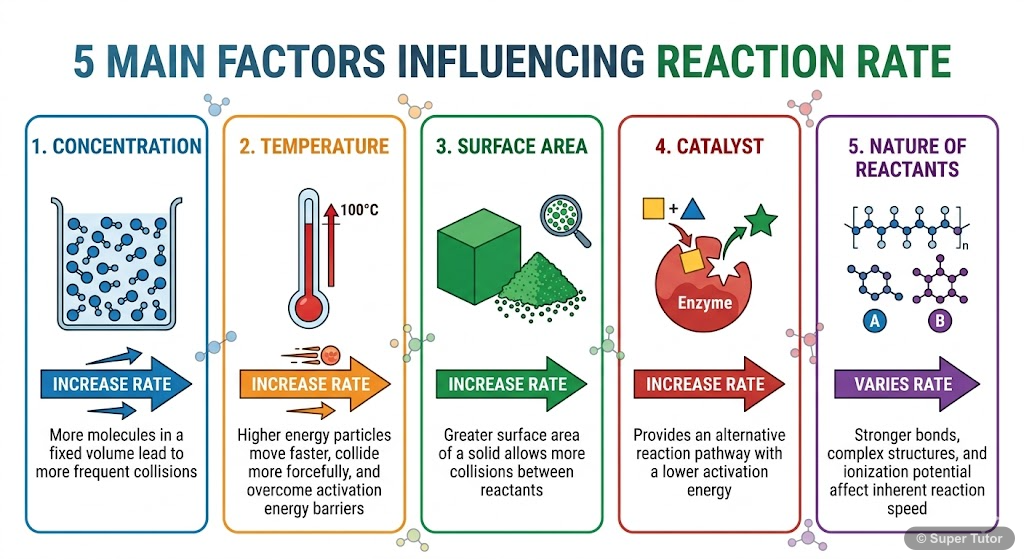
Learn better with visuals Super Tutor pairs illustrations like this with notes and quizzes for Chemical Kinetics.
The first 20 solutions are open to read. The other 19 are free with a Super Tutor account.
Intext Questions
3.1For the reaction R → P, the concentration of a reactant changes from 0.03M to 0.02M in 25 minutes. Calculate the average rate of reaction using units of time both in minutes and seconds.Show solution
Given:
- Initial concentration,
- Final concentration,
- Time interval,
Formula:
In minutes:
In seconds (converting: ):
Answer: Average rate
3.2In a reaction, 2A → Products, the concentration of A decreases from 0.5 mol L⁻¹ to 0.4 mol L⁻¹ in 10 minutes. Calculate the rate during this interval.Show solution
Given:
- Reaction:
- ,
Formula:
Calculation:
Answer: Rate of reaction
3.3For a reaction, A + B → Product; the rate law is given by, r = k[A]^(1/2)[B]². What is the order of the reaction?Show solution
Given: Rate law:
Concept: Order of reaction with respect to each reactant is the power of its concentration in the rate law. Overall order is the sum of all powers.
Calculation:
- Order with respect to A
- Order with respect to B
Answer: The order of the reaction is 2.5.
3.4The conversion of molecules X to Y follows second order kinetics. If concentration of X is increased to three times how will it affect the rate of formation of Y?Show solution
Given: , second order reaction.
Rate law:
Initial rate:
New rate when is tripled, i.e., :
Answer: The rate of formation of Y will increase 9 times when the concentration of X is tripled.
3.5A first order reaction has a rate constant 1.15 × 10⁻³ s⁻¹. How long will 5 g of this reactant take to reduce to 3 g?Show solution
Given:
- Initial amount,
- Final amount,
Formula for first order reaction:
Calculation:
Answer: The time required is .
3.6Time required to decompose SO₂Cl₂ to half of its initial amount is 60 minutes. If the decomposition is a first order reaction, calculate the rate constant of the reaction.Show solution
Given:
- Half-life,
- First order reaction
Formula:
Calculation:
Converting to s⁻¹:
Answer:
3.7What will be the effect of temperature on rate constant?Show solution
Answer:
The rate constant of a reaction increases with increase in temperature.
According to the Arrhenius equation:
As temperature increases, the exponential term increases (becomes less negative in exponent), so increases. It has been found experimentally that for most reactions, the rate constant nearly doubles for every rise in temperature. This is because at higher temperatures, more molecules possess energy equal to or greater than the activation energy .
3.8The rate of the chemical reaction doubles for an increase of 10K in absolute temperature from 298K. Calculate Eₐ.Show solution
Given:
- ,
- (rate doubles)
Formula (Arrhenius equation in two-temperature form):
Substituting values:
Answer:
3.9The activation energy for the reaction 2HI(g) → H₂ + I₂(g) is 209.5 kJ mol⁻¹ at 581K. Calculate the fraction of molecules of reactants having energy equal to or greater than activation energy.Show solution
Given:
Formula:
The fraction of molecules having energy is:
Taking logarithm:
Answer: The fraction of molecules having energy equal to or greater than activation energy .
Exercises
3.1From the rate expression for the following reactions, determine their order of reaction and the dimensions of the rate constants.
(i) 3NO(g) → N₂O(g); Rate = k[NO]²
(ii) H₂O₂(aq) + 3I⁻(aq) + 2H⁺ → 2H₂O(l) + I₃⁻; Rate = k[H₂O₂][I⁻]
(iii) CH₃CHO(g) → CH₄(g) + CO(g); Rate = k[CH₃CHO]^(3/2)
(iv) C₂H₅Cl(g) → C₂H₄(g) + HCl(g); Rate = k[C₂H₅Cl]Show solution
Concept: Order of reaction = sum of powers of concentration terms in rate law. Units of are derived from: , so
(i) Rate
- Order = 2 (second order)
- Units of :
(ii) Rate
- Order = 1 + 1 = 2 (second order)
- Units of :
(iii) Rate
- Order = 3/2 = 1.5 (1.5 order)
- Units of :
(iv) Rate
- Order = 1 (first order)
- Units of :
3.2For the reaction: 2A + B → A₂B, the rate = k[A][B]² with k = 2.0 × 10⁻⁶ mol⁻² L² s⁻¹. Calculate the initial rate of the reaction when [A] = 0.1 mol L⁻¹, [B] = 0.2 mol L⁻¹. Calculate the rate of reaction after [A] is reduced to 0.06 mol L⁻¹.Show solution
Given:
- Rate
- Initial: ,
Part 1 – Initial rate:
Part 2 – Rate when [A] is reduced to 0.06 mol L⁻¹:
The reaction is .
Decrease in
Since stoichiometry: 2 mol A reacts with 1 mol B,
Answer:
- Initial rate
- Rate after reduces to
3.3The decomposition of NH₃ on platinum surface is zero order reaction. What are the rates of production of N₂ and H₂ if k = 2.5 × 10⁻⁴ mol⁻¹ L s⁻¹?Show solution
Given:
- Reaction:
- Zero order reaction,
For zero order: Rate
This is the rate of disappearance of :
Rate of production of N₂:
Using stoichiometry:
So:
Rate of production of H₂:
Answer:
- Rate of production of
- Rate of production of
3.4The decomposition of dimethyl ether leads to the formation of CH₄, H₂ and CO and the reaction rate is given by Rate = k[CH₃OCH₃]^(3/2). The rate of reaction is followed by increase in pressure in a closed vessel, so the rate can also be expressed in terms of the partial pressure of dimethyl ether, i.e., Rate = k(p_{CH₃OCH₃})^(3/2). If the pressure is measured in bar and time in minutes, then what are the units of rate and rate constants?Show solution
Given:
- Rate
- Pressure in bar, time in minutes
Units of Rate:
Units of rate constant :
Answer:
- Units of rate
- Units of rate constant
3.5Mention the factors that affect the rate of a chemical reaction.Show solution
The following factors affect the rate of a chemical reaction:
- Concentration of reactants: Rate generally increases with increase in concentration of reactants (more molecules available for collision).
- Temperature: Rate increases with increase in temperature. For most reactions, rate nearly doubles for every rise in temperature (Arrhenius equation: ).
- Presence of a catalyst: A catalyst provides an alternate pathway with lower activation energy, thereby increasing the rate of reaction without being consumed.
- Nature of reactants: Physical state, surface area (for heterogeneous reactions), and bond types influence the rate.
- Pressure (for gaseous reactions): Increasing pressure increases concentration of gaseous reactants, thus increasing the rate.
- Surface area: For heterogeneous reactions, finely divided solids (larger surface area) react faster.
3.6A reaction is second order with respect to a reactant. How is the rate of reaction affected if the concentration of the reactant is (i) doubled (ii) reduced to half?Show solution
Given: Rate (second order with respect to reactant A)
(i) When concentration is doubled ():
The rate becomes 4 times the original rate.
(ii) When concentration is reduced to half ():
The rate becomes one-fourth of the original rate.
3.7What is the effect of temperature on the rate constant of a reaction? How can this effect of temperature on rate constant be represented quantitatively?Show solution
Effect of temperature on rate constant:
The rate constant of a reaction increases with increase in temperature. Experimentally, it is found that for most reactions, the rate constant approximately doubles for every 10 K rise in temperature.
Quantitative representation — Arrhenius Equation:
The effect of temperature on rate constant is given by the Arrhenius equation:
where:
- = rate constant
- = Arrhenius factor (pre-exponential factor or frequency factor)
- = activation energy (J mol⁻¹)
- = gas constant
- = absolute temperature (K)
Taking logarithm:
For two temperatures and :
As increases, increases, so increases.
3.8In a pseudo first order reaction in water, the following results were obtained:
t/s: 0, 30, 60, 90
[A]/mol L⁻¹: 0.55, 0.31, 0.17, 0.085
Calculate the average rate of reaction between the time interval 30 to 60 seconds.Show solution
Given:
- At :
- At :
Formula:
Calculation:
Answer: Average rate
3.9A reaction is first order in A and second order in B.
(i) Write the differential rate equation.
(ii) How is the rate affected on increasing the concentration of B three times?
(iii) How is the rate affected when the concentrations of both A and B are doubled?Show solution
Given: First order in A, second order in B.
(i) Differential rate equation:
(ii) Effect of tripling [B]:
Original rate:
New rate when :
The rate increases 9 times.
(iii) Effect of doubling both [A] and [B]:
New rate when and :
The rate increases 8 times.
3.10In a reaction between A and B, the initial rate of reaction (r₀) was measured for different initial concentrations of A and B as given below:
[A]/mol L⁻¹: 0.20, 0.20, 0.40
[B]/mol L⁻¹: 0.30, 0.10, 0.05
r₀/mol L⁻¹s⁻¹: 5.07×10⁻⁵, 5.07×10⁻⁵, 1.43×10⁻⁴
What is the order of the reaction with respect to A and B?Show solution
Let Rate
Finding order with respect to B (comparing experiments 1 and 2):
is same (0.20) in both; changes from 0.30 to 0.10.
Order with respect to B = 0.
Finding order with respect to A (comparing experiments 2 and 3):
changes but since , it doesn't matter. Using experiments 2 and 3:
Verification: ✓
Answer:
- Order with respect to A (or )
- Order with respect to B
- Overall order
3.11The following results have been obtained during the kinetic studies of the reaction: 2A + B → C + D
Experiment I: [A]=0.1, [B]=0.1, rate=6.0×10⁻³
Experiment II: [A]=0.3, [B]=0.2, rate=7.2×10⁻²
Experiment III: [A]=0.3, [B]=0.4, rate=2.88×10⁻¹
Experiment IV: [A]=0.4, [B]=0.1, rate=2.40×10⁻²
Determine the rate law and the rate constant for the reaction.Show solution
Let Rate
Finding order with respect to B (comparing experiments II and III):
is same (0.3):
Order with respect to B = 2.
Finding order with respect to A (comparing experiments I and IV):
is same (0.1):
Order with respect to A = 1.
Rate law:
Calculating rate constant (using Experiment I):
Verification with Experiment II:
✓
Answer:
- Rate law:
Experiment I: [A]=0.1, [B]=0.1, rate=2.0×10⁻²
Experiment II: [A]=?, [B]=0.2, rate=4.0×10⁻²
Experiment III: [A]=0.4, [B]=0.4, rate=?
Experiment IV: [A]=?, [B]=0.2, rate=2.0×10⁻²
Free with a Super Tutor account
(i) 200 s⁻¹
(ii) 2 min⁻¹
(iii) 4 years⁻¹
Free with a Super Tutor account
Free with a Super Tutor account
t/s: 0, 400, 800, 1200, 1600, 2000, 2400, 2800, 3200
10² × [N₂O₅]/mol L⁻¹: 1.63, 1.36, 1.14, 0.93, 0.78, 0.64, 0.53, 0.43, 0.35
(i) Plot [N₂O₅] against t.
(ii) Find the half-life period for the reaction.
(iii) Draw a graph between log[N₂O₅] and t.
(iv) What is the rate law?
(v) Calculate the rate constant.
(vi) Calculate the half-life period from k and compare it with (ii).
Free with a Super Tutor account
Free with a Super Tutor account
Free with a Super Tutor account
Free with a Super Tutor account
Free with a Super Tutor account
t(sec): 0, 360, 720
P(mm of Hg): 35.0, 54.0, 63.0
Calculate the rate constant.
Free with a Super Tutor account
SO₂Cl₂(g) → SO₂(g) + Cl₂(g)
Experiment 1: t=0, P=0.5 atm
Experiment 2: t=100 s, P=0.6 atm
Calculate the rate of the reaction when total pressure is 0.65 atm.
Free with a Super Tutor account
T/°C: 0, 20, 40, 60, 80
10⁵ × k/s⁻¹: 0.0787, 1.70, 25.7, 178, 2140
Draw a graph between ln k and 1/T and calculate the values of A and Eₐ. Predict the rate constant at 30°C and 50°C.
Free with a Super Tutor account
Free with a Super Tutor account
Free with a Super Tutor account
Free with a Super Tutor account
Free with a Super Tutor account
Free with a Super Tutor account
Free with a Super Tutor account
Free with a Super Tutor account
Free with a Super Tutor account
19 more solved questions in Chemical Kinetics
They are free with a Super Tutor account, along with practice quizzes and flashcards for this chapter. Free to start, no card needed.
Frequently Asked Questions
What are the important topics in Chemical Kinetics for Jharkhand Board Class 12 Chemistry?
Are these NCERT Solutions for Chemical Kinetics free?
How should I revise Chemical Kinetics for the Jharkhand Board Class 12 board exam?
Sources & Official References
Content is aligned to the official syllabus. Refer to the board website for the latest curriculum.
More resources for Chemical Kinetics
Practice Quiz
Test yourself with a quick quiz
Important Questions
Exam-style questions with answers
Revision Notes
Key points for last-minute revision
Formula Sheet
The chapter's formulas in one place
Chapter Summary
Understand the chapter at a glance
Concept Maps
See how topics connect
Study Plan
Step-by-step plan for this chapter
Flashcards
Quick-fire cards for active recall
Syllabus
What topics to cover
For serious students
Get the full Chemical Kinetics chapter — start free.
Quizzes, flashcards, an AI doubt solver and a study plan for Jharkhand Board Class 12 Chemistry. Free to start, no card needed.