Kings, Farmers and Towns (Early States and Economies) (c.600 BCE-600 CE) — Flashcards
Jharkhand Board · Class 12 · History
96 flashcards for Kings, Farmers and Towns (Early States and Economies) (c.600 BCE-600 CE) (Jharkhand Board Class 12 History) to test yourself on key.
Interactive on Super Tutor
Studying Kings, Farmers and Towns (Early States and Economies) (c.600 BCE-600 CE)? Get the full interactive chapter.
Quizzes, flashcards, AI doubt-solver and a step-by-step study plan — built for flashcards and more.
Free trial, no card needed.
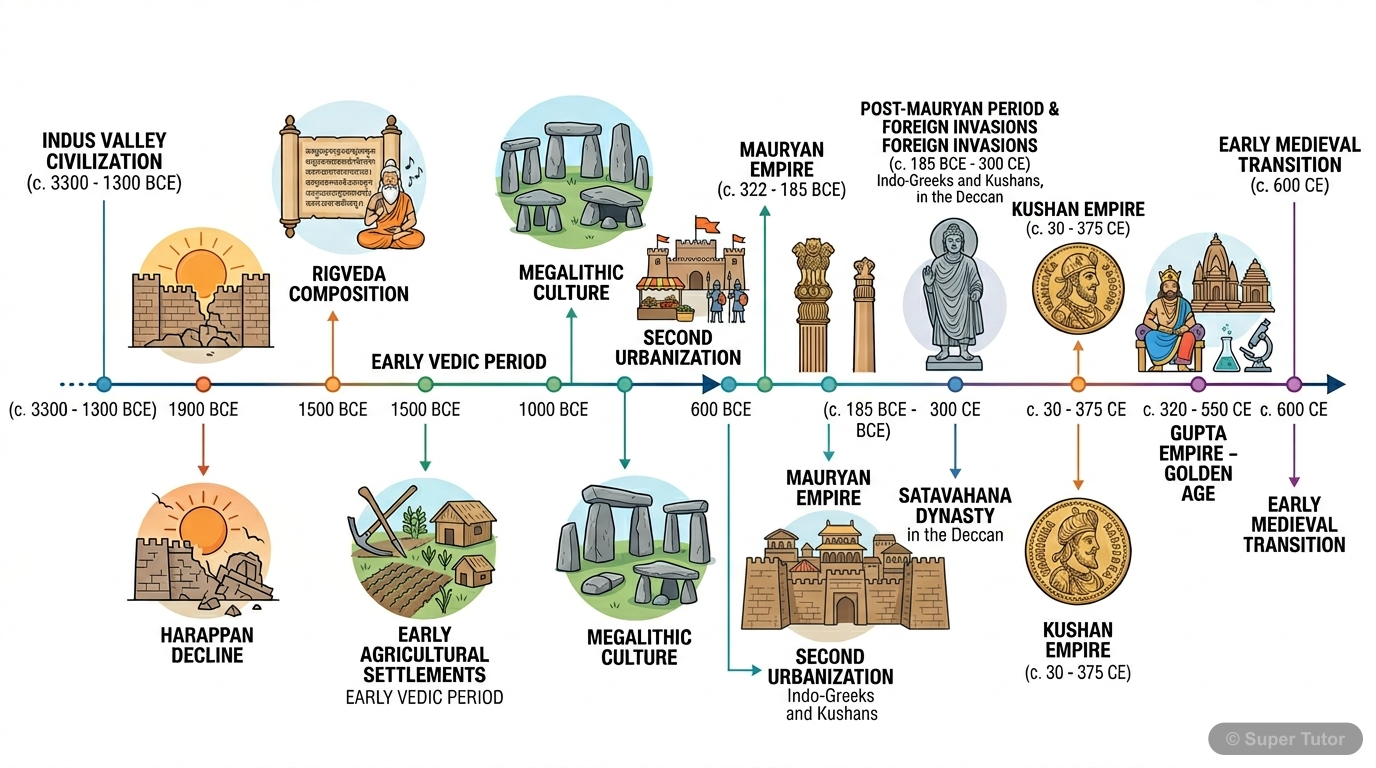
One of 18 illustrations for Kings, Farmers and Towns (Early States and Economies) (c.600 BCE-600 CE) in Super Tutor — alongside flashcards, concept maps and practice questions.
What major changes began from around the sixth century BCE in the subcontinent?
Answer
Early states, empires, and kingdoms emerged. Agriculture became more organised, new towns appeared, iron use grew, and coinage developed. Buddhism and Jainism also grew during this period.
उपमहाद्वीप में लगभग छठी शताब्दी BCE से कौन से बड़े बदलाव शुरू हुए?
Answer
प्रारंभिक राज्यों, साम्राज्यों और राज्यों का उदय हुआ। कृषि अधिक संगठित हो गई, नए शहर दिखाई दिए, लोहे का उपयोग बढ़ गया और सिक्कों का विकास हुआ। इस अवधि के दौरान बौद्ध धर्म और जैन धर्म भी विकसित हुए।…
महाजनपद क्या होता है?
Answer
महाजनपद प्रारंभिक बौद्ध और जैन ग्रंथों में उल्लिखित सोलह प्रमुख राज्यों में से एक था। वे प्रारंभिक भारत की महत्वपूर्ण राजनीतिक इकाइयाँ थीं, और कई की किलेबंद राजधानियाँ थीं।…
What is a mahajanapada?
Answer
A mahajanapada was one of the sixteen major states mentioned in early Buddhist and Jaina texts. They were important political units of early India, and many had fortified capitals.
What was the difference between most mahajanapadas and ganas or sanghas?
Answer
Most mahajanapadas were ruled by kings, while ganas or sanghas were oligarchies. In a gana or sangha, power was shared by a group of men, often called rajas.
अधिकांश महाजनपदों और गणों या संघों के बीच क्या अंतर था?
Answer
अधिकांश महाजनपदों पर राजाओं का शासन था, जबकि गण या संघ अल्पतंत्र थे। गण या संघ में, शक्ति पुरुषों के एक समूह द्वारा साझा की जाती थी, जिन्हें अक्सर राजा कहा जाता था।…
गणों या संघों के अध्ययन में बुद्ध और महावीर क्यों महत्वपूर्ण थे?
Answer
महावीर और बुद्ध दोनों गण या संघ राज्यों से संबंधित थे। यह दर्शाता है कि प्रारंभिक धार्मिक नेता राजनीतिक रूपों से जुड़े थे जहां शक्ति सामूहिक रूप से साझा की जाती थी, न कि एक राजा में केंद्रित थी।…
Why were the Buddha and Mahavira important in the study of ganas or sanghas?
Answer
Both Mahavira and the Buddha belonged to gana or sangha states. This shows that early religious leaders were linked to political forms where power was shared collectively, not concentrated in one king…
+88 more flashcards
Practise AllFrequently Asked Questions
What are the important topics in Kings, Farmers and Towns (Early States and Economies) (c.600 BCE-600 CE) for Jharkhand Board Class 12 History?
How many flashcards are available for Kings, Farmers and Towns (Early States and Economies) (c.600 BCE-600 CE)?
How should I revise Kings, Farmers and Towns (Early States and Economies) (c.600 BCE-600 CE) for the Jharkhand Board Class 12 board exam?
Sources & Official References
Content is aligned to the official syllabus. Refer to the board website for the latest curriculum.
More resources for Kings, Farmers and Towns (Early States and Economies) (c.600 BCE-600 CE)
Practice Quiz
Test yourself with a quick quiz
Important Questions
Exam-style questions with answers
Revision Notes
Key points for last-minute revision
Chapter Summary
Understand the chapter at a glance
Concept Maps
See how topics connect
Study Plan
Step-by-step plan for this chapter
Syllabus
What topics to cover
NCERT Solutions
Every textbook question solved step by step
For serious students
Get the full Kings, Farmers and Towns (Early States and Economies) (c.600 BCE-600 CE) chapter — start free.
Quizzes, flashcards, an AI doubt solver and a study plan for Jharkhand Board Class 12 History. Free to start, no card needed.