Mahatma Gandhi and the Nationalist Movement: Civil Disobedience and Beyond — Revision Notes
Jharkhand Board · Class 12 · History
Mahatma Gandhi and the Nationalist Movement: Civil Disobedience and Beyond revision notes for Jharkhand Board Class 12 History: 4 topics in quick points.
Interactive on Super Tutor
Studying Mahatma Gandhi and the Nationalist Movement: Civil Disobedience and Beyond? Get the full interactive chapter.
Quizzes, flashcards, AI doubt-solver and a step-by-step study plan — built for revision notes and more.
Free trial, no card needed.
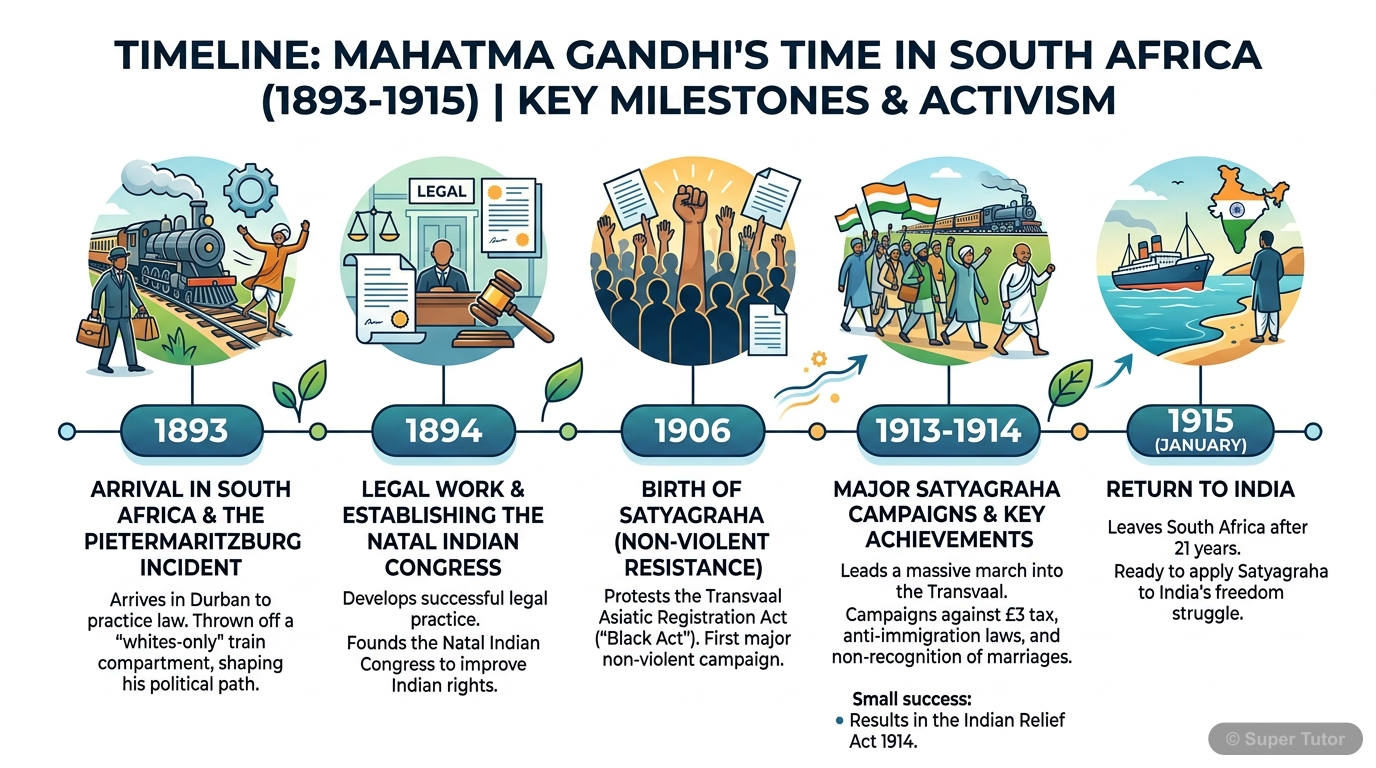
One of 11 illustrations for Mahatma Gandhi and the Nationalist Movement: Civil Disobedience and Beyond in Super Tutor — alongside flashcards, concept maps and practice questions.
Key Topics to Revise
1. Gandhi’s Entry into Indian Politics
- Gandhi returned to India in January 1915 after two decades abroad, mostly in South Africa.
- South Africa shaped him as a leader of non-violent protest, religion harmony, and opposition to caste discrimination.
- Gopal Krishna Gokhale became his acknowledged political mentor.
2. Early Peasant and Labour Struggles
- Gandhi spent much of 1917 in Champaran seeking security of tenure and freedom to choose crops for peasants.
- In 1918 he intervened in the Ahmedabad textile mill workers’ dispute.
- In 1918 he also joined the Kheda peasants’ tax remission campaign.
3. Rowlatt Satyagraha and Non-Cooperation
- During the First World War, the British had instituted censorship of the press and detention without trial.
- The Rowlatt Act continued these wartime measures.
- The Rowlatt Satyagraha made Gandhi a truly national leader.
4. Gandhi as a People’s Leader
- By 1922 Gandhi had transformed Indian nationalism into a mass movement.
- Poor peasants, workers, and artisans saw him as a Mahatma.
- People admired that he dressed simply, lived simply, and spoke in a language close to theirs.
Get complete notes with diagrams and examples
Full NotesKey Concepts
Frequently Asked Questions
What are the important topics in Mahatma Gandhi and the Nationalist Movement: Civil Disobedience and Beyond for Jharkhand Board Class 12 History?
How should I revise Mahatma Gandhi and the Nationalist Movement: Civil Disobedience and Beyond for the Jharkhand Board Class 12 board exam?
Sources & Official References
Content is aligned to the official syllabus. Refer to the board website for the latest curriculum.
More resources for Mahatma Gandhi and the Nationalist Movement: Civil Disobedience and Beyond
Practice Quiz
Test yourself with a quick quiz
Important Questions
Exam-style questions with answers
Chapter Summary
Understand the chapter at a glance
Concept Maps
See how topics connect
Study Plan
Step-by-step plan for this chapter
Flashcards
Quick-fire cards for active recall
Syllabus
What topics to cover
NCERT Solutions
Every textbook question solved step by step
For serious students
Get the full Mahatma Gandhi and the Nationalist Movement: Civil Disobedience and Beyond chapter — start free.
Quizzes, flashcards, an AI doubt solver and a study plan for Jharkhand Board Class 12 History. Free to start, no card needed.