Chapter 9 of 12
NCERT Solutions

Mahatma Gandhi and the Nationalist Movement: Civil Disobedience and Beyond

Jharkhand Board · Class 12 · History

NCERT Solutions for Mahatma Gandhi and the Nationalist Movement: Civil Disobedience and Beyond — Jharkhand Board Class 12 History.

48 questions22 flashcards5 concepts

Interactive on Super Tutor

Studying Mahatma Gandhi and the Nationalist Movement: Civil Disobedience and Beyond? Get the full interactive chapter.

Quizzes, flashcards, AI doubt-solver and a step-by-step study plan — built for ncert solutions and more.

1,000+ Class 12 students started this chapter today

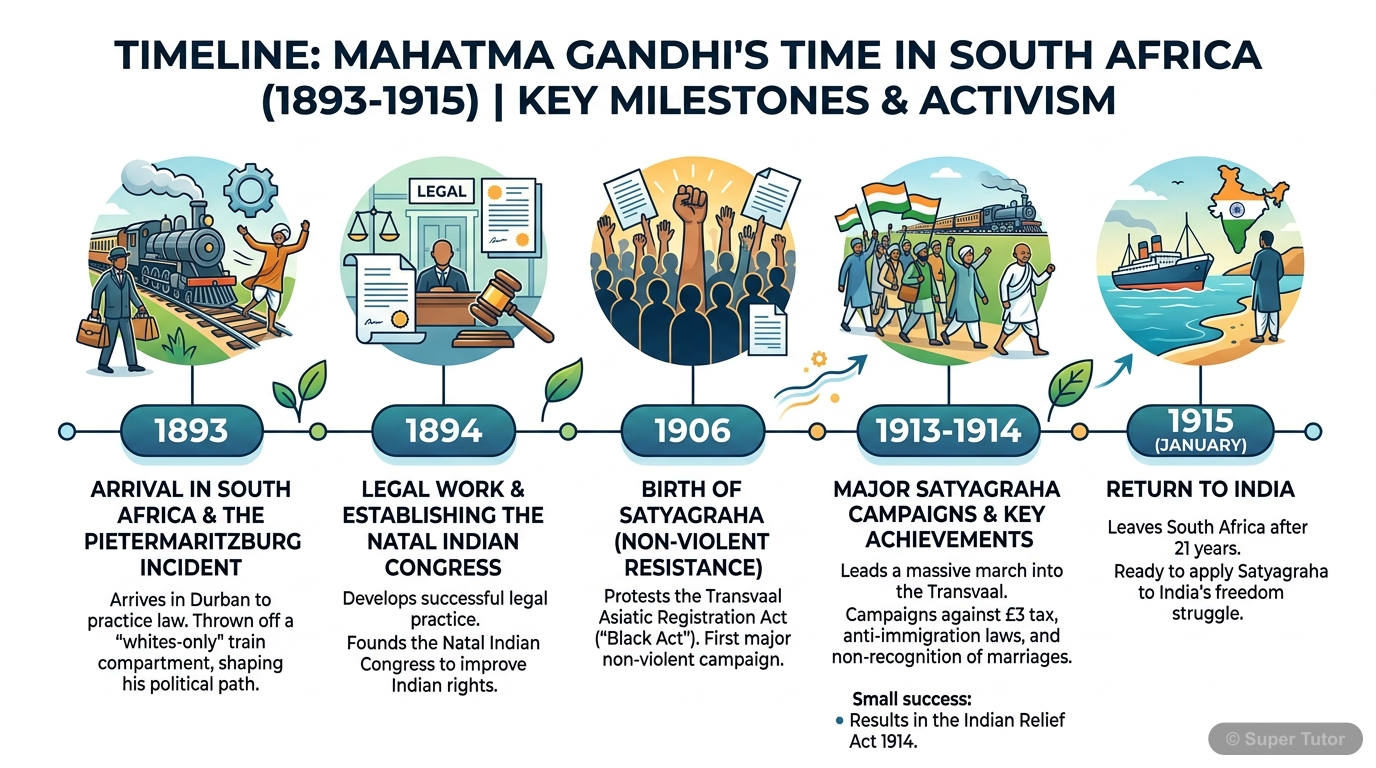
A timeline illustrating key events in Mahatma Gandhi's life in South Africa, including his arrival, legal career, development of Satyagraha, and advocacy for Indian rights, before his return to India.
Super Tutor

Super Tutor has 11+ illustrations like this for Mahatma Gandhi and the Nationalist Movement: Civil Disobedience and Beyond alone — flashcards, concept maps, and step-by-step visuals.

See them all
12 Questions Solved · 4 Sections

Answer in 100-150 Words

1How did Mahatma Gandhi seek to identify with the common people?Show solution
Given/Context: Mahatma Gandhi returned to India from South Africa in 1915 and sought to connect with the masses of India.

Answer:

Mahatma Gandhi identified with the common people in several significant ways:

1. Appearance and dress: He gave up Western clothes and adopted the dhoti and shawl — the dress of the ordinary Indian peasant. This made him visually indistinguishable from the poor.

2. Language: He encouraged communication of the nationalist message in the mother tongue rather than in English, making politics accessible to ordinary people.

3. Travel: He travelled across India in third-class railway compartments, experiencing the hardships faced by common people.

4. Championing their causes: He took up the struggles of peasants (Champaran, Kheda), mill workers (Ahmedabad), and the poor, showing genuine sympathy for their problems.

5. Promotion of khadi: By spinning the charkha and wearing khadi, he symbolically aligned himself with the self-reliant village economy.

Thus, unlike other politicians who talked down to the masses, Gandhi appeared to understand and relate to their lives, making him a truly people's leader.
2How was Mahatma Gandhi perceived by the peasants?Show solution
Given/Context: Mahatma Gandhi's mass appeal among peasants was a distinctive feature of the nationalist movement.

Answer:

The peasants perceived Mahatma Gandhi in an almost reverential, even supernatural light — as a Mahatma (great soul) rather than merely a political leader. Several aspects of this perception are notable:

1. Messianic figure: Peasants believed Gandhi had come to liberate them from British oppression and from the exploitation of landlords. They saw him as a saviour sent by the king to help them.

2. Miraculous powers: Rumours circulated among peasants that Gandhi possessed divine powers. For example, it was believed that those who opposed him met with misfortune — a man's house caught fire, another's goat was bitten by his own dogs.

3. Moral authority: Gandhi was seen as a moral force who could stop evil — people believed that uttering his name could stop brickbats from flying.

4. Identification with the poor: Unlike other leaders, Gandhi dressed like them, travelled like them, and fought for their causes (Champaran, Kheda), which made him appear as one of their own.

This perception transformed Gandhi into a symbol of hope and resistance for millions of Indian peasants.
3Why did the salt laws become an important issue of struggle?Show solution
Given/Context: In 1930, Mahatma Gandhi launched the Civil Disobedience Movement by breaking the salt laws through the famous Dandi March.

Answer:

Salt became an important symbol of protest for the following reasons:

1. Universal necessity: Salt is an essential item consumed by every Indian — rich or poor, Hindu or Muslim, from every region. A tax on salt therefore affected the entire population.

2. Oppressive taxation: The colonial government imposed a heavy tax on salt — sometimes as much as fourteen times its actual value. This was a direct burden on the poorest sections of society.

3. State monopoly: The British government held a monopoly over salt production and sale. It prevented Indians from manufacturing salt freely and even destroyed naturally occurring salt that people could have used without cost.

4. Symbol of colonial exploitation: As Gandhi argued, the salt tax was a "fourfold curse" — it deprived people of a village industry, involved destruction of natural property, caused national expenditure, and imposed an enormous tax on a starving people.

5. Unifying potential: Because salt was used by all Indians regardless of class, caste, or religion, the salt tax could unite the entire nation in protest.

Thus, the salt laws were both practically oppressive and symbolically powerful, making them an ideal focus for mass civil disobedience.
4Why are newspapers an important source for the study of the national movement?Show solution
Given/Context: Historians use a variety of sources to reconstruct the history of the national movement, and newspapers are among the most important.

Answer:

Newspapers are an important source for the study of the national movement for the following reasons:

1. Contemporary record: Newspapers published at the time tracked Mahatma Gandhi's movements, reported on his activities, and recorded events as they happened, providing a day-to-day account of the movement.

2. Diverse perspectives: Newspapers published in English as well as in various Indian languages represented different viewpoints — nationalist, loyalist, regional — giving historians a multi-dimensional picture of events.

3. Public opinion: They reflected what ordinary Indians thought about Gandhi and the movement, capturing popular sentiment that official records often ignored.

4. Spread of nationalism: Newspapers helped spread nationalist ideas to different parts of the country, and studying them reveals how the message of the movement was communicated.

Caution: However, newspapers must be read critically. They were not unbiased — they were published by people with their own political opinions. A London newspaper's account would differ greatly from an Indian nationalist paper's account of the same event. Therefore, historians must cross-check newspaper reports with other sources before drawing conclusions.
5Why was the charkha chosen as a symbol of nationalism?Show solution
Given/Context: Mahatma Gandhi promoted the spinning wheel (charkha) as a central symbol of the nationalist movement and of his constructive programme.

Answer:

The charkha was chosen as a symbol of nationalism for several important reasons:

1. Economic self-reliance: The charkha represented the idea of swadeshi — the use of Indian-made goods. By spinning their own cloth (khadi), Indians could reduce dependence on British mill-made cloth, thereby weakening the colonial economy.

2. Dignity of labour: Gandhi believed that manual labour was dignified. The charkha symbolised the idea that every Indian — whether rich or poor, educated or uneducated — could contribute to the freedom struggle through productive work.

3. Unity across classes: Spinning was an activity that could be performed by all Indians regardless of caste, class, religion, or region. It was therefore a unifying symbol.

4. Connection with the poor: The charkha was associated with the village economy and the life of the poor peasant. By adopting it, Gandhi signalled his identification with the masses.

5. Resistance to colonialism: Producing khadi was a direct act of defiance against British economic policies that had destroyed India's traditional textile industry.

Thus, the charkha was not merely an economic tool but a powerful political and cultural symbol of Indian self-sufficiency and resistance to colonial rule.

Write a Short Essay (250-300 Words)

6How was non-cooperation a form of protest?Show solution
Introduction:
Non-cooperation was a unique and powerful form of protest launched by Mahatma Gandhi in 1920-22. It was based on the idea that colonial rule survived because Indians cooperated with it — and that if Indians withdrew their cooperation, the British could not govern.

Withdrawal of cooperation:
The Non-cooperation Movement called upon Indians to boycott British institutions and symbols of colonial authority. Students were asked to leave government-run schools and colleges. Lawyers were urged to boycott British courts. Voters were asked not to participate in elections to legislative councils. People were encouraged to return honours and titles given by the British government.

Economic dimension:
On the economic front, Indians were asked to boycott foreign cloth and use only khadi. Import of British goods was to be stopped. This struck directly at the economic interests of the colonial power.

Constructive programme:
Non-cooperation was not merely negative. Gandhi paired it with a constructive programme: promotion of khadi, establishment of national schools and colleges, and efforts towards Hindu-Muslim unity and the removal of untouchability.

Mass participation:
The movement drew in diverse social groups — peasants, workers, students, women, and merchants — each participating in ways relevant to their own lives and grievances. Peasants refused to pay taxes; workers went on strike; women picketed shops selling foreign cloth.

Significance as protest:
Non-cooperation was a form of protest because it challenged the legitimacy of British rule without resorting to violence. It demonstrated that Indians could collectively refuse to sustain a system they considered unjust. It was, in Gandhi's words, a way of making the rulers feel the moral weight of the governed.

Conclusion:
Non-cooperation thus transformed passive subjects into active resisters, making it one of the most innovative forms of political protest in modern history.
7Why were the dialogues at the Round Table Conference inconclusive?Show solution
Introduction:
The Round Table Conferences were organised by the British government in London to discuss constitutional reforms for India. Despite high expectations, the dialogues remained inconclusive due to several deep-seated reasons.

Absence of key Congress leaders:
The First Round Table Conference (1930) was held without the Congress, as the Civil Disobedience Movement was at its peak and most Congress leaders were in jail. Without the most representative nationalist organisation, no meaningful agreement was possible.

Gandhi-Irwin Pact and Second RTC:
After the Gandhi-Irwin Pact of 1931, Gandhi attended the Second Round Table Conference as the sole representative of the Congress. However, he was unable to get the British to agree to the Congress's central demand — a commitment to full independence (Purna Swaraj).

Communal question:
A major stumbling block was the question of separate electorates for minorities, particularly Muslims and the Depressed Classes. B.R. Ambedkar demanded separate electorates for the Depressed Classes, which Gandhi strongly opposed, arguing it would permanently divide Hindu society. This deadlock made agreement impossible.

British reluctance:
The British, especially under Conservative Prime Minister Winston Churchill, were unwilling to make any firm commitment to Indian independence. They were prepared to offer only limited constitutional reforms, which were unacceptable to the Congress.

Multiplicity of voices:
The conferences brought together a large number of groups — princes, minorities, liberals — each with different and often conflicting demands. This made it impossible to arrive at a consensus.

Conclusion:
The Round Table Conferences thus failed because of the fundamental gap between Indian aspirations for complete independence and British willingness to offer only limited reforms, compounded by unresolved communal divisions within Indian society.
8In what way did Mahatma Gandhi transform the nature of the national movement?Show solution
Introduction:
Before Mahatma Gandhi's arrival on the Indian political scene, the national movement was largely confined to the educated, English-speaking urban elite. Gandhi fundamentally transformed its character, making it a truly mass movement.

Broadening the social base:
Gandhi brought into the movement social groups that had previously been untouched by nationalism — peasants, workers, women, tribals, and the poor. His campaigns in Champaran, Kheda, and Ahmedabad showed that the nationalist struggle could address the everyday grievances of ordinary people.

New methods of struggle:
Gandhi introduced the philosophy and technique of Satyagraha — non-violent resistance or truth-force. This was a departure from the earlier methods of petitions and prayers to the British. Satyagraha empowered ordinary people to resist injustice without weapons.

Organisational changes:
Gandhi reorganised the Congress, establishing new branches across India. Provincial committees were based on linguistic regions rather than artificial administrative boundaries, making the Congress more representative. A series of Praja Mandals were set up in princely states.

Use of vernacular languages:
By encouraging communication in mother tongues rather than English, Gandhi made the nationalist message accessible to millions who did not know English.

Symbolic politics:
Gandhi used powerful symbols — the charkha, khadi, the Dandi March — that resonated with the masses and gave the movement a cultural and moral dimension beyond mere politics.

Inclusion of diverse groups:
Gandhi's movement attracted both poor peasants and rich industrialists, Hindus and Muslims, men and women, making nationalism a genuinely inclusive force.

Conclusion:
In sum, Gandhi transformed the national movement from an elite affair into a people's movement, giving it a moral foundation, a mass base, and innovative methods of struggle that made it irresistible to colonial rule.
9What do private letters and autobiographies tell us about an individual? How are these sources different from official accounts?Show solution
Introduction:
Historians use a variety of sources to reconstruct the past. Private letters, autobiographies, and official accounts each offer different kinds of information and must be read with an awareness of their limitations.

What private letters tell us:
Private letters are written for a specific person and are therefore often more candid and personal than public documents. They reveal the inner thoughts, emotions, doubts, and personal relationships of the writer. They capture the human dimension of historical figures — their fears, hopes, and private opinions on events. For example, letters written by nationalist leaders to family members or close associates may reveal their anxieties about the movement that they would never express in public speeches.

What autobiographies tell us:
Autobiographies give a retrospective account of a person's life, often rich in human detail. They tell us how a person understood their own times, what they considered important, and how they wished to be remembered. They reveal the author's values, motivations, and interpretation of events.

Limitations of these sources:
Both letters and autobiographies are subjective. Autobiographies are written from memory and reflect what the author chose to remember or wished others to believe about them. Writing an autobiography is, as the chapter notes, "a way of framing a picture of yourself." Letters too reflect the writer's perspective and may not give the full picture.

Difference from official accounts:
Official accounts — such as government reports, police records, and administrative documents — are written from the perspective of the state. They reflect what officials saw, or wanted to believe. They tend to be formal, impersonal, and often shaped by the political interests of the ruling power. For instance, the colonial Home Department's Fortnightly Reports downplayed the success of the Salt March because officials were unwilling to admit the extent of popular support for Gandhi.

Conclusion:
While private letters and autobiographies offer intimate, personal insights into individuals, official accounts provide the state's perspective on events. Historians must use all these sources critically and in conjunction with each other to arrive at a balanced understanding of the past.

Map Work

10Find out about the route of the Dandi March. On a map of Gujarat plot the line of the march and mark the major towns and villages that it passed along the route.Show solution
Given: The Dandi March began on 12 March 1930 and ended on 6 April 1930.

Route of the Dandi March:

Mahatma Gandhi began the march from his Sabarmati Ashram near Ahmedabad and walked approximately 385 kilometres (240 miles) to the coastal village of Dandi in Navsari district, where he broke the salt law.

Major towns and villages along the route (to be marked on the map):

1. Sabarmati Ashram, Ahmedabad — Starting point (12 March 1930)
2. Aslali
3. Bareja
4. Navagam
5. Nadiad
6. Anand
7. Borsad
8. Ras
9. Matar
10. Dabhan
11. Nadiad (passing through)
12. Kareli
13. Ankhi
14. Surat (nearby)
15. Dandi, Navsari district — End point (6 April 1930), where Gandhi picked up salt from the seashore.

Instructions for map work:
- Take an outline map of Gujarat.
- Mark Ahmedabad (Sabarmati) in the north-central part of Gujarat.
- Draw a line moving southward through the districts of Kheda, Anand, Vadodara, Surat, and Navsari.
- Mark Dandi on the western coastline of Gujarat in Navsari district.
- Use arrows to show the direction of the march.
- Mark the major towns listed above along the route.

Note: The exact route passed through 78 villages over 24 days. Students are encouraged to consult a detailed historical atlas or the Gandhi Heritage Portal (www.gandhiheritageportal.org) for a precise village-by-village map of the march.

Project

11Read any two autobiographies of nationalist leaders. Look at the different ways in which the authors represent their own life and times, and interpret the national movement. See how their views differ. Write an account based on your studies.Show solution
Note to students: This is a project-based question requiring independent research. Below is a model framework and sample analysis to guide your project.

Suggested autobiographies:
1. *The Story of My Experiments with Truth* by Mahatma Gandhi
2. *An Autobiography: The Story of My Experiments with Truth* (same as above) and *Toward Freedom* by Jawaharlal Nehru (also titled *An Autobiography*)

Alternatively: Nehru's *Autobiography* and B.R. Ambedkar's *Waiting for a Visa* or writings.

Framework for comparison:

1. Self-representation:
- Gandhi presents himself as a seeker of truth, constantly experimenting with his personal and public life. He is candid about his failures and weaknesses, framing his life as a spiritual and moral journey.
- Nehru presents himself as a modern, rational, and somewhat conflicted individual — torn between his Western education and his Indian identity, between socialism and nationalism.

2. Interpretation of the national movement:
- Gandhi sees the movement primarily in moral and spiritual terms — as a struggle for truth (Satyagraha) and self-purification of the nation.
- Nehru interprets the movement in more political and economic terms — as a struggle against imperialism and for social and economic justice.

3. Views on key issues:
- On industrialisation: Gandhi was sceptical of modern industry and favoured village self-sufficiency; Nehru embraced industrialisation as essential for India's development.
- On religion in politics: Gandhi integrated religion and ethics into politics; Nehru was a secularist who was uncomfortable with religion in public life.

4. What the autobiographies do not tell us:
- Gandhi's autobiography ends in 1921 and does not cover the later phases of the movement.
- Nehru's autobiography, written in prison, reflects the anxieties and hopes of a particular moment (1934-35) and may not represent his later views.

Conclusion:
Both autobiographies are invaluable historical sources, but they must be read as subjective accounts shaped by the authors' personalities, beliefs, and the circumstances in which they were written. Comparing them reveals the diversity of thought within the nationalist movement itself.
12Choose any event that took place during the national movement. Try and read the letters and speeches of the leaders of the time. Try and see how the local leaders viewed the activities of the national leadership at the top. Write about the movement based on your reading.Show solution
Note to students: This is a research-based project. Below is a model framework using the Salt Satyagraha (1930) as the chosen event.

Chosen Event: The Salt Satyagraha and Civil Disobedience Movement (1930)

Step 1 — Sources to consult:
- *Collected Works of Mahatma Gandhi* (CWMG), Vol. 49 — available online at www.gandhiheritageportal.org
- Speeches and letters of local leaders such as C. Rajagopalachari (Tamil Nadu), Khan Abdul Ghaffar Khan (North-West Frontier Province), and regional Congress leaders.
- Newspaper reports from *The Hindu*, *Bombay Chronicle*, and vernacular papers of the time.

Step 2 — National leadership's perspective:
Gandhi chose salt as the symbol of protest because it was a universal necessity taxed oppressively by the British. His letter to Viceroy Irwin (2 March 1930) outlined his grievances and gave advance notice of the march — a characteristic act of transparency and moral challenge. Gandhi saw the march as a way of rousing the entire nation.

Step 3 — Local leaders' perspectives:
Local leaders often had to adapt Gandhi's call to local conditions:
- In Tamil Nadu, C. Rajagopalachari led a parallel salt march from Trichinopoly to Vedaranyam on the coast.
- In the North-West Frontier Province, Khan Abdul Ghaffar Khan (the "Frontier Gandhi") mobilised the Pathans through his Khudai Khidmatgar (Servants of God) movement, showing that non-violence could work even in a region known for its martial traditions.
- Local leaders in coastal areas organised communities to manufacture salt from seawater, directly defying the law.

Step 4 — Differences in perspective:
While Gandhi focused on the symbolic and moral dimensions of breaking the salt law, local leaders were often more concerned with the immediate practical consequences — arrests, lathi charges, and the need to sustain the movement at the grassroots level. Some local leaders felt that the movement needed to go further and address land revenue and tenancy issues more directly.

Conclusion:
The Salt Satyagraha demonstrates how a centrally conceived movement was adapted and enriched by local leaders across India. Reading their letters and speeches alongside Gandhi's reveals the complexity and diversity of the national movement — it was not a monolithic enterprise directed from the top, but a living, dynamic struggle shaped by countless individuals at every level of Indian society.

Stuck on a step?

Ask Super Tutor AI to explain any solution on this page in a simpler way — free, 24x7.

Ask a Doubt Free

Frequently Asked Questions

What are the important topics in Mahatma Gandhi and the Nationalist Movement: Civil Disobedience and Beyond for Jharkhand Board Class 12 History?
Mahatma Gandhi and the Nationalist Movement: Civil Disobedience and Beyond covers several key topics that are frequently asked in Jharkhand Board Class 12 board exams. Focus on the core concepts listed on this page and practise related questions to build confidence.
How to score full marks in Mahatma Gandhi and the Nationalist Movement: Civil Disobedience and Beyond — Jharkhand Board Class 12 History?
Understand the core concepts first, then work through the 48 practice questions available for this chapter. Revise formulas and definitions regularly, and use flashcards for quick recall before the exam.
Where can I get free NCERT Solutions for Mahatma Gandhi and the Nationalist Movement: Civil Disobedience and Beyond Class 12 History?
This page has free step-by-step NCERT Solutions for every exercise question in Mahatma Gandhi and the Nationalist Movement: Civil Disobedience and Beyond (Jharkhand Board Class 12 History) — written the way examiners award marks: given, formula, working, answer.

Sources & Official References

Content is aligned to the official syllabus. Refer to the board website for the latest curriculum.

For serious students

Get the full Mahatma Gandhi and the Nationalist Movement: Civil Disobedience and Beyond chapter — for free.

Quizzes, flashcards, AI doubt-solver and a step-by-step study plan for Jharkhand Board Class 12 History.