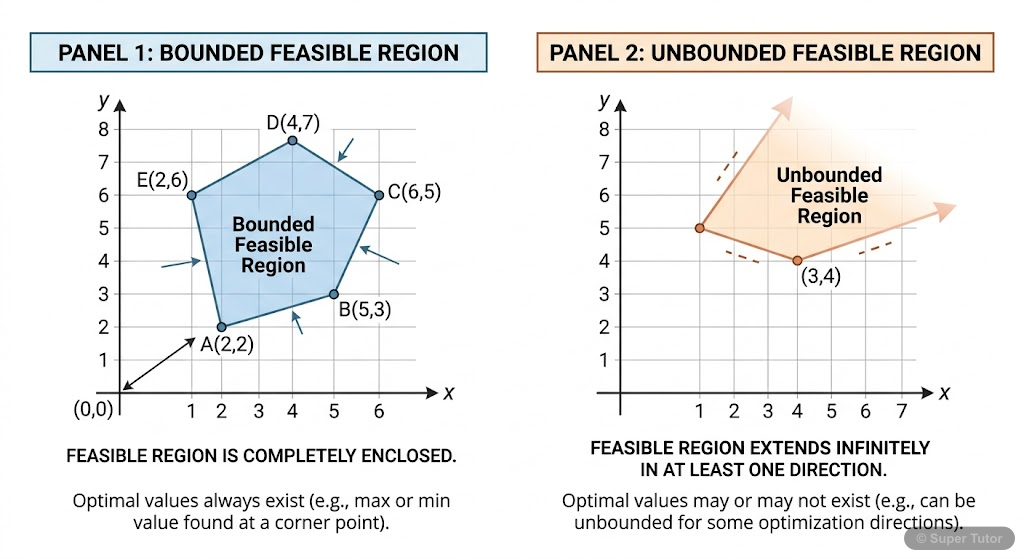
Linear Programming
Jharkhand Board · Class 12 · Mathematics
NCERT Solutions for Linear Programming — Jharkhand Board Class 12 Mathematics.
Interactive on Super Tutor
Studying Linear Programming? Get the full interactive chapter.
Quizzes, flashcards, AI doubt-solver and a step-by-step study plan — built for ncert solutions and more.
1,000+ Class 12 students started this chapter today

Learn better with visuals Super Tutor has hundreds of illustrations like this across every chapter — all free to try.
Get startedEXERCISE 12.1
1Maximise subject to the constraints: .Show solution
Constraints:
Step 1: Find the corner points of the feasible region.
The constraint meets the axes at and .
With , the feasible region is the triangle with vertices:
-
-
-
Step 2: Evaluate at each corner point.
| Corner Point | |
|---|---|
| | |
| | |
| | |
Step 3: Conclusion.
The maximum value of is at the point .
2Minimise subject to , , , .Show solution
Constraints:
Step 1: Find corner points of the feasible region.
- Line meets axes at and .
Intersection of the two lines:
Subtract from :
Intersection point: .
Corner points of the feasible region:
-
-
-
-
Step 2: Evaluate at each corner point.
| Corner Point | |
|---|---|
| | |
| | |
| | |
| | |
Step 3: Conclusion.
The minimum value of is at the point .
3Maximise subject to , , , .Show solution
Constraints:
Step 1: Find corner points of the feasible region.
- Line meets axes at and .
Intersection of the two lines:
From :
Substitute into :
Intersection point:
Corner points:
-
-
-
-
Step 2: Evaluate at each corner point.
| Corner Point | |
|---|---|
| | |
| | |
| | |
| | |
Step 3: Conclusion.
The maximum value of is at .
4Minimise such that , , .Show solution
Constraints:
Step 1: Find corner points of the feasible region.
- Line meets axes at and .
Intersection of the two lines:
Subtract from :
Intersection point:
The feasible region is unbounded (above both lines in the first quadrant). Corner points:
-
-
-
Step 2: Evaluate at each corner point.
| Corner Point | |
|---|---|
| | |
| | |
| | |
Step 3: Check for unbounded minimum.
The smallest value is at . Since the feasible region is unbounded, we check whether 3x + 5y < 7 has any point in the feasible region. The half-plane 3x + 5y < 7 has no common point with the feasible region.
Conclusion: The minimum value of is at .
5Maximise subject to , , .Show solution
Constraints:
Step 1: Find corner points of the feasible region.
- Line meets axes at and .
Intersection of the two lines:
From :
Substitute into :
Intersection point:
Corner points:
-
-
-
-
Step 2: Evaluate at each corner point.
| Corner Point | |
|---|---|
| | |
| | |
| | |
| | |
Step 3: Conclusion.
The maximum value of is at the point .
6Minimise subject to , , . Show that the minimum of occurs at more than two points.Show solution
Constraints:
Step 1: Find corner points of the feasible region.
- Line meets axes at and .
Intersection of the two lines:
From :
Substitute into :
Intersection point:
Note: Both lines meet at the same point on the -axis, . The feasible region is unbounded with corner points:
-
-
Step 2: Evaluate at each corner point.
| Corner Point | |
|---|---|
| | |
| | |
Step 3: Check for unbounded minimum.
Both corner points give . We check whether x + 2y < 6 has any point in the feasible region. The half-plane x + 2y < 6 has no common point with the feasible region.
Step 4: Conclusion — minimum at more than two points.
Since at both and , by the property of linear programming, every point on the line segment also gives .
The line segment joining and lies on , which is the same as the constraint boundary. Every point on this segment satisfies all constraints and gives .
Hence, the minimum value of is , and it occurs at infinitely many points (all points on the segment joining and ), i.e., at more than two points.
7Minimise and Maximise subject to , , , .Show solution
Constraints:
Step 1: Find corner points of the feasible region.
Key lines:
1.
2.
3. (i.e., )
Intersection of lines (2) and (3): and
Intersection of lines (1) and (3): and
Intersection of lines (1) and (2): and
But check : 0 - 120 = -120 < 0. Not feasible.
Check line (2) on -axis: at gives . Check : ✓. Check : ✓. Point .
Check line (1) on -axis: at gives . Check : ✓. Check : ✓. Point .
Corner points of feasible region:
-
-
-
-
Step 2: Evaluate at each corner point.
| Corner Point | |
|---|---|
| | |
| | |
| | |
| | |
Step 3: Conclusion.
- Minimum value of is at .
- Maximum value of is , which occurs at both and , and hence at every point on the line segment joining and .
8Minimise and Maximise subject to , , , .Show solution
Constraints:
Step 1: Find corner points of the feasible region.
Key lines:
1.
2.
3.
Intersection of (1) and (2): into :
Intersection of (2) and (3): into :
Intersection of (1) and -axis (): . Check : ? No. Not feasible.
Intersection of (3) and -axis (): . Check : ✓. Check : ✓. Point .
Intersection of (1) and -axis (): . Check : ✓. Check : ✓. Point .
Corner points of feasible region:
-
-
-
-
Step 2: Evaluate at each corner point.
| Corner Point | |
|---|---|
| | |
| | |
| | |
| | |
Step 3: Conclusion.
- Minimum value of is , occurring at both and , and hence at every point on the segment .
- Maximum value of is at .
9Maximise , subject to the constraints: , , , .Show solution
Constraints:
Step 1: Find corner points of the feasible region.
Key lines:
1.
2.
3.
Intersection of (1) and (3): into : . Point .
Intersection of (1) and (2): into : . Point .
Check: At : ✓.
At : x+y=3+3/2=9/2 < 5. Not satisfying constraint (2).
Intersection of (2) and (3): Subtract: . Point .
Check : ✓.
The feasible region is unbounded. Corner points:
-
-
- and the region extends to infinity.
Also check along upward: as , .
Step 2: Evaluate at corner points.
| Corner Point | |
|---|---|
| | |
| | |
Step 3: Conclusion.
Since the feasible region is unbounded and increases without bound as (along ), has no maximum value.
The feasible region is unbounded, so has no maximum (it can be made arbitrarily large).
10Maximise , subject to , , .Show solution
Constraints:
Step 1: Analyse the constraints.
- ... (i)
- ... (ii)
Step 2: Check for feasibility.
From (i): , which means y > x.
From (ii): .
These two conditions y > x and cannot be satisfied simultaneously for any real values of and .
Step 3: Conclusion.
There is no feasible region (the constraints are contradictory). Hence, the given linear programming problem has no feasible solution, and therefore has no maximum value.
Stuck on a step?
Ask Super Tutor AI to explain any solution on this page in a simpler way — free, 24x7.
Ask a Doubt FreeFrequently Asked Questions
What are the important topics in Linear Programming for Jharkhand Board Class 12 Mathematics?
How to score full marks in Linear Programming — Jharkhand Board Class 12 Mathematics?
Where can I get free NCERT Solutions for Linear Programming Class 12 Mathematics?
Sources & Official References
Content is aligned to the official syllabus. Refer to the board website for the latest curriculum.
More resources for Linear Programming
Important Questions
Practice with board exam-style questions
Syllabus
What topics to cover
Revision Notes
Key points for last-minute revision
Study Plan
Step-by-step plan to ace this chapter
Flashcards
Quick-fire cards for active recall
Formula Sheet
All formulas in one place
Chapter Summary
Understand the chapter at a glance
Practice Quiz
Test yourself with a quick quiz
Concept Maps
See how topics connect visually
For serious students
Get the full Linear Programming chapter — for free.
Quizzes, flashcards, AI doubt-solver and a step-by-step study plan for Jharkhand Board Class 12 Mathematics.