Chapter 1 of 13
NCERT Solutions

Relations and Functions

Jharkhand Board · Class 12 · Mathematics

NCERT Solutions for Relations and Functions — Jharkhand Board Class 12 Mathematics.

59 questions20 flashcards5 concepts

Interactive on Super Tutor

Studying Relations and Functions? Get the full interactive chapter.

Quizzes, flashcards, AI doubt-solver and a step-by-step study plan — built for ncert solutions and more.

1,000+ Class 12 students started this chapter today

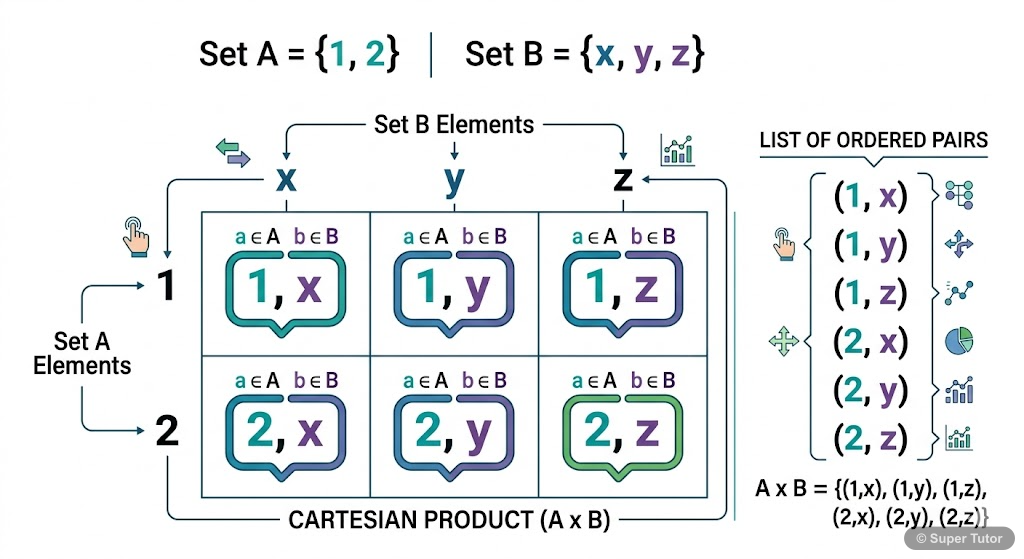
A visual representation of the Cartesian product A × B using a grid or mapping diagram, showing how ordered pairs are formed.
Super Tutor

This is just one of 8+ visuals inside Super Tutor's Relations and Functions chapter

Explore the full set
49 Questions Solved · 3 Sections

Exercise 1.1

1(i)Determine whether the relation R in the set A={1,2,3,,13,14}A = \{1, 2, 3, \dots, 13, 14\} defined as R={(x,y):3xy=0}R = \{(x, y): 3x - y = 0\} is reflexive, symmetric and transitive.Show solution
Given: A={1,2,3,,14}A = \{1, 2, 3, \dots, 14\}, R={(x,y):3xy=0}R = \{(x, y): 3x - y = 0\}, i.e., y=3xy = 3x.

Listing R: R={(1,3),(2,6),(3,9),(4,12)}R = \{(1,3),(2,6),(3,9),(4,12)\}

Reflexive: For reflexivity, (a,a)R(a,a) \in R for all aAa \in A, i.e., 3a=aa=03a = a \Rightarrow a = 0, which is not in AA. For example, (1,1)R(1,1) \notin R. Hence R is not reflexive.

Symmetric: (1,3)R(1,3) \in R but 3(3)=913(3) = 9 \neq 1, so (3,1)R(3,1) \notin R. Hence R is not symmetric.

Transitive: We need: if (x,y)R(x,y) \in R and (y,z)R(y,z) \in R, then (x,z)R(x,z) \in R. Check: (1,3)R(1,3) \in R and (3,9)R(3,9) \in R. Is (1,9)R(1,9) \in R? 3(1)=393(1) = 3 \neq 9. So (1,9)R(1,9) \notin R. Hence R is not transitive.

Conclusion: R is neither reflexive, nor symmetric, nor transitive.
1(ii)Determine whether the relation R in the set N\mathbf{N} of natural numbers defined as R = \{(x, y): y = x + 5 \text{ and } x < 4\} is reflexive, symmetric and transitive.Show solution
Given: R = \{(x,y): y = x+5,\ x < 4\}

Listing R: R={(1,6),(2,7),(3,8)}R = \{(1,6),(2,7),(3,8)\}

Reflexive: (1,1)R(1,1) \notin R since 11+51 \neq 1+5. Hence R is not reflexive.

Symmetric: (1,6)R(1,6) \in R but (6,1)R(6,1) \notin R since 6 \not< 4. Hence R is not symmetric.

Transitive: We need (x,y)R(x,y) \in R and (y,z)R(x,z)R(y,z) \in R \Rightarrow (x,z) \in R. The pairs in R have second elements 6,7,86,7,8, none of which is less than 4, so no pair (y,z)(y,z) exists in R for any (x,y)R(x,y) \in R. The condition is vacuously satisfied. Hence R is transitive.

Conclusion: R is neither reflexive nor symmetric, but it is transitive.
1(iii)Determine whether the relation R in the set A={1,2,3,4,5,6}A = \{1, 2, 3, 4, 5, 6\} defined as R={(x,y):y is divisible by x}R = \{(x, y): y \text{ is divisible by } x\} is reflexive, symmetric and transitive.Show solution
Given: R={(x,y):xy}R = \{(x,y): x \mid y\} on A={1,2,3,4,5,6}A = \{1,2,3,4,5,6\}.

Reflexive: Every element divides itself, so (a,a)R(a,a) \in R for all aAa \in A. Hence R is reflexive.

Symmetric: (1,2)R(1,2) \in R (since 2 is divisible by 1) but (2,1)R(2,1) \notin R (since 1 is not divisible by 2). Hence R is not symmetric.

Transitive: Suppose (x,y)R(x,y) \in R and (y,z)R(y,z) \in R, i.e., xyx \mid y and yzy \mid z. Then xzx \mid z, so (x,z)R(x,z) \in R. Hence R is transitive.

Conclusion: R is reflexive and transitive but not symmetric.
1(iv)Determine whether the relation R in the set Z\mathbf{Z} of all integers defined as R={(x,y):xy is an integer}R = \{(x, y): x - y \text{ is an integer}\} is reflexive, symmetric and transitive.Show solution
Given: R={(x,y):xyZ}R = \{(x,y): x - y \in \mathbf{Z}\} on Z\mathbf{Z}.

Reflexive: For any aZa \in \mathbf{Z}, aa=0Za - a = 0 \in \mathbf{Z}, so (a,a)R(a,a) \in R. Hence R is reflexive.

Symmetric: If (x,y)R(x,y) \in R, then xyZx - y \in \mathbf{Z}, so yx=(xy)Zy - x = -(x-y) \in \mathbf{Z}, giving (y,x)R(y,x) \in R. Hence R is symmetric.

Transitive: If (x,y)R(x,y) \in R and (y,z)R(y,z) \in R, then xyZx-y \in \mathbf{Z} and yzZy-z \in \mathbf{Z}. So xz=(xy)+(yz)Zx - z = (x-y)+(y-z) \in \mathbf{Z}, giving (x,z)R(x,z) \in R. Hence R is transitive.

Conclusion: R is reflexive, symmetric and transitive, hence an equivalence relation.
1(v)(a)Determine whether the relation R={(x,y):x and y work at the same place}R = \{(x,y): x \text{ and } y \text{ work at the same place}\} in the set A of human beings in a town is reflexive, symmetric and transitive.Show solution
Reflexive: Any person xx works at the same place as themselves, so (x,x)R(x,x) \in R. Hence R is reflexive.

Symmetric: If xx and yy work at the same place, then yy and xx work at the same place. So (x,y)R(y,x)R(x,y) \in R \Rightarrow (y,x) \in R. Hence R is symmetric.

Transitive: If xx and yy work at the same place, and yy and zz work at the same place, then xx and zz work at the same place. Hence R is transitive.

Conclusion: R is an equivalence relation.
1(v)(b)Determine whether the relation R={(x,y):x and y live in the same locality}R = \{(x,y): x \text{ and } y \text{ live in the same locality}\} in the set A of human beings in a town is reflexive, symmetric and transitive.Show solution
Reflexive: xx lives in the same locality as xx, so (x,x)R(x,x) \in R. Hence R is reflexive.

Symmetric: If xx and yy live in the same locality, then yy and xx live in the same locality. Hence R is symmetric.

Transitive: If x,yx,y live in the same locality and y,zy,z live in the same locality, then x,zx,z live in the same locality. Hence R is transitive.

Conclusion: R is an equivalence relation.
1(v)(c)Determine whether the relation R={(x,y):x is exactly 7 cm taller than y}R = \{(x,y): x \text{ is exactly 7 cm taller than } y\} in the set A of human beings in a town is reflexive, symmetric and transitive.Show solution
Reflexive: xx cannot be 7 cm taller than itself, so (x,x)R(x,x) \notin R. Hence R is not reflexive.

Symmetric: If xx is exactly 7 cm taller than yy, then yy is 7 cm shorter than xx, not taller. So (x,y)R⇏(y,x)R(x,y) \in R \not\Rightarrow (y,x) \in R. Hence R is not symmetric.

Transitive: If xx is 7 cm taller than yy, and yy is 7 cm taller than zz, then xx is 14 cm taller than zz, not 7 cm. So (x,y)R(x,y) \in R and (y,z)R⇏(x,z)R(y,z) \in R \not\Rightarrow (x,z) \in R. Hence R is not transitive.

Conclusion: R is neither reflexive, nor symmetric, nor transitive.
1(v)(d)Determine whether the relation R={(x,y):x is wife of y}R = \{(x,y): x \text{ is wife of } y\} in the set A of human beings in a town is reflexive, symmetric and transitive.Show solution
Reflexive: xx cannot be the wife of herself/himself, so (x,x)R(x,x) \notin R. Hence R is not reflexive.

Symmetric: If xx is the wife of yy, then yy is the husband of xx, not the wife. So (x,y)R⇏(y,x)R(x,y) \in R \not\Rightarrow (y,x) \in R. Hence R is not symmetric.

Transitive: If xx is the wife of yy, then yy is male, so yy cannot be the wife of anyone. The condition (x,y)R(x,y) \in R and (y,z)R(y,z) \in R never holds. Hence the condition is vacuously true, so R is transitive.

Conclusion: R is transitive but neither reflexive nor symmetric.
1(v)(e)Determine whether the relation R={(x,y):x is father of y}R = \{(x,y): x \text{ is father of } y\} in the set A of human beings in a town is reflexive, symmetric and transitive.Show solution
Reflexive: xx cannot be the father of himself, so (x,x)R(x,x) \notin R. Hence R is not reflexive.

Symmetric: If xx is the father of yy, then yy is the child of xx, not the father. So (x,y)R⇏(y,x)R(x,y) \in R \not\Rightarrow (y,x) \in R. Hence R is not symmetric.

Transitive: If xx is the father of yy, and yy is the father of zz, then xx is the grandfather of zz, not the father. So (x,y)R(x,y) \in R and (y,z)R⇏(x,z)R(y,z) \in R \not\Rightarrow (x,z) \in R. Hence R is not transitive.

Conclusion: R is neither reflexive, nor symmetric, nor transitive.
2Show that the relation R in the set R\mathbf{R} of real numbers, defined as R={(a,b):ab2}R = \{(a, b): a \leq b^2\} is neither reflexive nor symmetric nor transitive.Show solution
Not Reflexive: Take a=12a = \dfrac{1}{2}. Then aa2a \leq a^2 requires 1214\dfrac{1}{2} \leq \dfrac{1}{4}, which is false. So (12,12)R\left(\dfrac{1}{2}, \dfrac{1}{2}\right) \notin R. Hence R is not reflexive.

Not Symmetric: Take a=1,b=2a = 1, b = 2. Then 141 \leq 4 is true, so (1,2)R(1,2) \in R. But 212=12 \leq 1^2 = 1 is false, so (2,1)R(2,1) \notin R. Hence R is not symmetric.

Not Transitive: Take a=2,b=2,c=12a = 2, b = -2, c = -\dfrac{1}{2}.
- (2,2)R(2,-2) \in R? 2(2)2=42 \leq (-2)^2 = 4. Yes.
- (2,12)R(-2, -\frac{1}{2}) \in R? 2(12)2=14-2 \leq \left(-\frac{1}{2}\right)^2 = \frac{1}{4}. Yes.
- (2,12)R(2, -\frac{1}{2}) \in R? 2142 \leq \frac{1}{4}. No.

So (2,2)R(2,-2) \in R and (2,12)R(-2,-\frac{1}{2}) \in R but (2,12)R(2,-\frac{1}{2}) \notin R. Hence R is not transitive.

Conclusion: R is neither reflexive, nor symmetric, nor transitive.
3Check whether the relation R defined in the set {1,2,3,4,5,6}\{1, 2, 3, 4, 5, 6\} as R={(a,b):b=a+1}R = \{(a, b): b = a + 1\} is reflexive, symmetric or transitive.Show solution
Given: A={1,2,3,4,5,6}A = \{1,2,3,4,5,6\}, R={(a,b):b=a+1}R = \{(a,b): b = a+1\}.

Listing R: R={(1,2),(2,3),(3,4),(4,5),(5,6)}R = \{(1,2),(2,3),(3,4),(4,5),(5,6)\}

Reflexive: (1,1)R(1,1) \notin R since 11+11 \neq 1+1. Hence R is not reflexive.

Symmetric: (1,2)R(1,2) \in R but (2,1)R(2,1) \notin R since 12+11 \neq 2+1. Hence R is not symmetric.

Transitive: (1,2)R(1,2) \in R and (2,3)R(2,3) \in R, but (1,3)R(1,3) \notin R since 31+13 \neq 1+1. Hence R is not transitive.

Conclusion: R is neither reflexive, nor symmetric, nor transitive.
4Show that the relation R in R\mathbf{R} defined as R={(a,b):ab}R = \{(a, b): a \leq b\}, is reflexive and transitive but not symmetric.Show solution
Reflexive: For any aRa \in \mathbf{R}, aaa \leq a is always true. So (a,a)R(a,a) \in R for all aa. Hence R is reflexive.

Not Symmetric: Take a=1,b=2a = 1, b = 2. Then 121 \leq 2, so (1,2)R(1,2) \in R. But 212 \leq 1 is false, so (2,1)R(2,1) \notin R. Hence R is not symmetric.

Transitive: Let (a,b)R(a,b) \in R and (b,c)R(b,c) \in R, i.e., aba \leq b and bcb \leq c. Then aca \leq c, so (a,c)R(a,c) \in R. Hence R is transitive.

Conclusion: R is reflexive and transitive but not symmetric.
5Check whether the relation R in R\mathbf{R} defined by R={(a,b):ab3}R = \{(a, b): a \leq b^3\} is reflexive, symmetric or transitive.Show solution
Not Reflexive: Take a=12a = \dfrac{1}{2}. Then aa3a \leq a^3 requires 1218\dfrac{1}{2} \leq \dfrac{1}{8}, which is false. So (12,12)R\left(\dfrac{1}{2},\dfrac{1}{2}\right) \notin R. Hence R is not reflexive.

Not Symmetric: Take a=1,b=2a = 1, b = 2. Then 181 \leq 8, so (1,2)R(1,2) \in R. But 213=12 \leq 1^3 = 1 is false, so (2,1)R(2,1) \notin R. Hence R is not symmetric.

Not Transitive: Take a=3,b=32,c=65a = 3, b = \dfrac{3}{2}, c = \dfrac{6}{5}.
- (3,32)R(3, \frac{3}{2}) \in R? 3(32)3=278=3.3753 \leq \left(\frac{3}{2}\right)^3 = \frac{27}{8} = 3.375. Yes.
- (32,65)R(\frac{3}{2}, \frac{6}{5}) \in R? 32(65)3=216125=1.728\frac{3}{2} \leq \left(\frac{6}{5}\right)^3 = \frac{216}{125} = 1.728. Yes.
- (3,65)R(3, \frac{6}{5}) \in R? 3(65)3=1.7283 \leq \left(\frac{6}{5}\right)^3 = 1.728. No.

Hence R is not transitive.

Conclusion: R is neither reflexive, nor symmetric, nor transitive.
6Show that the relation R in the set {1,2,3}\{1, 2, 3\} given by R={(1,2),(2,1)}R = \{(1, 2), (2, 1)\} is symmetric but neither reflexive nor transitive.Show solution
Given: A={1,2,3}A = \{1,2,3\}, R={(1,2),(2,1)}R = \{(1,2),(2,1)\}.

Not Reflexive: (1,1)R(1,1) \notin R. Hence R is not reflexive.

Symmetric: (1,2)R(2,1)R(1,2) \in R \Rightarrow (2,1) \in R, and (2,1)R(1,2)R(2,1) \in R \Rightarrow (1,2) \in R. Hence R is symmetric.

Not Transitive: (1,2)R(1,2) \in R and (2,1)R(2,1) \in R, but (1,1)R(1,1) \notin R. Hence R is not transitive.

Conclusion: R is symmetric but neither reflexive nor transitive.
7Show that the relation R in the set A of all the books in a library of a college, given by R={(x,y):x and y have same number of pages}R = \{(x, y) : x \text{ and } y \text{ have same number of pages}\} is an equivalence relation.Show solution
Reflexive: Any book xx has the same number of pages as itself. So (x,x)R(x,x) \in R for all xAx \in A. Hence R is reflexive.

Symmetric: If xx and yy have the same number of pages, then yy and xx have the same number of pages. So (x,y)R(y,x)R(x,y) \in R \Rightarrow (y,x) \in R. Hence R is symmetric.

Transitive: If xx and yy have the same number of pages, and yy and zz have the same number of pages, then xx and zz have the same number of pages. So (x,y)R(x,y) \in R and (y,z)R(x,z)R(y,z) \in R \Rightarrow (x,z) \in R. Hence R is transitive.

Conclusion: Since R is reflexive, symmetric and transitive, R is an equivalence relation.
8Show that the relation R in the set A={1,2,3,4,5}A = \{1, 2, 3, 4, 5\} given by R={(a,b):ab is even}R = \{(a, b) : |a - b| \text{ is even}\}, is an equivalence relation. Show that all the elements of {1,3,5}\{1, 3, 5\} are related to each other and all the elements of {2,4}\{2, 4\} are related to each other. But no element of {1,3,5}\{1, 3, 5\} is related to any element of {2,4}\{2, 4\}.Show solution
Reflexive: For any aAa \in A, aa=0|a - a| = 0, which is even. So (a,a)R(a,a) \in R. Hence R is reflexive.

Symmetric: If (a,b)R(a,b) \in R, then ab|a-b| is even. Since ab=ba|a-b| = |b-a|, ba|b-a| is also even, so (b,a)R(b,a) \in R. Hence R is symmetric.

Transitive: If (a,b)R(a,b) \in R and (b,c)R(b,c) \in R, then ab|a-b| and bc|b-c| are both even, meaning aba-b and bcb-c are both even. Then ac=(ab)+(bc)a - c = (a-b)+(b-c) is even, so ac|a-c| is even, giving (a,c)R(a,c) \in R. Hence R is transitive.

Therefore, R is an equivalence relation.

Elements of {1,3,5}\{1,3,5\}: 13=2|1-3|=2 (even), 15=4|1-5|=4 (even), 35=2|3-5|=2 (even). So all elements of {1,3,5}\{1,3,5\} are related to each other.

Elements of {2,4}\{2,4\}: 24=2|2-4|=2 (even). So 2 and 4 are related to each other.

Cross-check: For a{1,3,5}a \in \{1,3,5\} and b{2,4}b \in \{2,4\}: 12=1,14=3,32=1,34=1,52=3,54=1|1-2|=1, |1-4|=3, |3-2|=1, |3-4|=1, |5-2|=3, |5-4|=1 — all odd. So no element of {1,3,5}\{1,3,5\} is related to any element of {2,4}\{2,4\}.
9(i)Show that the relation R={(a,b):ab is a multiple of 4}R = \{(a, b) : |a - b| \text{ is a multiple of } 4\} in the set A={xZ:0x12}A = \{x \in \mathbf{Z} : 0 \leq x \leq 12\} is an equivalence relation. Find the set of all elements related to 1.Show solution
Given: A={0,1,2,3,4,5,6,7,8,9,10,11,12}A = \{0,1,2,3,4,5,6,7,8,9,10,11,12\}, R={(a,b):4ab}R = \{(a,b): 4 \mid |a-b|\}.

Reflexive: For any aAa \in A, aa=0=4×0|a-a| = 0 = 4 \times 0, a multiple of 4. So (a,a)R(a,a) \in R. Hence R is reflexive.

Symmetric: If (a,b)R(a,b) \in R, then 4ab4 \mid |a-b|. Since ab=ba|a-b| = |b-a|, we have 4ba4 \mid |b-a|, so (b,a)R(b,a) \in R. Hence R is symmetric.

Transitive: If (a,b)R(a,b) \in R and (b,c)R(b,c) \in R, then 4(ab)4 \mid (a-b) and 4(bc)4 \mid (b-c). So 4[(ab)+(bc)]=(ac)4 \mid [(a-b)+(b-c)] = (a-c), giving 4ac4 \mid |a-c|, so (a,c)R(a,c) \in R. Hence R is transitive.

Therefore, R is an equivalence relation.

Set of elements related to 1: We need a1|a - 1| to be a multiple of 4, i.e., a1{0,±4,±8,±12,}a - 1 \in \{0, \pm4, \pm8, \pm12,\ldots\}, so a{1,5,9}a \in \{1, 5, 9\} (within AA).

Required set={1,5,9}\text{Required set} = \{1, 5, 9\}
9(ii)Show that the relation R={(a,b):a=b}R = \{(a, b) : a = b\} in the set A={xZ:0x12}A = \{x \in \mathbf{Z} : 0 \leq x \leq 12\} is an equivalence relation. Find the set of all elements related to 1.Show solution
Given: R={(a,b):a=b}R = \{(a,b): a = b\} on A={0,1,2,,12}A = \{0,1,2,\ldots,12\}.

Reflexive: For any aAa \in A, a=aa = a, so (a,a)R(a,a) \in R. Hence R is reflexive.

Symmetric: If (a,b)R(a,b) \in R, then a=ba = b, so b=ab = a, giving (b,a)R(b,a) \in R. Hence R is symmetric.

Transitive: If (a,b)R(a,b) \in R and (b,c)R(b,c) \in R, then a=ba = b and b=cb = c, so a=ca = c, giving (a,c)R(a,c) \in R. Hence R is transitive.

Therefore, R is an equivalence relation.

Set of elements related to 1: We need a=1a = 1. So the only element related to 1 is 1 itself.

Required set={1}\text{Required set} = \{1\}
10Give an example of a relation which is (i) Symmetric but neither reflexive nor transitive. (ii) Transitive but neither reflexive nor symmetric. (iii) Reflexive and symmetric but not transitive. (iv) Reflexive and transitive but not symmetric. (v) Symmetric and transitive but not reflexive.Show solution
(i) Symmetric but neither reflexive nor transitive:

Let A={1,2,3}A = \{1,2,3\} and R={(1,2),(2,1)}R = \{(1,2),(2,1)\}.
- Not reflexive: (1,1)R(1,1) \notin R.
- Symmetric: (1,2)R(2,1)R(1,2) \in R \Rightarrow (2,1) \in R. ✓
- Not transitive: (1,2)R(1,2) \in R and (2,1)R(2,1) \in R but (1,1)R(1,1) \notin R.

(ii) Transitive but neither reflexive nor symmetric:

Let A={1,2,3}A = \{1,2,3\} and R={(1,2),(2,3),(1,3)}R = \{(1,2),(2,3),(1,3)\}.
- Not reflexive: (1,1)R(1,1) \notin R.
- Not symmetric: (1,2)R(1,2) \in R but (2,1)R(2,1) \notin R.
- Transitive: (1,2)R,(2,3)R(1,3)R(1,2) \in R, (2,3) \in R \Rightarrow (1,3) \in R. ✓

(iii) Reflexive and symmetric but not transitive:

Let A={1,2,3}A = \{1,2,3\} and R={(1,1),(2,2),(3,3),(1,2),(2,1),(2,3),(3,2)}R = \{(1,1),(2,2),(3,3),(1,2),(2,1),(2,3),(3,2)\}.
- Reflexive: (1,1),(2,2),(3,3)R(1,1),(2,2),(3,3) \in R. ✓
- Symmetric: For every (a,b)R(a,b) \in R, (b,a)R(b,a) \in R. ✓
- Not transitive: (1,2)R(1,2) \in R and (2,3)R(2,3) \in R but (1,3)R(1,3) \notin R.

(iv) Reflexive and transitive but not symmetric:

Let R={(a,b):ab}R = \{(a,b): a \leq b\} on R\mathbf{R}.
- Reflexive: aaa \leq a. ✓
- Transitive: aba \leq b and bcacb \leq c \Rightarrow a \leq c. ✓
- Not symmetric: 121 \leq 2 but 2≰12 \not\leq 1.

(v) Symmetric and transitive but not reflexive:

Let A={1,2,3}A = \{1,2,3\} and R={(1,2),(2,1),(1,1),(2,2)}R = \{(1,2),(2,1),(1,1),(2,2)\}.
- Not reflexive: (3,3)R(3,3) \notin R.
- Symmetric: (1,2)R(2,1)R(1,2) \in R \Rightarrow (2,1) \in R. ✓
- Transitive: (1,2)R,(2,1)R(1,1)R(1,2) \in R,(2,1) \in R \Rightarrow (1,1) \in R ✓; (2,1)R,(1,2)R(2,2)R(2,1) \in R,(1,2) \in R \Rightarrow (2,2) \in R ✓.
11Show that the relation R={(P,Q):distance of point P from origin=distance of point Q from origin}R = \{(P, Q) : \text{distance of point } P \text{ from origin} = \text{distance of point } Q \text{ from origin}\} in the set A of points in a plane is an equivalence relation. Further, show that the set of all points related to a point P(0,0)P \neq (0,0) is the circle passing through P with origin as centre.Show solution
Let OO denote the origin. For any point PP in the plane, let d(P)d(P) denote the distance of PP from OO.

Reflexive: d(P)=d(P)d(P) = d(P) for any point PP, so (P,P)R(P,P) \in R. Hence R is reflexive.

Symmetric: If (P,Q)R(P,Q) \in R, then d(P)=d(Q)d(P) = d(Q), so d(Q)=d(P)d(Q) = d(P), giving (Q,P)R(Q,P) \in R. Hence R is symmetric.

Transitive: If (P,Q)R(P,Q) \in R and (Q,S)R(Q,S) \in R, then d(P)=d(Q)d(P) = d(Q) and d(Q)=d(S)d(Q) = d(S), so d(P)=d(S)d(P) = d(S), giving (P,S)R(P,S) \in R. Hence R is transitive.

Therefore, R is an equivalence relation.

Set of all points related to P(0,0)P \neq (0,0): The set of all points QQ such that (P,Q)R(P,Q) \in R is {Q:d(Q)=d(P)}\{Q : d(Q) = d(P)\}, i.e., all points at distance d(P)d(P) from the origin. This is precisely the circle with centre at the origin and radius d(P)d(P), which passes through PP.
12Show that the relation R={(T1,T2):T1 is similar to T2}R = \{(T_1, T_2) : T_1 \text{ is similar to } T_2\} defined in the set A of all triangles is an equivalence relation. Consider right angle triangles T1T_1 (sides 3,4,5), T2T_2 (sides 5,12,13) and T3T_3 (sides 6,8,10). Which triangles among T1T_1, T2T_2 and T3T_3 are related?Show solution
Reflexive: Every triangle is similar to itself. So (T,T)R(T,T) \in R for all TAT \in A. Hence R is reflexive.

Symmetric: If T1T_1 is similar to T2T_2, then T2T_2 is similar to T1T_1. So (T1,T2)R(T2,T1)R(T_1,T_2) \in R \Rightarrow (T_2,T_1) \in R. Hence R is symmetric.

Transitive: If T1T_1 is similar to T2T_2 and T2T_2 is similar to T3T_3, then T1T_1 is similar to T3T_3. Hence R is transitive.

Therefore, R is an equivalence relation.

Which triangles are related?

Check if T1T_1 (sides 3,4,5) and T3T_3 (sides 6,8,10) are similar:
36=48=510=12\frac{3}{6} = \frac{4}{8} = \frac{5}{10} = \frac{1}{2}
The ratios of corresponding sides are equal, so T1T3T_1 \sim T_3. Hence (T1,T3)R(T_1, T_3) \in R.

Check T1T_1 and T2T_2 (sides 5,12,13): 35412\dfrac{3}{5} \neq \dfrac{4}{12}, so T1T_1 and T2T_2 are not similar.

Check T2T_2 and T3T_3: 56128\dfrac{5}{6} \neq \dfrac{12}{8}, so T2T_2 and T3T_3 are not similar.

Conclusion: T1T_1 and T3T_3 are related to each other.
13Show that the relation R={(P1,P2):P1 and P2 have same number of sides}R = \{(P_1, P_2) : P_1 \text{ and } P_2 \text{ have same number of sides}\} defined in the set A of all polygons is an equivalence relation. What is the set of all elements in A related to the right angle triangle T with sides 3, 4 and 5?Show solution
Reflexive: Any polygon PP has the same number of sides as itself. So (P,P)R(P,P) \in R. Hence R is reflexive.

Symmetric: If P1P_1 and P2P_2 have the same number of sides, then P2P_2 and P1P_1 have the same number of sides. So (P1,P2)R(P2,P1)R(P_1,P_2) \in R \Rightarrow (P_2,P_1) \in R. Hence R is symmetric.

Transitive: If P1P_1 and P2P_2 have the same number of sides, and P2P_2 and P3P_3 have the same number of sides, then P1P_1 and P3P_3 have the same number of sides. Hence R is transitive.

Therefore, R is an equivalence relation.

Set of elements related to triangle T: The triangle T has 3 sides. The set of all elements related to T is the set of all polygons having 3 sides, i.e., the set of all triangles in A.
14Let L be the set of all lines in XY plane and R be the relation in L defined as R={(L1,L2):L1 is parallel to L2}R = \{(L_1, L_2) : L_1 \text{ is parallel to } L_2\}. Show that R is an equivalence relation. Find the set of all lines related to the line y=2x+4y = 2x + 4.Show solution
Reflexive: Every line is parallel to itself (a line is considered parallel to itself). So (L,L)R(L,L) \in R for all LL \in L. Hence R is reflexive.

Symmetric: If L1L2L_1 \parallel L_2, then L2L1L_2 \parallel L_1. So (L1,L2)R(L2,L1)R(L_1,L_2) \in R \Rightarrow (L_2,L_1) \in R. Hence R is symmetric.

Transitive: If L1L2L_1 \parallel L_2 and L2L3L_2 \parallel L_3, then L1L3L_1 \parallel L_3. Hence R is transitive.

Therefore, R is an equivalence relation.

Set of lines related to y=2x+4y = 2x + 4: The given line has slope 2. All lines parallel to it also have slope 2 and are of the form y=2x+cy = 2x + c, where cRc \in \mathbf{R}.

Required set={y=2x+c:cR}\text{Required set} = \{y = 2x + c : c \in \mathbf{R}\}
15Let RR be the relation in the set {1,2,3,4}\{1, 2, 3, 4\} given by R={(1,2),(2,2),(1,1),(4,4),(1,3),(3,3),(3,2)}R = \{(1, 2), (2, 2), (1, 1), (4, 4), (1, 3), (3, 3), (3, 2)\}. Choose the correct answer.Show solution
Correct Answer: (B) R is reflexive and transitive but not symmetric.

Reflexive: (1,1),(2,2),(3,3),(4,4)R(1,1),(2,2),(3,3),(4,4) \in R. ✓ R is reflexive.

Not Symmetric: (1,2)R(1,2) \in R but (2,1)R(2,1) \notin R. So R is not symmetric.

Transitive: Check all pairs:
- (1,2)R,(2,2)R(1,2)R(1,2) \in R, (2,2) \in R \Rightarrow (1,2) \in R
- (1,3)R,(3,2)R(1,2)R(1,3) \in R, (3,2) \in R \Rightarrow (1,2) \in R
- (1,3)R,(3,3)R(1,3)R(1,3) \in R, (3,3) \in R \Rightarrow (1,3) \in R
- (3,2)R,(2,2)R(3,2)R(3,2) \in R, (2,2) \in R \Rightarrow (3,2) \in R

All required pairs are present. R is transitive.

Hence option (B) is correct.
16Let RR be the relation in the set NN given by R = \{(a, b) : a = b - 2, b > 6\}. Choose the correct answer.Show solution
Correct Answer: (C) (6,8)R(6,8) \in R.

Verification of each option:

For (a,b)R(a,b) \in R: we need a=b2a = b-2 and b > 6.

(A) (2,4)(2,4): b=4b = 4, but 4 \not> 6. ✗

(B) (3,8)(3,8): a=3a = 3, b2=63b-2 = 6 \neq 3. ✗

(C) (6,8)(6,8): a=6a = 6, b2=82=6b-2 = 8-2 = 6 ✓, and b = 8 > 6 ✓. So (6,8)R(6,8) \in R. ✓

(D) (8,7)(8,7): b = 7 > 6 ✓, but b2=58b-2 = 5 \neq 8. ✗

Hence option (C) is correct.

Exercise 1.2

1Show that the function f:RRf : \mathbf{R}_* \to \mathbf{R}_* defined by f(x)=1xf(x) = \frac{1}{x} is one-one and onto, where R\mathbf{R}_* is the set of all non-zero real numbers. Is the result true, if the domain R\mathbf{R}_* is replaced by N\mathbf{N} with co-domain being same as R\mathbf{R}_*?Show solution
**Part 1: f:RRf: \mathbf{R}_* \to \mathbf{R}_*, f(x)=1xf(x) = \dfrac{1}{x}

One-one (Injective): Let f(x1)=f(x2)f(x_1) = f(x_2).
1x1=1x2x1=x2\frac{1}{x_1} = \frac{1}{x_2} \Rightarrow x_1 = x_2
So ff is one-one.

Onto (Surjective):** For any yRy \in \mathbf{R}_*, we need xRx \in \mathbf{R}_* such that f(x)=yf(x) = y, i.e., 1x=yx=1y\dfrac{1}{x} = y \Rightarrow x = \dfrac{1}{y}. Since y0y \neq 0, x=1yRx = \dfrac{1}{y} \in \mathbf{R}_* and f(1y)=yf\left(\dfrac{1}{y}\right) = y. So ff is onto.

Hence ff is bijective.

**Part 2: f:NRf: \mathbf{N} \to \mathbf{R}_*, f(x)=1xf(x) = \dfrac{1}{x}

One-one: f(x1)=f(x2)x1=x2f(x_1) = f(x_2) \Rightarrow x_1 = x_2. So ff is still one-one.

Onto:** Consider y=12Ry = \dfrac{1}{2} \in \mathbf{R}_*. We need xNx \in \mathbf{N} such that 1x=12\dfrac{1}{x} = \dfrac{1}{2}, giving x=2Nx = 2 \in \mathbf{N}. But consider y=12.5=0.4Ry = \dfrac{1}{2.5} = 0.4 \in \mathbf{R}_*; we need x=2.5Nx = 2.5 \notin \mathbf{N}. So ff is not onto.

Conclusion: The result is not true when the domain is replaced by N\mathbf{N}; ff is one-one but not onto.
2(i)Check the injectivity and surjectivity of f:NNf: \mathbf{N} \to \mathbf{N} given by f(x)=x2f(x) = x^2.Show solution
Injective: Let f(x1)=f(x2)f(x_1) = f(x_2), i.e., x12=x22x_1^2 = x_2^2. Since x1,x2Nx_1, x_2 \in \mathbf{N}, both are positive, so x1=x2x_1 = x_2. Hence ff is injective.

Surjective: Consider y=2Ny = 2 \in \mathbf{N}. We need xNx \in \mathbf{N} such that x2=2x^2 = 2, i.e., x=2Nx = \sqrt{2} \notin \mathbf{N}. So ff is not surjective.

Conclusion: ff is injective but not surjective.
2(ii)Check the injectivity and surjectivity of f:ZZf: \mathbf{Z} \to \mathbf{Z} given by f(x)=x2f(x) = x^2.Show solution
Injective: f(1)=1=f(1)f(-1) = 1 = f(1), but 11-1 \neq 1. So ff is not injective.

Surjective: Consider y=1Zy = -1 \in \mathbf{Z}. We need x2=1x^2 = -1, which has no real solution. So ff is not surjective.

Conclusion: ff is neither injective nor surjective.
2(iii)Check the injectivity and surjectivity of f:RRf: \mathbf{R} \to \mathbf{R} given by f(x)=x2f(x) = x^2.Show solution
Injective: f(1)=1=f(1)f(-1) = 1 = f(1), but 11-1 \neq 1. So ff is not injective.

Surjective: Consider y=1Ry = -1 \in \mathbf{R}. We need x2=1x^2 = -1, which has no real solution. So ff is not surjective.

Conclusion: ff is neither injective nor surjective.
2(iv)Check the injectivity and surjectivity of f:NNf: \mathbf{N} \to \mathbf{N} given by f(x)=x3f(x) = x^3.Show solution
Injective: Let f(x1)=f(x2)f(x_1) = f(x_2), i.e., x13=x23x_1^3 = x_2^3. This gives x1=x2x_1 = x_2. So ff is injective.

Surjective: Consider y=2Ny = 2 \in \mathbf{N}. We need x3=2x^3 = 2, i.e., x=21/3Nx = 2^{1/3} \notin \mathbf{N}. So ff is not surjective.

Conclusion: ff is injective but not surjective.
2(v)Check the injectivity and surjectivity of f:ZZf: \mathbf{Z} \to \mathbf{Z} given by f(x)=x3f(x) = x^3.Show solution
Injective: Let f(x1)=f(x2)f(x_1) = f(x_2), i.e., x13=x23x_1^3 = x_2^3. This gives x1=x2x_1 = x_2 (cube function is strictly monotone on Z\mathbf{Z}). So ff is injective.

Surjective: Consider y=2Zy = 2 \in \mathbf{Z}. We need x3=2x^3 = 2, i.e., x=21/3Zx = 2^{1/3} \notin \mathbf{Z}. So ff is not surjective.

Conclusion: ff is injective but not surjective.
3Prove that the Greatest Integer Function f:RRf: \mathbf{R} \to \mathbf{R}, given by f(x)=[x]f(x) = [x], is neither one-one nor onto.Show solution
Not one-one: f(1.2)=[1.2]=1f(1.2) = [1.2] = 1 and f(1.5)=[1.5]=1f(1.5) = [1.5] = 1, but 1.21.51.2 \neq 1.5. So ff is not one-one.

Not onto: Consider y=1.5Ry = 1.5 \in \mathbf{R}. We need xRx \in \mathbf{R} such that [x]=1.5[x] = 1.5. But [x][x] is always an integer for any xRx \in \mathbf{R}, so [x]=1.5[x] = 1.5 has no solution. Hence ff is not onto.

Conclusion: The greatest integer function is neither one-one nor onto.
4Show that the Modulus Function f:RRf: \mathbf{R} \to \mathbf{R}, given by f(x)=xf(x) = |x|, is neither one-one nor onto.Show solution
Not one-one: f(1)=1=1f(-1) = |-1| = 1 and f(1)=1=1f(1) = |1| = 1, but 11-1 \neq 1. So ff is not one-one.

Not onto: Consider y=1Ry = -1 \in \mathbf{R}. We need x=1|x| = -1, but x0|x| \geq 0 for all xRx \in \mathbf{R}, so no such xx exists. Hence ff is not onto.

Conclusion: The modulus function is neither one-one nor onto.
5Show that the Signum Function f:RRf: \mathbf{R} \to \mathbf{R}, given by f(x)={1,amp;xgt;00,amp;x=01,amp;xlt;0f(x) = \begin{cases} 1, & x > 0 \\ 0, & x = 0 \\ -1, & x < 0 \end{cases} is neither one-one nor onto.Show solution
Not one-one: f(1)=1f(1) = 1 and f(2)=1f(2) = 1, but 121 \neq 2. So ff is not one-one.

Not onto: The range of ff is {1,0,1}\{-1, 0, 1\}, which is a proper subset of R\mathbf{R}. For example, y=2Ry = 2 \in \mathbf{R} has no pre-image. Hence ff is not onto.

Conclusion: The signum function is neither one-one nor onto.
6Let A={1,2,3}A = \{1, 2, 3\}, B={4,5,6,7}B = \{4, 5, 6, 7\} and let f={(1,4),(2,5),(3,6)}f = \{(1, 4), (2, 5), (3, 6)\} be a function from AA to BB. Show that ff is one-one.Show solution
Given: f(1)=4, f(2)=5, f(3)=6f(1) = 4,\ f(2) = 5,\ f(3) = 6.

The images of distinct elements of AA under ff are:
- f(1)=4f(1) = 4
- f(2)=5f(2) = 5
- f(3)=6f(3) = 6

All images are distinct: 4564 \neq 5 \neq 6.

Since different elements of AA map to different elements of BB, ff is one-one.
7(i)State whether the function f:RRf: \mathbf{R} \to \mathbf{R} defined by f(x)=34xf(x) = 3 - 4x is one-one, onto or bijective.Show solution
One-one: Let f(x1)=f(x2)f(x_1) = f(x_2).
34x1=34x24x1=4x2x1=x23 - 4x_1 = 3 - 4x_2 \Rightarrow -4x_1 = -4x_2 \Rightarrow x_1 = x_2
So ff is one-one.

Onto: For any yRy \in \mathbf{R}, we need xRx \in \mathbf{R} such that 34x=y3 - 4x = y, i.e., x=3y4Rx = \dfrac{3-y}{4} \in \mathbf{R}. So every yRy \in \mathbf{R} has a pre-image. Hence ff is onto.

Conclusion: ff is bijective (one-one and onto).
7(ii)State whether the function f:RRf: \mathbf{R} \to \mathbf{R} defined by f(x)=1+x2f(x) = 1 + x^2 is one-one, onto or bijective.Show solution
Not one-one: f(1)=1+1=2f(-1) = 1 + 1 = 2 and f(1)=1+1=2f(1) = 1 + 1 = 2, but 11-1 \neq 1. So ff is not one-one.

Not onto: For any xRx \in \mathbf{R}, f(x)=1+x21f(x) = 1 + x^2 \geq 1. So y=0Ry = 0 \in \mathbf{R} has no pre-image. Hence ff is not onto.

Conclusion: ff is neither one-one nor onto, hence not bijective.
8Let AA and BB be sets. Show that f:A×BB×Af: A \times B \to B \times A such that f(a,b)=(b,a)f(a, b) = (b, a) is bijective.Show solution
One-one: Let f(a1,b1)=f(a2,b2)f(a_1, b_1) = f(a_2, b_2).
(b1,a1)=(b2,a2)b1=b2 and a1=a2(a1,b1)=(a2,b2)(b_1, a_1) = (b_2, a_2) \Rightarrow b_1 = b_2 \text{ and } a_1 = a_2 \Rightarrow (a_1, b_1) = (a_2, b_2)
So ff is one-one.

Onto: For any (b,a)B×A(b, a) \in B \times A, we have (a,b)A×B(a, b) \in A \times B and f(a,b)=(b,a)f(a, b) = (b, a). So every element of B×AB \times A has a pre-image in A×BA \times B. Hence ff is onto.

Conclusion: ff is bijective.
9Let f:NNf: \mathbf{N} \to \mathbf{N} be defined by f(n)={n+12,amp;if n is oddn2,amp;if n is evenf(n) = \begin{cases} \frac{n+1}{2}, & \text{if } n \text{ is odd} \\ \frac{n}{2}, & \text{if } n \text{ is even} \end{cases}. State whether ff is bijective. Justify your answer.Show solution
Check one-one: Consider f(1)=1+12=1f(1) = \dfrac{1+1}{2} = 1 and f(2)=22=1f(2) = \dfrac{2}{2} = 1. So f(1)=f(2)=1f(1) = f(2) = 1 but 121 \neq 2. Hence ff is not one-one.

Check onto: For any nNn \in \mathbf{N}:
- nn is the image of 2n12n-1 (odd): f(2n1)=(2n1)+12=nf(2n-1) = \dfrac{(2n-1)+1}{2} = n.
So every natural number has a pre-image. Hence ff is onto.

Conclusion: ff is onto but not one-one, so ff is not bijective.
10Let A=R{3}A = \mathbf{R} - \{3\} and B=R{1}B = \mathbf{R} - \{1\}. Consider the function f:ABf: A \to B defined by f(x)=x2x3f(x) = \dfrac{x-2}{x-3}. Is ff one-one and onto?Show solution
One-one: Let f(x1)=f(x2)f(x_1) = f(x_2).
x12x13=x22x23\frac{x_1 - 2}{x_1 - 3} = \frac{x_2 - 2}{x_2 - 3}
(x12)(x23)=(x22)(x13)(x_1 - 2)(x_2 - 3) = (x_2 - 2)(x_1 - 3)
x1x23x12x2+6=x1x23x22x1+6x_1 x_2 - 3x_1 - 2x_2 + 6 = x_1 x_2 - 3x_2 - 2x_1 + 6
3x12x2=3x22x1-3x_1 - 2x_2 = -3x_2 - 2x_1
x1=x2x1=x2-x_1 = -x_2 \Rightarrow x_1 = x_2
So ff is one-one.

Onto: Let yB=R{1}y \in B = \mathbf{R} - \{1\}. We need xAx \in A such that f(x)=yf(x) = y:
x2x3=yx2=y(x3)x2=yx3y\frac{x-2}{x-3} = y \Rightarrow x - 2 = y(x-3) \Rightarrow x - 2 = yx - 3y
xyx=23yx(1y)=23yx=23y1yx - yx = 2 - 3y \Rightarrow x(1-y) = 2 - 3y \Rightarrow x = \frac{2-3y}{1-y}
Since y1y \neq 1, xx is well-defined. Check x3x \neq 3: if x=3x = 3, then 23y1y=323y=33y2=3\dfrac{2-3y}{1-y} = 3 \Rightarrow 2-3y = 3-3y \Rightarrow 2 = 3, a contradiction. So xAx \in A.

Hence ff is onto.

Conclusion: ff is both one-one and onto, i.e., bijective.
11Let f:RRf: \mathbf{R} \to \mathbf{R} be defined as f(x)=x4f(x) = x^4. Choose the correct answer.Show solution
Correct Answer: (D) ff is neither one-one nor onto.

Not one-one: f(1)=(1)4=1=f(1)f(-1) = (-1)^4 = 1 = f(1), but 11-1 \neq 1. So ff is not one-one.

Not onto: For y=1Ry = -1 \in \mathbf{R}, we need x4=1x^4 = -1, which has no real solution. So ff is not onto.

Hence option (D) is correct.
12Let f:RRf: \mathbf{R} \to \mathbf{R} be defined as f(x)=3xf(x) = 3x. Choose the correct answer.Show solution
Correct Answer: (A) ff is one-one onto.

One-one: f(x1)=f(x2)3x1=3x2x1=x2f(x_1) = f(x_2) \Rightarrow 3x_1 = 3x_2 \Rightarrow x_1 = x_2. So ff is one-one.

Onto: For any yRy \in \mathbf{R}, x=y3Rx = \dfrac{y}{3} \in \mathbf{R} and f(y3)=3y3=yf\left(\dfrac{y}{3}\right) = 3 \cdot \dfrac{y}{3} = y. So ff is onto.

Hence option (A) is correct.

Miscellaneous Exercise on Chapter 1

1Show that the function f: \mathbf{R} \to \{x \in \mathbf{R}: -1 < x < 1\} defined by f(x)=x1+xf(x) = \dfrac{x}{1+|x|}, xRx \in \mathbf{R} is one-one and onto.Show solution
One-one: Let f(x1)=f(x2)f(x_1) = f(x_2), i.e., x11+x1=x21+x2\dfrac{x_1}{1+|x_1|} = \dfrac{x_2}{1+|x_2|}.

Case 1: Both x1,x20x_1, x_2 \geq 0:
x11+x1=x21+x2x1(1+x2)=x2(1+x1)x1=x2\frac{x_1}{1+x_1} = \frac{x_2}{1+x_2} \Rightarrow x_1(1+x_2) = x_2(1+x_1) \Rightarrow x_1 = x_2

Case 2: Both x_1, x_2 < 0:
x11x1=x21x2x1(1x2)=x2(1x1)x1=x2\frac{x_1}{1-x_1} = \frac{x_2}{1-x_2} \Rightarrow x_1(1-x_2) = x_2(1-x_1) \Rightarrow x_1 = x_2

Case 3: x_1 \geq 0, x_2 < 0: Then f(x1)0f(x_1) \geq 0 and f(x_2) < 0, so f(x1)f(x2)f(x_1) \neq f(x_2).

In all cases, f(x1)=f(x2)x1=x2f(x_1) = f(x_2) \Rightarrow x_1 = x_2. So ff is one-one.

Onto: Let y(1,1)y \in (-1,1).

Case 1: y0y \geq 0: Set x=y1yx = \dfrac{y}{1-y} (note y < 1 so 1-y > 0, giving x0x \geq 0). Then:
f(x)=x1+x=y1y1+y1y=y1y11y=yf(x) = \frac{x}{1+x} = \frac{\frac{y}{1-y}}{1+\frac{y}{1-y}} = \frac{\frac{y}{1-y}}{\frac{1}{1-y}} = y

Case 2: y < 0: Set x=y1+yx = \dfrac{y}{1+y} (note y > -1 so 1+y > 0, giving x < 0). Then:
f(x)=x1x=y1+y1y1+y=y1+y11+y=yf(x) = \frac{x}{1-x} = \frac{\frac{y}{1+y}}{1-\frac{y}{1+y}} = \frac{\frac{y}{1+y}}{\frac{1}{1+y}} = y

So every y(1,1)y \in (-1,1) has a pre-image. Hence ff is onto.

Conclusion: ff is bijective.
2Show that the function f:RRf: \mathbf{R} \to \mathbf{R} given by f(x)=x3f(x) = x^3 is injective.Show solution
Given: f:RRf: \mathbf{R} \to \mathbf{R}, f(x)=x3f(x) = x^3.

Let f(x1)=f(x2)f(x_1) = f(x_2), i.e., x13=x23x_1^3 = x_2^3.

x13x23=0(x1x2)(x12+x1x2+x22)=0x_1^3 - x_2^3 = 0 \Rightarrow (x_1 - x_2)(x_1^2 + x_1 x_2 + x_2^2) = 0

Now, x12+x1x2+x22=(x1+x22)2+3x2240x_1^2 + x_1 x_2 + x_2^2 = \left(x_1 + \dfrac{x_2}{2}\right)^2 + \dfrac{3x_2^2}{4} \geq 0, and equals 0 only when x1=x2=0x_1 = x_2 = 0.

If x12+x1x2+x22=0x_1^2 + x_1 x_2 + x_2^2 = 0, then x1=x2=0x_1 = x_2 = 0.
Otherwise, x1x2=0x1=x2x_1 - x_2 = 0 \Rightarrow x_1 = x_2.

In both cases, x1=x2x_1 = x_2. Hence ff is injective.
3Given a non-empty set X, consider P(X) which is the set of all subsets of X. Define the relation R in P(X) as: for subsets A, B in P(X), ARB if and only if ABA \subset B. Is R an equivalence relation on P(X)? Justify your answer.Show solution
Reflexive: For any AP(X)A \in P(X), AAA \subseteq A, so (A,A)R(A,A) \in R. Hence R is reflexive.

Not Symmetric: Let X={1,2}X = \{1,2\}. Take A={1}A = \{1\} and B={1,2}B = \{1,2\}. Then ABA \subset B, so (A,B)R(A,B) \in R. But B⊄AB \not\subset A, so (B,A)R(B,A) \notin R. Hence R is not symmetric.

Transitive: If ABA \subseteq B and BCB \subseteq C, then ACA \subseteq C. So (A,B)R(A,B) \in R and (B,C)R(A,C)R(B,C) \in R \Rightarrow (A,C) \in R. Hence R is transitive.

Conclusion: R is reflexive and transitive but not symmetric. Therefore, R is not an equivalence relation.
4Find the number of all onto functions from the set {1,2,3,,n}\{1, 2, 3, \dots, n\} to itself.Show solution
Given: We need to count onto (surjective) functions from {1,2,3,,n}\{1,2,3,\ldots,n\} to itself.

A function from a finite set to itself is onto if and only if it is one-one (bijective), since the domain and co-domain have the same finite cardinality.

The number of bijections (permutations) from {1,2,,n}\{1,2,\ldots,n\} to itself is n!n!.

Number of onto functions=n!\boxed{\text{Number of onto functions} = n!}
5Let A={1,0,1,2}A = \{-1, 0, 1, 2\}, B={4,2,0,2}B = \{-4, -2, 0, 2\} and f,g:ABf, g: A \to B be defined by f(x)=x2xf(x) = x^2 - x and g(x)=2x121g(x) = 2\left|x - \frac{1}{2}\right| - 1. Are ff and gg equal?Show solution
Compute f(x)=x2xf(x) = x^2 - x for each xAx \in A:
- f(1)=1(1)=2f(-1) = 1 - (-1) = 2
- f(0)=00=0f(0) = 0 - 0 = 0
- f(1)=11=0f(1) = 1 - 1 = 0
- f(2)=42=2f(2) = 4 - 2 = 2

Compute g(x)=2x121g(x) = 2\left|x - \frac{1}{2}\right| - 1 for each xAx \in A:
- g(1)=21121=2321=31=2g(-1) = 2\left|-1 - \frac{1}{2}\right| - 1 = 2 \cdot \frac{3}{2} - 1 = 3 - 1 = 2
- g(0)=20121=2121=11=0g(0) = 2\left|0 - \frac{1}{2}\right| - 1 = 2 \cdot \frac{1}{2} - 1 = 1 - 1 = 0
- g(1)=21121=2121=11=0g(1) = 2\left|1 - \frac{1}{2}\right| - 1 = 2 \cdot \frac{1}{2} - 1 = 1 - 1 = 0
- g(2)=22121=2321=31=2g(2) = 2\left|2 - \frac{1}{2}\right| - 1 = 2 \cdot \frac{3}{2} - 1 = 3 - 1 = 2

Comparison: f(1)=g(1)=2f(-1) = g(-1) = 2, f(0)=g(0)=0f(0) = g(0) = 0, f(1)=g(1)=0f(1) = g(1) = 0, f(2)=g(2)=2f(2) = g(2) = 2.

Since f(a)=g(a)f(a) = g(a) for all aAa \in A, ff and gg are equal functions.
6Let A={1,2,3}A = \{1, 2, 3\}. Then number of relations containing (1,2)(1, 2) and (1,3)(1, 3) which are reflexive and symmetric but not transitive is (A) 1 (B) 2 (C) 3 (D) 4Show solution
Correct Answer: (A) 1

For R to be reflexive on A={1,2,3}A = \{1,2,3\}, it must contain (1,1),(2,2),(3,3)(1,1),(2,2),(3,3).

For R to be symmetric and contain (1,2)(1,2) and (1,3)(1,3), it must also contain (2,1)(2,1) and (3,1)(3,1).

So the minimum relation is:
R={(1,1),(2,2),(3,3),(1,2),(2,1),(1,3),(3,1)}R = \{(1,1),(2,2),(3,3),(1,2),(2,1),(1,3),(3,1)\}

Check transitivity: (2,1)R(2,1) \in R and (1,3)R(1,3) \in R, but (2,3)R(2,3) \notin R. So R is not transitive. ✓

If we add (2,3)(2,3) to make it transitive, we must also add (3,2)(3,2) for symmetry, and then (2,2),(3,3)(2,2),(3,3) are already there, and (3,1)R,(1,2)R(3,2)(3,1) \in R, (1,2) \in R \Rightarrow (3,2) needed — already added. Now check: (2,3),(3,1)(2,1)(2,3),(3,1) \Rightarrow (2,1) ✓. This relation becomes an equivalence relation (transitive).

So there is exactly 1 relation that is reflexive and symmetric but not transitive.

Hence option (A) is correct.
7Let A={1,2,3}A = \{1, 2, 3\}. Then number of equivalence relations containing (1,2)(1, 2) is (A) 1 (B) 2 (C) 3 (D) 4Show solution
Correct Answer: (B) 2

An equivalence relation must be reflexive, symmetric and transitive. It must contain (1,1),(2,2),(3,3)(1,1),(2,2),(3,3) and also (1,2)(1,2) and (2,1)(2,1) (for symmetry).

Equivalence Relation 1: The smallest equivalence relation containing (1,2)(1,2):
R1={(1,1),(2,2),(3,3),(1,2),(2,1)}R_1 = \{(1,1),(2,2),(3,3),(1,2),(2,1)\}
This partitions AA as {1,2}{3}\{1,2\}\{3\}. Check: reflexive ✓, symmetric ✓, transitive ✓.

Equivalence Relation 2: The largest equivalence relation (universal relation):
R2=A×A={(1,1),(1,2),(1,3),(2,1),(2,2),(2,3),(3,1),(3,2),(3,3)}R_2 = A \times A = \{(1,1),(1,2),(1,3),(2,1),(2,2),(2,3),(3,1),(3,2),(3,3)\}
This partitions AA as {1,2,3}\{1,2,3\}. It contains (1,2)(1,2) ✓.

Any other equivalence relation containing (1,2)(1,2) would need to include (2,3)(2,3) or (1,3)(1,3) as well, leading back to R2R_2.

So there are exactly 2 equivalence relations containing (1,2)(1,2).

Hence option (B) is correct.

Stuck on a step?

Ask Super Tutor AI to explain any solution on this page in a simpler way — free, 24x7.

Ask a Doubt Free

Frequently Asked Questions

What are the important topics in Relations and Functions for Jharkhand Board Class 12 Mathematics?
Relations and Functions covers several key topics that are frequently asked in Jharkhand Board Class 12 board exams. Focus on the core concepts listed on this page and practise related questions to build confidence.
How to score full marks in Relations and Functions — Jharkhand Board Class 12 Mathematics?
Understand the core concepts first, then work through the 59 practice questions available for this chapter. Revise formulas and definitions regularly, and use flashcards for quick recall before the exam.
Where can I get free NCERT Solutions for Relations and Functions Class 12 Mathematics?
This page has free step-by-step NCERT Solutions for every exercise question in Relations and Functions (Jharkhand Board Class 12 Mathematics) — written the way examiners award marks: given, formula, working, answer.

Sources & Official References

Content is aligned to the official syllabus. Refer to the board website for the latest curriculum.

For serious students

Get the full Relations and Functions chapter — for free.

Quizzes, flashcards, AI doubt-solver and a step-by-step study plan for Jharkhand Board Class 12 Mathematics.