Chapter 12 of 15
NCERT Solutions

The crisis of democratic order

Jharkhand Board · Class 12 · Political Science

NCERT Solutions for The crisis of democratic order — Jharkhand Board Class 12 Political Science.

45 questions22 flashcards5 concepts

Interactive on Super Tutor

Studying The crisis of democratic order? Get the full interactive chapter.

Quizzes, flashcards, AI doubt-solver and a step-by-step study plan — built for ncert solutions and more.

1,000+ Class 12 students started this chapter today

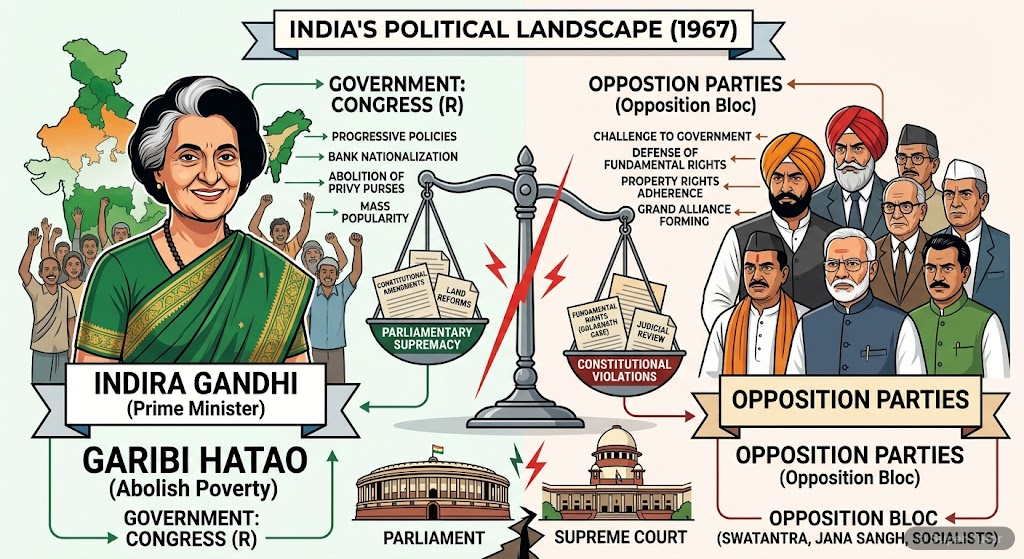
An infographic illustrating the key political developments and tensions in India from 1967, including Indira Gandhi's rise, bitter party competition, and judiciary-government conflicts.
Super Tutor

Learn better with visuals Super Tutor has hundreds of illustrations like this across every chapter — all free to try.

Get started
10 Questions Solved · 1 Section

The Crisis of Democratic Order — Exercise Questions

1State whether the following statements regarding the Emergency are correct or incorrect.
(a) It was declared in 1975 by Indira Gandhi.
(b) It led to the suspension of all fundamental rights.
(c) It was proclaimed due to the deteriorating economic conditions.
(d) Many Opposition leaders were arrested during the emergency.
(e) CPI supported the proclamation of the Emergency.
Show solution
(a) Correct. The National Emergency was declared on 25 June 1975 by Prime Minister Indira Gandhi on the advice of the Cabinet, and was proclaimed by President Fakhruddin Ali Ahmed under Article 352 of the Constitution.

(b) Incorrect. The Emergency led to the suspension of most Fundamental Rights, but not all. Article 20 (protection against arbitrary conviction) and Article 21 (right to life and personal liberty) were initially retained, though the 44th Amendment later made them non-suspendable. In practice, however, even these rights were severely curtailed during the Emergency.

(c) Incorrect. The official reason given by the government for declaring the Emergency was internal disturbance and threat to the security of India. The Allahabad High Court verdict against Indira Gandhi and the political agitation led by Jayaprakash Narayan were the actual triggers, not deteriorating economic conditions.

(d) Correct. Immediately after the proclamation of Emergency, thousands of Opposition leaders and activists — including Jayaprakash Narayan, Morarji Desai, L.K. Advani, Atal Bihari Vajpayee, and others — were arrested under the Maintenance of Internal Security Act (MISA) and the Defence of India Rules (DIR).

(e) Correct. The Communist Party of India (CPI) supported the proclamation of Emergency, describing it as a necessary step to protect the country from reactionary and fascist forces. It was one of the few political parties that backed Indira Gandhi's decision.
2Find the odd one out in the context of proclamation of Emergency:
(a) The call for 'Total Revolution'
(b) The Railway Strike of 1974
(c) The Naxalite Movement
(d) The Allahabad High Court verdict
(e) The findings of the Shah Commission Report
Show solution
Odd one out: (e) The findings of the Shah Commission Report.

Reason: Options (a), (b), (c), and (d) were all events or developments that occurred *before* the proclamation of Emergency in June 1975 and are cited as factors that led to or provided the context for the Emergency. In contrast, the Shah Commission was appointed *after* the Emergency, in 1977, by the Janata Party Government to investigate the excesses committed *during* the Emergency. Therefore, it is the odd one out as it is a consequence/inquiry related to the Emergency, not a cause of it.
3Match the following:
(a) Total Revolution
(b) Garibi hatao
(c) Students' Protest
(d) Railway Strike

i. Indira Gandhi
ii. Jayaprakash Narayan
iii. Bihar Movement
iv. George Fernandes
Show solution
The correct matching is:

| Term | Leader/Event |
|---|---|
| (a) Total Revolution | (ii) Jayaprakash Narayan |
| (b) Garibi hatao | (i) Indira Gandhi |
| (c) Students' Protest | (iii) Bihar Movement |
| (d) Railway Strike | (iv) George Fernandes |

Explanation:
- (a) Total Revolution — Jayaprakash Narayan (JP): JP gave the call for 'Sampoorna Kranti' (Total Revolution) in 1974–75, urging a fundamental transformation of Indian society, economy, and polity.
- (b) Garibi hatao — Indira Gandhi: 'Garibi hatao' (Remove Poverty) was Indira Gandhi's famous slogan during the 1971 general elections, which helped her win a massive mandate.
- (c) Students' Protest — Bihar Movement: The students' agitation in Bihar in 1974 against corruption and misgovernance became the Bihar Movement, which later merged with JP's Total Revolution movement.
- (d) Railway Strike — George Fernandes: The historic nationwide Railway Strike of 1974 was led by George Fernandes, then the leader of the railway workers' union. The government crushed the strike with a heavy hand.
4What were the reasons which led to the mid-term elections in 1980?Show solution
Given: After the 1977 elections, the Janata Party came to power. However, mid-term elections were held in January 1980.

Reasons for mid-term elections in 1980:

1. Internal conflicts within the Janata Party: The Janata Party was a coalition of diverse political groups — the Congress (O), Jana Sangh, Bharatiya Lok Dal, Socialists, and others — who had united only to defeat Indira Gandhi. Once in power, they were divided by ideological differences and personal rivalries.

2. Issue of 'Dual Membership': A major controversy arose over the dual membership of Jana Sangh leaders in the Rashtriya Swayamsevak Sangh (RSS). The Socialists and Charan Singh's faction demanded that Jana Sangh members give up their RSS membership, which they refused. This deepened the rift.

3. Leadership crisis: There was no consensus on leadership. Morarji Desai was the Prime Minister, but Charan Singh and Jagjivan Ram were also powerful claimants. This led to constant infighting.

4. Collapse of the government: Charan Singh, with the support of the Congress (I), withdrew support from the Morarji Desai government, causing it to fall. Charan Singh became Prime Minister but could not prove majority in the Lok Sabha. He resigned without facing a confidence vote, and fresh elections were called.

5. Failure of governance: The Janata government failed to provide stable and effective governance. It was seen as more focused on persecuting Indira Gandhi (through the Shah Commission) than on addressing people's problems.

Result: In the January 1980 mid-term elections, the Congress (I) under Indira Gandhi won a landslide victory, winning 353 seats out of 542.
5The Shah Commission was appointed in 1977 by the Janata Party Government. Why was it appointed and what were its findings?Show solution
Why was the Shah Commission appointed?

After the Emergency ended and the Janata Party came to power in 1977, there was widespread demand for an inquiry into the excesses and abuses of power committed during the Emergency period (1975–77). The Janata Government appointed the Shah Commission of Inquiry in May 1977, headed by Justice J.C. Shah (former Chief Justice of India), to:
- Inquire into the circumstances and reasons for the proclamation of Emergency.
- Investigate the excesses, abuses of authority, and malpractices committed during the Emergency.

Findings of the Shah Commission:

1. Arbitrary arrests: The Commission found that a large number of people — political leaders, activists, journalists, and ordinary citizens — were arrested arbitrarily without proper legal basis under MISA and DIR.

2. Suspension of civil liberties: Fundamental Rights were suspended and citizens had no recourse to courts. Habeas corpus petitions were not entertained.

3. Censorship of the press: The media was subjected to strict censorship. Newspapers were not allowed to publish anything critical of the government. Some newspapers were even shut down.

4. Forced sterilisation: The Commission found evidence of coercive family planning measures, particularly forced sterilisations, especially in Uttar Pradesh and other states. This caused great public resentment.

5. Demolition drives: Slums were demolished in Delhi and other cities, displacing thousands of poor people, often without adequate notice or rehabilitation.

6. Misuse of government machinery: The police, bureaucracy, and intelligence agencies were misused to serve the political interests of the ruling party rather than the public.

7. Role of Sanjay Gandhi: The Commission noted that Sanjay Gandhi, who held no official position, wielded enormous extra-constitutional authority and was responsible for many excesses.

Significance: The Shah Commission's report is an important document that provides a detailed account of how democratic institutions and civil liberties were undermined during the Emergency.
6What reasons did the Government give for declaring a National Emergency in 1975?Show solution
Given: The National Emergency was proclaimed on 25 June 1975 by President Fakhruddin Ali Ahmed on the advice of Prime Minister Indira Gandhi.

Official reasons given by the Government:

1. Threat of internal disturbance: The government invoked Article 352 of the Constitution, which allows proclamation of Emergency when the security of India or any part thereof is threatened by war, external aggression, or armed rebellion (at the time, the provision was 'internal disturbance'). The government claimed that there was a serious threat to internal security and the stability of the nation.

2. Destabilisation by Opposition: The government argued that the Opposition, led by Jayaprakash Narayan, was inciting the police and the armed forces to revolt against the government and not to obey orders. JP's call to the police and army to disobey 'illegal and immoral orders' was cited as a dangerous and unconstitutional act.

3. Threat to law and order: The government claimed that the agitations, strikes, and protests (including the JP movement and the Railway Strike of 1974) had created a situation of lawlessness and anarchy that threatened the democratic order.

4. Allahabad High Court verdict: Though not officially stated as a reason, the Allahabad High Court's verdict on 12 June 1975 — which found Indira Gandhi guilty of electoral malpractices and declared her election void — created a political crisis. The government used the resulting political turmoil as justification.

5. Protecting democratic institutions: The government claimed that the Emergency was necessary to protect democratic institutions and the Constitution from being subverted by reactionary forces.

Note: Critics and the Shah Commission later found that these reasons were largely pretextual and that the real motive was to protect Indira Gandhi's political position after the Allahabad High Court verdict.
7The 1977 elections for the first time saw the Opposition coming into power at the Centre. What would you consider as the reasons for this development?Show solution
Given: The 1977 general elections resulted in the defeat of the Congress and the Janata Party coming to power — the first time the Opposition formed the government at the Centre since Independence.

Reasons for this historic development:

1. Anti-Emergency sentiment: The Emergency (1975–77) had created widespread resentment among the people. The suspension of civil liberties, arbitrary arrests, press censorship, and atrocities committed during the Emergency turned public opinion strongly against Indira Gandhi and the Congress.

2. Unity of the Opposition: For the first time, the major Opposition parties — Congress (O), Jana Sangh, Bharatiya Lok Dal, Socialist Party, and others — came together to form the Janata Party under the leadership of Jayaprakash Narayan. This unity prevented the splitting of anti-Congress votes.

3. Excesses of the Emergency: Specific excesses such as forced sterilisations (especially in UP and Bihar), demolition of slums, and the high-handed behaviour of Sanjay Gandhi's Youth Congress alienated large sections of the population, including those who had previously supported Congress.

4. Role of Jayaprakash Narayan: JP's moral authority and his call for a 'Total Revolution' had already mobilised large sections of society against the government. His leadership gave the Opposition movement credibility and mass appeal.

5. Sympathy for political prisoners: The arrest of thousands of Opposition leaders, journalists, and activists during the Emergency generated public sympathy for them. When they were released before the elections, they became powerful voices against the Congress.

6. Press freedom restored: When the Emergency was lifted and press censorship ended, newspapers reported extensively on the excesses of the Emergency period, further damaging the Congress's image.

7. Indira Gandhi's miscalculation: Indira Gandhi called elections believing she would win. This gave the Opposition an opportunity to contest elections on the issue of democracy vs. authoritarianism — a contest they won decisively.

8. North Indian swing: The anti-Congress wave was particularly strong in the Hindi heartland states (UP, Bihar, Rajasthan, MP, Delhi), which together send a large number of MPs to the Lok Sabha. The Janata Party swept these states.

Result: The Janata Party won 295 seats and, with allies, had a comfortable majority. Congress was reduced to 154 seats. Morarji Desai became India's first non-Congress Prime Minister.
8Discuss the effects of Emergency on the following aspects of our polity:
- Effects on civil liberties for citizens.
- Impact on relationship between the Executive and Judiciary
- Functioning of Mass Media
- Working of the Police and Bureaucracy.
Show solution
Effects of Emergency (1975–77) on various aspects of Indian polity:

---

1. Effects on Civil Liberties for Citizens:
- Fundamental Rights guaranteed under Part III of the Constitution were suspended. Citizens could not approach courts for enforcement of their rights.
- The right to move courts for habeas corpus was suspended, meaning people could be detained indefinitely without trial.
- Freedom of speech and expression was curtailed. People could not criticise the government publicly.
- Thousands of political activists, Opposition leaders, students, and ordinary citizens were arrested under MISA (Maintenance of Internal Security Act) and DIR (Defence of India Rules) without being told the reasons for their arrest.
- Forced sterilisations and demolition of slums violated the bodily integrity and housing rights of millions of poor people.
- The Emergency demonstrated how fragile civil liberties can be when the executive is determined to suppress them.

---

2. Impact on Relationship between the Executive and Judiciary:
- The relationship between the executive and the judiciary became severely strained during the Emergency.
- The Supreme Court, in the ADM Jabalpur vs. Shivkant Shukla case (1976) — also known as the Habeas Corpus case — ruled (by a 4:1 majority) that during Emergency, citizens cannot approach courts even for the right to life and personal liberty. This was widely criticised as a capitulation of the judiciary to executive pressure.
- Justice H.R. Khanna gave a lone dissent, upholding the right to life even during Emergency, and was subsequently superseded for the post of Chief Justice of India.
- The government passed the 42nd Constitutional Amendment (1976), which curtailed the powers of the judiciary and made it difficult to challenge constitutional amendments.
- The Emergency showed that the judiciary could be pressured or intimidated by a determined executive, raising questions about judicial independence.
- After the Emergency, the 44th Amendment (1978) restored and strengthened the position of the judiciary.

---

3. Functioning of Mass Media:
- Censorship was imposed on the press immediately after the Emergency was declared. All newspapers had to submit their content for government approval before publication.
- Many newspapers and journals that refused to comply were shut down. Power supply to newspaper offices was cut off on the night of 25–26 June 1975 to prevent publication.
- The government used All India Radio (AIR) and Doordarshan (state-controlled media) as propaganda tools to project a positive image of the Emergency.
- Some newspapers and journalists practised self-censorship to avoid government action.
- A few newspapers, like the Indian Express and the Statesman, showed some resistance. The Indian Express published blank editorials as a form of silent protest.
- The Emergency revealed the vulnerability of a free press to government control and the importance of protecting press freedom through law.
- After the Emergency, the Press Council of India was strengthened to protect press freedom.

---

4. Working of the Police and Bureaucracy:
- The police and bureaucracy were used as instruments of political repression during the Emergency. They were expected to carry out the orders of the ruling party rather than act as neutral public servants.
- The police made arbitrary arrests, often without warrants, and detained people for long periods without trial.
- Bureaucrats who were seen as sympathetic to the Opposition were transferred or harassed, while those who were loyal to the ruling party were rewarded.
- Sanjay Gandhi and his associates exercised extra-constitutional authority over the police and bureaucracy, directing them to carry out programmes like forced sterilisation and slum demolition.
- The Emergency demonstrated the dangers of politicising the police and bureaucracy and the importance of insulating them from political interference.
- The Shah Commission's report documented numerous instances of police brutality and bureaucratic complicity in the excesses of the Emergency.
9In what way did the imposition of Emergency affect the party system in India? Elaborate your answer with examples.Show solution
Given: The Emergency was imposed in June 1975 and lifted in March 1977. Elections were held in March 1977.

Effects of Emergency on the Party System in India:

1. Unification of Opposition parties:
The most significant effect of the Emergency on the party system was the coming together of diverse Opposition parties into a single political formation — the Janata Party (1977). Parties like the Congress (O), Jana Sangh, Bharatiya Lok Dal, Socialist Party, and the Congress for Democracy (led by Jagjivan Ram) merged to fight the 1977 elections unitedly. This was unprecedented in Indian political history.

2. Near two-party contest in 1977:
The 1977 elections were fought essentially as a contest between the Congress (I) on one side and the Janata Party on the other. This gave the Indian party system a rare two-party character, unlike the usual multi-party contests.

3. End of Congress dominance:
The Emergency and its excesses severely damaged the Congress's image. The 1977 elections ended the Congress's uninterrupted dominance of Indian politics since Independence. For the first time, a non-Congress government came to power at the Centre. This marked the beginning of the era of coalition politics in India.

4. Split in Congress:
The Emergency and its aftermath led to splits within the Congress. After the 1977 defeat, the Congress split into Congress (I) (led by Indira Gandhi) and Congress (S) (led by old guard leaders like Y.B. Chavan). This fragmentation weakened the Congress for several years.

5. Disintegration of the Janata Party:
The Janata Party, formed in the heat of anti-Emergency sentiment, could not hold together once in power. Ideological differences (especially over the RSS connection of Jana Sangh members), personal rivalries, and power struggles led to its collapse by 1979. The Jana Sangh members later formed the Bharatiya Janata Party (BJP) in 1980. This showed that the Emergency had created a temporary unity that could not be sustained.

6. Rise of regional parties:
The weakening of the Congress and the instability of the Janata Party created political space for regional parties to grow. Parties like the Telugu Desam Party (TDP), Asom Gana Parishad, and others emerged in the 1980s, partly as a result of the political churning set in motion by the Emergency.

7. Strengthening of democratic consciousness:
The Emergency made political parties and citizens more conscious of the importance of democratic norms and civil liberties. It led to constitutional amendments (44th Amendment, 1978) that made it harder to misuse Emergency provisions.

Conclusion: The Emergency was a watershed moment in Indian political history. It transformed the party system by ending one-party dominance, creating new political formations, and ultimately leading to a more competitive multi-party system.
10Read the passage and answer the questions below:
"Indian democracy was never so close to a two-party system as it was during the 1977 elections. However, the next few years saw a complete change. Soon after its defeat, the Indian National Congress split into two groups... The Janata Party also went through major convulsions..."
— David Butler, Ashok Lahiri and Prannoy Roy (quoted by Partha Chatterjee)

(a) What made the party system in India look like a two-party system in 1977?
(b) Many more than two parties existed in 1977. Why then are the authors describing this period as close to a two-party system?
(c) What caused splits in Congress and the Janata parties?
Show solution
(a) What made the party system in India look like a two-party system in 1977?

The 1977 elections were fought in the backdrop of the Emergency (1975–77), which had created a sharp polarisation in Indian politics between:
- The Congress (I) led by Indira Gandhi, which had imposed the Emergency, and
- The Janata Party, a grand alliance of all major Opposition parties — Congress (O), Jana Sangh, Bharatiya Lok Dal, Socialist Party, and Congress for Democracy — which had united to fight the Emergency and restore democracy.

This unity of the Opposition under the banner of the Janata Party created a situation where the election was essentially a straight contest between two sides: the Congress and the Janata Party. The electorate too voted along these lines, making it appear like a two-party contest. The Janata Party won 295 seats and the Congress was reduced to 154 seats, with very few seats going to other parties.

---

(b) Many more than two parties existed in 1977. Why then are the authors describing this period as close to a two-party system?

The authors are describing the 1977 elections as 'close to a two-party system' not because only two parties existed, but because the effective political contest was between only two formations:
1. The Congress (I) on one side.
2. The Janata Party (which was itself a merger of several parties) on the other.

In a true two-party system, only two parties compete for power. In 1977, although many parties existed, most of them had merged into the Janata Party for electoral purposes. The election results also reflected this binary contest — almost all seats went to either the Congress or the Janata Party. The political choice before the voter was essentially binary: support the Emergency or oppose it. This is why the authors describe it as 'close to a two-party system' even though technically more than two parties existed.

---

(c) What caused splits in Congress and the Janata parties?

Splits in the Congress:
- After the Congress's humiliating defeat in 1977, there was a power struggle within the party between those who supported Indira Gandhi and those who blamed her for the Emergency and the defeat.
- The old guard leaders (like Y.B. Chavan, Devraj Urs, and others) wanted to democratise the party and reduce Indira Gandhi's dominance.
- This led to a split: Congress (I) (I for Indira) remained under Indira Gandhi's control, while the other faction became Congress (S) (S for Socialist/old guard).
- Indira Gandhi's faction eventually won back power in 1980, while the other faction faded away.

Splits in the Janata Party:
- The Janata Party was an artificial coalition held together only by the common goal of defeating Indira Gandhi and ending the Emergency. Once in power, the underlying differences surfaced.
- Ideological differences: The Jana Sangh members maintained their links with the RSS, which was unacceptable to the Socialists and Charan Singh's faction, who demanded they choose between the Janata Party and the RSS.
- Personal rivalries and power struggle: There was intense competition for leadership among Morarji Desai, Charan Singh, and Jagjivan Ram.
- Charan Singh's defection: Charan Singh, with Congress (I) support, withdrew from the Janata government, causing it to fall. He became Prime Minister briefly but could not prove majority.
- The Janata Party eventually broke up. The Jana Sangh members formed the Bharatiya Janata Party (BJP) in 1980, and other factions went their separate ways.
- The fundamental reason for the split was that the Janata Party was a marriage of convenience, not a party with a shared ideology or programme.

Stuck on a step?

Ask Super Tutor AI to explain any solution on this page in a simpler way — free, 24x7.

Ask a Doubt Free

Frequently Asked Questions

What are the important topics in The crisis of democratic order for Jharkhand Board Class 12 Political Science?
The crisis of democratic order covers several key topics that are frequently asked in Jharkhand Board Class 12 board exams. Focus on the core concepts listed on this page and practise related questions to build confidence.
How to score full marks in The crisis of democratic order — Jharkhand Board Class 12 Political Science?
Understand the core concepts first, then work through the 45 practice questions available for this chapter. Revise formulas and definitions regularly, and use flashcards for quick recall before the exam.
Where can I get free NCERT Solutions for The crisis of democratic order Class 12 Political Science?
This page has free step-by-step NCERT Solutions for every exercise question in The crisis of democratic order (Jharkhand Board Class 12 Political Science) — written the way examiners award marks: given, formula, working, answer.

Sources & Official References

Content is aligned to the official syllabus. Refer to the board website for the latest curriculum.

For serious students

Get the full The crisis of democratic order chapter — for free.

Quizzes, flashcards, AI doubt-solver and a step-by-step study plan for Jharkhand Board Class 12 Political Science.