The Fundamental Unit of Life — Flashcards
Jharkhand Board · Class 9 · Science
22 flashcards for The Fundamental Unit of Life (Jharkhand Board Class 9 Science) to test yourself on key terms and facts.
Interactive on Super Tutor
Studying The Fundamental Unit of Life? Get the full interactive chapter.
Quizzes, flashcards, AI doubt-solver and a step-by-step study plan — built for flashcards and more.
Free trial, no card needed.
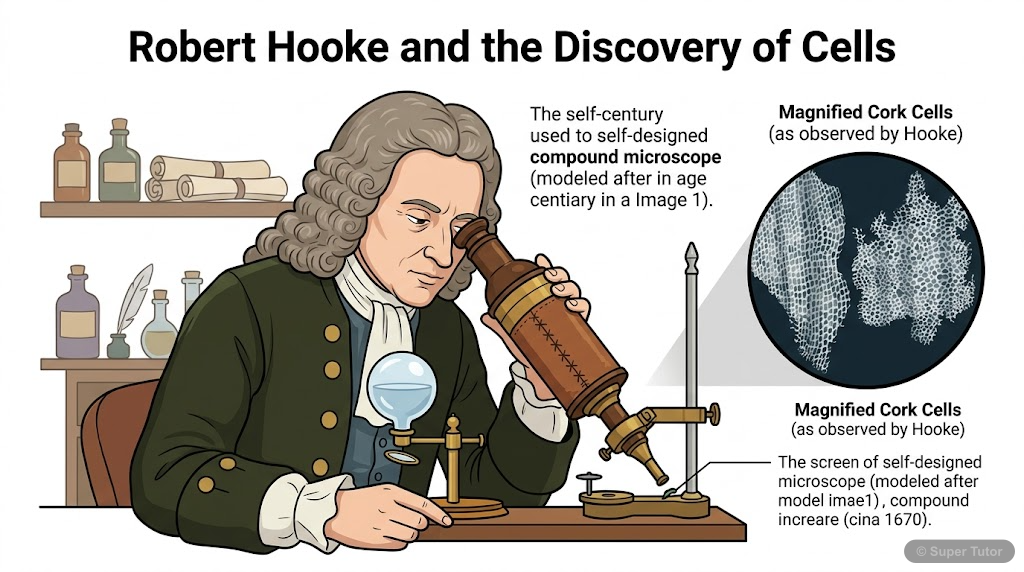
Learn better with visuals Super Tutor pairs illustrations like this with notes and quizzes for The Fundamental Unit of Life.
Who first discovered cells and what did he observe?
Answer
Robert Hooke first discovered cells in 1665. He observed a thin slice of cork under a microscope and saw small compartments that looked like a honeycomb structure. He called these compartments 'cells'…
What is a cell?
Answer
A cell is the smallest structural and functional unit of life. It is the basic building block of all living organisms. All living things are made up of one or more cells.
What is the difference between unicellular and multicellular organisms? Give examples.
Answer
Unicellular organisms: Made of only one cell (e.g., Amoeba, Paramecium, bacteria). Multicellular organisms: Made of many cells working together (e.g., plants, animals, fungi). All multicellular organi…
What are the three main components found in almost every cell?
Answer
1. Plasma membrane (cell membrane) - outer covering 2. Nucleus - control center containing genetic material 3. Cytoplasm - jelly-like substance filling the cell…
What is the plasma membrane and what is its main function?
Answer
The plasma membrane is the outermost covering of the cell made of lipids and proteins. Its main function is to control what enters and exits the cell. It is selectively permeable, allowing some substa…
What is diffusion and how does it help cells?
Answer
Diffusion is the movement of substances from an area of high concentration to an area of low concentration. In cells, it helps exchange gases like oxygen and carbon dioxide across the cell membrane wi…
What is osmosis?
Answer
Osmosis is the movement of water molecules through a selectively permeable membrane from an area of higher water concentration to an area of lower water concentration. It is a special type of diffusio…
What happens to a cell in hypotonic, isotonic, and hypertonic solutions?
Answer
Hypotonic (dilute): Cell gains water and swells up Isotonic (equal concentration): No net water movement, cell stays same size Hypertonic (concentrated): Cell loses water and shrinks…
+14 more flashcards
Practise AllFrequently Asked Questions
What are the important topics in The Fundamental Unit of Life for Jharkhand Board Class 9 Science?
How many flashcards are available for The Fundamental Unit of Life?
How should I revise The Fundamental Unit of Life for Class 9 exams?
Sources & Official References
Content is aligned to the official syllabus. Refer to the board website for the latest curriculum.
More resources for The Fundamental Unit of Life
Practice Quiz
Test yourself with a quick quiz
Important Questions
Exam-style questions with answers
Revision Notes
Key points for last-minute revision
Chapter Summary
Understand the chapter at a glance
Concept Maps
See how topics connect
Study Plan
Step-by-step plan for this chapter
Syllabus
What topics to cover
NCERT Solutions
Every textbook question solved step by step
For serious students
Get the full The Fundamental Unit of Life chapter — start free.
Quizzes, flashcards, an AI doubt solver and a study plan for Jharkhand Board Class 9 Science. Free to start, no card needed.