Chapter 5 of 12
NCERT Solutions

The Fundamental Unit of Life

Jharkhand Board · Class 9 · Science

NCERT Solutions for The Fundamental Unit of Life — Jharkhand Board Class 9 Science.

28 questions22 flashcards5 concepts

Interactive on Super Tutor

Studying The Fundamental Unit of Life? Get the full interactive chapter.

Quizzes, flashcards, AI doubt-solver and a step-by-step study plan — built for ncert solutions and more.

1,000+ Class 9 students started this chapter today

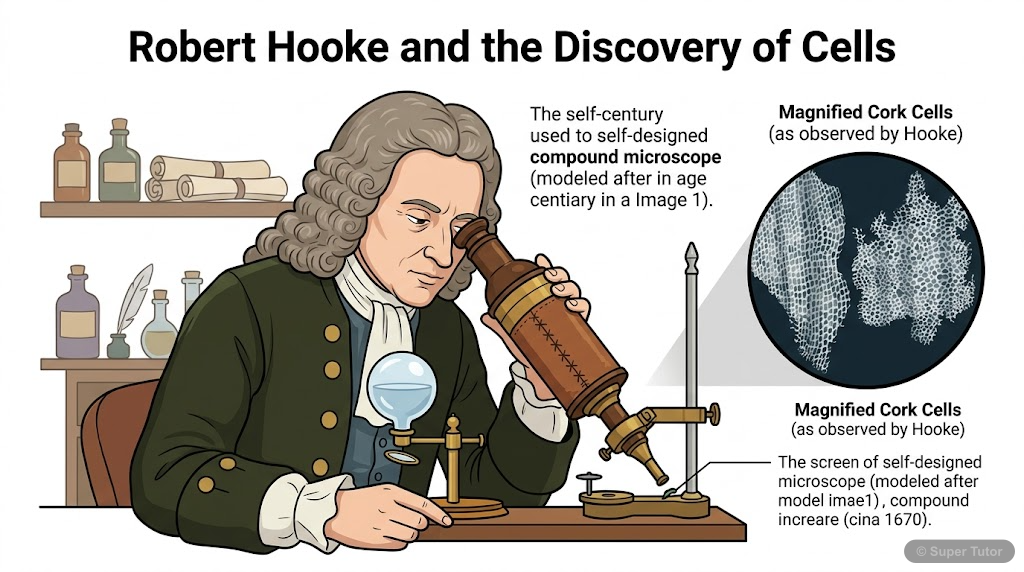
An illustration depicting Robert Hooke observing a thin slice of cork under his self-designed primitive microscope, showing the honeycomb-like structure of cork cells he described.
Super Tutor

Learn better with visuals Super Tutor has hundreds of illustrations like this across every chapter — all free to try.

Get started
10 Questions Solved · 1 Section

Exercises

1Make a comparison and write down ways in which plant cells are different from animal cells.Show solution
Given: We need to compare plant cells and animal cells.

Differences between Plant Cells and Animal Cells:

| Feature | Plant Cell | Animal Cell |
|---|---|---|
| Cell wall | Present (made of cellulose) | Absent |
| Chloroplasts | Present (for photosynthesis) | Absent |
| Vacuole | Large central vacuole present | Small or absent |
| Centrosome/Centrioles | Generally absent | Present |
| Shape | Usually fixed, rectangular | Irregular or round |
| Plastids | Present (chloroplasts, chromoplasts, leucoplasts) | Absent |
| Lysosomes | Rarely present | Commonly present |
| Energy storage | Starch granules | Glycogen granules |

Conclusion: Plant cells have a cell wall, chloroplasts, and a large central vacuole which are absent in animal cells, while animal cells have centrioles and lysosomes which are generally absent in plant cells.
2How is a prokaryotic cell different from a eukaryotic cell?Show solution
Given: We need to distinguish between prokaryotic and eukaryotic cells.

Differences between Prokaryotic and Eukaryotic Cells:

| Feature | Prokaryotic Cell | Eukaryotic Cell |
|---|---|---|
| Nuclear membrane | Absent (no true nucleus) | Present (well-defined nucleus) |
| Size | Generally smaller (1–10 µm) | Generally larger (10–100 µm) |
| Membrane-bound organelles | Absent | Present (mitochondria, ER, Golgi, etc.) |
| Chromosome number | Single chromosome (circular DNA) | Multiple chromosomes |
| Histone proteins | Absent | Present with DNA |
| Ribosomes | 70S (smaller) | 80S (larger) |
| Cell division | Binary fission | Mitosis/Meiosis |
| Examples | Bacteria, Blue-green algae | Plant cells, Animal cells, Fungi |

Conclusion: Prokaryotic cells lack a membrane-bound nucleus and membrane-bound organelles, whereas eukaryotic cells possess both.
3What would happen if the plasma membrane ruptures or breaks down?Show solution
Given: The plasma membrane is the outermost boundary of the cell (in animal cells) that controls the movement of substances in and out of the cell.

Concept: The plasma membrane is selectively permeable and maintains the internal environment of the cell.

What would happen:

1. The cell would lose its ability to regulate the entry and exit of substances — essential molecules like glucose, ions, and water would leak out.
2. The cytoplasm would spill out into the external environment, disrupting all cellular activities.
3. Harmful substances from outside would freely enter the cell, causing damage.
4. The cell would lose its shape and structural integrity.
5. Ultimately, the cell would die because it cannot maintain homeostasis.

Conclusion: Rupture of the plasma membrane would lead to the death of the cell as it can no longer control its internal environment.
4What would happen to the life of a cell if there was no Golgi apparatus?Show solution
Given: The Golgi apparatus (Golgi complex) is a membrane-bound organelle involved in processing, packaging, and dispatching materials synthesised in the cell.

Functions of Golgi apparatus:
- It receives proteins and lipids from the Endoplasmic Reticulum (ER), modifies them, packages them, and sends them to their destinations inside or outside the cell.
- It is involved in the formation of lysosomes.
- It helps in the synthesis of cell wall material in plant cells.

What would happen without Golgi apparatus:

1. Proteins and lipids synthesised by the ER would not be processed or packaged properly.
2. Secretion of enzymes, hormones, and other substances would stop — the cell could not communicate or function properly.
3. Lysosomes would not be formed, so intracellular digestion would be disrupted.
4. Waste materials would accumulate inside the cell, leading to cell death.
5. In plant cells, cell wall formation would be impaired.

Conclusion: Without the Golgi apparatus, the cell's secretory and packaging functions would collapse, eventually leading to cell dysfunction and death.
5Which organelle is known as the powerhouse of the cell? Why?Show solution
Answer: Mitochondria is known as the powerhouse of the cell.

Reason:

- Mitochondria are the sites of cellular respiration, the process by which energy is released from food (glucose) in the presence of oxygen.
- The energy released is stored in the form of ATP (Adenosine Triphosphate) molecules.
- ATP is the energy currency of the cell — it provides energy for all cellular activities such as muscle contraction, protein synthesis, active transport, etc.
- The process occurs in two stages:
- Glycolysis in the cytoplasm
- Krebs cycle and oxidative phosphorylation in the mitochondria

Glucose+O2MitochondriaCO2+H2O+ATP (Energy)\text{Glucose} + \text{O}_2 \xrightarrow{\text{Mitochondria}} \text{CO}_2 + \text{H}_2\text{O} + \text{ATP (Energy)}

Conclusion: Since mitochondria generate most of the cell's supply of ATP (energy), they are called the powerhouse of the cell.
6Where do the lipids and proteins constituting the cell membrane get synthesised?Show solution
Given: The cell membrane is made up of lipids and proteins.

Answer:

- Lipids (fats) that form the cell membrane are synthesised in the Smooth Endoplasmic Reticulum (SER). SER lacks ribosomes and is specialised for lipid synthesis.

- Proteins that are part of the cell membrane are synthesised by ribosomes attached to the Rough Endoplasmic Reticulum (RER). The RER has ribosomes on its surface which manufacture proteins.

- After synthesis, both lipids and proteins are transported to the Golgi apparatus, where they are processed and packaged before being sent to the cell membrane.

Conclusion: Lipids are synthesised in the SER and proteins are synthesised on the RER; both are then assembled to form the cell membrane.
7How does an Amoeba obtain its food?Show solution
Given: Amoeba is a unicellular organism.

Process — Endocytosis (Phagocytosis):

Amoeba obtains its food by a process called endocytosis, specifically phagocytosis (cell eating). The steps are:

1. When Amoeba senses food (like a bacterium or algal cell), it extends finger-like projections of its cell membrane called pseudopodia (false feet).
2. The pseudopodia surround the food particle from all sides.
3. The tips of the pseudopodia fuse together, enclosing the food particle within a membrane-bound sac called a food vacuole.
4. Digestive enzymes are secreted into the food vacuole, breaking down the food into simpler molecules.
5. The digested nutrients are absorbed into the cytoplasm.
6. Undigested waste is expelled outside the cell.

Conclusion: Amoeba obtains food through endocytosis (phagocytosis) using pseudopodia to engulf food particles, which is possible due to the flexibility of its cell membrane.
8What is osmosis?Show solution
Definition:

Osmosis is the movement of water molecules through a selectively permeable membrane from a region of higher water concentration (lower solute concentration / hypotonic solution) to a region of lower water concentration (higher solute concentration / hypertonic solution).

Key points:
- Osmosis is a special type of diffusion involving only water molecules.
- It occurs across a semi-permeable (selectively permeable) membrane.
- It continues until equilibrium is reached (both sides have equal concentration).

Types:
- Endosmosis: Movement of water into the cell when placed in a hypotonic solution — cell swells.
- Exosmosis: Movement of water out of the cell when placed in a hypertonic solution — cell shrinks (plasmolysis in plant cells).

Example: When a raisin is placed in water, it swells up due to osmosis (water moves into the raisin).

Conclusion: Osmosis is the passive movement of water across a selectively permeable membrane from a dilute solution to a concentrated solution.
9Carry out the following osmosis experiment: Take four peeled potato halves and scoop each one out to make potato cups. One of these potato cups should be made from a boiled potato. Put each potato cup in a trough containing water. (a) Keep cup A empty (b) Put one teaspoon sugar in cup B (c) Put one teaspoon salt in cup C (d) Put one teaspoon sugar in the boiled potato cup D. Keep these for two hours. Then observe the four potato cups and answer the following: (i) Explain why water gathers in the hollowed portion of B and C. (ii) Why is potato A necessary for this experiment? (iii) Explain why water does not gather in the hollowed out portions of A and D.Show solution
Setup:
- Cup A: Empty (raw potato) — control
- Cup B: Sugar in raw potato cup
- Cup C: Salt in raw potato cup
- Cup D: Sugar in boiled potato cup
- All cups placed in a trough of water for 2 hours.

---

(i) Explain why water gathers in the hollowed portion of B and C.

Answer:
The sugar in cup B and salt in cup C dissolve in the small amount of water present and create a concentrated (hypertonic) solution inside the hollow portion. The potato cells surrounding the hollow act as a selectively permeable membrane. The water in the trough (and inside the potato cells) is at a higher concentration than the solution inside the hollow.

Therefore, water moves by osmosis from the potato cells (and from the trough through the potato) into the hollow portion — from the region of higher water concentration to lower water concentration.

This is why water accumulates in the hollowed portions of B and C.

---

(ii) Why is potato A necessary for this experiment?

Answer:
Potato cup A (empty, raw potato) serves as the control for the experiment.

- It shows that in the absence of any solute (sugar or salt), no water accumulates in the hollow.
- It helps us confirm that the water gathering in B and C is specifically due to the osmotic effect of the dissolved sugar/salt, and not due to any other factor such as the shape of the cup or the water in the trough.
- Without a control, we cannot draw a valid scientific conclusion.

---

(iii) Explain why water does not gather in the hollowed out portions of A and D.

For Cup A (empty raw potato):
There is no solute (sugar or salt) in the hollow. The concentration of water inside the hollow is the same as (or not significantly different from) the concentration in the potato cells and the trough water. Therefore, there is no osmotic gradient and no net movement of water into the hollow. No water accumulates.

For Cup D (sugar in boiled potato):
Boiling the potato kills the cells and destroys the selectively permeable membrane of the potato cells. Since osmosis requires a functional selectively permeable membrane, the dead cells of the boiled potato cannot act as such a membrane. Even though sugar is present and creates a concentration gradient, water cannot move by osmosis through the dead, ruptured membranes. Therefore, no water gathers in cup D.

Conclusion: This experiment demonstrates that osmosis requires both a concentration gradient AND an intact selectively permeable membrane.
10Which type of cell division is required for growth and repair of body and which type is involved in formation of gametes?Show solution
Answer:

1. For growth and repair of the body:
Mitosis (mitotic cell division) is required.
- In mitosis, a parent cell divides to produce two daughter cells, each with the same number of chromosomes as the parent cell (the chromosome number is maintained).
- This ensures that new cells formed during growth or repair are identical to the original cells.
- Example: Healing of a wound, replacement of old blood cells, growth of tissues.

2. For formation of gametes (reproductive cells):
Meiosis (meiotic cell division) is involved.
- In meiosis, a parent cell divides to produce four daughter cells, each with half the number of chromosomes of the parent cell (haploid cells).
- This reduction in chromosome number is essential so that when two gametes (sperm and egg) fuse during fertilisation, the resulting zygote has the correct (diploid) number of chromosomes.
- Example: Formation of sperm cells in testes and egg cells in ovaries.

Conclusion:
Growth and RepairMitosis\text{Growth and Repair} \rightarrow \textbf{Mitosis}
Formation of GametesMeiosis\text{Formation of Gametes} \rightarrow \textbf{Meiosis}

Stuck on a step?

Ask Super Tutor AI to explain any solution on this page in a simpler way — free, 24x7.

Ask a Doubt Free

Frequently Asked Questions

What are the important topics in The Fundamental Unit of Life for Jharkhand Board Class 9 Science?
Key topics in The Fundamental Unit of Life include Correct vs Incorrect: What Happens to Cells in Different Solutions, Cell Structure - Complete Overview, The Fundamental Unit of Life — Complete Concept Map. These are the concepts Jharkhand Board Class 9 examiners draw on most — study them first, then practise related questions.
How to score full marks in The Fundamental Unit of Life — Jharkhand Board Class 9 Science?
Understand the core concepts first, then work through the 28 practice questions available for this chapter. Revise formulas and definitions regularly, and use flashcards for quick recall before the exam.
Where can I get free NCERT Solutions for The Fundamental Unit of Life Class 9 Science?
This page has free step-by-step NCERT Solutions for every exercise question in The Fundamental Unit of Life (Jharkhand Board Class 9 Science) — written the way examiners award marks: given, formula, working, answer.

Sources & Official References

Content is aligned to the official syllabus. Refer to the board website for the latest curriculum.

For serious students

Get the full The Fundamental Unit of Life chapter — for free.

Quizzes, flashcards, AI doubt-solver and a step-by-step study plan for Jharkhand Board Class 9 Science.