Chapter 2 of 12
NCERT Solutions

Polynomials — NCERT Solutions

Jammu & Kashmir Board · Class 9 · Mathematics

NCERT Solutions for Polynomials, Jammu & Kashmir Board Class 9 Mathematics: 30 textbook questions solved step by step.

29 questions24 flashcards9 formulas & key relations5 concepts

Interactive on Super Tutor

Studying Polynomials? Get the full interactive chapter.

Quizzes, flashcards, AI doubt-solver and a step-by-step study plan — built for NCERT solutions and more.

Free trial, no card needed.
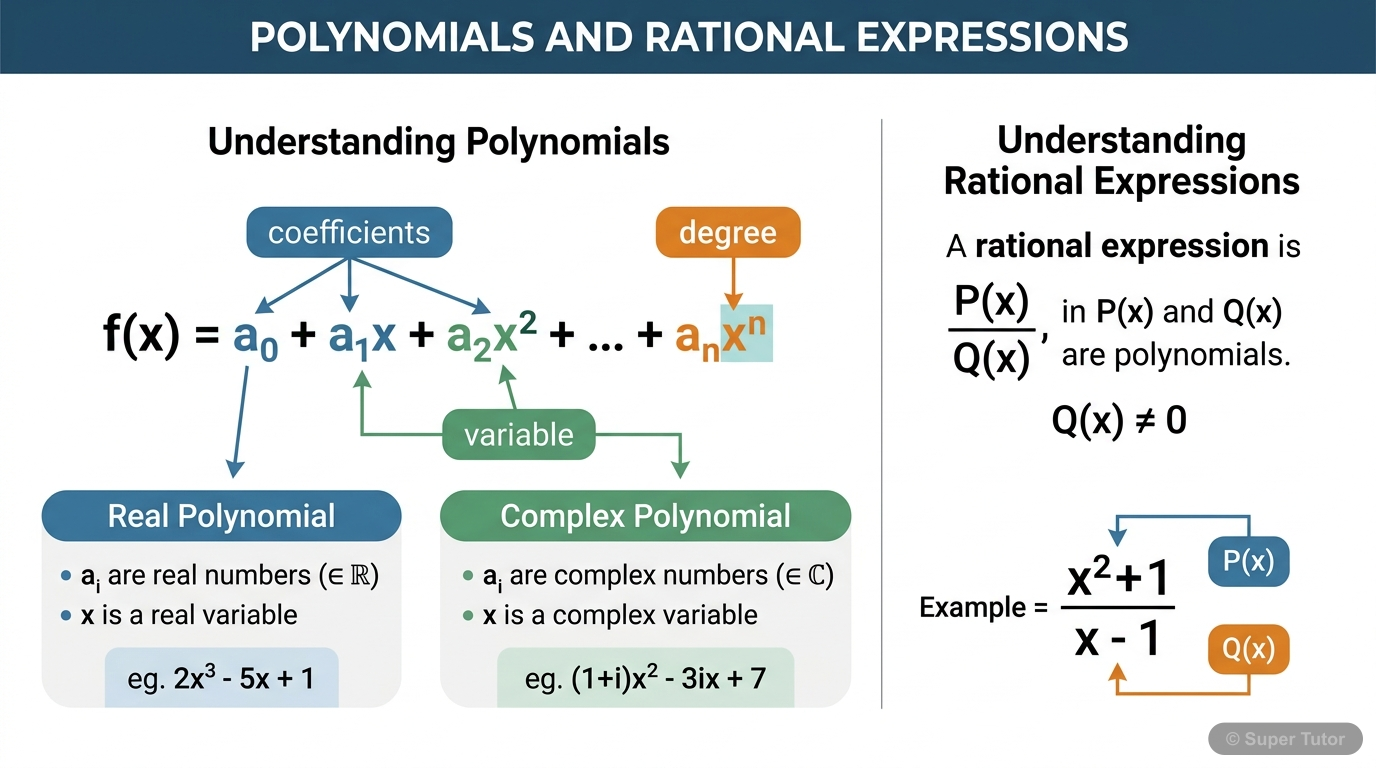
A labeled diagram illustrating the general form of a polynomial, distinguishing between real and complex polynomials by highlighting the nature of coefficients and variables. Also includes the definit
Super Tutor

One of 3 illustrations for Polynomials in Super Tutor — alongside flashcards, concept maps and practice questions.

30 Questions Solved · 4 Sections

The first 15 solutions are open to read. The other 15 are free with a Super Tutor account.

Exercise 2.1

1Which of the following expressions are polynomials in one variable and which are not? State reasons for your answer.
(i) 4x2−3x+74x^{2} - 3x + 7
(ii) y2+2y^{2} + \sqrt{2}
(iii) 3t+t23\sqrt{t} + t\sqrt{2}
(iv) y+2yy + \frac{2}{y}
(v) x10+y3+t50x^{10} + y^3 + t^{50}
Show solution

Concept: A polynomial in one variable is an expression of the form anxn+an−1xn−1+⋯+a0a_n x^n + a_{n-1}x^{n-1} + \cdots + a_0 where all exponents of the variable are whole numbers (non-negative integers).

(i) 4x2−3x+74x^{2} - 3x + 7
All exponents of xx are whole numbers (2, 1, 0). It is a polynomial in one variable xx.

(ii) y2+2y^{2} + \sqrt{2}
All exponents of yy are whole numbers (2, 0). It is a polynomial in one variable yy.

(iii) 3t+t23\sqrt{t} + t\sqrt{2}
3t=3t1/23\sqrt{t} = 3t^{1/2}. The exponent 12\frac{1}{2} is not a whole number. Hence it is not a polynomial.

(iv) y+2yy + \frac{2}{y}
2y=2y−1\frac{2}{y} = 2y^{-1}. The exponent −1-1 is not a whole number. Hence it is not a polynomial.

(v) x10+y3+t50x^{10} + y^3 + t^{50}
This expression contains three variables xx, yy, and tt. Hence it is not a polynomial in one variable (it is a polynomial in three variables).

2Write the coefficients of x2x^2 in each of the following:
(i) 2+x2+x2 + x^{2} + x
(ii) 2−x2+x32 - x^{2} + x^{3}
(iii) π2x2+x\frac{\pi}{2} x^2 + x
(iv) 2x−1\sqrt{2} x - 1
Show solution

Concept: The coefficient of x2x^2 is the number multiplied with x2x^2 in the expression.

(i) 2+x2+x2 + x^{2} + x
The term containing x2x^2 is 1⋅x21 \cdot x^2.
Coefficient of x2x^2 = 1\mathbf{1}

(ii) 2−x2+x32 - x^{2} + x^{3}
The term containing x2x^2 is −1⋅x2-1 \cdot x^2.
Coefficient of x2x^2 = −1\mathbf{-1}

(iii) π2x2+x\frac{\pi}{2} x^2 + x
The term containing x2x^2 is π2x2\frac{\pi}{2} x^2.
Coefficient of x2x^2 = π2\dfrac{\boldsymbol{\pi}}{\mathbf{2}}

(iv) 2x−1\sqrt{2} x - 1
There is no x2x^2 term in this expression.
Coefficient of x2x^2 = 0\mathbf{0}

3Give one example each of a binomial of degree 35, and of a monomial of degree 100.Show solution

Concept:

  • A binomial has exactly two terms.
  • A monomial has exactly one term.
  • The degree is the highest power of the variable.

Binomial of degree 35:
x35+1x^{35} + 1
This has two terms and the highest power is 35.

Monomial of degree 100:
x100x^{100}
This has one term and the highest power is 100.

4Write the degree of each of the following polynomials:
(i) 5x3+4x2+7x5x^{3} + 4x^{2} + 7x
(ii) 4−y24 - y^{2}
(iii) 5t−75t - \sqrt{7}
(iv) 3
Show solution

Concept: The degree of a polynomial is the highest power of the variable in the polynomial.

(i) 5x3+4x2+7x5x^{3} + 4x^{2} + 7x
Highest power of xx is 3.
Degree = 3\mathbf{3}

(ii) 4−y24 - y^{2}
Highest power of yy is 2.
Degree = 2\mathbf{2}

(iii) 5t−75t - \sqrt{7}
Highest power of tt is 1.
Degree = 1\mathbf{1}

(iv) 33
3=3⋅x03 = 3 \cdot x^0. This is a non-zero constant polynomial.
Degree = 0\mathbf{0}

5Classify the following as linear, quadratic and cubic polynomials:
(i) x2+xx^{2} + x
(ii) x−x3x - x^3
(iii) y+y2+4y + y^2 + 4
(iv) 1+x1 + x
(v) 3t3t
(vi) r2r^2
(vii) 7x37x^3
Show solution

Concept:

  • Linear polynomial: degree 1
  • Quadratic polynomial: degree 2
  • Cubic polynomial: degree 3

(i) x2+xx^{2} + x — Highest degree = 2 → Quadratic polynomial

(ii) x−x3x - x^3 — Highest degree = 3 → Cubic polynomial

(iii) y+y2+4y + y^2 + 4 — Highest degree = 2 → Quadratic polynomial

(iv) 1+x1 + x — Highest degree = 1 → Linear polynomial

(v) 3t3t — Highest degree = 1 → Linear polynomial

(vi) r2r^2 — Highest degree = 2 → Quadratic polynomial

(vii) 7x37x^3 — Highest degree = 3 → Cubic polynomial

Exercise 2.2

1Find the value of the polynomial 5x−4x2+35x - 4x^2 + 3 at
(i) x=0x = 0
(ii) x=−1x = -1
(iii) x=2x = 2
Show solution

Let p(x)=5x−4x2+3p(x) = 5x - 4x^2 + 3

(i) At x=0x = 0:
p(0)=5(0)−4(0)2+3=0−0+3=3p(0) = 5(0) - 4(0)^2 + 3 = 0 - 0 + 3 = \mathbf{3}

(ii) At x=−1x = -1:
p(−1)=5(−1)−4(−1)2+3=−5−4(1)+3=−5−4+3=−6p(-1) = 5(-1) - 4(-1)^2 + 3 = -5 - 4(1) + 3 = -5 - 4 + 3 = \mathbf{-6}

(iii) At x=2x = 2:
p(2)=5(2)−4(2)2+3=10−4(4)+3=10−16+3=−3p(2) = 5(2) - 4(2)^2 + 3 = 10 - 4(4) + 3 = 10 - 16 + 3 = \mathbf{-3}

2Find p(0),p(1)p(0), p(1) and p(2)p(2) for each of the following polynomials:
(i) p(y)=y2−y+1p(y) = y^2 - y + 1
(ii) p(t)=2+t+2t2−t3p(t) = 2 + t + 2t^2 - t^3
(iii) p(x)=x3p(x) = x^3
(iv) p(x)=(x−1)(x+1)p(x) = (x - 1)(x + 1)
Show solution

(i) p(y)=y2−y+1p(y) = y^2 - y + 1
p(0)=0−0+1=1p(0) = 0 - 0 + 1 = \mathbf{1}
p(1)=1−1+1=1p(1) = 1 - 1 + 1 = \mathbf{1}
p(2)=4−2+1=3p(2) = 4 - 2 + 1 = \mathbf{3}

(ii) p(t)=2+t+2t2−t3p(t) = 2 + t + 2t^2 - t^3
p(0)=2+0+0−0=2p(0) = 2 + 0 + 0 - 0 = \mathbf{2}
p(1)=2+1+2(1)−1=2+1+2−1=4p(1) = 2 + 1 + 2(1) - 1 = 2 + 1 + 2 - 1 = \mathbf{4}
p(2)=2+2+2(4)−8=2+2+8−8=4p(2) = 2 + 2 + 2(4) - 8 = 2 + 2 + 8 - 8 = \mathbf{4}

(iii) p(x)=x3p(x) = x^3
p(0)=03=0p(0) = 0^3 = \mathbf{0}
p(1)=13=1p(1) = 1^3 = \mathbf{1}
p(2)=23=8p(2) = 2^3 = \mathbf{8}

(iv) p(x)=(x−1)(x+1)p(x) = (x-1)(x+1)
p(0)=(0−1)(0+1)=(−1)(1)=−1p(0) = (0-1)(0+1) = (-1)(1) = \mathbf{-1}
p(1)=(1−1)(1+1)=(0)(2)=0p(1) = (1-1)(1+1) = (0)(2) = \mathbf{0}
p(2)=(2−1)(2+1)=(1)(3)=3p(2) = (2-1)(2+1) = (1)(3) = \mathbf{3}

3Verify whether the following are zeroes of the polynomial, indicated against them.
(i) p(x)=3x+1, x=−13p(x) = 3x + 1,\ x = -\frac{1}{3}
(ii) p(x)=5x−π, x=45p(x) = 5x - \pi,\ x = \frac{4}{5}
(iii) p(x)=x2−1, x=1,−1p(x) = x^2 - 1,\ x = 1, -1
(iv) p(x)=(x+1)(x−2), x=−1,2p(x) = (x + 1)(x - 2),\ x = -1, 2
(v) p(x)=x2, x=0p(x) = x^2,\ x = 0
(vi) p(x)=lx+m, x=−mlp(x) = lx + m,\ x = -\frac{m}{l}
(vii) p(x)=3x2−1, x=−13,23p(x) = 3x^2 - 1,\ x = -\frac{1}{\sqrt{3}}, \frac{2}{\sqrt{3}}
(viii) p(x)=2x+1, x=12p(x) = 2x + 1,\ x = \frac{1}{2}
Show solution

Concept: x=ax = a is a zero of p(x)p(x) if and only if p(a)=0p(a) = 0.

(i) p(x)=3x+1p(x) = 3x + 1 at x=−13x = -\frac{1}{3}:
p ⁣(−13)=3(−13)+1=−1+1=0p\!\left(-\tfrac{1}{3}\right) = 3\left(-\tfrac{1}{3}\right) + 1 = -1 + 1 = 0
Yes, x=−13x = -\dfrac{1}{3} is a zero of p(x)p(x).

(ii) p(x)=5x−πp(x) = 5x - \pi at x=45x = \frac{4}{5}:
p ⁣(45)=5(45)−π=4−π≠0p\!\left(\tfrac{4}{5}\right) = 5\left(\tfrac{4}{5}\right) - \pi = 4 - \pi \neq 0
No, x=45x = \dfrac{4}{5} is not a zero of p(x)p(x).

(iii) p(x)=x2−1p(x) = x^2 - 1 at x=1x = 1 and x=−1x = -1:
p(1)=12−1=0p(1) = 1^2 - 1 = 0
p(−1)=(−1)2−1=1−1=0p(-1) = (-1)^2 - 1 = 1 - 1 = 0
Yes, both x=1x = 1 and x=−1x = -1 are zeroes of p(x)p(x).

(iv) p(x)=(x+1)(x−2)p(x) = (x+1)(x-2) at x=−1x = -1 and x=2x = 2:
p(−1)=(−1+1)(−1−2)=(0)(−3)=0p(-1) = (-1+1)(-1-2) = (0)(-3) = 0
p(2)=(2+1)(2−2)=(3)(0)=0p(2) = (2+1)(2-2) = (3)(0) = 0
Yes, both x=−1x = -1 and x=2x = 2 are zeroes of p(x)p(x).

(v) p(x)=x2p(x) = x^2 at x=0x = 0:
p(0)=02=0p(0) = 0^2 = 0
Yes, x=0x = 0 is a zero of p(x)p(x).

(vi) p(x)=lx+mp(x) = lx + m at x=−mlx = -\frac{m}{l}:
p ⁣(−ml)=l(−ml)+m=−m+m=0p\!\left(-\tfrac{m}{l}\right) = l\left(-\tfrac{m}{l}\right) + m = -m + m = 0
Yes, x=−mlx = -\dfrac{m}{l} is a zero of p(x)p(x).

(vii) p(x)=3x2−1p(x) = 3x^2 - 1 at x=−13x = -\frac{1}{\sqrt{3}} and x=23x = \frac{2}{\sqrt{3}}:
p ⁣(−13)=3(13)−1=1−1=0p\!\left(-\tfrac{1}{\sqrt{3}}\right) = 3\left(\tfrac{1}{3}\right) - 1 = 1 - 1 = 0
So x=−13x = -\dfrac{1}{\sqrt{3}} is a zero.
p ⁣(23)=3(43)−1=4−1=3≠0p\!\left(\tfrac{2}{\sqrt{3}}\right) = 3\left(\tfrac{4}{3}\right) - 1 = 4 - 1 = 3 \neq 0
So x=23x = \dfrac{2}{\sqrt{3}} is not a zero of p(x)p(x).

(viii) p(x)=2x+1p(x) = 2x + 1 at x=12x = \frac{1}{2}:
p ⁣(12)=2(12)+1=1+1=2≠0p\!\left(\tfrac{1}{2}\right) = 2\left(\tfrac{1}{2}\right) + 1 = 1 + 1 = 2 \neq 0
No, x=12x = \dfrac{1}{2} is not a zero of p(x)p(x).

4Find the zero of the polynomial in each of the following cases:
(i) p(x)=x+5p(x) = x + 5
(ii) p(x)=x−5p(x) = x - 5
(iii) p(x)=2x+5p(x) = 2x + 5
(iv) p(x)=3x−2p(x) = 3x - 2
(v) p(x)=3xp(x) = 3x
(vi) p(x)=ax, a≠0p(x) = ax,\ a \neq 0
(vii) p(x)=cx+d, c≠0p(x) = cx + d,\ c \neq 0
Show solution

Concept: To find the zero, set p(x)=0p(x) = 0 and solve for xx.

(i) p(x)=x+5p(x) = x + 5:
x+5=0  ⟹  x=−5x + 5 = 0 \implies x = -5
Zero is −5\mathbf{-5}.

(ii) p(x)=x−5p(x) = x - 5:
x−5=0  ⟹  x=5x - 5 = 0 \implies x = 5
Zero is 5\mathbf{5}.

(iii) p(x)=2x+5p(x) = 2x + 5:
2x+5=0  ⟹  2x=−5  ⟹  x=−522x + 5 = 0 \implies 2x = -5 \implies x = -\dfrac{5}{2}
Zero is −52\mathbf{-\dfrac{5}{2}}.

(iv) p(x)=3x−2p(x) = 3x - 2:
3x−2=0  ⟹  3x=2  ⟹  x=233x - 2 = 0 \implies 3x = 2 \implies x = \dfrac{2}{3}
Zero is 23\mathbf{\dfrac{2}{3}}.

(v) p(x)=3xp(x) = 3x:
3x=0  ⟹  x=03x = 0 \implies x = 0
Zero is 0\mathbf{0}.

(vi) p(x)=ax, a≠0p(x) = ax,\ a \neq 0:
ax=0  ⟹  x=0ax = 0 \implies x = 0
Zero is 0\mathbf{0}.

(vii) p(x)=cx+d, c≠0p(x) = cx + d,\ c \neq 0:
cx+d=0  ⟹  cx=−d  ⟹  x=−dccx + d = 0 \implies cx = -d \implies x = -\dfrac{d}{c}
Zero is −dc\mathbf{-\dfrac{d}{c}}.

Exercise 2.3

1Determine which of the following polynomials has (x+1)(x + 1) a factor:
(i) x3+x2+x+1x^3 + x^2 + x + 1
(ii) x4+x3+x2+x+1x^4 + x^3 + x^2 + x + 1
(iii) x4+3x3+3x2+x+1x^4 + 3x^3 + 3x^2 + x + 1
(iv) x3−x2−(2+2)x+2x^3 - x^2 - (2 + \sqrt{2})x + \sqrt{2}
Show solution

Concept (Factor Theorem): (x+1)(x+1) is a factor of p(x)p(x) if and only if p(−1)=0p(-1) = 0.

(i) p(x)=x3+x2+x+1p(x) = x^3 + x^2 + x + 1:
p(−1)=(−1)3+(−1)2+(−1)+1=−1+1−1+1=0p(-1) = (-1)^3 + (-1)^2 + (-1) + 1 = -1 + 1 - 1 + 1 = 0
Since p(−1)=0p(-1) = 0, (x+1)(x+1) is a factor.

(ii) p(x)=x4+x3+x2+x+1p(x) = x^4 + x^3 + x^2 + x + 1:
p(−1)=1−1+1−1+1=1≠0p(-1) = 1 - 1 + 1 - 1 + 1 = 1 \neq 0
Since p(−1)≠0p(-1) \neq 0, (x+1)(x+1) is not a factor.

(iii) p(x)=x4+3x3+3x2+x+1p(x) = x^4 + 3x^3 + 3x^2 + x + 1:
p(−1)=1+3(−1)+3(1)+(−1)+1=1−3+3−1+1=1≠0p(-1) = 1 + 3(-1) + 3(1) + (-1) + 1 = 1 - 3 + 3 - 1 + 1 = 1 \neq 0
Since p(−1)≠0p(-1) \neq 0, (x+1)(x+1) is not a factor.

(iv) p(x)=x3−x2−(2+2)x+2p(x) = x^3 - x^2 - (2+\sqrt{2})x + \sqrt{2}:
p(−1)=(−1)3−(−1)2−(2+2)(−1)+2p(-1) = (-1)^3 - (-1)^2 - (2+\sqrt{2})(-1) + \sqrt{2}
=−1−1+2+2+2=0+22=22≠0= -1 - 1 + 2 + \sqrt{2} + \sqrt{2} = 0 + 2\sqrt{2} = 2\sqrt{2} \neq 0
Since p(−1)≠0p(-1) \neq 0, (x+1)(x+1) is not a factor.

2Use the Factor Theorem to determine whether g(x)g(x) is a factor of p(x)p(x) in each of the following cases:
(i) p(x)=2x3+x2−2x−1, g(x)=x+1p(x) = 2x^3 + x^2 - 2x - 1,\ g(x) = x + 1
(ii) p(x)=x3+3x2+3x+1, g(x)=x+2p(x) = x^3 + 3x^2 + 3x + 1,\ g(x) = x + 2
(iii) p(x)=x3−4x2+x+6, g(x)=x−3p(x) = x^3 - 4x^2 + x + 6,\ g(x) = x - 3
Show solution

Concept: g(x)=x−ag(x) = x - a is a factor of p(x)p(x) iff p(a)=0p(a) = 0.

(i) g(x)=x+1g(x) = x + 1, zero is x=−1x = -1:
p(−1)=2(−1)3+(−1)2−2(−1)−1=−2+1+2−1=0p(-1) = 2(-1)^3 + (-1)^2 - 2(-1) - 1 = -2 + 1 + 2 - 1 = 0
Since p(−1)=0p(-1) = 0, g(x)g(x) is a factor of p(x)p(x).

(ii) g(x)=x+2g(x) = x + 2, zero is x=−2x = -2:
p(−2)=(−2)3+3(−2)2+3(−2)+1=−8+12−6+1=−1≠0p(-2) = (-2)^3 + 3(-2)^2 + 3(-2) + 1 = -8 + 12 - 6 + 1 = -1 \neq 0
Since p(−2)≠0p(-2) \neq 0, g(x)g(x) is not a factor of p(x)p(x).

(iii) g(x)=x−3g(x) = x - 3, zero is x=3x = 3:
p(3)=33−4(3)2+3+6=27−36+3+6=0p(3) = 3^3 - 4(3)^2 + 3 + 6 = 27 - 36 + 3 + 6 = 0
Since p(3)=0p(3) = 0, g(x)g(x) is a factor of p(x)p(x).

3Find the value of kk, if x−1x - 1 is a factor of p(x)p(x) in each of the following cases:
(i) p(x)=x2+x+kp(x) = x^2 + x + k
(ii) p(x)=2x2+kx+2p(x) = 2x^{2} + kx + \sqrt{2}
(iii) p(x)=kx2−2x+1p(x) = kx^2 - \sqrt{2}x + 1
(iv) p(x)=kx2−3x+kp(x) = kx^2 - 3x + k
Show solution

Concept: If (x−1)(x-1) is a factor of p(x)p(x), then by Factor Theorem, p(1)=0p(1) = 0.

(i) p(x)=x2+x+kp(x) = x^2 + x + k:
p(1)=1+1+k=0  ⟹  2+k=0  ⟹  k=−2p(1) = 1 + 1 + k = 0 \implies 2 + k = 0 \implies \mathbf{k = -2}

(ii) p(x)=2x2+kx+2p(x) = 2x^2 + kx + \sqrt{2}:
p(1)=2+k+2=0  ⟹  k=−2−2  ⟹  k=−(2+2)p(1) = 2 + k + \sqrt{2} = 0 \implies k = -2 - \sqrt{2} \implies \mathbf{k = -(2 + \sqrt{2})}

(iii) p(x)=kx2−2x+1p(x) = kx^2 - \sqrt{2}x + 1:
p(1)=k−2+1=0  ⟹  k=2−1  ⟹  k=2−1p(1) = k - \sqrt{2} + 1 = 0 \implies k = \sqrt{2} - 1 \implies \mathbf{k = \sqrt{2} - 1}

(iv) p(x)=kx2−3x+kp(x) = kx^2 - 3x + k:
p(1)=k−3+k=0  ⟹  2k=3  ⟹  k=32p(1) = k - 3 + k = 0 \implies 2k = 3 \implies \mathbf{k = \dfrac{3}{2}}

4Factorise:
(i) 12x2−7x+112x^{2} - 7x + 1
(ii) 2x2+7x+32x^{2} + 7x + 3
(iii) 6x2+5x−66x^{2} + 5x - 6
(iv) 3x2−x−43x^{2} - x - 4
Show solution

Method: Splitting the middle term.

(i) 12x2−7x+112x^2 - 7x + 1:
We need two numbers whose product = 12×1=1212 \times 1 = 12 and sum = −7-7.
Numbers: −3-3 and −4-4.
12x2−7x+1=12x2−4x−3x+112x^2 - 7x + 1 = 12x^2 - 4x - 3x + 1
=4x(3x−1)−1(3x−1)= 4x(3x - 1) - 1(3x - 1)
=(4x−1)(3x−1)= \mathbf{(4x - 1)(3x - 1)}

(ii) 2x2+7x+32x^2 + 7x + 3:
Product = 2×3=62 \times 3 = 6, sum = 77. Numbers: 66 and 11.
2x2+7x+3=2x2+6x+x+32x^2 + 7x + 3 = 2x^2 + 6x + x + 3
=2x(x+3)+1(x+3)= 2x(x + 3) + 1(x + 3)
=(2x+1)(x+3)= \mathbf{(2x + 1)(x + 3)}

(iii) 6x2+5x−66x^2 + 5x - 6:
Product = 6×(−6)=−366 \times (-6) = -36, sum = 55. Numbers: 99 and −4-4.
6x2+5x−6=6x2+9x−4x−66x^2 + 5x - 6 = 6x^2 + 9x - 4x - 6
=3x(2x+3)−2(2x+3)= 3x(2x + 3) - 2(2x + 3)
=(3x−2)(2x+3)= \mathbf{(3x - 2)(2x + 3)}

(iv) 3x2−x−43x^2 - x - 4:
Product = 3×(−4)=−123 \times (-4) = -12, sum = −1-1. Numbers: −4-4 and 33.
3x2−x−4=3x2−4x+3x−43x^2 - x - 4 = 3x^2 - 4x + 3x - 4
=x(3x−4)+1(3x−4)= x(3x - 4) + 1(3x - 4)
=(x+1)(3x−4)= \mathbf{(x + 1)(3x - 4)}

5Factorise:
(i) x3−2x2−x+2x^{3} - 2x^{2} - x + 2
(ii) x3−3x2−9x−5x^{3} - 3x^{2} - 9x - 5
(iii) x3+13x2+32x+20x^{3} + 13x^{2} + 32x + 20
(iv) 2y3+y2−2y−12y^{3} + y^{2} - 2y - 1
Show solution

Method: Factor Theorem — find a zero by trial, then divide/group.

(i) p(x)=x3−2x2−x+2p(x) = x^3 - 2x^2 - x + 2:
p(1)=1−2−1+2=0p(1) = 1 - 2 - 1 + 2 = 0, so (x−1)(x-1) is a factor.
x3−2x2−x+2=x2(x−1)−(x−1)(x+2)x^3 - 2x^2 - x + 2 = x^2(x-1) - (x-1)(x+2)
Let us group:
=x2(x−1)−(x−1)−x(x−1)= x^2(x - 1) - (x - 1) - x(x-1)
Better: divide p(x)p(x) by (x−1)(x-1):
x3−2x2−x+2=(x−1)(x2−x−2)x^3 - 2x^2 - x + 2 = (x-1)(x^2 - x - 2)
Now factorise x2−x−2=(x−2)(x+1)x^2 - x - 2 = (x-2)(x+1).
(x−1)(x−2)(x+1)\boxed{(x-1)(x-2)(x+1)}

(ii) p(x)=x3−3x2−9x−5p(x) = x^3 - 3x^2 - 9x - 5:
p(5)=125−75−45−5=0p(5) = 125 - 75 - 45 - 5 = 0, so (x−5)(x-5) is a factor.
Divide: x3−3x2−9x−5=(x−5)(x2+2x+1)=(x−5)(x+1)2x^3 - 3x^2 - 9x - 5 = (x-5)(x^2 + 2x + 1) = (x-5)(x+1)^2
(x−5)(x+1)2\boxed{(x-5)(x+1)^2}

(iii) p(x)=x3+13x2+32x+20p(x) = x^3 + 13x^2 + 32x + 20:
p(−1)=−1+13−32+20=0p(-1) = -1 + 13 - 32 + 20 = 0, so (x+1)(x+1) is a factor.
Divide: x3+13x2+32x+20=(x+1)(x2+12x+20)x^3 + 13x^2 + 32x + 20 = (x+1)(x^2 + 12x + 20)
Factorise x2+12x+20=(x+2)(x+10)x^2 + 12x + 20 = (x+2)(x+10).
(x+1)(x+2)(x+10)\boxed{(x+1)(x+2)(x+10)}

(iv) p(y)=2y3+y2−2y−1p(y) = 2y^3 + y^2 - 2y - 1:
p(1)=2+1−2−1=0p(1) = 2 + 1 - 2 - 1 = 0, so (y−1)(y-1) is a factor.
Group: 2y3+y2−2y−1=y2(2y+1)−1(2y+1)=(2y+1)(y2−1)=(2y+1)(y−1)(y+1)2y^3 + y^2 - 2y - 1 = y^2(2y+1) - 1(2y+1) = (2y+1)(y^2-1) = (2y+1)(y-1)(y+1)
(2y+1)(y−1)(y+1)\boxed{(2y+1)(y-1)(y+1)}

Exercise 2.4

1Use suitable identities to find the following products:
(i) (x+4)(x+10)(x + 4)(x + 10)
(ii) (x+8)(x−10)(x + 8)(x - 10)
(iii) (3x+4)(3x−5)(3x + 4)(3x - 5)
(iv) (y2−32)(y2−32)\left(y^{2} - \frac{3}{2}\right)\left(y^{2} - \frac{3}{2}\right)
(v) (3−2x)(3+2x)(3 - 2x)(3 + 2x)
Show solution

Identity used: (x+a)(x+b)=x2+(a+b)x+ab(x+a)(x+b) = x^2 + (a+b)x + ab and (x+y)(x−y)=x2−y2(x+y)(x-y) = x^2 - y^2, (x−y)2=x2−2xy+y2(x-y)^2 = x^2 - 2xy + y^2.

(i) (x+4)(x+10)(x+4)(x+10): Using Identity IV with a=4,b=10a=4, b=10:
=x2+(4+10)x+(4)(10)=x2+14x+40= x^2 + (4+10)x + (4)(10) = \mathbf{x^2 + 14x + 40}

(ii) (x+8)(x−10)(x+8)(x-10): Using Identity IV with a=8,b=−10a=8, b=-10:
=x2+(8−10)x+(8)(−10)=x2−2x−80= x^2 + (8-10)x + (8)(-10) = \mathbf{x^2 - 2x - 80}

(iii) (3x+4)(3x−5)(3x+4)(3x-5): Using Identity IV with x→3xx \to 3x, a=4a=4, b=−5b=-5:
=(3x)2+(4−5)(3x)+(4)(−5)=9x2−3x−20=9x2−3x−20= (3x)^2 + (4-5)(3x) + (4)(-5) = 9x^2 - 3x - 20 = \mathbf{9x^2 - 3x - 20}

(iv) (y2−32)2\left(y^2 - \dfrac{3}{2}\right)^2: Using Identity II (x−y)2=x2−2xy+y2(x-y)^2 = x^2 - 2xy + y^2 with x=y2x = y^2, y=32y = \dfrac{3}{2}:
=y4−2⋅y2⋅32+94=y4−3y2+94= y^4 - 2 \cdot y^2 \cdot \frac{3}{2} + \frac{9}{4} = \mathbf{y^4 - 3y^2 + \dfrac{9}{4}}

(v) (3−2x)(3+2x)(3-2x)(3+2x): Using Identity III (a−b)(a+b)=a2−b2(a-b)(a+b) = a^2 - b^2 with a=3a=3, b=2xb=2x:
=9−4x2=9−4x2= 9 - 4x^2 = \mathbf{9 - 4x^2}

2Evaluate the following products without multiplying directly:
(i) 103×107103 \times 107
(ii) 95×9695 \times 96
(iii) 104×96104 \times 96

Free with a Super Tutor account

3Factorise the following using appropriate identities:
(i) 9x2+6xy+y29x^{2} + 6xy + y^{2}
(ii) 4y2−4y+14y^{2} - 4y + 1
(iii) x2−y2100x^{2} - \dfrac{y^{2}}{100}

Free with a Super Tutor account

4Expand each of the following, using suitable identities:
(i) (x+2y+4z)2(x + 2y + 4z)^{2}
(ii) (2x−y+z)2(2x - y + z)^{2}
(iii) (−2x+3y+2z)2(-2x + 3y + 2z)^{2}
(iv) (3a−7b−c)2(3a - 7b - c)^{2}
(v) (−2x+5y−3z)2(-2x + 5y - 3z)^{2}
(vi) [14a−12b+1]2\left[\frac{1}{4}a - \frac{1}{2}b + 1\right]^{2}

Free with a Super Tutor account

5Factorise:
(i) 4x2+9y2+16z2+12xy−24yz−16xz4x^{2} + 9y^{2} + 16z^{2} + 12xy - 24yz - 16xz
(ii) 2x2+y2+8z2−22xy+42yz−8xz2x^{2} + y^{2} + 8z^{2} - 2\sqrt{2}xy + 4\sqrt{2}yz - 8xz

Free with a Super Tutor account

6Write the following cubes in expanded form:
(i) (2x+1)3(2x + 1)^{3}
(ii) (2a−3b)3(2a - 3b)^{3}
(iii) [32x+1]3\left[\frac{3}{2}x + 1\right]^{3}
(iv) [x−23y]3\left[x - \frac{2}{3}y\right]^{3}

Free with a Super Tutor account

7Evaluate the following using suitable identities:
(i) (99)3(99)^{3}
(ii) (102)3(102)^{3}
(iii) (998)3(998)^{3}

Free with a Super Tutor account

8Factorise each of the following:
(i) 8a3+b3+12a2b+6ab28a^{3} + b^{3} + 12a^{2}b + 6ab^{2}
(ii) 8a3−b3−12a2b+6ab28a^{3} - b^{3} - 12a^{2}b + 6ab^{2}
(iii) 27−125a3−135a+225a227 - 125a^{3} - 135a + 225a^{2}
(iv) 64a3−27b3−144a2b+108ab264a^{3} - 27b^{3} - 144a^{2}b + 108ab^{2}
(v) 27p3−1216−92p2+14p27p^{3} - \dfrac{1}{216} - \dfrac{9}{2}p^{2} + \dfrac{1}{4}p

Free with a Super Tutor account

9Verify:
(i) x3+y3=(x+y)(x2−xy+y2)x^{3} + y^{3} = (x + y)(x^{2} - xy + y^{2})
(ii) x3−y3=(x−y)(x2+xy+y2)x^{3} - y^{3} = (x - y)(x^{2} + xy + y^{2})

Free with a Super Tutor account

10Factorise each of the following:
(i) 27y3+125z327y^{3} + 125z^{3}
(ii) 64m3−343n364m^{3} - 343n^{3}

Free with a Super Tutor account

11Factorise: 27x3+y3+z3−9xyz27x^{3} + y^{3} + z^{3} - 9xyz

Free with a Super Tutor account

12Verify that x3+y3+z3−3xyz=12(x+y+z)[(x−y)2+(y−z)2+(z−x)2]x^{3} + y^{3} + z^{3} - 3xyz = \dfrac{1}{2}(x + y + z)\left[(x - y)^{2} + (y - z)^{2} + (z - x)^{2}\right]

Free with a Super Tutor account

13If x+y+z=0x + y + z = 0, show that x3+y3+z3=3xyzx^{3} + y^{3} + z^{3} = 3xyz.

Free with a Super Tutor account

14Without actually calculating the cubes, find the value of each of the following:
(i) (−12)3+(7)3+(5)3(-12)^{3} + (7)^{3} + (5)^{3}
(ii) (28)3+(−15)3+(−13)3(28)^{3} + (-15)^{3} + (-13)^{3}

Free with a Super Tutor account

15Give possible expressions for the length and breadth of each of the following rectangles, in which their areas are given:
(i) Area: 25a2−35a+1225a^{2} - 35a + 12
(ii) Area: 35y2+13y−1235y^{2} + 13y - 12

Free with a Super Tutor account

16What are the possible expressions for the dimensions of the cuboids whose volumes are given below?
(i) Volume: 3x2−12x3x^{2} - 12x
(ii) Volume: 12ky2+8ky−20k12ky^{2} + 8ky - 20k

Free with a Super Tutor account

15 more solved questions in Polynomials

They are free with a Super Tutor account, along with practice quizzes and flashcards for this chapter. Free to start, no card needed.

Frequently Asked Questions

What are the important topics in Polynomials for Jammu & Kashmir Board Class 9 Mathematics?
Key topics in Polynomials include Introduction to Polynomials, Types of Polynomials, Zeros of a Polynomial, Remainder and Factor Theorems. Study these first, then practise questions on each for Class 9 exams.
Are these NCERT Solutions for Polynomials free?
The first 15 of the 30 solutions on this page are open to read. The other 15 are free with a Super Tutor account — signing up is free and needs no card.
How should I revise Polynomials for Class 9 exams?
Learn the core ideas first, then work through the 29 practice questions on Polynomials. Revise definitions regularly and use flashcards for quick recall before the exam.

Sources & Official References

Content is aligned to the official syllabus. Refer to the board website for the latest curriculum.

For serious students

Get the full Polynomials chapter — start free.

Quizzes, flashcards, an AI doubt solver and a study plan for Jammu & Kashmir Board Class 9 Mathematics. Free to start, no card needed.