Quadrilaterals — NCERT Solutions
Jammu & Kashmir Board · Class 9 · Mathematics
NCERT Solutions for Quadrilaterals, Jammu & Kashmir Board Class 9 Mathematics: 13 textbook questions solved step by step.
Interactive on Super Tutor
Studying Quadrilaterals? Get the full interactive chapter.
Quizzes, flashcards, AI doubt-solver and a step-by-step study plan — built for NCERT solutions and more.
Free trial, no card needed.
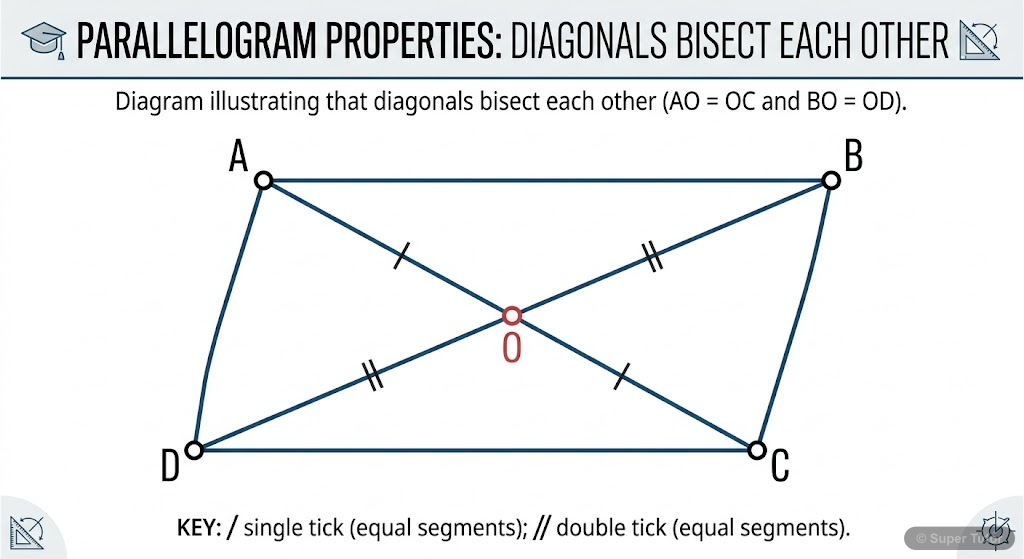
One of 3 illustrations for Quadrilaterals in Super Tutor — alongside flashcards, concept maps and practice questions.
The first 7 solutions are open to read. The other 6 are free with a Super Tutor account.
Exercise 8.1
1If the diagonals of a parallelogram are equal, then show that it is a rectangle.Show solution
Given: ABCD is a parallelogram in which diagonal AC = diagonal BD.
To prove: ABCD is a rectangle.
Proof:
In and :
- (opposite sides of a parallelogram)
- (common)
- (given, diagonals are equal)
By SSS congruence rule:
Therefore, (CPCT)
Since and is a transversal:
Since ABCD is a parallelogram with one angle , ABCD is a rectangle.
2Show that the diagonals of a square are equal and bisect each other at right angles.Show solution
Given: ABCD is a square, i.e., and all angles are .
To prove: (a) , (b) diagonals bisect each other, (c) they bisect at right angles.
(a) AC = BD:
In and :
- (common)
- (sides of a square)
By SAS:
(CPCT)
(b) Diagonals bisect each other:
Let diagonals AC and BD intersect at O.
In and :
- (sides of a square)
- (alternate interior angles, )
- (alternate interior angles)
By AAS:
and (CPCT)
Hence diagonals bisect each other.
(c) Diagonals bisect at right angles:
In and :
- (proved above)
- (sides of a square)
- (common)
By SSS:
(CPCT)
But (linear pair)
Hence diagonals bisect each other at right angles.
3Diagonal AC of a parallelogram ABCD bisects (see Fig. 8.11). Show that (i) it bisects also, (ii) ABCD is a rhombus.Show solution
Given: ABCD is a parallelogram in which diagonal AC bisects , i.e., .
(i) AC bisects :
Since and is a transversal:
Since and is a transversal:
But (given)
From (1), (2) and (3):
Therefore, AC bisects also.
(ii) ABCD is a rhombus:
In :
(sides opposite equal angles are equal)
Since ABCD is a parallelogram, and .
Therefore .
Hence ABCD is a rhombus.
4ABCD is a rectangle in which diagonal AC bisects as well as . Show that: (i) ABCD is a square (ii) diagonal BD bisects as well as .Show solution
Given: ABCD is a rectangle; AC bisects and .
So and (since each angle of a rectangle is ).
(i) ABCD is a square:
In :
Since ABCD is a rectangle, and .
Therefore .
A rectangle with all sides equal is a square.
(ii) BD bisects and :
Since ABCD is a square, .
In :
Also (since )
So BD bisects .
Similarly in :
So BD bisects also.
5In parallelogram ABCD, two points P and Q are taken on diagonal BD such that DP = BQ (see Fig. 8.12). Show that: (i) (ii) (iii) (iv) (v) APCQ is a parallelogram.Show solution
Given: ABCD is a parallelogram; P and Q are on diagonal BD such that .
(i) :
In and :
- (opposite sides of parallelogram)
- (given)
- (alternate interior angles, since and is transversal)
By SAS:
(ii) :
From (i), (CPCT)
(iii) :
In and :
- (opposite sides of parallelogram)
- (given)
- (alternate interior angles, since and is transversal)
By SAS:
(iv) :
From (iii), (CPCT)
(v) APCQ is a parallelogram:
From (ii):
From (iv):
Since both pairs of opposite sides are equal, APCQ is a parallelogram.
6ABCD is a parallelogram and AP and CQ are perpendiculars from vertices A and C on diagonal BD (see Fig. 8.13). Show that (i) (ii) .Show solution
Given: ABCD is a parallelogram; and .
(i) :
In and :
- (given, AP and CQ are perpendiculars)
- (opposite sides of parallelogram)
- (alternate interior angles, since and is transversal)
By AAS:
(ii) :
From (i), (CPCT)
7ABCD is a trapezium in which AB || CD and AD = BC (see Fig. 8.14). Show that (i) (ii) (iii) (iv) diagonal AC = diagonal BD.
[Hint: Extend AB and draw a line through C parallel to DA intersecting AB produced at E.]Show solution
Given: ABCD is a trapezium with and .
Construction: Extend AB to E and draw , meeting AB produced at E.
(i) :
Since and (by construction and given), ADCE is a parallelogram.
(opposite sides of parallelogram)
But (given), so .
In : (base angles of isosceles triangle)
(same angle)
Now, ... wait, let us use co-interior angles.
Since :
In , , so .
Also (since and , co-interior angles with )
(ii) :
Since :
Since :
(iii) :
In and :
- (common)
- (given)
- (proved in (i))
By SAS:
(iv) diagonal AC = diagonal BD:
From (iii): (CPCT)
Exercise 8.2
Free with a Super Tutor account
Free with a Super Tutor account
Free with a Super Tutor account
Free with a Super Tutor account
Free with a Super Tutor account
Free with a Super Tutor account
6 more solved questions in Quadrilaterals
They are free with a Super Tutor account, along with practice quizzes and flashcards for this chapter. Free to start, no card needed.
Frequently Asked Questions
What are the important topics in Quadrilaterals for Jammu & Kashmir Board Class 9 Mathematics?
Are these NCERT Solutions for Quadrilaterals free?
How should I revise Quadrilaterals for Class 9 exams?
Sources & Official References
Content is aligned to the official syllabus. Refer to the board website for the latest curriculum.
More resources for Quadrilaterals
For serious students
Get the full Quadrilaterals chapter — start free.
Quizzes, flashcards, an AI doubt solver and a study plan for Jammu & Kashmir Board Class 9 Mathematics. Free to start, no card needed.