Chapter 9 of 14
NCERT Solutions

Magnetism and Matter

Kerala Board · Class 12 · Physics

NCERT Solutions for Magnetism and Matter — Kerala Board Class 12 Physics.

29 questions22 flashcards5 concepts

Interactive on Super Tutor

Studying Magnetism and Matter? Get the full interactive chapter.

Quizzes, flashcards, AI doubt-solver and a step-by-step study plan — built for ncert solutions and more.

1,000+ Class 12 students started this chapter today

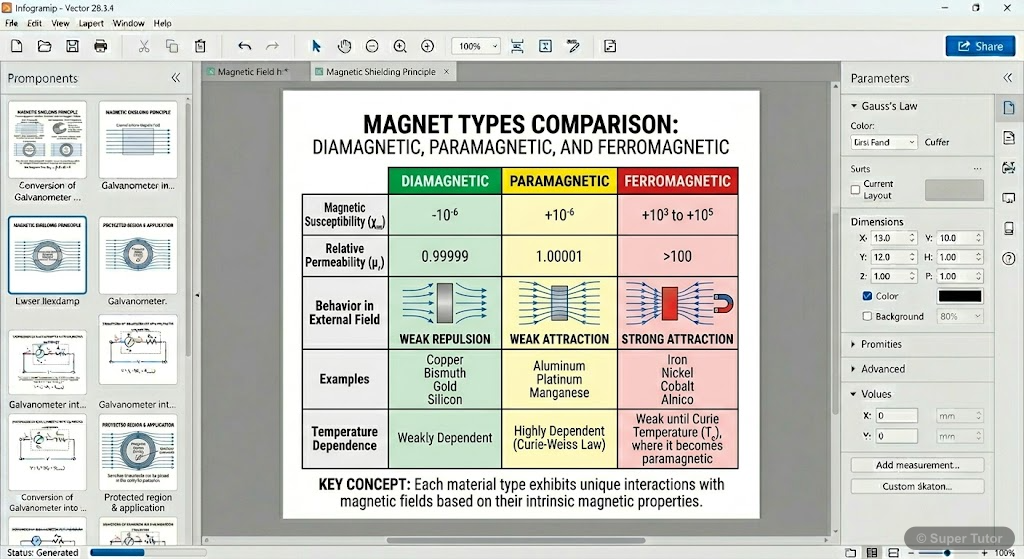
A comparison chart (table-like infographic) summarizing the key properties of diamagnetic, paramagnetic, and ferromagnetic materials, including their magnetic susceptibility, relative permeability, be
Super Tutor

This is just one of 10+ visuals inside Super Tutor's Magnetism and Matter chapter

Explore the full set
7 Questions Solved · 1 Section

EXERCISES

5.1A short bar magnet placed with its axis at 30° with a uniform external magnetic field of 0.25 T experiences a torque of magnitude equal to 4.5 × 10⁻² J. What is the magnitude of magnetic moment of the magnet?Show solution
Given:
- Angle between axis of magnet and field, θ=30°\theta = 30°
- External magnetic field, B=0.25B = 0.25 T
- Torque, τ=4.5×10²\tau = 4.5 \times 10^{-2} J

Formula used:
τ=mBsinθ\tau = mB\sin\theta

Calculation:
m=τBsinθ=4.5×1020.25×sin30°m = \frac{\tau}{B\sin\theta} = \frac{4.5 \times 10^{-2}}{0.25 \times \sin 30°}
m=4.5×1020.25×0.5=4.5×1020.125m = \frac{4.5 \times 10^{-2}}{0.25 \times 0.5} = \frac{4.5 \times 10^{-2}}{0.125}
m=0.36 J T1\boxed{m = 0.36 \text{ J T}^{-1}}
5.2A short bar magnet of magnetic moment m = 0.32 JT⁻¹ is placed in a uniform magnetic field of 0.15 T. If the bar is free to rotate in the plane of the field, which orientation would correspond to its (a) stable, and (b) unstable equilibrium? What is the potential energy of the magnet in each case?Show solution
Given:
- Magnetic moment, m=0.32m = 0.32 J T1^{-1}
- Magnetic field, B=0.15B = 0.15 T

Concept: Potential energy of a magnetic dipole in a field is U=mB=mBcosθU = -\mathbf{m}\cdot\mathbf{B} = -mB\cos\theta

(a) Stable Equilibrium:
Occurs when potential energy is minimum, i.e., θ=0°\theta = 0° (magnetic moment aligned parallel to the field B\mathbf{B}).
Ustable=mBcos0°=mBU_{\text{stable}} = -mB\cos 0° = -mB
Ustable=(0.32)(0.15)=4.8×10² JU_{\text{stable}} = -(0.32)(0.15) = \boxed{-4.8 \times 10^{-2} \text{ J}}

(b) Unstable Equilibrium:
Occurs when potential energy is maximum, i.e., θ=180°\theta = 180° (magnetic moment aligned antiparallel to the field B\mathbf{B}).
Uunstable=mBcos180°=+mBU_{\text{unstable}} = -mB\cos 180° = +mB
Uunstable=+(0.32)(0.15)=+4.8×10² JU_{\text{unstable}} = +(0.32)(0.15) = \boxed{+4.8 \times 10^{-2} \text{ J}}
5.3A closely wound solenoid of 800 turns and area of cross section 2.5 × 10⁻⁴ m² carries a current of 3.0 A. Explain the sense in which the solenoid acts like a bar magnet. What is its associated magnetic moment?Show solution
Given:
- Number of turns, N=800N = 800
- Area of cross-section, A=2.5×10⁴A = 2.5 \times 10^{-4}
- Current, I=3.0I = 3.0 A

Explanation: A current-carrying solenoid produces a magnetic field similar to that of a bar magnet. The end from which the current flows anticlockwise acts as the North pole and the end from which it flows clockwise acts as the South pole. Thus the solenoid behaves like a bar magnet with a definite north and south pole.

Formula:
m=NIAm = NIA

Calculation:
m=800×3.0×2.5×104m = 800 \times 3.0 \times 2.5 \times 10^{-4}
m=0.60 A m2=0.60 J T1\boxed{m = 0.60 \text{ A m}^2 = 0.60 \text{ J T}^{-1}}
5.4If the solenoid in Exercise 5.3 is free to turn about the vertical direction and a uniform horizontal magnetic field of 0.25 T is applied, what is the magnitude of torque on the solenoid when its axis makes an angle of 30° with the direction of applied field?Show solution
Given:
- Magnetic moment of solenoid (from Exercise 5.3), m=0.60m = 0.60 J T1^{-1}
- Magnetic field, B=0.25B = 0.25 T
- Angle, θ=30°\theta = 30°

Formula:
τ=mBsinθ\tau = mB\sin\theta

Calculation:
τ=0.60×0.25×sin30°\tau = 0.60 \times 0.25 \times \sin 30°
τ=0.60×0.25×0.5\tau = 0.60 \times 0.25 \times 0.5
τ=7.5×10² N m\boxed{\tau = 7.5 \times 10^{-2} \text{ N m}}
5.5A bar magnet of magnetic moment 1.5 JT⁻¹ lies aligned with the direction of a uniform magnetic field of 0.22 T.
(a) What is the amount of work required by an external torque to turn the magnet so as to align its magnetic moment: (i) normal to the field direction, (ii) opposite to the field direction?
(b) What is the torque on the magnet in cases (i) and (ii)?
Show solution
Given:
- Magnetic moment, m=1.5m = 1.5 J T1^{-1}
- Magnetic field, B=0.22B = 0.22 T
- Initial orientation: θ1=0°\theta_1 = 0° (aligned with field)

Formula for work done:
W=U2U1=mBcosθ2(mBcosθ1)=mB(cosθ1cosθ2)W = U_2 - U_1 = -mB\cos\theta_2 - (-mB\cos\theta_1) = mB(\cos\theta_1 - \cos\theta_2)

---

(a)(i) Turning to normal (θ2=90°\theta_2 = 90°):
W=mB(cos0°cos90°)=mB(10)=mBW = mB(\cos 0° - \cos 90°) = mB(1 - 0) = mB
W=1.5×0.22=0.33 JW = 1.5 \times 0.22 = \boxed{0.33 \text{ J}}

(a)(ii) Turning to opposite direction (θ2=180°\theta_2 = 180°):
W=mB(cos0°cos180°)=mB(1(1))=2mBW = mB(\cos 0° - \cos 180°) = mB(1 - (-1)) = 2mB
W=2×1.5×0.22=0.66 JW = 2 \times 1.5 \times 0.22 = \boxed{0.66 \text{ J}}

---

(b) Torque: τ=mBsinθ\tau = mB\sin\theta

(i) At θ=90°\theta = 90°:
τ=mBsin90°=1.5×0.22×1=0.33 N m\tau = mB\sin 90° = 1.5 \times 0.22 \times 1 = \boxed{0.33 \text{ N m}}

(ii) At θ=180°\theta = 180°:
τ=mBsin180°=1.5×0.22×0=0 N m\tau = mB\sin 180° = 1.5 \times 0.22 \times 0 = \boxed{0 \text{ N m}}
5.6A closely wound solenoid of 2000 turns and area of cross-section 1.6 × 10⁻⁴ m², carrying a current of 4.0 A, is suspended through its centre allowing it to turn in a horizontal plane.
(a) What is the magnetic moment associated with the solenoid?
(b) What is the force and torque on the solenoid if a uniform horizontal magnetic field of 7.5 × 10⁻² T is set up at an angle of 30° with the axis of the solenoid?
Show solution
Given:
- Number of turns, N=2000N = 2000
- Area of cross-section, A=1.6×10⁴A = 1.6 \times 10^{-4}
- Current, I=4.0I = 4.0 A
- Magnetic field, B=7.5×10²B = 7.5 \times 10^{-2} T
- Angle between axis and field, θ=30°\theta = 30°

---

(a) Magnetic Moment:
m=NIA=2000×4.0×1.6×104m = NIA = 2000 \times 4.0 \times 1.6 \times 10^{-4}
m=1.28 A m2=1.28 J T1\boxed{m = 1.28 \text{ A m}^2 = 1.28 \text{ J T}^{-1}}

---

(b) Force and Torque:

Force: In a uniform magnetic field, the net force on a magnetic dipole is zero.
F=0\boxed{F = 0}

Torque:
τ=mBsinθ=1.28×7.5×102×sin30°\tau = mB\sin\theta = 1.28 \times 7.5 \times 10^{-2} \times \sin 30°
τ=1.28×7.5×102×0.5\tau = 1.28 \times 7.5 \times 10^{-2} \times 0.5
τ=4.8×10² N m\boxed{\tau = 4.8 \times 10^{-2} \text{ N m}}
5.7A short bar magnet has a magnetic moment of 0.48 J T⁻¹. Give the direction and magnitude of the magnetic field produced by the magnet at a distance of 10 cm from the centre of the magnet on (a) the axis, (b) the equatorial lines (normal bisector) of the magnet.Show solution
Given:
- Magnetic moment, m=0.48m = 0.48 J T1^{-1}
- Distance, r=10r = 10 cm =0.1= 0.1 m
- μ04π=107\frac{\mu_0}{4\pi} = 10^{-7} T m A1^{-1}

---

(a) Field on the axial line:

Formula:
Baxial=μ04π2mr3B_{\text{axial}} = \frac{\mu_0}{4\pi} \cdot \frac{2m}{r^3}

Calculation:
Baxial=107×2×0.48(0.1)3B_{\text{axial}} = 10^{-7} \times \frac{2 \times 0.48}{(0.1)^3}
Baxial=107×0.96103B_{\text{axial}} = 10^{-7} \times \frac{0.96}{10^{-3}}
Baxial=107×960B_{\text{axial}} = 10^{-7} \times 960
Baxial=0.96×10⁴ T=0.96 G\boxed{B_{\text{axial}} = 0.96 \times 10^{-4} \text{ T} = 0.96 \text{ G}}

Direction: Along the South-to-North direction of the magnet (i.e., along the magnetic moment m\mathbf{m}).

---

(b) Field on the equatorial line:

Formula:
Bequatorial=μ04πmr3B_{\text{equatorial}} = \frac{\mu_0}{4\pi} \cdot \frac{m}{r^3}

Calculation:
Bequatorial=107×0.48(0.1)3B_{\text{equatorial}} = 10^{-7} \times \frac{0.48}{(0.1)^3}
Bequatorial=107×0.48103B_{\text{equatorial}} = 10^{-7} \times \frac{0.48}{10^{-3}}
Bequatorial=107×480B_{\text{equatorial}} = 10^{-7} \times 480
Bequatorial=0.48×10⁴ T=0.48 G\boxed{B_{\text{equatorial}} = 0.48 \times 10^{-4} \text{ T} = 0.48 \text{ G}}

Direction: Opposite to the direction of the magnetic moment m\mathbf{m} (i.e., from North to South pole of the magnet, antiparallel to m\mathbf{m}).

Stuck on a step?

Ask Super Tutor AI to explain any solution on this page in a simpler way — free, 24x7.

Ask a Doubt Free

Frequently Asked Questions

What are the important topics in Magnetism and Matter for Kerala Board Class 12 Physics?
Magnetism and Matter covers several key topics that are frequently asked in Kerala Board Class 12 board exams. Focus on the core concepts listed on this page and practise related questions to build confidence.
How to score full marks in Magnetism and Matter — Kerala Board Class 12 Physics?
Understand the core concepts first, then work through the 29 practice questions available for this chapter. Revise formulas and definitions regularly, and use flashcards for quick recall before the exam.
Where can I get free NCERT Solutions for Magnetism and Matter Class 12 Physics?
This page has free step-by-step NCERT Solutions for every exercise question in Magnetism and Matter (Kerala Board Class 12 Physics) — written the way examiners award marks: given, formula, working, answer.

Sources & Official References

Content is aligned to the official syllabus. Refer to the board website for the latest curriculum.

For serious students

Get the full Magnetism and Matter chapter — for free.

Quizzes, flashcards, AI doubt-solver and a step-by-step study plan for Kerala Board Class 12 Physics.