Chapter 10 of 14
NCERT Solutions

Nucle

Kerala Board · Class 12 · Physics

NCERT Solutions for Nucle — Kerala Board Class 12 Physics.

30 questions22 flashcards5 concepts

Interactive on Super Tutor

Studying Nucle? Get the full interactive chapter.

Quizzes, flashcards, AI doubt-solver and a step-by-step study plan — built for ncert solutions and more.

1,000+ Class 12 students started this chapter today

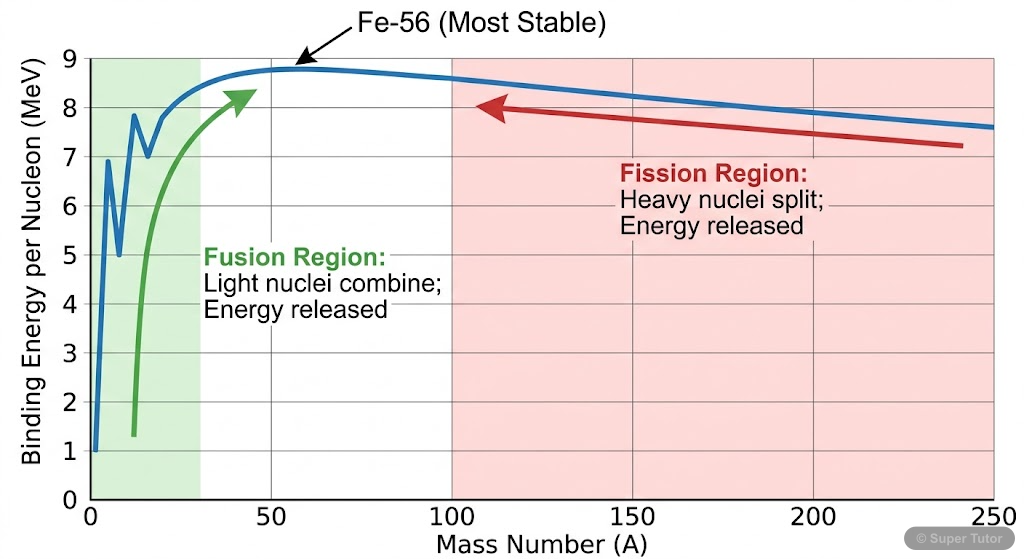
A graph showing the binding energy per nucleon as a function of mass number, highlighting regions of stability, and explaining nuclear fission and fusion processes.
Super Tutor

This is just one of 15+ visuals inside Super Tutor's Nucle chapter

Explore the full set
10 Questions Solved · 1 Section

EXERCISES

13.1Obtain the binding energy (in MeV) of a nitrogen nucleus (147N)\left(\frac{14}{7}\mathrm{N}\right), given m(147N)=14.00307um\left(\frac{14}{7}\mathrm{N}\right) = 14.00307\,\mathrm{u}.Show solution
Given:
- Z=7Z = 7 (protons), N=AZ=147=7N = A - Z = 14 - 7 = 7 (neutrons)
- m(147N)=14.00307um\left(\frac{14}{7}\mathrm{N}\right) = 14.00307\,\mathrm{u}
- mp=mH=1.007825um_p = m_H = 1.007825\,\mathrm{u}, mn=1.008665um_n = 1.008665\,\mathrm{u}

Formula:
ΔM=[ZmH+(AZ)mn]M\Delta M = \bigl[Z\,m_H + (A-Z)\,m_n\bigr] - M

Step 1: Calculate total mass of constituents.
Σm=7×1.007825+7×1.008665\Sigma m = 7 \times 1.007825 + 7 \times 1.008665
=7.054775+7.060655=14.115430u= 7.054775 + 7.060655 = 14.115430\,\mathrm{u}

Step 2: Calculate mass defect.
ΔM=14.11543014.00307=0.11236u\Delta M = 14.115430 - 14.00307 = 0.11236\,\mathrm{u}

Step 3: Convert to energy.
ΔEb=ΔM×931.5MeV/u\Delta E_b = \Delta M \times 931.5\,\mathrm{MeV/u}
=0.11236×931.5=104.66MeV= 0.11236 \times 931.5 = 104.66\,\mathrm{MeV}

Binding energy of 147N\frac{14}{7}\mathrm{N} nucleus 104.66MeV\approx 104.66\,\mathrm{MeV}.
13.2Obtain the binding energy of the nuclei 5626Fe\frac{56}{26}\mathrm{Fe} and 20983Bi\frac{209}{83}\mathrm{Bi} in units of MeV from the following data:
m(5626Fe)=55.934939u,m(20983Bi)=208.980388um\left(\frac{56}{26}\mathrm{Fe}\right) = 55.934939\,\mathrm{u}, \quad m\left(\frac{209}{83}\mathrm{Bi}\right) = 208.980388\,\mathrm{u}
Show solution
Given data: mH=1.007825um_H = 1.007825\,\mathrm{u}, mn=1.008665um_n = 1.008665\,\mathrm{u}, 1u=931.5MeV/c21\,\mathrm{u} = 931.5\,\mathrm{MeV/c^2}

---

For 5626Fe\frac{56}{26}\mathrm{Fe}: Z=26Z=26, A=56A=56, N=30N=30

Step 1: Total mass of constituents.
Σm=26×1.007825+30×1.008665\Sigma m = 26 \times 1.007825 + 30 \times 1.008665
=26.20345+30.25995=56.46340u= 26.20345 + 30.25995 = 56.46340\,\mathrm{u}

Step 2: Mass defect.
ΔM=56.4634055.934939=0.528461u\Delta M = 56.46340 - 55.934939 = 0.528461\,\mathrm{u}

Step 3: Binding energy.
ΔEb=0.528461×931.5=492.26MeV\Delta E_b = 0.528461 \times 931.5 = 492.26\,\mathrm{MeV}

Binding energy per nucleon =492.26568.79MeV/nucleon= \dfrac{492.26}{56} \approx 8.79\,\mathrm{MeV/nucleon}

---

For 20983Bi\frac{209}{83}\mathrm{Bi}: Z=83Z=83, A=209A=209, N=126N=126

Step 1: Total mass of constituents.
Σm=83×1.007825+126×1.008665\Sigma m = 83 \times 1.007825 + 126 \times 1.008665
=83.64948+127.09179=210.74127u= 83.64948 + 127.09179 = 210.74127\,\mathrm{u}

Step 2: Mass defect.
ΔM=210.74127208.980388=1.760882u\Delta M = 210.74127 - 208.980388 = 1.760882\,\mathrm{u}

Step 3: Binding energy.
ΔEb=1.760882×931.5=1640.26MeV\Delta E_b = 1.760882 \times 931.5 = 1640.26\,\mathrm{MeV}

Binding energy per nucleon =1640.262097.85MeV/nucleon= \dfrac{1640.26}{209} \approx 7.85\,\mathrm{MeV/nucleon}
13.3A given coin has a mass of 3.0g3.0\,\mathrm{g}. Calculate the nuclear energy that would be required to separate all the neutrons and protons from each other. For simplicity assume that the coin is entirely made of 6329Cu\frac{63}{29}\mathrm{Cu} atoms (of mass 62.92960u62.92960\,\mathrm{u}).Show solution
Given:
- Mass of coin =3.0g= 3.0\,\mathrm{g}
- A=63A = 63, Z=29Z = 29, N=34N = 34
- m(6329Cu)=62.92960um\left(\frac{63}{29}\mathrm{Cu}\right) = 62.92960\,\mathrm{u}
- mH=1.007825um_H = 1.007825\,\mathrm{u}, mn=1.008665um_n = 1.008665\,\mathrm{u}
- NA=6.023×10²³mol1N_A = 6.023 \times 10^{23}\,\mathrm{mol}^{-1}

Step 1: Number of Cu atoms in the coin.
n=3.063×6.023×1023=3.0×6.023×102363n = \frac{3.0}{63} \times 6.023 \times 10^{23} = \frac{3.0 \times 6.023 \times 10^{23}}{63}
=2.868×10²²atoms= 2.868 \times 10^{22}\,\text{atoms}

Step 2: Mass defect per nucleus.
Σm=29×1.007825+34×1.008665\Sigma m = 29 \times 1.007825 + 34 \times 1.008665
=29.22693+34.29461=63.52154u= 29.22693 + 34.29461 = 63.52154\,\mathrm{u}
ΔM=63.5215462.92960=0.59194u\Delta M = 63.52154 - 62.92960 = 0.59194\,\mathrm{u}

Step 3: Binding energy per nucleus.
ΔEb=0.59194×931.5=551.38MeV\Delta E_b = 0.59194 \times 931.5 = 551.38\,\mathrm{MeV}

Step 4: Total energy for all nuclei in the coin.
Etotal=551.38×2.868×1022MeVE_{\text{total}} = 551.38 \times 2.868 \times 10^{22}\,\mathrm{MeV}
=1.5814×1025MeV= 1.5814 \times 10^{25}\,\mathrm{MeV}

Converting to Joules:
Etotal=1.5814×1025×1.6×1013JE_{\text{total}} = 1.5814 \times 10^{25} \times 1.6 \times 10^{-13}\,\mathrm{J}
Etotal2.53×1012J\boxed{E_{\text{total}} \approx 2.53 \times 10^{12}\,\mathrm{J}}
13.4Obtain approximately the ratio of the nuclear radii of the gold isotope 19779Au\frac{197}{79}\mathrm{Au} and the silver isotope 10747Ag\frac{107}{47}\mathrm{Ag}.Show solution
Given:
- AAu=197A_{\mathrm{Au}} = 197, AAg=107A_{\mathrm{Ag}} = 107
- Nuclear radius formula: R=R0A1/3R = R_0 A^{1/3}

Step 1: Write the ratio of radii.
RAuRAg=R0(AAu)1/3R0(AAg)1/3=(197107)1/3\frac{R_{\mathrm{Au}}}{R_{\mathrm{Ag}}} = \frac{R_0 (A_{\mathrm{Au}})^{1/3}}{R_0 (A_{\mathrm{Ag}})^{1/3}} = \left(\frac{197}{107}\right)^{1/3}

Step 2: Calculate.
197107=1.8411\frac{197}{107} = 1.8411
(1.8411)1/31.2285\left(1.8411\right)^{1/3} \approx 1.2285

RAuRAg1.23\boxed{\frac{R_{\mathrm{Au}}}{R_{\mathrm{Ag}}} \approx 1.23}

*(Note: The question states 10779Au\frac{107}{79}\mathrm{Au} in the OCR but the standard problem uses 19779Au\frac{197}{79}\mathrm{Au}; the calculation above uses A=197A=197 for gold as is standard.)*
13.5The QQ value of a nuclear reaction A+bC+dA + b \rightarrow C + d is defined by Q=[mA+mbmCmd]c2Q = [m_A + m_b - m_C - m_d]c^2. Determine the QQ-value of the following reactions and state whether the reactions are exothermic or endothermic.
(i) 11H+13H12H+12H{}^1_1\mathrm{H} + {}^3_1\mathrm{H} \rightarrow {}^2_1\mathrm{H} + {}^2_1\mathrm{H}
(ii) 612C+612C1020Ne+24He{}^{12}_6\mathrm{C} + {}^{12}_6\mathrm{C} \rightarrow {}^{20}_{10}\mathrm{Ne} + {}^4_2\mathrm{He}
Show solution
Given atomic masses:
- m(12H)=2.014102um({}^2_1\mathrm{H}) = 2.014102\,\mathrm{u}
- m(13H)=3.016049um({}^3_1\mathrm{H}) = 3.016049\,\mathrm{u}
- m(612C)=12.000000um({}^{12}_6\mathrm{C}) = 12.000000\,\mathrm{u}
- m(1020Ne)=19.992439um({}^{20}_{10}\mathrm{Ne}) = 19.992439\,\mathrm{u}
- m(24He)=4.002603um({}^4_2\mathrm{He}) = 4.002603\,\mathrm{u}
- m(11H)=1.007825um({}^1_1\mathrm{H}) = 1.007825\,\mathrm{u}

*Note: Since the same number of electrons appear on both sides, atomic masses can be used directly in place of nuclear masses.*

---

(i) 11H+13H12H+12H{}^1_1\mathrm{H} + {}^3_1\mathrm{H} \rightarrow {}^2_1\mathrm{H} + {}^2_1\mathrm{H}

Initial mass:
mi=1.007825+3.016049=4.023874um_i = 1.007825 + 3.016049 = 4.023874\,\mathrm{u}

Final mass:
mf=2×2.014102=4.028204um_f = 2 \times 2.014102 = 4.028204\,\mathrm{u}

Mass difference:
Δm=mimf=4.0238744.028204=0.004330u\Delta m = m_i - m_f = 4.023874 - 4.028204 = -0.004330\,\mathrm{u}

Q-value:
Q=0.004330×931.5=4.034MeVQ = -0.004330 \times 931.5 = -4.034\,\mathrm{MeV}

Since Q < 0, the reaction is endothermic.

---

(ii) 612C+612C1020Ne+24He{}^{12}_6\mathrm{C} + {}^{12}_6\mathrm{C} \rightarrow {}^{20}_{10}\mathrm{Ne} + {}^4_2\mathrm{He}

Initial mass:
mi=2×12.000000=24.000000um_i = 2 \times 12.000000 = 24.000000\,\mathrm{u}

Final mass:
mf=19.992439+4.002603=23.995042um_f = 19.992439 + 4.002603 = 23.995042\,\mathrm{u}

Mass difference:
Δm=24.00000023.995042=0.004958u\Delta m = 24.000000 - 23.995042 = 0.004958\,\mathrm{u}

Q-value:
Q=0.004958×931.5=4.618MeVQ = 0.004958 \times 931.5 = 4.618\,\mathrm{MeV}

Since Q > 0, the reaction is exothermic.
13.6Suppose, we think of fission of a 5626Fe\frac{56}{26}\mathrm{Fe} nucleus into two equal fragments 2813Al\frac{28}{13}\mathrm{Al}. Is the fission energetically possible? Argue by working out QQ of the process. Given m(5626Fe)=55.93494um\left(\frac{56}{26}\mathrm{Fe}\right) = 55.93494\,\mathrm{u} and m(2813Al)=27.98191um\left(\frac{28}{13}\mathrm{Al}\right) = 27.98191\,\mathrm{u}.Show solution
Reaction: 2656Fe21328Al{}^{56}_{26}\mathrm{Fe} \rightarrow 2\,{}^{28}_{13}\mathrm{Al}

Step 1: Calculate Q-value.
Q=[m(2656Fe)2m(1328Al)]c2Q = \bigl[m({}^{56}_{26}\mathrm{Fe}) - 2\,m({}^{28}_{13}\mathrm{Al})\bigr]c^2

Step 2: Substitute values.
Δm=55.934942×27.98191\Delta m = 55.93494 - 2 \times 27.98191
=55.9349455.96382=0.02888u= 55.93494 - 55.96382 = -0.02888\,\mathrm{u}

Step 3: Convert to MeV.
Q=0.02888×931.5=26.90MeVQ = -0.02888 \times 931.5 = -26.90\,\mathrm{MeV}

Since Q < 0, the fission of 2656Fe{}^{56}_{26}\mathrm{Fe} into two 1328Al{}^{28}_{13}\mathrm{Al} fragments is not energetically possible (it is endothermic — energy would need to be supplied). This makes physical sense because 2656Fe{}^{56}_{26}\mathrm{Fe} lies near the peak of the binding energy per nucleon curve, so breaking it into lighter fragments does not release energy.
13.7The fission properties of 94239Pu{}^{239}_{94}\mathrm{Pu} are very similar to those of 92235U{}^{235}_{92}\mathrm{U}. The average energy released per fission is 180 MeV. How much energy, in MeV, is released if all the atoms in 1 kg of pure 94239Pu{}^{239}_{94}\mathrm{Pu} undergo fission?Show solution
Given:
- Mass of 94239Pu=1kg=1000g{}^{239}_{94}\mathrm{Pu} = 1\,\mathrm{kg} = 1000\,\mathrm{g}
- Molar mass =239g/mol= 239\,\mathrm{g/mol}
- Energy per fission =180MeV= 180\,\mathrm{MeV}
- NA=6.023×10²³mol1N_A = 6.023 \times 10^{23}\,\mathrm{mol}^{-1}

Step 1: Number of atoms in 1 kg.
N=1000239×6.023×1023N = \frac{1000}{239} \times 6.023 \times 10^{23}
=4.18×1021×6.023×1023(incorrect grouping — redo)= 4.18 \times 10^{21} \times 6.023 \times 10^{23}\,\text{(incorrect grouping — redo)}
N=1000×6.023×1023239=6.023×1026239N = \frac{1000 \times 6.023 \times 10^{23}}{239} = \frac{6.023 \times 10^{26}}{239}
=2.52×1024atoms= 2.52 \times 10^{24}\,\text{atoms}

Step 2: Total energy released.
E=N×180MeVE = N \times 180\,\mathrm{MeV}
=2.52×1024×180= 2.52 \times 10^{24} \times 180
E4.536×1026MeV\boxed{E \approx 4.536 \times 10^{26}\,\mathrm{MeV}}

In Joules:
E=4.536×1026×1.6×1013=7.26×10¹³JE = 4.536 \times 10^{26} \times 1.6 \times 10^{-13} = 7.26 \times 10^{13}\,\mathrm{J}
13.8How long can an electric lamp of 100 W be kept glowing by fusion of 2.0kg2.0\,\mathrm{kg} of deuterium? Take the fusion reaction as
12H+12H23He+n+3.27MeV{}^2_1\mathrm{H} + {}^2_1\mathrm{H} \rightarrow {}^3_2\mathrm{He} + n + 3.27\,\mathrm{MeV}
Show solution
Given:
- Mass of deuterium =2.0kg=2000g= 2.0\,\mathrm{kg} = 2000\,\mathrm{g}
- Molar mass of deuterium =2g/mol= 2\,\mathrm{g/mol}
- Energy per fusion event =3.27MeV= 3.27\,\mathrm{MeV} (two deuterons fuse)
- Power of lamp P=100WP = 100\,\mathrm{W}
- NA=6.023×10²³mol1N_A = 6.023 \times 10^{23}\,\mathrm{mol}^{-1}

Step 1: Number of deuterium nuclei.
N=20002×6.023×1023=1000×6.023×1023=6.023×1026N = \frac{2000}{2} \times 6.023 \times 10^{23} = 1000 \times 6.023 \times 10^{23} = 6.023 \times 10^{26}

Step 2: Number of fusion events.
Each fusion event consumes 2 deuterons:
Nfusions=6.023×10262=3.0115×1026N_{\text{fusions}} = \frac{6.023 \times 10^{26}}{2} = 3.0115 \times 10^{26}

Step 3: Total energy released.
E=3.0115×1026×3.27MeVE = 3.0115 \times 10^{26} \times 3.27\,\mathrm{MeV}
=9.848×1026MeV= 9.848 \times 10^{26}\,\mathrm{MeV}
=9.848×1026×1.6×1013J= 9.848 \times 10^{26} \times 1.6 \times 10^{-13}\,\mathrm{J}
=1.576×10¹⁴J= 1.576 \times 10^{14}\,\mathrm{J}

Step 4: Time for which lamp glows.
t=EP=1.576×1014100=1.576×10¹²st = \frac{E}{P} = \frac{1.576 \times 10^{14}}{100} = 1.576 \times 10^{12}\,\mathrm{s}

Converting to years (1year=3.154×10⁷s1\,\mathrm{year} = 3.154 \times 10^7\,\mathrm{s}):
t=1.576×10123.154×1074.99×104yearst = \frac{1.576 \times 10^{12}}{3.154 \times 10^7} \approx 4.99 \times 10^4\,\mathrm{years}

t5.0×104years\boxed{t \approx 5.0 \times 10^4\,\text{years}}
13.9Calculate the height of the potential barrier for a head on collision of two deuterons. (Hint: The height of the potential barrier is given by the Coulomb repulsion between the two deuterons when they just touch each other. Assume that they can be taken as hard spheres of radius 2.0 fm.)Show solution
Given:
- Radius of each deuteron r=2.0fm=2.0×10¹⁵mr = 2.0\,\mathrm{fm} = 2.0 \times 10^{-15}\,\mathrm{m}
- Charge of each deuteron q=e=1.6×10¹⁹Cq = e = 1.6 \times 10^{-19}\,\mathrm{C}
- 14πε0=9×10⁹Nm2C2\dfrac{1}{4\pi\varepsilon_0} = 9 \times 10^9\,\mathrm{N\,m^2\,C^{-2}}

Concept: When two deuterons just touch, the distance between their centres is d=r+r=2rd = r + r = 2r. The potential barrier height equals the Coulomb potential energy at this separation.

Step 1: Distance between centres when touching.
d=2r=2×2.0×1015=4.0×10¹⁵md = 2r = 2 \times 2.0 \times 10^{-15} = 4.0 \times 10^{-15}\,\mathrm{m}

Step 2: Coulomb potential energy.
U=14πε0e2dU = \frac{1}{4\pi\varepsilon_0}\cdot\frac{e^2}{d}
=9×109×(1.6×1019)24.0×1015= \frac{9 \times 10^9 \times (1.6 \times 10^{-19})^2}{4.0 \times 10^{-15}}
=9×109×2.56×10384.0×1015= \frac{9 \times 10^9 \times 2.56 \times 10^{-38}}{4.0 \times 10^{-15}}
=2.304×10284.0×1015= \frac{2.304 \times 10^{-28}}{4.0 \times 10^{-15}}
=5.76×10¹⁴J= 5.76 \times 10^{-14}\,\mathrm{J}

Step 3: Convert to MeV.
U=5.76×10141.6×1013=0.36MeVU = \frac{5.76 \times 10^{-14}}{1.6 \times 10^{-13}} = 0.36\,\mathrm{MeV}

Height of potential barrier360keV=0.36MeV\boxed{\text{Height of potential barrier} \approx 360\,\mathrm{keV} = 0.36\,\mathrm{MeV}}
13.10From the relation R=R0A1/3R = R_0 A^{1/3}, where R0R_0 is a constant and AA is the mass number of a nucleus, show that the nuclear matter density is nearly constant (i.e. independent of AA).Show solution
Given: R=R0A1/3R = R_0 A^{1/3}, where R0=1.2fmR_0 = 1.2\,\mathrm{fm}.

Step 1: Volume of the nucleus (assumed spherical).
V=43πR3=43π(R0A1/3)3=43πR03AV = \frac{4}{3}\pi R^3 = \frac{4}{3}\pi (R_0 A^{1/3})^3 = \frac{4}{3}\pi R_0^3 A

Step 2: Mass of the nucleus.
The nucleus contains AA nucleons, each of mass approximately mm (mass of a proton or neutron 1.67×1027kg\approx 1.67 \times 10^{-27}\,\mathrm{kg}):
MAmM \approx A \cdot m

Step 3: Nuclear density.
ρ=MV=Am43πR03A=m43πR03\rho = \frac{M}{V} = \frac{A \cdot m}{\dfrac{4}{3}\pi R_0^3 A} = \frac{m}{\dfrac{4}{3}\pi R_0^3}

Observation: The mass number AA cancels completely from the expression. Therefore, ρ\rho is independent of AA — it is the same for all nuclei.

Step 4: Numerical estimate.
ρ=1.67×102743π(1.2×10¹⁵)3\rho = \frac{1.67 \times 10^{-27}}{\dfrac{4}{3}\pi (1.2 \times 10^{-15})^3}
=1.67×102743π×1.728×1045= \frac{1.67 \times 10^{-27}}{\dfrac{4}{3}\pi \times 1.728 \times 10^{-45}}
=1.67×10277.238×1045= \frac{1.67 \times 10^{-27}}{7.238 \times 10^{-45}}
2.3×10¹⁷kg/m3\approx 2.3 \times 10^{17}\,\mathrm{kg/m^3}

This is of the order of 1017kg/m310^{17}\,\mathrm{kg/m^3}, confirming that nuclear matter density is nearly constant and independent of the mass number AA.

Stuck on a step?

Ask Super Tutor AI to explain any solution on this page in a simpler way — free, 24x7.

Ask a Doubt Free

Frequently Asked Questions

What are the important topics in Nucle for Kerala Board Class 12 Physics?
Nucle covers several key topics that are frequently asked in Kerala Board Class 12 board exams. Focus on the core concepts listed on this page and practise related questions to build confidence.
How to score full marks in Nucle — Kerala Board Class 12 Physics?
Understand the core concepts first, then work through the 30 practice questions available for this chapter. Revise formulas and definitions regularly, and use flashcards for quick recall before the exam.
Where can I get free NCERT Solutions for Nucle Class 12 Physics?
This page has free step-by-step NCERT Solutions for every exercise question in Nucle (Kerala Board Class 12 Physics) — written the way examiners award marks: given, formula, working, answer.

Sources & Official References

Content is aligned to the official syllabus. Refer to the board website for the latest curriculum.

For serious students

Get the full Nucle chapter — for free.

Quizzes, flashcards, AI doubt-solver and a step-by-step study plan for Kerala Board Class 12 Physics.