Social Influence and Group Processes — Flashcards
Manipur Board · Class 12 · Psychology
68 flashcards for Social Influence and Group Processes (Manipur Board Class 12 Psychology) to test yourself on key terms and facts.
Interactive on Super Tutor
Studying Social Influence and Group Processes? Get the full interactive chapter.
Quizzes, flashcards, AI doubt-solver and a step-by-step study plan — built for flashcards and more.
Free trial, no card needed.
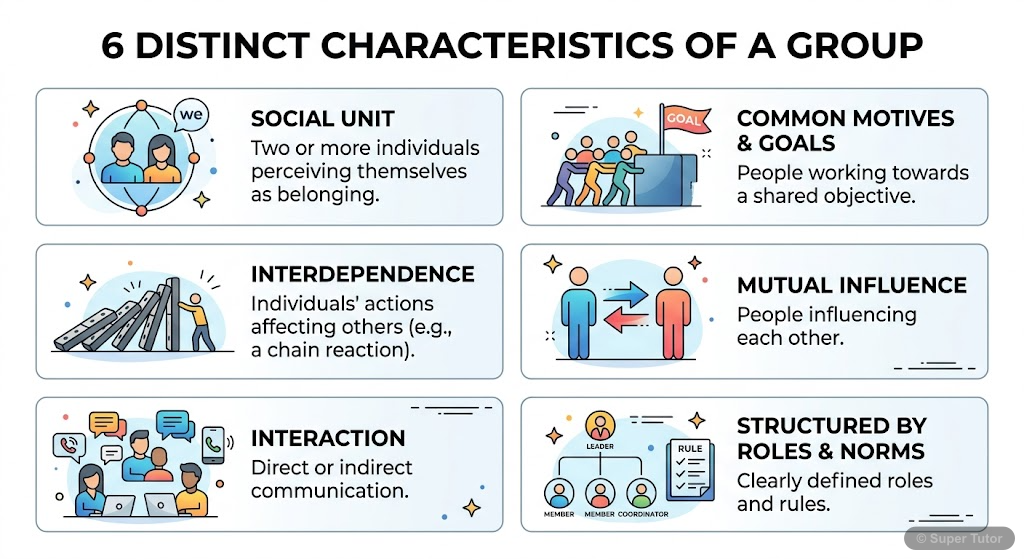
Learn better with visuals Super Tutor pairs illustrations like this with notes and quizzes for Social Influence and Group Processes.
What is a group in psychology?
Answer
A group is an organised system of two or more individuals who interact and depend on one another, share common motives, have role relationships, and follow norms that regulate behaviour. Family, class…
मनोविज्ञान में समूह क्या है?
Answer
समूह दो या दो से अधिक व्यक्तियों की एक संगठित प्रणाली है जो परस्पर संपर्क करते हैं और एक दूसरे पर निर्भर करते हैं, सामान्य उद्देश्यों को साझा करते हैं, भूमिका संबंध रखते हैं, और व्यवहार को विनियमित कर…
Why are a crowd and a group not the same?
Answer
A crowd has no structure, no clear belongingness, and no interdependence among members. A group has roles, norms, status differences, and mutual dependence. A crowd may collect by chance, but a group …
भीड़ और समूह एक ही क्यों नहीं होते?
Answer
भीड़ में कोई संरचना नहीं होती, कोई स्पष्ट अपनत्व नहीं होता, और सदस्यों के बीच कोई अन्योन्याश्रय नहीं होता। एक समूह में भूमिकाएँ, मानदंड, स्थिति में अंतर और आपसी निर्भरता होती है। भीड़ संयोग से एकत्रित…
What makes group formation possible?
Answer
Group formation is facilitated by proximity, similarity, and common motives and goals. Repeated contact, shared interests, and shared aims help people come together as a group.
समूह का निर्माण किस कारण से संभव है?
Answer
समूह का निर्माण निकटता, समानता और सामान्य उद्देश्यों और लक्ष्यों द्वारा किया जाता है। बार-बार संपर्क, साझा हित और साझा लक्ष्य लोगों को एक समूह के रूप में एक साथ आने में मदद करते हैं।…
Why do people join groups?
Answer
People join groups for security, status, self-esteem, satisfaction of psychological and social needs, goal achievement, and knowledge and information. Groups give comfort, recognition, belongingness, …
लोग समूहों में क्यों शामिल होते हैं?
Answer
लोग सुरक्षा, प्रतिष्ठा, आत्मसम्मान, मनोवैज्ञानिक और सामाजिक आवश्यकताओं की संतुष्टि, लक्ष्य प्राप्ति और ज्ञान एवं सूचना के लिए समूहों में शामिल होते हैं। समूह आराम, मान्यता, अपनत्व और समर्थन देते हैं।…
+60 more flashcards
Practise AllFrequently Asked Questions
What are the important topics in Social Influence and Group Processes for Manipur Board Class 12 Psychology?
How many flashcards are available for Social Influence and Group Processes?
How should I revise Social Influence and Group Processes for the Manipur Board Class 12 board exam?
Sources & Official References
Content is aligned to the official syllabus. Refer to the board website for the latest curriculum.
More resources for Social Influence and Group Processes
Practice Quiz
Test yourself with a quick quiz
Important Questions
Exam-style questions with answers
Revision Notes
Key points for last-minute revision
Chapter Summary
Understand the chapter at a glance
Concept Maps
See how topics connect
Study Plan
Step-by-step plan for this chapter
Syllabus
What topics to cover
NCERT Solutions
Every textbook question solved step by step
For serious students
Get the full Social Influence and Group Processes chapter — start free.
Quizzes, flashcards, an AI doubt solver and a study plan for Manipur Board Class 12 Psychology. Free to start, no card needed.