Social Influence and Group Processes — Practice Quiz
Manipur Board · Class 12 · Psychology
Try a 4-question quiz on Social Influence and Group Processes for Manipur Board Class 12 Psychology: tap an answer to check it and see why.
Interactive on Super Tutor
Studying Social Influence and Group Processes? Get the full interactive chapter.
Quizzes, flashcards, AI doubt-solver and a step-by-step study plan — built for practice quiz and more.
Free trial, no card needed.
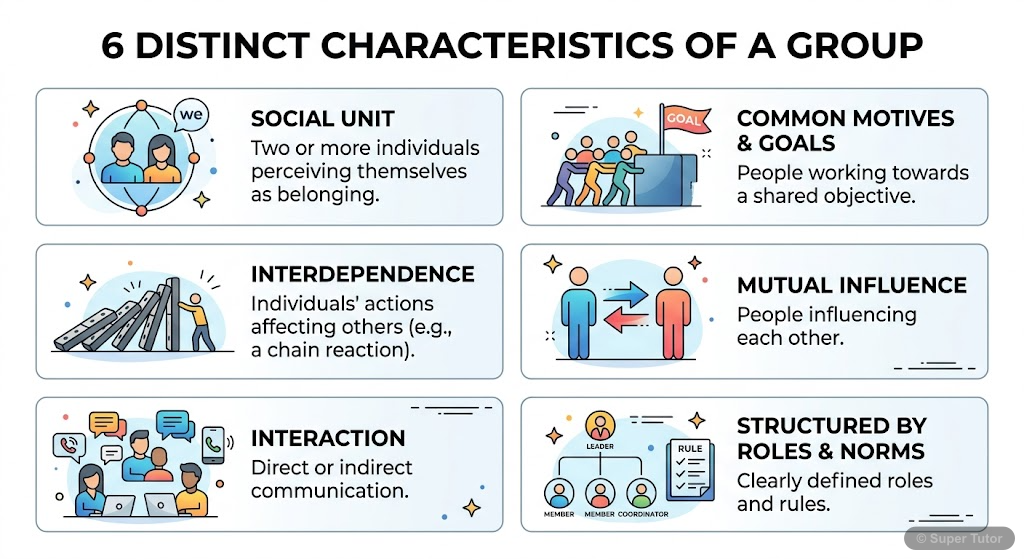
Learn better with visuals Super Tutor pairs illustrations like this with notes and quizzes for Social Influence and Group Processes.
Quick Quiz: Social Influence and Group Processes
0/4Tap an answer to check it instantly. No sign-up needed for these 4.
What is the minimum number of individuals required to form a group?
Your family is an example of which type of group?
The first stage in Tuckman's model of group formation is:
Social loafing refers to:
Sample Questions
Which of the following are characteristics of a group? (Select all correct answers)
Show answer
Interdependence among members, Common motives and goals, Set of roles and norms
Groups have interdependence, common goals, and structured roles/norms. They are not random collections and must have interaction.
Which factors facilitate group formation? (Select all correct answers)
Show answer
Proximity, Similarity, Common goals
Proximity (being close), similarity in interests/attitudes, and common motives/goals all help in group formation. Physical distance hinders it.
Groupthink occurs when:
Show answer
Groups prioritize unanimity over realistic appraisal
Groupthink happens when highly cohesive groups prioritize unanimity and consensus over realistic evaluation of alternatives, leading to poor decisions.
Which term refers to one's own group?
Show answer
Ingroup
Ingroup refers to one's own group (we), while outgroup refers to other groups (they). This categorization affects social perceptions.
+45 more questions on Social Influence and Group Processes (Manipur Board Class 12 Psychology)
Practise AllFrequently Asked Questions
What are the important topics in Social Influence and Group Processes for Manipur Board Class 12 Psychology?
How many practice questions are there for Social Influence and Group Processes?
Sources & Official References
Content is aligned to the official syllabus. Refer to the board website for the latest curriculum.
More resources for Social Influence and Group Processes
Important Questions
Exam-style questions with answers
Revision Notes
Key points for last-minute revision
Chapter Summary
Understand the chapter at a glance
Concept Maps
See how topics connect
Study Plan
Step-by-step plan for this chapter
Flashcards
Quick-fire cards for active recall
Syllabus
What topics to cover
NCERT Solutions
Every textbook question solved step by step
For serious students
Get the full Social Influence and Group Processes chapter — start free.
Quizzes, flashcards, an AI doubt solver and a study plan for Manipur Board Class 12 Psychology. Free to start, no card needed.