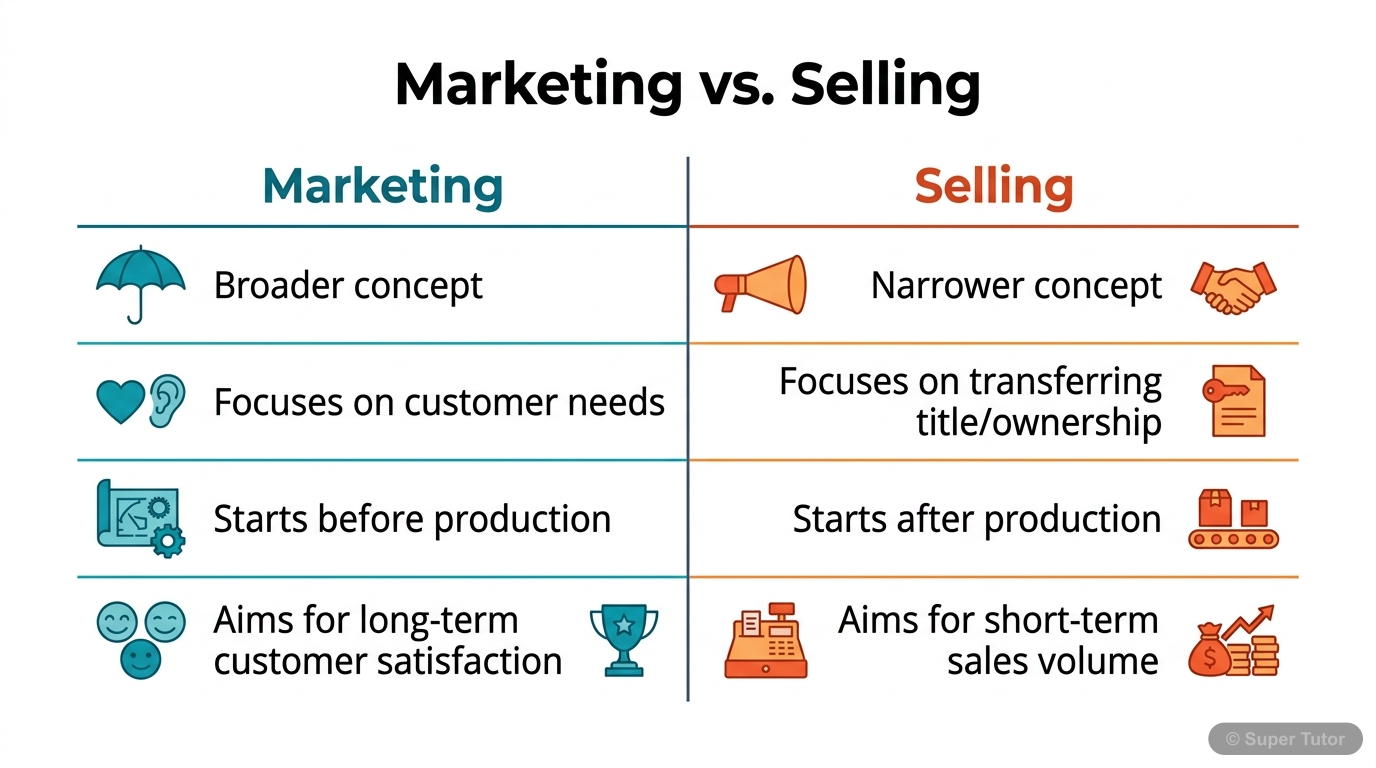
Marketing
Meghalaya Board · Class 12 · Business Studies
NCERT Solutions for Marketing — Meghalaya Board Class 12 Business Studies.
Interactive on Super Tutor
Studying Marketing? Get the full interactive chapter.
Quizzes, flashcards, AI doubt-solver and a step-by-step study plan — built for ncert solutions and more.
1,000+ Class 12 students started this chapter today

Super Tutor has 17+ illustrations like this for Marketing alone — flashcards, concept maps, and step-by-step visuals.
See them allVery Short Answer Type
1State any two advantages of branding to marketers of goods and services.Show solution
Two advantages of branding to marketers:
(i) Helps in product differentiation: A brand name helps a marketer distinguish his product from competitors' products. For example, 'Surf Excel' is differentiated from other detergents through its brand name, making it easier for consumers to identify and choose it.
(ii) Enables differential pricing: A well-established brand commands a premium price. Marketers can charge higher prices for branded products compared to unbranded ones because consumers associate the brand with quality and reliability. For example, branded medicines are priced higher than generic ones.
Additional advantages include: Helps in advertising and promotion, creates brand loyalty, and facilitates easy introduction of new products under the same brand name.
2How does branding help in differential pricing?Show solution
Concept: Differential pricing means charging different prices for similar products.
Explanation:
Branding helps in differential pricing in the following ways:
1. A well-known and reputed brand creates a perception of superior quality in the minds of consumers. Consumers are willing to pay a higher price for a trusted brand compared to an unknown or unbranded product.
2. Once a brand establishes loyalty among consumers, the marketer can charge a premium price. For example, 'Nike' shoes are priced much higher than unbranded shoes of similar quality because of the brand value.
3. Different brands of the same company can be priced differently to target different market segments. For example, a company may sell a premium brand at a high price and a budget brand at a lower price.
Conclusion: Thus, branding creates perceived value differences, enabling marketers to charge different prices for similar products.
3What is the societal concept of marketing?Show solution
Societal Concept of Marketing:
The societal concept of marketing holds that a firm should make good marketing decisions by considering:
- The wants and long-run interests of consumers,
- The requirements of the firm (profits), and
- The long-run interests of society.
In other words, it is not enough for a firm to satisfy individual consumer needs and earn profits; it must also act in the best long-term interest of society as a whole.
Example: A firm manufacturing automobiles should not only satisfy the consumer's desire for a car but also consider the environmental impact (pollution, fuel efficiency) and societal well-being.
Key Idea: Marketing decisions should balance three considerations — company profits, consumer satisfaction, and social welfare. This concept goes beyond the marketing concept by adding the dimension of social responsibility.
4Enlist the advantages of packaging of consumer products.Show solution
Advantages of Packaging:
(i) Product Identification: Packaging helps in identifying the product easily. The distinctive colour, design, and shape of a package help consumers recognise the product at a glance. For example, the distinctive red colour of Coca-Cola packaging.
(ii) Product Protection: Packaging protects the product from damage, spoilage, leakage, pilferage, and contamination during storage, transportation, and handling.
(iii) Facilitates Use of the Product: Good packaging makes it convenient for consumers to use the product. For example, toothpaste in a tube, shampoo in a pump bottle.
(iv) Promotion of Products: An attractive package acts as a silent salesman. It attracts the attention of customers and promotes the product at the point of purchase.
(v) Convenience in Handling: Packaging makes it easier to handle, store, and transport the product both for the seller and the buyer.
5List five shopping products purchased by you or your family during the last few months.Show solution
Concept: Shopping products are those products for which consumers spend considerable time and effort in gathering information and comparing alternatives on the basis of price, quality, style, and suitability before making a purchase decision.
Five Shopping Products:
1. Television Set – Consumers compare brands, features, and prices before buying.
2. Refrigerator – Requires comparison of capacity, energy rating, brand, and price.
3. Mobile Phone – Consumers compare features, camera quality, battery life, and price.
4. Washing Machine – Compared on the basis of capacity, brand, and technology.
5. Furniture (Sofa Set) – Consumers compare design, material, durability, and price.
Note: These are products where the consumer invests time and effort in the purchase decision, unlike convenience products which are bought frequently with minimum effort.
6A marketer of colour TV having 20% of the current market share of the country aims at enhancing the market share to 50 per cent in next three years. For achieving this objective he specified an action programme. Name the function of marketing being discussed above.Show solution
Answer: The function of marketing being discussed is Marketing Planning.
Justification: Marketing planning involves setting marketing objectives and determining the strategies and action programmes to achieve those objectives. In this case, the marketer has:
- Set a clear objective (increase market share from 20% to 50%),
- Specified a time frame (3 years), and
- Developed an action programme to achieve the objective.
This is precisely what marketing planning entails — deciding in advance what is to be done, how it is to be done, and who is to do it to achieve the marketing goals of the organisation.
Short Answer Type
1What is marketing? What functions does it perform in the process of exchange of goods and services? Explain.Show solution
Marketing has been described as the performance of business activities that direct the flow of goods and services from producers to consumers. In modern terms, marketing is a social and managerial process by which individuals and groups obtain what they need and want through creating, offering, and exchanging products of value with others.
Marketing is not merely a post-production activity. It includes activities performed before goods are produced (like market research) and continues even after goods are sold (like after-sales service).
---
Functions of Marketing:
(i) Gathering and Analysing Market Information: Identifying the needs and wants of consumers through market research to make informed decisions.
(ii) Marketing Planning: Developing plans to achieve marketing objectives, including strategies for product, price, place, and promotion.
(iii) Product Designing and Development: Designing products that satisfy consumer needs better than competitors.
(iv) Standardisation and Grading: Standardisation ensures that products conform to predetermined specifications. Grading involves classifying products into different groups based on quality.
(v) Packaging and Labelling: Designing the container/wrapper and attaching labels to protect and identify the product.
(vi) Branding: Giving a distinctive name/symbol to a product to differentiate it from competitors.
(vii) Customer Support Services: Providing after-sales services, handling complaints, and maintaining customer relationships.
(viii) Pricing of Products: Determining the price at which the product will be sold, considering costs, competition, and demand.
(ix) Promotion: Informing and persuading potential customers through advertising, personal selling, sales promotion, and publicity.
(x) Physical Distribution: Managing the movement of goods from producer to consumer through transportation and warehousing.
(xi) Transportation: Moving goods from the place of production to the place of consumption.
(xii) Storage/Warehousing: Storing goods to bridge the time gap between production and consumption.
Conclusion: These functions collectively ensure the smooth flow of goods and services from producers to consumers, creating time, place, and possession utilities.
2Distinguish between the product concept and production concept of marketing.Show solution
| Basis | Production Concept | Product Concept |
|---|---|---|
| Focus | Focuses on production efficiency and wide availability of products at low cost. | Focuses on quality, performance, and innovative features of the product. |
| Assumption | Consumers prefer products that are widely available and affordable. | Consumers prefer products that offer the most quality, performance, and features. |
| Managerial Orientation | Management focuses on improving production and distribution efficiency. | Management focuses on making superior products and improving them over time. |
| Consumer Needs | Assumes consumers are primarily interested in product availability and low prices. | Assumes consumers will favour products with the best quality regardless of price. |
| Risk | May lead to marketing myopia by ignoring consumer needs. | May also lead to marketing myopia — over-focus on product quality while ignoring actual consumer needs. |
| Example | A firm producing low-cost goods in large quantities. | A firm investing heavily in R&D to produce the best quality product. |
Conclusion: Both concepts have limitations as they do not fully consider consumer needs and market dynamics. The modern marketing concept overcomes these limitations by focusing on identifying and satisfying consumer needs profitably.
3Product is a bundle of utilities. Explain.Show solution
Meaning of Product:
In marketing, a product is not merely a physical object. It is a mixture of tangible and intangible attributes that are capable of being exchanged for a value, with the ability to satisfy customer needs and wants.
Product as a Bundle of Utilities:
A product provides various types of utilities (satisfactions) to the consumer:
(i) Form Utility: The physical form of the product — its shape, size, colour, and design — provides satisfaction. For example, a stylish mobile phone provides form utility.
(ii) Place Utility: The product being available at the right place provides utility. For example, a cold drink available at a nearby store.
(iii) Time Utility: The product being available at the right time provides utility. For example, an umbrella available during the rainy season.
(iv) Possession Utility: The transfer of ownership of the product to the consumer provides utility.
(v) Information Utility: The product provides information about its use, features, and benefits through labelling and packaging.
(vi) Service Utility: After-sales services, warranties, and guarantees add to the utility of the product.
Example: When a consumer buys a washing machine, they get:
- Physical product (form utility),
- Delivery at home (place utility),
- After-sales service (service utility),
- Warranty (psychological utility).
Conclusion: Thus, a product is not just a physical item but a complete bundle of utilities — tangible and intangible — that together satisfy the needs and wants of the consumer.
4What are industrial products? How are they different from consumer products? Explain.Show solution
Industrial products are those products which are used as inputs in producing other products or in providing services. They are purchased by business firms for use in their production processes. For example, raw materials, machinery, tools, and lubricants.
Classification of Industrial Products:
1. Materials and Parts – Raw materials (cotton, iron ore) and manufactured parts (tyres, engines).
2. Capital Items – Installations (factories, heavy machinery) and accessory equipment (computers, tools).
3. Supplies and Business Services – Operating supplies (lubricants, stationery) and business services (legal, consulting).
---
Distinction between Industrial Products and Consumer Products:
| Basis | Industrial Products | Consumer Products |
|---|---|---|
| Meaning | Used as inputs in producing other products or services. | Purchased by ultimate consumers for personal use. |
| Buyers | Business firms, manufacturers, and institutions. | Individual consumers and households. |
| Purpose | Used for further production or business operations. | Used for personal satisfaction and consumption. |
| Number of Buyers | Fewer buyers but purchases are in large quantities. | Large number of buyers but purchases are in small quantities. |
| Nature of Demand | Derived demand (depends on demand for consumer goods). | Direct demand (based on personal needs and desires). |
| Buying Process | Technical and complex; involves multiple decision-makers. | Simple; based on personal preference and habit. |
| Examples | Machinery, raw materials, tools, lubricants. | Bread, clothes, television, shoes. |
Conclusion: The key difference lies in the purpose of purchase — industrial products are used for production while consumer products are used for personal consumption.
5Distinguish between convenience product and shopping product.Show solution
| Basis | Convenience Product | Shopping Product |
|---|---|---|
| Meaning | Products that are purchased frequently, immediately, and with minimum shopping effort. | Products for which consumers spend considerable time comparing alternatives before buying. |
| Buying Effort | Minimum effort; bought out of habit or impulse. | Considerable time and effort spent in gathering information and comparing. |
| Price | Generally low-priced. | Relatively higher-priced. |
| Frequency of Purchase | Purchased frequently and regularly. | Purchased less frequently. |
| Comparison | Little or no comparison made. | Extensive comparison on price, quality, style, and suitability. |
| Distribution | Widely available at many outlets. | Available at select retail outlets. |
| Brand Loyalty | High brand loyalty for some products. | Consumer evaluates multiple brands before deciding. |
| Examples | Bread, soap, toothpaste, newspapers, matchboxes. | Television, refrigerator, clothing, furniture, mobile phones. |
Conclusion: Convenience products are low-involvement purchases made routinely, while shopping products involve high involvement and careful evaluation before purchase.
6Describe the functions of labeling in the marketing of products.Show solution
Meaning of Labelling:
A label is the printed information on the package of a product. It may vary from a simple tag attached to the product to complex graphics that are part of the package.
Functions of Labelling:
(i) Describes the Product: The label provides important information about the product such as its name, ingredients/contents, directions for use, date of manufacture, expiry date, and precautions. This helps consumers make informed purchase decisions.
(ii) Identifies the Product or Brand: The label helps consumers identify the product and the brand. The brand name, logo, and distinctive design on the label help consumers recognise the product easily among competing products.
(iii) Grading of Products: Labels help in grading products into different categories based on quality. For example, fruits and vegetables are graded as Grade A, Grade B, etc., based on size and quality.
(iv) Aids in Promotion: An attractive and informative label acts as a promotional tool. It attracts the attention of consumers at the point of purchase and communicates the product's benefits and features.
(v) Provides Legal Information: Labels carry mandatory legal information such as MRP (Maximum Retail Price), net weight, manufacturer's address, and statutory warnings (e.g., 'Smoking is injurious to health' on cigarette packs).
(vi) Facilitates Consumer Protection: Labels help consumers make informed choices and protect them from being misled about the product's contents, quality, or price.
Conclusion: Labelling is a vital marketing function that serves informational, promotional, and legal purposes, benefiting both consumers and marketers.
7Discuss the role of intermediaries in the distribution of consumer non-durable products.Show solution
Meaning of Intermediaries:
Intermediaries (also called middlemen) are individuals or firms that act as links between producers and consumers in the distribution channel. They include wholesalers, retailers, agents, and distributors.
Consumer Non-Durable Products: These are products that are consumed quickly and purchased frequently, such as food items, soap, toothpaste, and beverages.
Role of Intermediaries in Distribution of Consumer Non-Durable Products:
(i) Wider Market Coverage: Non-durable products need to reach a large number of consumers spread across wide geographic areas. Intermediaries help manufacturers achieve this wide coverage without maintaining their own distribution network.
(ii) Bulk Breaking: Manufacturers produce in large quantities. Wholesalers buy in bulk from manufacturers and sell in smaller quantities to retailers, who then sell in even smaller quantities to consumers. This process of bulk breaking makes products accessible to consumers.
(iii) Storage and Warehousing: Intermediaries store goods and bridge the time gap between production and consumption. This ensures continuous availability of non-durable products.
(iv) Transportation: Intermediaries arrange for the movement of goods from manufacturers to various retail outlets, ensuring timely availability.
(v) Financing: Intermediaries often purchase goods on credit from manufacturers and sell on credit to retailers, thereby providing financial support to the distribution chain.
(vi) Risk Bearing: Intermediaries bear the risk of price fluctuations, damage, and unsold stock, reducing the risk for manufacturers.
(vii) Promotion: Retailers display products attractively and inform consumers about new products, thereby promoting sales.
(viii) Market Information: Intermediaries provide valuable feedback to manufacturers about consumer preferences, complaints, and market trends.
Conclusion: Intermediaries play an indispensable role in ensuring that consumer non-durable products are available at the right place, at the right time, and in the right quantity, making them essential links in the distribution chain.
8Define advertising? What are its main features? Explain.Show solution
Advertising is an impersonal form of communication which is paid for by the marketers (sponsors) to promote some goods, service, or idea. It is a non-personal presentation and promotion of ideas, goods, or services by an identified sponsor through various media such as television, radio, newspapers, magazines, and the internet.
---
Main Features of Advertising:
(i) Paid Form: Advertising is a paid form of communication. The sponsor (marketer) pays for the space or time used in the media. This distinguishes it from publicity, which is free.
(ii) Impersonal: Advertising is a non-personal form of communication. There is no direct face-to-face contact between the advertiser and the audience. The message is conveyed through mass media.
(iii) Identified Sponsor: Every advertisement has an identified sponsor — the company or individual who pays for and is responsible for the advertisement. This distinguishes advertising from propaganda.
(iv) Mass Reach: Advertising can reach a large number of people simultaneously across wide geographic areas. It is suitable for mass marketing.
(v) Flexibility: Advertising can be adapted to different media (TV, radio, print, digital) and can be targeted to specific audiences.
(vi) Repetition: Advertising messages can be repeated multiple times to reinforce the message in the minds of consumers.
(vii) Expressiveness: Advertising can use creative visuals, sounds, colours, and language to make the message more appealing and memorable.
(viii) One-Way Communication: Advertising is a one-way communication — from the advertiser to the audience. There is no immediate feedback from the audience.
Conclusion: Advertising is a powerful and widely used tool of promotion that helps in creating awareness, building brand image, and stimulating demand for products and services.
9Discuss the role of 'sales promotion' as an element of promotion mix.Show solution
Sales promotion refers to short-term incentives which are designed to encourage buyers to make an immediate purchase of a product or service. It includes all promotional efforts other than advertising, personal selling, and publicity.
---
Role of Sales Promotion as an Element of Promotion Mix:
(i) Stimulates Immediate Purchase: Sales promotion tools like discounts, rebates, and free samples create a sense of urgency and encourage consumers to buy immediately rather than postponing the purchase decision.
(ii) Attracts New Customers: Offers like free samples, contests, and lucky draws attract new customers who may not have tried the product before.
(iii) Retains Existing Customers: Loyalty programmes, bonus packs, and special offers help retain existing customers and build brand loyalty.
(iv) Increases Sales Volume: Short-term incentives boost sales volume during slow periods or when a new product is being launched.
(v) Supports Advertising: Sales promotion complements advertising by converting the awareness created by advertising into actual sales.
(vi) Encourages Dealers and Retailers: Trade promotions (discounts to dealers, display allowances) motivate retailers and dealers to stock and promote the product.
(vii) Helps in Product Introduction: Free samples and demonstrations help introduce new products to consumers, encouraging trial purchases.
Common Sales Promotion Tools:
- Rebates and discounts
- Free samples
- Buy-one-get-one-free offers
- Lucky draws and contests
- Coupons and refunds
- Product combinations (combo offers)
- Instant draws and assigned gifts
Conclusion: Sales promotion is an important short-term tactical tool in the promotion mix that directly stimulates consumer buying behaviour and supports the overall marketing objectives of the firm.
10As the marketing manager of a big hotel located at an important tourist destination, what societal concerns would be faced by you and what steps would you plan to take care of these concerns? Discuss.Show solution
Societal Concerns Faced:
(i) Environmental Pollution: Hotel operations generate waste, use large amounts of water and energy, and may contribute to air and noise pollution, affecting the local environment and tourist destination.
(ii) Waste Management: Large quantities of food waste, plastic waste, and other solid waste generated by the hotel can harm the local environment.
(iii) Cultural Sensitivity: Hotels at tourist destinations must respect local culture, traditions, and heritage. Insensitive practices may offend local communities.
(iv) Fair Employment Practices: Ensuring fair wages, safe working conditions, and equal opportunities for local employees.
(v) Impact on Local Community: Hotel operations should not displace local residents or harm their livelihoods.
(vi) Overcrowding and Resource Depletion: Tourism can lead to overcrowding and depletion of natural resources like water and forests.
---
Steps to Address These Concerns:
(i) Green Practices: Implement energy-saving measures (solar panels, LED lighting), water conservation (rainwater harvesting, water recycling), and reduce carbon footprint.
(ii) Waste Management: Set up proper waste segregation, composting of food waste, and recycling programmes. Eliminate single-use plastics.
(iii) Community Engagement: Employ local people, source food and supplies from local vendors, and support local artisans and cultural programmes.
(iv) Cultural Respect: Train staff to respect local customs and traditions. Promote local culture through hotel events and décor.
(v) CSR Activities: Undertake corporate social responsibility activities like supporting local schools, healthcare, and environmental conservation projects.
(vi) Sustainable Tourism: Promote responsible tourism practices among guests — encourage them to respect the local environment and culture.
Conclusion: By adopting the societal marketing concept, the hotel can balance profitability with social responsibility, ensuring long-term sustainability and goodwill in the community.
11What information is generally placed on the package of a food product? Design a label for one of the food products of your choice.Show solution
1. Product Name: Name of the food product (e.g., 'Whole Wheat Biscuits').
2. Brand Name: Name of the manufacturer/brand (e.g., 'Britannia').
3. Net Weight/Quantity: Weight or volume of the contents (e.g., '200 g').
4. Ingredients: List of all ingredients used, in descending order of quantity.
5. Nutritional Information: Calories, proteins, carbohydrates, fats, vitamins, and minerals per serving.
6. Date of Manufacture: When the product was manufactured.
7. Best Before / Expiry Date: The date up to which the product is safe to consume.
8. MRP (Maximum Retail Price): Price inclusive of all taxes.
9. Manufacturer's Name and Address: Name and address of the manufacturer.
10. Batch Number / Lot Number: For traceability and quality control.
11. FSSAI License Number: Food Safety and Standards Authority of India registration number.
12. Storage Instructions: How to store the product (e.g., 'Store in a cool, dry place').
13. Directions for Use: How to consume or prepare the product.
14. Country of Origin: Where the product was manufactured.
15. Allergen Information: Warnings about common allergens (e.g., 'Contains gluten, milk').
---
Sample Label Design for 'Whole Wheat Biscuits':
```
╔══════════════════════════════════════╗
║ NUTRI BITES ║
║ Whole Wheat Biscuits ║
║ ║
║ Net Weight: 200 g ║
║ ║
║ Ingredients: Whole wheat flour, ║
║ sugar, edible vegetable oil, oats, ║
║ salt, raising agents. ║
║ ║
║ Nutritional Info (per 100g): ║
║ Energy: 450 kcal | Protein: 8g ║
║ Carbohydrates: 65g | Fat: 18g ║
║ ║
║ Mfg. Date: Jan 2025 ║
║ Best Before: Dec 2025 ║
║ ║
║ MRP: ₹30 (Incl. of all taxes) ║
║ ║
║ Mfd. by: Nutri Foods Pvt. Ltd., ║
║ Plot 12, Industrial Area, ║
║ New Delhi - 110001 ║
║ ║
║ FSSAI Lic. No.: 12345678901234 ║
║ Store in a cool, dry place. ║
║ Contains Gluten. ║
╚══════════════════════════════════════╝
```
Conclusion: A well-designed label provides complete and accurate information to consumers, helping them make informed purchase decisions while fulfilling legal requirements.
12For buyers of consumer durable products, what 'customer care services' would you plan as a manager of a firm marketing new brand of motorcycle. Discuss.Show solution
Meaning of Customer Care Services:
Customer care services (also called after-sales services) are services provided to customers after the purchase of a product to ensure their satisfaction and build long-term relationships.
---
Customer Care Services Planned for a New Motorcycle Brand:
(i) Pre-Delivery Inspection (PDI): Before delivering the motorcycle to the customer, a thorough inspection will be conducted to ensure the vehicle is in perfect condition — checking engine, brakes, lights, and all components.
(ii) Free Service Coupons: Offer the first 2–3 services free of charge within the warranty period. This encourages customers to bring the vehicle to authorised service centres.
(iii) Warranty: Provide a comprehensive warranty (e.g., 2 years or 30,000 km, whichever is earlier) covering manufacturing defects in engine, transmission, and other components.
(iv) 24×7 Roadside Assistance: Provide a toll-free helpline and roadside assistance service for breakdowns, flat tyres, and emergencies.
(v) Authorised Service Network: Establish a wide network of authorised service centres across the country to ensure easy access to quality service.
(vi) Spare Parts Availability: Ensure genuine spare parts are readily available at all authorised service centres and dealers at reasonable prices.
(vii) Customer Helpline: Set up a dedicated customer care helpline (toll-free number and online chat) to address queries, complaints, and feedback.
(viii) Mobile Service Units: Deploy mobile service vans in areas where service centres are not easily accessible.
(ix) Annual Maintenance Contracts (AMC): Offer AMC packages for customers who want hassle-free maintenance at a fixed annual cost.
(x) Customer Feedback System: Regularly collect feedback from customers through surveys, calls, and online reviews to improve products and services.
(xi) Loyalty Programmes: Reward loyal customers with points, discounts on accessories, and priority service.
(xii) Training for Customers: Provide new buyers with a brief orientation on how to operate and maintain the motorcycle safely.
Conclusion: Excellent customer care services not only ensure customer satisfaction but also build brand loyalty, generate positive word-of-mouth, and give the new motorcycle brand a competitive edge in the market.
Long Answer Type
1What is marketing concept? How does it help in the effective marketing of goods and services.Show solution
The marketing concept holds that achieving organisational goals depends on determining the needs and wants of target markets and delivering the desired satisfactions more effectively and efficiently than competitors. It is a customer-oriented philosophy that puts the customer at the centre of all business decisions.
The marketing concept rests on four pillars:
1. Target Market: Identifying the specific group of customers to be served.
2. Customer Needs: Understanding and satisfying customer needs and wants.
3. Integrated Marketing: All departments working together to serve the customer.
4. Profitability: Achieving organisational goals (profit) through customer satisfaction.
---
Evolution of Marketing Concepts:
(i) Production Concept: Consumers prefer products that are widely available and affordable. Focus is on production efficiency.
(ii) Product Concept: Consumers prefer products with the best quality and features. Focus is on product improvement.
(iii) Selling Concept: Consumers will not buy enough unless the firm undertakes aggressive selling and promotion.
(iv) Marketing Concept: Focus on identifying and satisfying customer needs better than competitors.
(v) Societal Marketing Concept: Balancing consumer satisfaction, company profits, and long-term social welfare.
---
How the Marketing Concept Helps in Effective Marketing:
(i) Customer Orientation: By focusing on customer needs, firms develop products that consumers actually want, reducing the risk of product failure.
(ii) Better Product Development: Understanding customer needs leads to the development of products with the right features, quality, and price.
(iii) Competitive Advantage: Firms that satisfy customers better than competitors gain a sustainable competitive advantage and higher market share.
(iv) Customer Loyalty: Satisfied customers become repeat buyers and brand ambassadors, reducing marketing costs and increasing revenue.
(v) Integrated Approach: The marketing concept requires all departments (production, finance, HR) to work towards customer satisfaction, leading to better coordination and efficiency.
(vi) Long-term Profitability: By building customer relationships and loyalty, firms achieve sustainable long-term profits rather than short-term gains.
(vii) Market Expansion: Understanding diverse customer needs helps firms identify new market segments and expand their business.
(viii) Reduced Wastage: By producing what customers want, firms avoid overproduction and wastage of resources.
Conclusion: The marketing concept is the most effective approach to marketing because it aligns the firm's activities with customer needs, leading to mutual benefit for both the firm and its customers. It transforms marketing from a mere selling activity into a comprehensive customer-centric business philosophy.
2What is marketing mix? What are its main elements? Explain.Show solution
Marketing mix is a set of marketing tools that a firm uses to pursue its marketing objectives in a target market. It is the combination of four key variables — Product, Price, Place, and Promotion — that a firm uses to create an offer for its target customers. These are popularly known as the 'Four Ps of Marketing'.
The marketing mix is designed to satisfy the needs of the target market while achieving the firm's marketing objectives.
---
Main Elements of Marketing Mix:
### 1. Product
Product refers to anything that can be offered to a market to satisfy a want or need. It is a mixture of tangible and intangible attributes.
Key decisions under Product:
- Product design, features, and quality
- Branding and brand name
- Packaging and labelling
- Product range and variety
- After-sales services and warranties
Products can be classified as consumer products (convenience, shopping, speciality) or industrial products (materials, capital items, supplies).
### 2. Price
Price is the amount of money paid by a buyer in consideration of the purchase of a product or service. It is the only element of the marketing mix that generates revenue; all others involve costs.
Key decisions under Price:
- Pricing strategy (penetration, skimming, competitive)
- Discounts and allowances
- Credit terms and payment period
- Price flexibility
Factors affecting price: Product cost, utility and demand, competition, government regulations, and marketing methods used.
### 3. Place (Physical Distribution)
Place refers to the activities that make the product available to target consumers at the right place and at the right time. It involves decisions about channels of distribution and physical distribution.
Key decisions under Place:
- Choice of distribution channel (direct, indirect)
- Number and type of intermediaries (wholesalers, retailers)
- Transportation and warehousing
- Inventory management
- Order processing
### 4. Promotion
Promotion refers to the use of communication to inform potential customers about a product and persuade them to buy it.
Elements of Promotion Mix:
- Advertising: Paid, impersonal mass communication (TV, radio, print, digital).
- Personal Selling: Direct face-to-face communication between salesperson and customer.
- Sales Promotion: Short-term incentives to stimulate immediate purchase (discounts, free samples, contests).
- Publicity/Public Relations: Non-paid, non-personal communication to build a positive image.
---
Interrelationship of the Four Ps:
The four elements of the marketing mix are interrelated and must be carefully balanced. For example:
- A premium product (Product) should be priced high (Price), sold through exclusive outlets (Place), and promoted through prestige advertising (Promotion).
- A mass-market product should be priced low, distributed widely, and promoted through mass media.
Conclusion: The marketing mix is the foundation of any marketing strategy. By carefully combining the four Ps, a firm can create a compelling offer that satisfies target customers and achieves its marketing objectives.
3How does branding help in creating product differentiation? Does it help in marketing of goods and services? Explain.Show solution
Branding is the process of giving a distinctive name, symbol, design, or a combination of these to a product to identify it and differentiate it from competitors' products. A brand may include a brand name (e.g., 'Colgate'), a brand mark (logo), and a trademark (legally protected brand).
---
How Branding Helps in Creating Product Differentiation:
Product differentiation means making a product appear different from competing products in the minds of consumers. Branding helps in this in the following ways:
(i) Unique Identity: A brand gives a product a unique identity through its name, logo, colour, and design. For example, the 'Apple' logo immediately distinguishes Apple products from all other smartphones.
(ii) Quality Perception: A strong brand creates a perception of superior quality. Consumers associate well-known brands with reliability and quality, making the branded product appear different from unbranded alternatives.
(iii) Emotional Differentiation: Brands create emotional connections with consumers. For example, 'Nike' is associated with athletic achievement and motivation, differentiating it from other sportswear brands.
(iv) Price Differentiation: Branded products can be priced differently (usually higher) from unbranded products, creating a perceived value difference.
(v) Positioning: Branding helps in positioning the product in a specific segment of the market. For example, 'Rolls-Royce' is positioned as a luxury brand, clearly differentiated from mass-market cars.
---
How Branding Helps in Marketing of Goods and Services:
(i) Facilitates Advertising: A brand name makes advertising more effective. Consumers can easily identify and remember the product being advertised.
(ii) Builds Customer Loyalty: A strong brand creates loyal customers who repeatedly buy the same brand, reducing the need for constant promotional efforts.
(iii) Enables Premium Pricing: Well-established brands can command higher prices, increasing profit margins.
(iv) Facilitates New Product Introduction: A company with a strong brand can introduce new products under the same brand name (brand extension), benefiting from the existing brand reputation. For example, 'Tata' brand is used across cars, salt, tea, and hotels.
(v) Reduces Price Competition: Branded products compete on quality and image rather than just price, reducing the impact of price competition.
(vi) Legal Protection: A registered trademark protects the brand from being copied by competitors.
(vii) Helps in Market Segmentation: Different brands can be created for different market segments, allowing the firm to serve multiple segments effectively.
(viii) Builds Company Image: A portfolio of strong brands enhances the overall image and reputation of the company.
Conclusion: Branding is a powerful marketing tool that creates product differentiation, builds customer loyalty, enables premium pricing, and facilitates effective marketing of goods and services. It transforms a commodity into a valued product in the minds of consumers.
4What are the factors affecting determination of the price of a product or service? Explain.Show solution
Price may be defined as the amount of money paid by a buyer or received by a seller in consideration of the purchase of a product or service. Pricing is a critical decision in marketing as it directly affects revenue, profits, and market share.
---
Factors Affecting Determination of Price:
### 1. Product Cost
The cost of producing, distributing, and selling the product sets the minimum price (floor price) below which the firm cannot sell without incurring losses. Costs include:
- Fixed Costs: Costs that do not change with output (rent, salaries, depreciation).
- Variable Costs: Costs that vary with output (raw materials, labour).
- Total Cost: Fixed cost + Variable cost.
The price must cover all costs and provide a reasonable profit margin.
### 2. Utility and Demand
The utility provided by the product and the demand for it determine the maximum price (ceiling price) that consumers are willing to pay.
- If demand is high and supply is limited, prices can be set higher.
- If demand is elastic (sensitive to price changes), prices must be kept low.
- If demand is inelastic (not sensitive to price changes), higher prices can be charged.
### 3. Competition
The prices charged by competitors for similar products significantly influence pricing decisions.
- In a highly competitive market, a firm may have to match or undercut competitors' prices.
- If the firm has a unique product with few competitors, it has more pricing flexibility.
- Price leadership (following the price set by the dominant firm in the industry) is common in oligopolistic markets.
### 4. Government and Legal Regulations
The government may regulate prices of essential commodities (medicines, food grains) to protect consumers. Firms must comply with:
- Price controls and price ceilings set by the government.
- Anti-monopoly and competition laws that prevent predatory pricing.
- Mandatory printing of MRP (Maximum Retail Price) on products.
### 5. Marketing Methods Used
The marketing methods and strategies adopted by the firm also affect pricing:
- Distribution Channel: If the product passes through many intermediaries, each adding their margin, the final price to the consumer will be higher.
- Advertising and Promotion: Heavy advertising expenditure increases costs, which may be reflected in higher prices.
- Credit Terms: Offering credit facilities to buyers may require higher prices to cover the cost of credit.
- Product Quality and Packaging: Premium packaging and high quality justify higher prices.
### Additional Factors:
(vi) Pricing Objectives: Whether the firm aims for profit maximisation, market share maximisation, or survival will influence pricing.
(vii) Stage in Product Life Cycle: New products may be priced high (skimming) or low (penetration) depending on the strategy. Mature products face more price competition.
(viii) Consumer Psychology: Consumers often associate higher prices with better quality. Psychological pricing (e.g., ₹999 instead of ₹1000) also influences purchase decisions.
Conclusion: Pricing is a complex decision influenced by internal factors (costs, objectives) and external factors (demand, competition, government regulations). An effective pricing strategy balances all these factors to achieve the firm's marketing and financial objectives.
5Explain the major activities involved in the physical distribution of products.Show solution
Physical distribution covers all the activities required to physically move goods from manufacturers to the customers. It involves decisions about the movement of goods and the channels through which they move. Efficient physical distribution ensures that the right product is available at the right place, at the right time, and in the right condition.
---
Major Activities Involved in Physical Distribution:
### 1. Order Processing
Order processing is the first step in physical distribution. It involves:
- Receiving orders from customers or dealers.
- Checking the availability of stock.
- Preparing invoices and dispatch documents.
- Communicating with the warehouse for dispatch.
Efficient order processing reduces the order-to-delivery cycle time and improves customer satisfaction. Modern firms use computerised order management systems (ERP) for faster processing.
### 2. Transportation
Transportation involves the physical movement of goods from the place of production to the place of consumption. It is the most important component of physical distribution.
Modes of Transportation:
- Road Transport (Trucks/Lorries): Flexible, door-to-door delivery, suitable for short and medium distances.
- Rail Transport: Suitable for bulk goods over long distances at lower cost.
- Air Transport: Fastest mode, suitable for perishable and high-value goods, but expensive.
- Water Transport (Ships): Cheapest mode for international trade and bulk goods.
- Pipeline Transport: Used for liquids and gases (oil, natural gas).
Factors in choosing transport mode: Cost, speed, reliability, nature of goods, and distance.
### 3. Warehousing (Storage)
Warehousing involves storing goods from the time they are produced until they are needed by consumers. It bridges the time gap between production and consumption.
Functions of Warehousing:
- Stores goods safely until needed.
- Enables bulk buying and seasonal production.
- Provides facilities for grading, packaging, and labelling.
- Acts as a distribution centre.
Types of Warehouses:
- Private warehouses (owned by the firm).
- Public warehouses (available for hire).
- Bonded warehouses (for imported goods under customs supervision).
- Cold storage warehouses (for perishable goods).
### 4. Inventory Management (Stock Control)
Inventory management involves maintaining the optimum level of stock to meet customer demand without excessive investment in inventory.
Key Concepts:
- Minimum Stock Level: The minimum quantity that must always be maintained to avoid stockouts.
- Maximum Stock Level: The maximum quantity that should be held to avoid overstocking.
- Reorder Level: The stock level at which a new order should be placed.
- Just-in-Time (JIT) Inventory: A system where materials are ordered and received just when they are needed in the production process, minimising inventory holding costs.
Importance: Proper inventory management reduces storage costs, prevents stockouts, and ensures smooth production and distribution.
---
Conclusion: Physical distribution is a critical component of the marketing mix. Efficient management of order processing, transportation, warehousing, and inventory ensures that products reach customers in the right condition, at the right time and place, thereby enhancing customer satisfaction and reducing costs.
6'Expenditure on advertising is a social waste.' Do you agree? Discuss.Show solution
Advertising is the most commonly used tool of promotion. It is a paid, impersonal form of communication used by marketers to promote goods and services. While advertising plays a vital role in marketing, it has been criticised as a social waste. Let us examine both sides of this argument.
---
Arguments in Favour of the Statement (Advertising is a Social Waste):
(i) Adds to Cost: Advertising expenditure is ultimately passed on to consumers in the form of higher prices. Critics argue that this increases the cost of products without adding any real value.
(ii) Undermines Social Values: Some advertisements promote materialism, unrealistic body images, and unhealthy lifestyles. Advertisements for tobacco, alcohol, and junk food may have negative social impacts.
(iii) Confuses Buyers: When multiple competing brands advertise similar products with similar claims, consumers may become confused rather than informed, making it difficult to make rational purchase decisions.
(iv) Encourages Sale of Inferior Products: Advertising can be used to promote inferior or harmful products by creating false impressions about their quality and benefits.
(v) Wasteful Duplication: When competing firms spend heavily on advertising similar products, it results in wasteful duplication of resources.
---
Arguments Against the Statement (Advertising is NOT a Social Waste):
(i) Promotes Competition: Advertising promotes healthy competition among firms, leading to better products, lower prices, and more choices for consumers.
(ii) Generates Employment: The advertising industry directly employs millions of people — copywriters, designers, media professionals, and indirectly supports many more in related industries.
(iii) Supports Mass Media: Advertising revenue supports newspapers, television channels, radio stations, and websites, making them affordable or free for consumers.
(iv) Educates Consumers: Advertising informs consumers about new products, their features, uses, and prices, helping them make informed purchase decisions.
(v) Stimulates Demand: Advertising stimulates demand for products, which encourages production, creates employment, and contributes to economic growth.
(vi) Reduces Prices: By stimulating demand and enabling mass production, advertising can actually lead to lower prices through economies of scale.
(vii) Promotes Social Causes: Advertising is also used for social causes — promoting health awareness, education, environmental protection, and national integration.
(viii) Does Not Add to Cost Significantly: The cost of advertising per unit is very small when spread over large volumes of production. The benefits of increased sales far outweigh the advertising costs.
---
Conclusion:
We do NOT fully agree that expenditure on advertising is a social waste. While some criticisms of advertising are valid, most of them are exaggerated or not entirely true. Advertising, when used ethically and responsibly, is an essential and beneficial function of marketing. It informs consumers, stimulates demand, promotes competition, and contributes to economic development. The key is to regulate advertising to prevent misleading or harmful advertisements while allowing it to perform its legitimate marketing functions.
7Distinguish between advertising and personal selling.Show solution
| Basis | Advertising | Personal Selling |
|---|---|---|
| Meaning | Advertising is a paid, impersonal form of communication used to promote goods and services to a mass audience. | Personal selling involves oral presentation of a message in the form of conversation with one or more prospective customers for the purpose of making sales. |
| Nature | Impersonal — no direct contact between the advertiser and the audience. | Personal — involves direct face-to-face interaction between the salesperson and the customer. |
| Cost | Cost per contact is very low due to mass reach. | Cost per contact is very high as it involves individual interaction. |
| Reach | Can reach a very large number of people simultaneously across wide geographic areas. | Limited reach — a salesperson can contact only a limited number of customers at a time. |
| Flexibility | The message is standardised and cannot be customised for individual customers. | The message can be customised and adapted to the specific needs and objections of each customer. |
| Feedback | No immediate feedback from the audience. One-way communication. | Immediate feedback is possible. Two-way communication. |
| Persuasion | Less persuasive as there is no personal interaction. | More persuasive as the salesperson can directly address customer concerns and objections. |
| Medium | Uses mass media — TV, radio, newspapers, magazines, internet. | Uses direct personal contact — face-to-face meetings, telephone calls, video calls. |
| Suitability | Suitable for consumer goods with mass markets (FMCG, durables). | Suitable for industrial products, high-value products, and complex products requiring demonstration. |
| Control | Advertiser has full control over the message content and timing. | The salesperson has flexibility but the firm has less control over what is communicated. |
| Examples | TV commercials, newspaper ads, hoardings, social media ads. | Door-to-door selling, retail sales, B2B sales visits. |
Conclusion: Both advertising and personal selling are important elements of the promotion mix. Advertising is more suitable for creating mass awareness, while personal selling is more effective for closing sales and building long-term customer relationships. Most firms use a combination of both to achieve their promotional objectives.
8Explain the factors determining the choice of channel of distribution.Show solution
A channel of distribution refers to the path or route through which goods and services flow from the producer to the ultimate consumer. It includes all the intermediaries (wholesalers, retailers, agents) involved in this process.
---
Factors Determining the Choice of Channel of Distribution:
### A. Product-Related Factors
(i) Nature of the Product:
- Perishable products (milk, vegetables, bread) require short channels with fewer intermediaries to ensure quick delivery.
- Non-perishable products (canned goods, clothing) can use longer channels.
- Industrial products are usually sold directly to buyers (zero-level channel) as they require technical expertise and after-sales service.
(ii) Unit Value of the Product:
- High-value products (jewellery, industrial machinery) are usually sold directly or through short channels to maintain control over the selling process.
- Low-value, mass-market products use longer channels with many intermediaries.
(iii) Technical Nature:
- Products requiring technical demonstration, installation, or after-sales service (computers, industrial equipment) are sold directly or through specialised dealers.
(iv) Standardisation:
- Standardised products can be sold through longer channels, while customised products require direct selling.
### B. Market-Related Factors
(v) Size of Market:
- If the market is large and geographically dispersed, longer channels with wholesalers and retailers are needed.
- If the market is small and concentrated, direct selling or short channels are preferred.
(vi) Number of Buyers:
- If there are a large number of buyers spread over a wide area, longer channels are used.
- If there are few buyers (as in industrial markets), direct channels are preferred.
(vii) Buying Habits:
- If consumers prefer to buy from nearby retail stores, a longer channel with retailers is needed.
- If consumers prefer direct buying (online or from the manufacturer), direct channels are used.
### C. Company-Related Factors
(viii) Financial Strength:
- Financially strong companies can afford to maintain their own sales force and distribution network (direct channel).
- Smaller companies with limited resources prefer to use intermediaries.
(ix) Degree of Control Desired:
- If the company wants greater control over pricing, promotion, and customer service, it prefers shorter or direct channels.
- If control is less important, longer channels can be used.
(x) Marketing Policies:
- Companies with aggressive marketing policies and large advertising budgets may prefer direct channels to maintain brand image.
### D. Competitive Factors
(xi) Channels Used by Competitors:
- A firm may choose the same channels as competitors to ensure its products are available wherever competitors' products are sold.
- Alternatively, a firm may choose different channels to gain a competitive advantage.
### E. Environmental Factors
(xii) Legal Regulations:
- Government regulations may restrict the use of certain types of intermediaries or require specific distribution practices for certain products (e.g., medicines, alcohol).
(xiii) Availability of Intermediaries:
- The choice of channel also depends on the availability of suitable intermediaries in the target market.
---
Conclusion: The choice of distribution channel is a strategic decision that depends on a combination of product characteristics, market conditions, company resources, and competitive environment. The ideal channel is one that ensures the product reaches the target customer at the right place, at the right time, and at the minimum cost.
Project Work
1Identify a product or service for a new launch for attracting potential consumers for your product. Prepare a project file to — (a) Advertise the product or service selected. (b) Write a Press Release for the launch of new product or service. (c) Publicity of your product as a PR tool.Show solution
---
## (a) Advertisement for EcoSip Bamboo Water Bottle
Product: EcoSip — Biodegradable Bamboo Water Bottle
Target Audience: Environmentally conscious youth, college students, working professionals (Age 18–40)
Medium: Social Media (Instagram, YouTube), Print (Magazines), Outdoor Hoardings
---
Advertisement Copy:
Headline: *"Drink Water. Save the Planet. Choose EcoSip."*
Visual: A young person hiking in a lush green forest, holding a sleek bamboo water bottle, with the tagline overlaid.
Body Copy:
*"Every year, 8 million tonnes of plastic enter our oceans. It's time to make a change.*
*Introducing EcoSip — India's first 100% biodegradable bamboo water bottle.*
*Stylish. Durable. Eco-friendly.*
*Keep your water cool for 12 hours. Keep the Earth green forever.*
*Available in 5 vibrant colours. BPA-free. Leak-proof.*
*Join the green revolution. One sip at a time."*
Call to Action: *"Order now at www.ecosip.in | Use code GREEN20 for 20% off your first order!"*
Tagline: *"EcoSip — Sip Smart. Live Green."*
---
## (b) Press Release for the Launch of EcoSip
---
FOR IMMEDIATE RELEASE
Date: [Current Date]
Contact:
Ms. Priya Sharma
Head of Marketing, EcoSip India Pvt. Ltd.
Email: press@ecosip.in | Phone: +91-98765-43210
---
ECOSIP INDIA LAUNCHES INDIA'S FIRST 100% BIODEGRADABLE BAMBOO WATER BOTTLE
*Revolutionary eco-friendly product aims to reduce single-use plastic consumption by 50 million bottles annually*
New Delhi, [Date] — EcoSip India Pvt. Ltd. today announced the launch of EcoSip, India's first 100% biodegradable bamboo water bottle, at a grand launch event held at The Leela Palace, New Delhi. The product is designed to offer a sustainable, stylish, and affordable alternative to single-use plastic water bottles.
Speaking at the launch, Mr. Arjun Mehta, CEO of EcoSip India, said: *"India generates over 3.5 million tonnes of plastic waste every year. EcoSip is our answer to this crisis. We believe that sustainability and style can go hand in hand, and EcoSip proves exactly that."*
Key Features of EcoSip:
- Made from 100% natural bamboo — fully biodegradable and compostable
- BPA-free, food-grade inner lining
- Keeps beverages cold for 12 hours and hot for 8 hours
- Available in 500ml and 750ml sizes
- 5 vibrant colour options
- Leak-proof and lightweight design
- Priced affordably at ₹599 (500ml) and ₹749 (750ml)
EcoSip will be available across leading e-commerce platforms (Amazon, Flipkart), the company's website (www.ecosip.in), and select retail stores across 20 major cities from [launch date].
The company has partnered with leading environmental NGOs and plans to plant one tree for every bottle sold under its 'One Bottle, One Tree' initiative.
*About EcoSip India Pvt. Ltd.:* EcoSip India is a New Delhi-based sustainable products company committed to reducing plastic waste through innovative, eco-friendly alternatives.
###
---
## (c) Publicity of EcoSip as a PR Tool
Public Relations Strategy for EcoSip:
Publicity as a PR tool involves generating free, non-paid media coverage to build awareness and credibility for the product. The following PR activities will be undertaken for EcoSip:
---
1. Media Coverage and Press Conferences:
- Organise a press conference inviting journalists from leading newspapers (Times of India, Hindustan Times), TV channels (NDTV, CNN-News18), and digital media platforms.
- Distribute press kits containing the press release, product samples, and fact sheets.
- Aim for feature articles in environment and lifestyle sections of major publications.
2. Influencer and Celebrity Endorsement:
- Partner with environmental activists, fitness influencers, and eco-conscious celebrities to use and promote EcoSip on their social media platforms.
- Leverage user-generated content by encouraging customers to share photos with #EcoSipGreen.
3. Corporate Social Responsibility (CSR) Initiatives:
- Launch the 'One Bottle, One Tree' campaign — for every EcoSip bottle sold, one tree will be planted in collaboration with environmental NGOs.
- Organise beach and river clean-up drives in partnership with schools and colleges, distributing EcoSip bottles to participants.
4. Participation in Events and Exhibitions:
- Participate in environment fairs, sustainability expos, and college festivals to demonstrate the product and generate buzz.
- Set up interactive stalls showing the environmental impact of plastic vs. bamboo bottles.
5. Social Media PR:
- Create engaging content on Instagram, YouTube, and Twitter highlighting the environmental benefits of EcoSip.
- Share behind-the-scenes videos of the manufacturing process to build transparency and credibility.
- Run a 'Switch to Green' challenge on social media, encouraging people to replace their plastic bottles with EcoSip.
6. Community Relations:
- Partner with schools and colleges to promote eco-friendly habits among students.
- Offer special discounts to educational institutions and environmental organisations.
7. Awards and Recognition:
- Apply for sustainability and innovation awards to gain recognition and media coverage.
---
Expected Outcomes of PR Activities:
- Increased brand awareness among target audience.
- Enhanced credibility and trust due to third-party media coverage.
- Positive brand image associated with environmental responsibility.
- Viral social media campaigns generating organic reach.
- Long-term customer loyalty built on shared values of sustainability.
---
Conclusion:
The integrated marketing communication strategy for EcoSip — combining advertising, press releases, and PR activities — will create strong brand awareness, build credibility, and drive sales among environmentally conscious consumers. By aligning the brand with the growing global movement for sustainability, EcoSip is well-positioned to become a market leader in the eco-friendly products segment.
Stuck on a step?
Ask Super Tutor AI to explain any solution on this page in a simpler way — free, 24x7.
Ask a Doubt FreeFrequently Asked Questions
What are the important topics in Marketing for Meghalaya Board Class 12 Business Studies?
How to score full marks in Marketing — Meghalaya Board Class 12 Business Studies?
Where can I get free NCERT Solutions for Marketing Class 12 Business Studies?
Sources & Official References
Content is aligned to the official syllabus. Refer to the board website for the latest curriculum.
More resources for Marketing
Important Questions
Practice with board exam-style questions
Syllabus
What topics to cover
Revision Notes
Key points for last-minute revision
Study Plan
Step-by-step plan to ace this chapter
Flashcards
Quick-fire cards for active recall
Formula Sheet
All formulas in one place
Chapter Summary
Understand the chapter at a glance
Practice Quiz
Test yourself with a quick quiz
Concept Maps
See how topics connect visually
For serious students
Get the full Marketing chapter — for free.
Quizzes, flashcards, AI doubt-solver and a step-by-step study plan for Meghalaya Board Class 12 Business Studies.