Chapter 8 of 11
NCERT Solutions

Organizing

Meghalaya Board · Class 12 · Business Studies

NCERT Solutions for Organizing — Meghalaya Board Class 12 Business Studies.

32 questions24 flashcards5 concepts

Interactive on Super Tutor

Studying Organizing? Get the full interactive chapter.

Quizzes, flashcards, AI doubt-solver and a step-by-step study plan — built for ncert solutions and more.

1,000+ Class 12 students started this chapter today

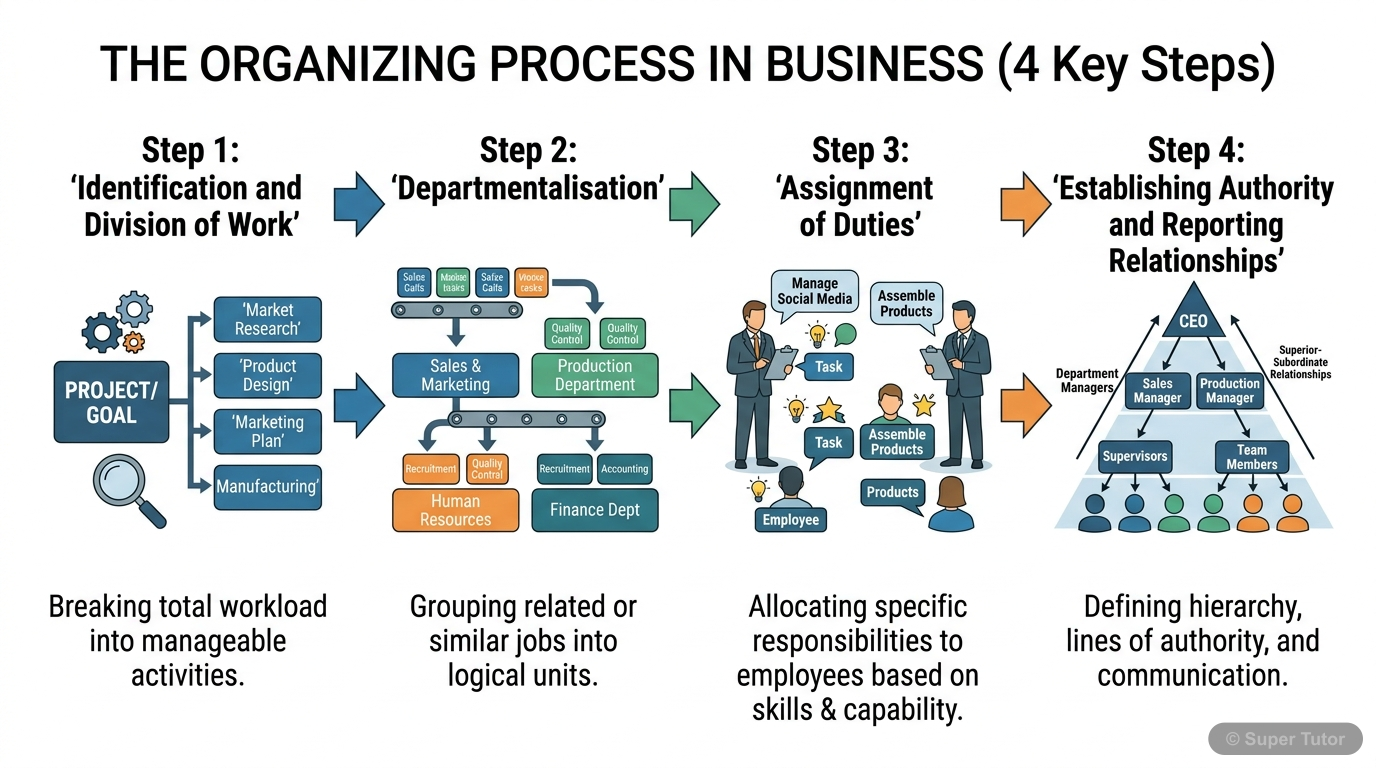
A flowchart illustrating the four key steps in the organising process: Identification and division of work, Departmentalisation, Assignment of duties, and Establishing authority and reporting relation
Super Tutor

Learn better with visuals Super Tutor has hundreds of illustrations like this across every chapter — all free to try.

Get started
20 Questions Solved · 3 Sections

Very Short Answer Type

1Identify the network of social relationships which arises spontaneously due to interaction at work.Show solution
The network of social relationships which arises spontaneously due to interaction at work is called Informal Organisation.

It emerges naturally from the social interactions among employees and is not deliberately created by management. It exists within the formal organisation and is based on personal relationships, common interests, and friendships.
2What does the term 'Span of management' refer to?Show solution
Span of Management (also called Span of Control) refers to the number of subordinates that a manager or superior can effectively supervise and manage at a given point of time.

- A wider span means more subordinates under one manager, leading to a flat organisational structure.
- A narrower span means fewer subordinates under one manager, leading to a tall organisational structure.

The span of management determines the levels of management in an organisation.
3State any two circumstances under which the functional structure will prove to be an appropriate choice.Show solution
Functional structure is an appropriate choice under the following two circumstances:

1. When the organisation is large in size and has a single product line or limited range of products: Since activities can be grouped by functions (e.g., Production, Marketing, Finance, HR), it ensures specialisation and efficiency.

2. When the organisation requires a high degree of specialisation: Functional structure groups similar activities together, allowing employees to develop expertise in their respective functional areas, which is beneficial when technical specialisation is critical to the organisation's success.
4Draw a diagram depicting a functional structure.Show solution
A functional organisational structure groups activities on the basis of functions performed. The diagram is as follows:

Managing Director\text{Managing Director}
\downarrow
Production ManagerMarketing ManagerFinance ManagerHR Manager\text{Production Manager} \quad | \quad \text{Marketing Manager} \quad | \quad \text{Finance Manager} \quad | \quad \text{HR Manager}
\downarrow \qquad\qquad\qquad\qquad \downarrow \qquad\qquad\qquad\qquad \downarrow \qquad\qquad\qquad\qquad \downarrow
Production StaffSales StaffAccounts StaffPersonnel Staff\text{Production Staff} \quad \text{Sales Staff} \quad \text{Accounts Staff} \quad \text{Personnel Staff}

Description: At the top is the Managing Director. Below the MD, the organisation is divided into functional departments — Production, Marketing, Finance, and Human Resources. Each department is headed by a functional manager who supervises the staff within that function.
5A company has its registered office in Delhi, manufacturing unit at Gurgaon and marketing and sales department at Faridabad. The company manufactures consumer products. Which type of organisational structure should it adopt to achieve its target?Show solution
Given: The company has operations spread across different locations — registered office in Delhi, manufacturing at Gurgaon, and marketing/sales at Faridabad. It manufactures consumer products.

Recommended Structure: Functional Organisational Structure

Reasons:
1. The company is dealing in a single line of consumer products, which makes functional grouping of activities (Production, Marketing, Finance, etc.) appropriate.
2. Since the company has distinct functional activities — manufacturing and marketing/sales — a functional structure allows each department to specialise in its area.
3. It ensures better coordination among the different functional departments spread across locations.
4. It promotes managerial efficiency as each functional head is an expert in their domain.

Thus, a Functional Structure is the most suitable choice for this company.

Short Answer Type

1What are the steps in the process of organising?Show solution
Organising is the process of defining and grouping activities and establishing authority relationships among them. The steps in the process of organising are:

Step 1: Identification and Division of Work
- The total work to be done is divided into specific jobs and tasks.
- This avoids duplication of effort and ensures that all activities necessary to achieve goals are assigned.

Step 2: Departmentalisation
- Similar and related activities are grouped together into departments or units.
- This grouping can be done on the basis of functions, products, territory, customers, etc.
- Example: All marketing activities are grouped under the Marketing Department.

Step 3: Assignment of Duties
- Once departments are formed, each department is placed under the charge of an individual (manager).
- Jobs are assigned to individuals based on their skills, qualifications, and competencies.
- This ensures that the right person is doing the right job.

Step 4: Establishing Reporting Relationships
- After assigning duties, authority and responsibility are defined.
- A clear chain of command is established so that every individual knows who they report to and who reports to them.
- This creates a hierarchy and ensures coordination among departments.

These four steps together complete the process of organising and help in achieving organisational goals effectively.
2Discuss the elements of delegation.Show solution
Delegation is the process by which a manager transfers some of his/her authority and responsibility to subordinates for the accomplishment of specific tasks. It has three interrelated elements:

1. Authority
- Authority refers to the right of an individual to command subordinates and to take decisions within the scope of his/her position.
- It flows downward from superior to subordinate.
- Without authority, a subordinate cannot perform the assigned task effectively.
- Example: A production manager has the authority to direct workers and requisition materials.

2. Responsibility
- Responsibility is the obligation of a subordinate to perform the assigned duty to the best of his/her ability.
- It flows upward — the subordinate is responsible to the superior for the completion of the task.
- Responsibility cannot be fully delegated; the superior remains ultimately responsible.
- Example: The foreman is responsible for achieving the production target assigned by the manager.

3. Accountability
- Accountability means being answerable for the final outcome of the assigned task.
- It flows upward — the subordinate is accountable to the superior for the use of authority and performance of responsibility.
- Unlike authority, accountability cannot be delegated at all.
- Example: If the foreman fails to meet the target, he is accountable to the production manager.

Relationship among the three elements:
Authoritydelegated downward\text{Authority} \rightarrow \text{delegated downward}
Responsibilityflows upward\text{Responsibility} \rightarrow \text{flows upward}
Accountabilityflows upward and cannot be delegated\text{Accountability} \rightarrow \text{flows upward and cannot be delegated}

All three elements must be balanced — authority should be commensurate with responsibility.
3How does informal organisation support the formal organisation?Show solution
Informal organisation arises spontaneously out of social interactions among employees at the workplace. It supports the formal organisation in the following ways:

1. Faster Communication: Informal channels (grapevine) spread information quickly, which supplements the slow formal channels and helps in faster decision-making.

2. Fulfillment of Social Needs: Informal organisation satisfies the social and psychological needs of employees (need for belonging, recognition, friendship), which increases their morale and job satisfaction, thereby improving productivity.

3. Fills Gaps in Formal Structure: Formal organisation cannot anticipate every situation. Informal organisation fills the gaps and inadequacies of the formal structure by providing flexibility and adaptability.

4. Feedback to Management: Informal groups provide managers with useful feedback about employee feelings, attitudes, and concerns, which helps management take corrective action.

5. Promotes Cooperation: Informal relationships foster a spirit of teamwork and cooperation among employees, which supports the achievement of formal organisational goals.

Thus, informal organisation acts as a complement to the formal organisation and makes it more effective.
4Can a large sized organisation be totally centralised or decentralised? Give your opinion.Show solution
No, a large-sized organisation cannot be totally centralised or totally decentralised. Both extremes are impractical and undesirable.

Why Total Centralisation is Not Possible:
- In a large organisation, the top management cannot handle all decisions alone due to the sheer volume and complexity of work.
- It would lead to delays in decision-making, overburdening of top management, and inability to respond quickly to local/operational problems.
- Lower-level managers and employees would feel demotivated as they have no authority.

Why Total Decentralisation is Not Possible:
- If all authority is delegated to lower levels, there would be no coordination and the organisation would lose its unity of direction.
- Top management would lose control over operations, leading to chaos and conflicting decisions.
- Strategic decisions require centralised authority to maintain consistency and alignment with organisational goals.

Opinion:
A large organisation should maintain a balance between centralisation and decentralisation. Routine and operational decisions should be decentralised to lower levels for speed and efficiency, while strategic and policy decisions should remain centralised with top management. This ensures both control and flexibility, which is essential for the effective functioning of a large organisation.
5Decentralisation is extending delegation to the lowest level. Comment.Show solution
Yes, the given statement is largely correct. Decentralisation is indeed an extension of delegation throughout the organisation, including to the lowest levels.

Delegation vs. Decentralisation:

| Basis | Delegation | Decentralisation |
|---|---|---|
| Meaning | Transfer of authority from one superior to one subordinate | Systematic dispersal of authority throughout the organisation |
| Scope | Limited — between two individuals | Wide — throughout the organisation |
| Purpose | To reduce workload of manager | To increase role of lower-level managers |
| Nature | A process | A philosophy/policy |

Explanation:
- Delegation is the process by which a manager assigns some of his/her authority to a subordinate. It is a one-to-one transfer.
- Decentralisation is the result of systematically delegating authority at all levels of the organisation — from top management to middle management to lower management and even to the operational level.
- When delegation is extended throughout the organisation and becomes a policy rather than an individual act, it becomes decentralisation.

Conclusion:
Decentralisation is not merely delegation — it is delegation extended to the lowest level of the organisation as a deliberate policy. It represents a philosophy of management where decision-making authority is spread across all levels, enabling faster decisions, greater motivation, and better utilisation of managerial talent at all levels.
6Neha runs a factory wherein she manufactures shoes. The business has been doing well and she intends to expand by diversifying into leather bags as well as western formal wear thereby making her company a complete provider of corporate wear. Which type of structure would you recommend for her expanded organisation and why?Show solution
Given: Neha currently manufactures shoes and plans to diversify into leather bags and western formal wear — three distinct product lines.

Recommended Structure: Divisional Organisational Structure

Reasons:

1. Multiple Product Lines: Since Neha will now have three distinct product lines — Shoes, Leather Bags, and Western Formal Wear — a divisional structure allows each product to have its own separate division with dedicated resources.

2. Product Specialisation: Each division can focus on the specific needs, design, production, and marketing of its product, leading to better quality and customer satisfaction.

3. Better Coordination: All functions (production, marketing, finance) related to one product are under one division, ensuring better coordination and faster decision-making.

4. Accountability: Each division head is responsible for the performance of their product line, making it easier to measure profitability and fix accountability.

5. Flexibility and Growth: A divisional structure allows Neha to add new product lines (divisions) in the future without disrupting the existing structure.

6. Greater Initiative: Division managers have greater autonomy, which encourages initiative and entrepreneurial thinking.

Conclusion:
A Divisional Structure is the most appropriate choice for Neha's expanded organisation as it will help her manage three distinct product lines efficiently, ensure product-focused specialisation, and support future growth.
7The production manager asked the foreman to achieve a target production of 200 units per day, but he doesn't give him the authority to requisition tools and materials from the stores department. Can the production manager blame the foreman if he is not able to achieve the desired target? Give reasons.Show solution
No, the production manager cannot blame the foreman for not achieving the target of 200 units per day.

Reason — Principle of Parity of Authority and Responsibility:

This situation violates the fundamental principle of delegation which states that authority and responsibility must be commensurate (equal). That is, a person should be given adequate authority to discharge the responsibility assigned to him.

Analysis:
- The foreman has been given the responsibility to produce 200 units per day.
- However, he has not been given the authority to requisition tools and materials from the stores department.
- Without tools and materials, the foreman cannot carry out production, no matter how capable he is.
- Since the foreman lacks the necessary authority to obtain the resources required to fulfil his responsibility, he cannot be held accountable for the failure.

Conclusion:
The production manager is at fault for assigning responsibility without corresponding authority. According to the principle of parity of authority and responsibility, responsibility without authority is meaningless. The production manager should either:
1. Grant the foreman the authority to requisition tools and materials, or
2. Reduce the production target to what is achievable with the resources available.

Therefore, the production manager cannot justifiably blame the foreman for not achieving the target.

Long Answer Type

1Why is delegation considered essential for effective organising?Show solution
Delegation is the process by which a manager assigns some of his/her authority and responsibility to subordinates for the accomplishment of specific tasks. It is considered essential for effective organising for the following reasons:

1. Effective Management:
- A manager cannot perform all tasks alone. By delegating routine tasks to subordinates, managers can focus on important and strategic decisions.
- This leads to better utilisation of managerial time and talent.

2. Employee Development:
- Delegation gives subordinates an opportunity to handle challenging tasks and develop their managerial skills.
- It prepares them for higher responsibilities in the future, creating a pool of trained managers.

3. Motivation of Employees:
- When authority is delegated, employees feel trusted and valued.
- This increases their morale, job satisfaction, and motivation to perform better.

4. Facilitates Growth:
- Delegation enables an organisation to expand its operations without overburdening the top management.
- As the organisation grows, delegation ensures that work is distributed efficiently across all levels.

5. Basis of Hierarchy:
- Delegation creates a chain of command and establishes reporting relationships.
- It defines who has authority over whom, which is the foundation of the organisational hierarchy.

6. Better Coordination:
- When authority is clearly delegated, each person knows their role and responsibilities.
- This reduces confusion, overlapping of work, and conflicts, leading to better coordination.

7. Quick Decision-Making:
- Delegation allows decisions to be made at the level where the problem exists, without waiting for top management approval.
- This speeds up the decision-making process and improves responsiveness.

Conclusion:
Delegation is the cornerstone of effective organising. Without delegation, a manager would be overburdened, employees would be underutilised, and the organisation would fail to grow. It is, therefore, essential for building an efficient and effective organisation.
2What is a divisional structure? Discuss its advantages and limitations.Show solution
Divisional Structure:

A divisional structure is an organisational structure in which the activities of an organisation are grouped on the basis of products. Each product group or division is treated as a separate unit and is provided with all the functional departments (production, marketing, finance, HR, etc.) needed to operate independently.

For example, a company manufacturing cars, trucks, and motorcycles may have three separate divisions — one for each product.

Diagram:
Managing Director\text{Managing Director}
\downarrow
Division A (Cars)Division B (Trucks)Division C (Motorcycles)\text{Division A (Cars)} \quad | \quad \text{Division B (Trucks)} \quad | \quad \text{Division C (Motorcycles)}
\downarrow \qquad\qquad\qquad\qquad \downarrow \qquad\qquad\qquad\qquad \downarrow
Production | Marketing | Finance (for each division)\text{Production | Marketing | Finance (for each division)}

---

Advantages of Divisional Structure:

1. Product Specialisation: Each division focuses on a specific product, leading to better quality, innovation, and customer satisfaction.

2. Better Coordination: All functions related to one product are under one division, ensuring better coordination and faster decision-making.

3. Accountability: The performance of each division can be measured separately, making it easier to fix responsibility and accountability on division heads.

4. Flexibility: New divisions can be added or removed without affecting other divisions, making the structure adaptable to change.

5. Development of Managerial Talent: Division managers handle all functions of their product, which develops their overall managerial skills and prepares them for top management positions.

6. Greater Initiative: Division managers have greater autonomy, which encourages initiative and entrepreneurial thinking.

---

Limitations of Divisional Structure:

1. Costly: Each division has its own set of functional departments, leading to duplication of resources and higher costs.

2. Departmental Conflicts: Divisions may compete with each other for resources (budget, personnel), leading to conflicts and unhealthy rivalry.

3. Ignoring Organisational Interests: Division managers may focus only on their division's goals and ignore the overall organisational interests.

4. Increased Requirement of General Managers: Each division needs a general manager with expertise in all functional areas, making it difficult to find and retain such talent.

---

Conclusion:
Divisional structure is suitable for large organisations with multiple product lines. Despite its limitations, it offers significant advantages in terms of product focus, accountability, and flexibility, making it a popular choice for diversified companies.
3Decentralisation is an optional policy. Explain why an organisation would choose to be decentralised.Show solution
Decentralisation refers to the systematic dispersal of authority to make decisions throughout all levels of the organisation. It is indeed an optional policy — management can choose the degree of decentralisation based on the organisation's needs. The following reasons explain why an organisation would choose to be decentralised:

1. Development of Managerial Talent:
- Decentralisation gives lower-level managers the opportunity to make decisions and handle responsibilities.
- This develops their managerial skills and prepares them for higher positions, creating a strong pipeline of future leaders.

2. Quick Decision-Making:
- In a decentralised organisation, decisions are made at the level where the problem exists, without waiting for approval from top management.
- This speeds up the decision-making process and improves the organisation's responsiveness to market changes.

3. Reduces Burden on Top Management:
- By delegating authority to lower levels, top management is relieved of routine operational decisions.
- This allows top management to focus on strategic planning, policy-making, and long-term goals.

4. Development of Initiative:
- When employees are given authority to make decisions, they feel trusted and empowered.
- This fosters a sense of initiative, creativity, and entrepreneurship among employees at all levels.

5. Facilitates Growth:
- As an organisation grows in size and complexity, centralised decision-making becomes impractical.
- Decentralisation allows the organisation to manage its expanded operations efficiently by distributing authority across divisions and departments.

6. Better Control:
- Decentralisation enables each division or department to be treated as a separate profit centre.
- Performance can be measured at each level, making it easier to identify problems and take corrective action.

7. Improves Motivation and Morale:
- Employees who have authority and responsibility feel more engaged and motivated.
- This leads to higher job satisfaction, lower employee turnover, and better overall performance.

Conclusion:
Although decentralisation is optional, organisations choose it because it leads to faster decisions, better talent development, reduced burden on top management, and greater motivation among employees. It is particularly beneficial for large, diversified, and geographically spread organisations.
4Distinguish between centralisation and decentralisation.Show solution
Centralisation refers to the concentration of decision-making authority at the top level of management. Decentralisation refers to the systematic dispersal of authority to make decisions throughout all levels of the organisation.

Distinction between Centralisation and Decentralisation:

| Basis | Centralisation | Decentralisation |
|---|---|---|
| Meaning | Concentration of decision-making authority at the top level | Dispersal of decision-making authority to all levels of management |
| Authority | Authority is retained by top management | Authority is delegated to middle and lower levels |
| Decision-Making | Decisions are made by top management | Decisions are made at the level where the problem exists |
| Communication | Mostly downward communication | Both upward and downward communication |
| Speed | Decision-making is slow due to concentration at top | Decision-making is faster as authority is closer to the problem |
| Burden on Top Management | Top management is overburdened with routine decisions | Top management is relieved of routine decisions and can focus on strategy |
| Employee Development | Limited scope for development of lower-level managers | Greater scope for development of managerial talent at all levels |
| Motivation | Lower motivation among employees due to lack of authority | Higher motivation as employees feel trusted and empowered |
| Suitability | Suitable for small organisations or during crisis | Suitable for large, diversified, and geographically spread organisations |
| Control | Easier to maintain uniformity and control | Control is exercised through performance measurement at each level |

Conclusion:
Centralisation and decentralisation are two ends of a spectrum. Most organisations maintain a balance between the two — centralising strategic decisions while decentralising operational decisions.
5How is a functional structure different from a divisional structure?Show solution
Distinction between Functional Structure and Divisional Structure:

| Basis | Functional Structure | Divisional Structure |
|---|---|---|
| Meaning | Activities are grouped on the basis of functions (e.g., Production, Marketing, Finance) | Activities are grouped on the basis of products (e.g., Division A, Division B) |
| Basis of Grouping | Functions performed | Products manufactured |
| Specialisation | Functional specialisation — employees become experts in their function | Product specialisation — each division focuses on one product |
| Coordination | Coordination between departments may be difficult | Better coordination within each division as all functions are under one roof |
| Accountability | Difficult to fix accountability for overall product performance | Easy to fix accountability as each division is a separate profit centre |
| Cost | Less costly — no duplication of functional departments | More costly — each division has its own set of functional departments |
| Flexibility | Less flexible — difficult to add new product lines | More flexible — new divisions can be added easily |
| Managerial Development | Limited — managers specialise in one function | Better — division managers handle all functions, developing overall skills |
| Suitability | Suitable for organisations with a single or limited product line | Suitable for organisations with multiple product lines |
| Conflict | Functional empires and inter-departmental conflicts | Conflicts between divisions over resources |

Conclusion:
The choice between functional and divisional structure depends on the size of the organisation, the number of products, and the degree of diversification. Functional structure is preferred for single-product organisations, while divisional structure is preferred for diversified, multi-product organisations.
6A company which manufactures a popular brand of toys has been enjoying good market reputation. It has a functional organisational structure with separate departments for Production, Marketing, Finance, Human Resources and Research and Development. Lately to use its brand name and also to cash on to new business opportunities it is thinking to diversify into manufacture of new range of electronic toys for which a new market is emerging. Which organisation structure should be adopted in this situation? Give concrete reasons with regard to benefits the company will derive from the steps it should take.Show solution
Given:
- The company currently manufactures toys and has a functional structure.
- It plans to diversify into electronic toys — a new product line.

Recommended Structure: Divisional Organisational Structure

The company should shift from a functional structure to a divisional structure with two divisions:
- Division 1: Traditional Toys
- Division 2: Electronic Toys

Each division will have its own Production, Marketing, Finance, HR, and R&D departments.

---

Reasons and Benefits:

1. Product Specialisation:
- Traditional toys and electronic toys are very different in terms of technology, production processes, and target markets.
- A divisional structure allows each division to focus exclusively on its product, leading to better quality and innovation.

2. Better Coordination:
- All functions (production, marketing, R&D) related to electronic toys will be under one division, ensuring seamless coordination and faster product development.

3. Accountability:
- Each division will be treated as a separate profit centre.
- The performance of the electronic toys division can be measured independently, making it easier to assess profitability and fix responsibility.

4. Flexibility:
- The divisional structure allows the company to manage two distinct product lines without disrupting existing operations.
- If the electronic toys business grows, the division can be expanded independently.

5. Leveraging Brand Name:
- The company can use its established brand reputation in the traditional toys market to promote electronic toys through a separate but related division.

6. Development of Managerial Talent:
- Division managers will handle all functions of their product line, developing well-rounded managerial skills.

7. Adaptability to New Market:
- The electronic toys market is emerging and dynamic. A dedicated division with its own R&D and marketing team can respond quickly to market changes and customer preferences.

Conclusion:
The company should adopt a Divisional Structure to effectively manage its diversification into electronic toys. This will ensure product focus, better coordination, clear accountability, and the flexibility needed to succeed in the new and growing electronic toys market.
7A company manufacturing sewing machines set up in 1945 by the British promoters follows formal organisation culture in totality. It is facing lot of problems in delays in decision making. As the result it is not able to adapt to changing business environment. The work force is also not motivated since they cannot vent their grievances except through formal channels, which involve red tape. Employee turnover is high. Its market share is also declining due to changed circumstances and business environment. You are to advise the company with regard to change it should bring about in its organisation structure to overcome the problems faced by it. Give reasons in terms of benefits it will derive from the changes suggested by you.Show solution
Problems Identified:
1. Delays in decision-making due to rigid formal structure.
2. Inability to adapt to changing business environment.
3. Low employee motivation — grievances can only be expressed through formal channels.
4. High employee turnover.
5. Declining market share.

Advice: The company should allow and encourage Informal Organisation alongside the Formal Organisation, and also move towards Decentralisation.

---

Change 1: Allow Informal Organisation to Co-exist with Formal Organisation

The company follows formal organisation culture in totality, which is the root cause of many problems. It should allow informal groups and communication channels to exist.

Benefits:

1. Faster Communication: Informal channels (grapevine) will allow information to flow quickly, reducing delays in decision-making.

2. Fulfillment of Social Needs: Employees will be able to interact freely, fulfilling their social and psychological needs, which will improve morale and reduce employee turnover.

3. Grievance Redressal: Employees can vent their grievances informally to supervisors and peers, without going through red tape. This will improve employee satisfaction.

4. Flexibility: Informal organisation provides flexibility to adapt to changing situations, which the rigid formal structure cannot.

5. Better Teamwork: Informal relationships foster cooperation and teamwork, improving overall productivity.

---

Change 2: Move Towards Decentralisation

The company should decentralise decision-making authority to middle and lower levels of management.

Benefits:

1. Quick Decision-Making: Decisions will be made at the level where the problem exists, reducing delays and improving responsiveness to market changes.

2. Reduced Burden on Top Management: Top management can focus on strategic decisions while operational decisions are handled at lower levels.

3. Employee Motivation: When employees are given authority and responsibility, they feel valued and motivated, reducing turnover.

4. Development of Managerial Talent: Lower-level managers will develop decision-making skills, creating a strong management pipeline.

5. Adaptability: Decentralised organisations can adapt more quickly to changing business environments.

---

Conclusion:
The company should balance formal and informal organisation and decentralise decision-making. These changes will reduce delays, improve employee motivation, lower turnover, and help the company regain its market share by becoming more agile and responsive to the changing business environment.
8A company X limited manufacturing cosmetics, which has enjoyed a pre-eminent position in business, has grown in size. Its business was very good till 1991. But after that, new liberalised environment has seen entry of many MNCs in the sector. With the result the market share of X limited has declined. The company had followed a very centralised business model with Directors and divisional heads making even minor decisions. Before 1991 this business model had served the company very well as consumers had no choice. But now the company is under pressure to reform. What organisation structure changes should the company bring about in order to retain its market share? How will the changes suggested by you help the firm? Keep in mind that the sector in which the company is FMCG.Show solution
Problems Identified:
- Highly centralised decision-making — even minor decisions are made by Directors and divisional heads.
- Slow response to market changes in the post-liberalisation competitive environment.
- Declining market share due to competition from MNCs.
- The FMCG sector requires quick decisions, innovation, and responsiveness to consumer preferences.

Recommended Changes:

---

Change 1: Move from Centralisation to Decentralisation

The company should decentralise its decision-making authority by delegating authority to middle and lower levels of management.

Benefits:

1. Quick Decision-Making:
- In the FMCG sector, speed is critical. Decentralisation allows decisions to be made at the operational level without waiting for approval from Directors.
- This will help the company respond quickly to changing consumer preferences, competitor actions, and market trends.

2. Reduced Burden on Top Management:
- Directors and divisional heads will be freed from minor operational decisions.
- They can focus on strategic planning, new product development, and competitive strategy to counter MNCs.

3. Development of Managerial Talent:
- Lower-level managers will develop decision-making skills and take ownership of their areas.
- This creates a strong management team capable of handling the competitive FMCG environment.

4. Greater Initiative and Innovation:
- Empowered managers at lower levels will be more creative and innovative in developing new products and marketing strategies to compete with MNCs.

5. Better Customer Service:
- Regional and local managers, being closer to the market, can make decisions that are more aligned with local consumer needs and preferences.

---

Change 2: Adopt a Divisional Structure (if not already in place)

Since the company is in FMCG and likely has multiple product lines (skincare, haircare, makeup, etc.), it should adopt a divisional structure with each product line as a separate division.

Benefits:

1. Product Specialisation: Each division can focus on its specific product line, leading to better quality and faster innovation.

2. Accountability: Each division can be treated as a profit centre, making it easier to measure performance and compete with MNCs.

3. Flexibility: New product lines can be added as separate divisions to capture emerging market opportunities.

4. Better Coordination: All functions (production, marketing, R&D) for each product are under one division, enabling faster product launches.

---

Change 3: Allow Informal Organisation

The company should also allow informal communication and relationships to flourish alongside the formal structure.

Benefits:
- Faster information flow and better employee morale.
- Employees can share ideas and innovations informally, fostering a culture of creativity.

---

Conclusion:
X Limited should decentralise its decision-making, adopt a divisional structure, and allow informal organisation to co-exist with the formal structure. These changes will make the company more agile, innovative, and responsive to the competitive FMCG market, helping it retain and regain its market share against MNC competitors.

Stuck on a step?

Ask Super Tutor AI to explain any solution on this page in a simpler way — free, 24x7.

Ask a Doubt Free

Frequently Asked Questions

What are the important topics in Organizing for Meghalaya Board Class 12 Business Studies?
Organizing covers several key topics that are frequently asked in Meghalaya Board Class 12 board exams. Focus on the core concepts listed on this page and practise related questions to build confidence.
How to score full marks in Organizing — Meghalaya Board Class 12 Business Studies?
Understand the core concepts first, then work through the 32 practice questions available for this chapter. Revise formulas and definitions regularly, and use flashcards for quick recall before the exam.
Where can I get free NCERT Solutions for Organizing Class 12 Business Studies?
This page has free step-by-step NCERT Solutions for every exercise question in Organizing (Meghalaya Board Class 12 Business Studies) — written the way examiners award marks: given, formula, working, answer.

Sources & Official References

Content is aligned to the official syllabus. Refer to the board website for the latest curriculum.

For serious students

Get the full Organizing chapter — for free.

Quizzes, flashcards, AI doubt-solver and a step-by-step study plan for Meghalaya Board Class 12 Business Studies.