Data Communication — NCERT Solutions
Meghalaya Board · Class 12 · Computer Science
NCERT Solutions for Data Communication, Meghalaya Board Class 12 Computer Science: 17 textbook questions solved step by step.
Interactive on Super Tutor
Studying Data Communication? Get the full interactive chapter.
Quizzes, flashcards, AI doubt-solver and a step-by-step study plan — built for NCERT solutions and more.
Free trial, no card needed.
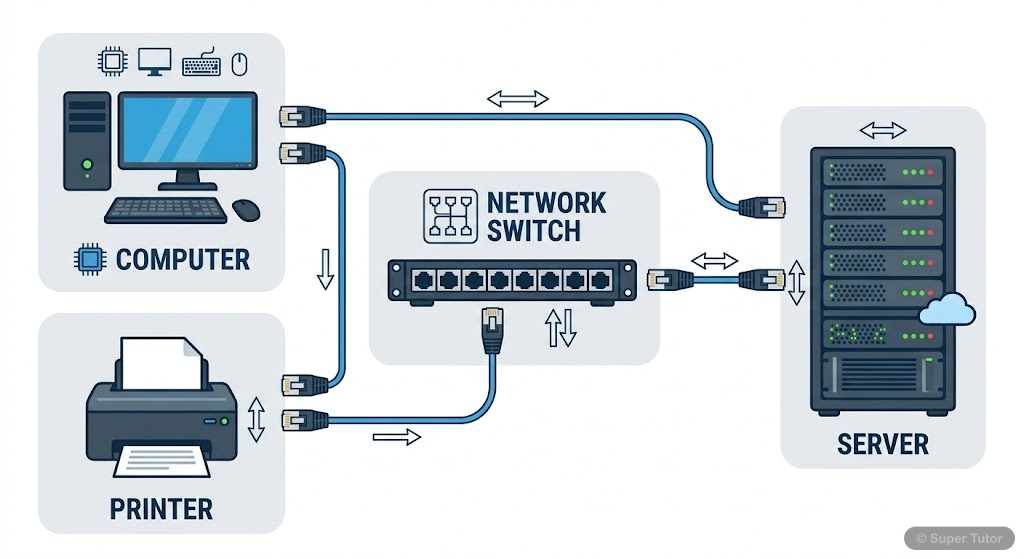
Learn better with visuals Super Tutor pairs illustrations like this with notes and quizzes for Data Communication.
The first 9 solutions are open to read. The other 8 are free with a Super Tutor account.
EXERCISE — Data Communication (Chapter 11)
1What is data communication? What are the main components of data communication?Show solution
Data Communication:
Data communication refers to the exchange of data (information) between two or more networked or connected devices (such as laptops, PCs, printers, routers, etc.) through some transmission medium.
Main Components of Data Communication:
- Sender: The device or entity that originates and sends the message. Example: a computer, mobile phone.
- Receiver: The device or entity that receives the message sent by the sender. Example: a printer, another computer.
- Message: The actual data or information to be exchanged. It can be in the form of text, numbers, images, audio, video, multimedia, etc.
- Communication Media (Channel): The path or medium through which the message travels from sender to receiver. It can be wired (e.g., twisted pair cable, coaxial cable, optical fibre) or wireless (e.g., radio waves, microwaves, satellite links).
- Protocols: A set of rules that must be followed by the communicating parties to ensure successful and reliable data communication. Examples: HTTP, Ethernet, TCP/IP.
2Which communication mode allows communication in both directions simultaneously?Show solution
Answer: Full-Duplex Mode
Explanation:
In full-duplex communication mode, data can be transmitted in both directions simultaneously between the sender and the receiver. Both parties can send and receive data at the same time.
Example: A telephone conversation — both persons can speak and listen at the same time.
(Note: Simplex allows communication in one direction only; Half-duplex allows communication in both directions but not simultaneously.)
3Among LAN, MAN, and WAN, which has the highest speed and which one can cover the largest area?Show solution
Highest Speed: LAN (Local Area Network)
- LAN operates within a small geographical area (a building or campus) and uses high-speed wired or wireless connections. It typically offers speeds ranging from 100 Mbps to 10 Gbps.
Largest Area Coverage: WAN (Wide Area Network)
- WAN covers the largest geographical area — it can span cities, countries, or even the entire globe. The Internet itself is the largest example of a WAN.
Summary Table:
| Network | Speed | Coverage Area |
|---|---|---|
| LAN | Highest | Small (building/campus) |
| MAN | Medium | City/town |
| WAN | Lowest | Country/world |
4What are three categories of wired media? Explain them.Show solution
The three categories of wired (guided) transmission media are:
1. Twisted Pair Cable:
- Consists of pairs of copper wires twisted together.
- The twisted configuration minimises electrical interference from nearby pairs.
- Two types: Unshielded Twisted Pair (UTP) and Shielded Twisted Pair (STP).
- Least expensive and most commonly used in telephone lines and LANs.
2. Coaxial Cable:
- Has a central copper wire (core) surrounded by insulating material, which is further surrounded by an outer conductor (copper mesh), all wrapped in a plastic cover.
- Better shielded and has more bandwidth than twisted pair cable.
- Used to carry signals of higher frequencies over longer distances.
- Example: Cable TV connections.
3. Optical Fibre Cable:
- Carries data in the form of light signals through a thin strand of glass.
- Uses the principle of refraction to direct light through the medium.
- Structure: thin glass core → cladding (less dense glass) → outer jacket (PVC/Teflon).
- Has very high bandwidth, supports long-distance transmission, is immune to electromagnetic interference, and is lightweight.
- Used in backbone networks.
- Disadvantage: Expensive and unidirectional (two cables needed for full-duplex).
5Compare wired and wireless media.Show solution
Comparison between Wired and Wireless Media:
| Feature | Wired Media | Wireless Media |
|---|---|---|
| Transmission | Data travels through physical cables/wires | Data travels as electromagnetic waves through air |
| Cost | Higher installation cost due to cabling | Lower installation cost; no cables needed |
| Mobility | Limited; devices must be physically connected | High mobility; devices can move freely |
| Speed | Generally higher and more stable speed | Speed may vary; can be affected by interference |
| Security | More secure; difficult to intercept | Less secure; signals can be intercepted |
| Interference | Less susceptible to interference | More susceptible to electromagnetic interference |
| Examples | Twisted pair, coaxial cable, optical fibre | Bluetooth, Wi-Fi, WiMax, satellite |
| Maintenance | Difficult to maintain/repair cables | Easier to maintain; no physical cables |
| Range | Limited by cable length | Can cover larger areas (especially satellite) |
6Which transmission media carries signals in the form of light?Show solution
Answer: Optical Fibre Cable
Optical Fibre Cable carries data in the form of light signals. It uses the principle of refraction to direct light through a thin transparent strand of glass (the core). The core is surrounded by a layer of less dense glass called cladding, and the whole arrangement is covered with an outer jacket made of PVC or Teflon.
7List out the advantages and disadvantages of optical fiber cable.Show solution
Advantages of Optical Fibre Cable:
- High Bandwidth: Supports very high data transfer rates due to high bandwidth.
- Long Distance Transmission: Signals can travel longer distances without significant loss or degradation.
- Immune to Electromagnetic Interference: Electromagnetic noise does not affect optical fibre since data travels as light.
- Lightweight: Optical fibre cables are lighter than metallic cables.
- High Security: Difficult to tap or intercept the light signals, making it more secure.
- No Electrical Hazard: Since it uses light (not electricity), there is no risk of electrical sparks.
Disadvantages of Optical Fibre Cable:
- Expensive: Optical fibre cables and associated equipment (transmitters, receivers) are costly.
- Unidirectional: Light travels in one direction only; two separate cables are required for full-duplex communication.
- Fragile: Glass fibre is more fragile compared to metallic cables and requires careful handling.
- Difficult to Install and Maintain: Requires specialised skills and equipment for installation and repair.
- Specialised Connectors: Requires special connectors and splicing techniques.
8What is the range of frequency for radio waves?Show solution
Range of Frequency for Radio Waves:
Radio waves have a frequency range of approximately 3 KHz to 1 GHz (i.e., 3 × 10³ Hz to 1 × 10⁹ Hz).
They fall in the lower end of the electromagnetic spectrum used for wireless communication (which ranges from 3 KHz to 900 THz overall).
Radio waves are used in AM/FM radio broadcasting, television broadcasting, and cellular networks (lower generations).
918 Gbps is equal to how many Bits per second?Show solution
Given: 18 Gbps
Formula:
Calculation:
Free with a Super Tutor account
Free with a Super Tutor account
Free with a Super Tutor account
Free with a Super Tutor account
Free with a Super Tutor account
Free with a Super Tutor account
Free with a Super Tutor account
Free with a Super Tutor account
8 more solved questions in Data Communication
They are free with a Super Tutor account, along with practice quizzes and flashcards for this chapter. Free to start, no card needed.
Frequently Asked Questions
What are the important topics in Data Communication for Meghalaya Board Class 12 Computer Science?
Are these NCERT Solutions for Data Communication free?
How should I revise Data Communication for the Meghalaya Board Class 12 board exam?
Sources & Official References
Content is aligned to the official syllabus. Refer to the board website for the latest curriculum.
More resources for Data Communication
Practice Quiz
Test yourself with a quick quiz
Important Questions
Exam-style questions with answers
Revision Notes
Key points for last-minute revision
Formula Sheet
The chapter's formulas in one place
Chapter Summary
Understand the chapter at a glance
Concept Maps
See how topics connect
Study Plan
Step-by-step plan for this chapter
Flashcards
Quick-fire cards for active recall
Syllabus
What topics to cover
For serious students
Get the full Data Communication chapter — start free.
Quizzes, flashcards, an AI doubt solver and a study plan for Meghalaya Board Class 12 Computer Science. Free to start, no card needed.