Contemporary Centers of Power — Revision Notes
Meghalaya Board · Class 12 · Political Science
Contemporary Centers of Power revision notes for Meghalaya Board Class 12 Political Science: 4 topics in quick points.
Interactive on Super Tutor
Studying Contemporary Centers of Power? Get the full interactive chapter.
Quizzes, flashcards, AI doubt-solver and a step-by-step study plan — built for revision notes and more.
Free trial, no card needed.
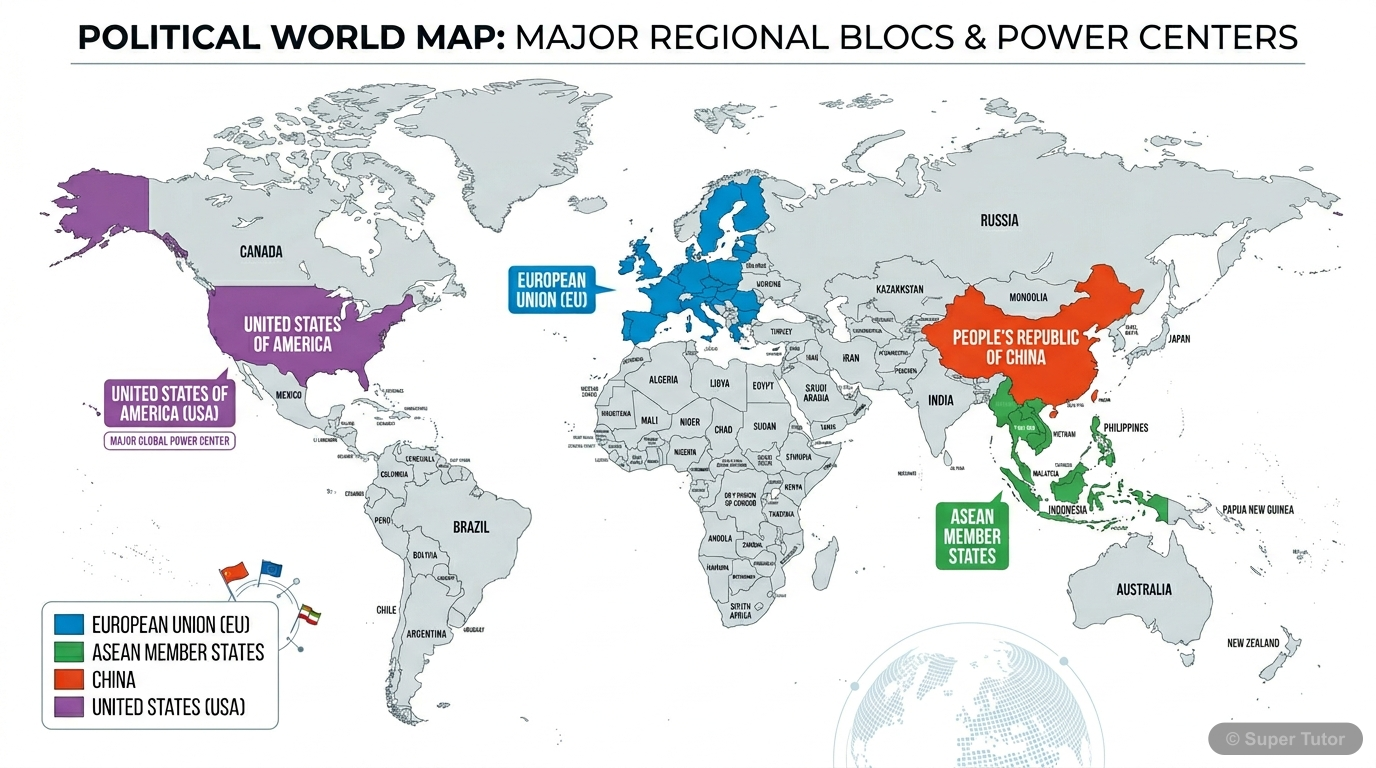
One of 11 illustrations for Contemporary Centers of Power in Super Tutor — alongside flashcards, concept maps and practice questions.
Key Topics to Revise
European Union
- The European integration process began after the Second World War, when European states faced economic ruin and political insecurity.
- The OEEC was established in 1948 to channel Marshall Plan aid to west European states.
- The Council of Europe was established in 1949 as a step in political cooperation.
ASEAN
- ASEAN was established in 1967 by five countries: Indonesia, Malaysia, the Philippines, Singapore, and Thailand.
- These countries signed the Bangkok Declaration.
- ASEAN later expanded to ten members with Brunei Darussalam, Vietnam, Lao PDR, Myanmar, and Cambodia.
Rise of the Chinese Economy
- China became the People’s Republic of China in 1949 after the communist revolution under Mao.
- Its early economy followed the Soviet model and relied on state-owned heavy industry.
- China cut itself off from the capitalist world and depended on its own resources and some Soviet aid and advice.
India-China Relations
- India and China were important Asian powers before Western imperialism.
- Their zones of influence rarely overlapped, so political and cultural interaction was limited.
- After independence, there was hope of cooperation, expressed by the slogan Hindi-Chini bhai-bhai.
Get complete notes with diagrams and examples
Full NotesKey Concepts
Frequently Asked Questions
What are the important topics in Contemporary Centers of Power for Meghalaya Board Class 12 Political Science?
How should I revise Contemporary Centers of Power for the Meghalaya Board Class 12 board exam?
Sources & Official References
Content is aligned to the official syllabus. Refer to the board website for the latest curriculum.
More resources for Contemporary Centers of Power
Practice Quiz
Test yourself with a quick quiz
Important Questions
Exam-style questions with answers
Chapter Summary
Understand the chapter at a glance
Concept Maps
See how topics connect
Study Plan
Step-by-step plan for this chapter
Flashcards
Quick-fire cards for active recall
Syllabus
What topics to cover
NCERT Solutions
Every textbook question solved step by step
For serious students
Get the full Contemporary Centers of Power chapter — start free.
Quizzes, flashcards, an AI doubt solver and a study plan for Meghalaya Board Class 12 Political Science. Free to start, no card needed.