Contemporary South Asia — Revision Notes
Meghalaya Board · Class 12 · Political Science
Contemporary South Asia revision notes for Meghalaya Board Class 12 Political Science: 4 topics in quick points.
Interactive on Super Tutor
Studying Contemporary South Asia? Get the full interactive chapter.
Quizzes, flashcards, AI doubt-solver and a step-by-step study plan — built for revision notes and more.
Free trial, no card needed.
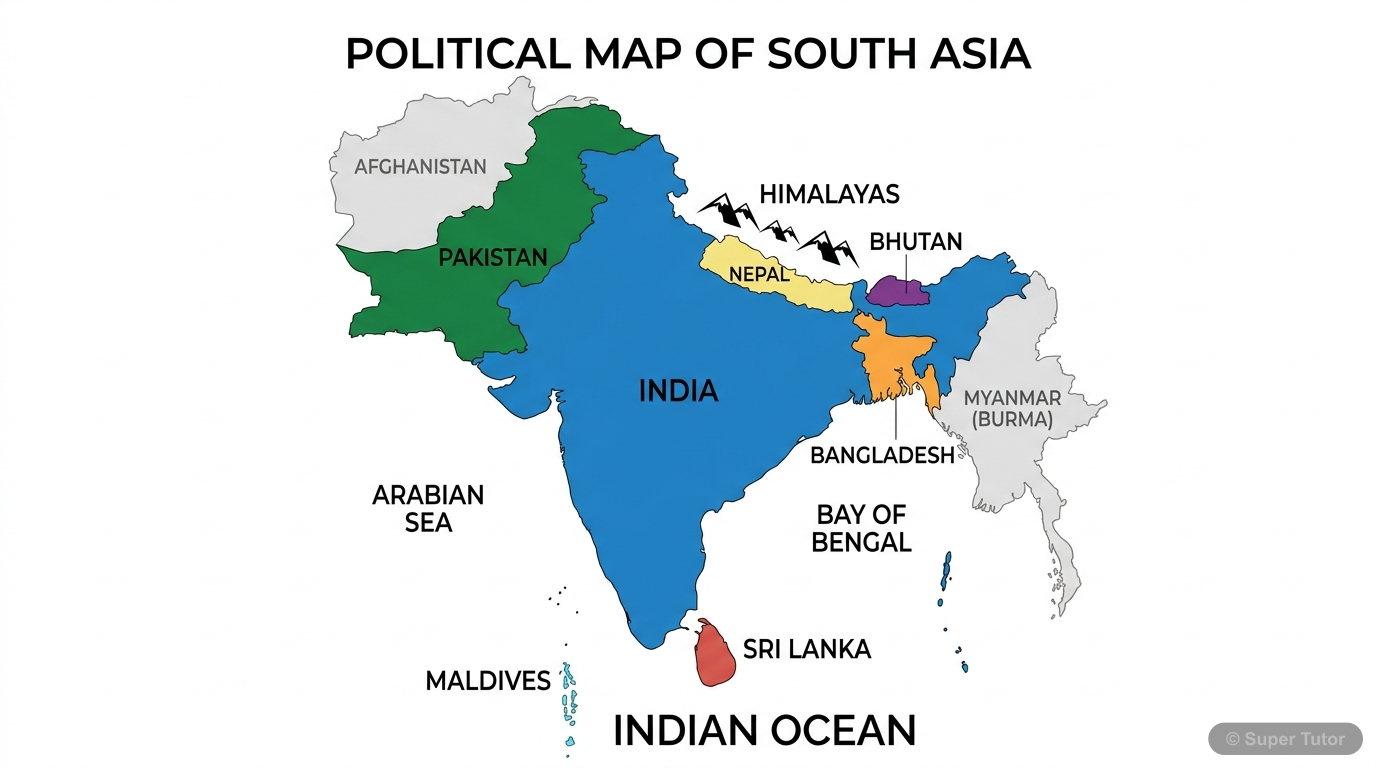
Learn better with visuals Super Tutor pairs illustrations like this with notes and quizzes for Contemporary South Asia.
Key Topics to Revise
1. Meaning and Scope of South Asia
- South Asia, as defined here, includes seven countries: Bangladesh, Bhutan, India, the Maldives, Nepal, Pakistan, and Sri Lanka.
- The Himalayas in the north and the Indian Ocean, Arabian Sea, and Bay of Bengal in the south, west, and east give the region a natural identity.
- Afghanistan and Myanmar are often discussed with South Asia, but they are not part of the seven-country definition used here.
2. Democracy in South Asia
- India and Sri Lanka have successfully operated democratic systems since independence.
- Pakistan and Bangladesh have experienced both civilian and military rulers.
- Nepal was a constitutional monarchy till 2006, became a democratic republic in 2008, and adopted a new constitution in 2015.
3. Pakistan: Military Rule and Democratic Struggle
- After Pakistan framed its first constitution, General Ayub Khan took over administration and got himself elected.
- Ayub Khan gave up office after popular dissatisfaction.
- General Yahya Khan then took over through military rule.
4. Bangladesh: Independence and Democratic Recovery
- Bangladesh was part of Pakistan from 1947 to 1971.
- People in East Pakistan resented domination by West Pakistan and the imposition of Urdu.
- Sheikh Mujib-ur Rahman led the popular struggle against West Pakistani domination.
Get complete notes with diagrams and examples
Full NotesKey Concepts
Frequently Asked Questions
What are the important topics in Contemporary South Asia for Meghalaya Board Class 12 Political Science?
How should I revise Contemporary South Asia for the Meghalaya Board Class 12 board exam?
Sources & Official References
Content is aligned to the official syllabus. Refer to the board website for the latest curriculum.
More resources for Contemporary South Asia
Practice Quiz
Test yourself with a quick quiz
Important Questions
Exam-style questions with answers
Chapter Summary
Understand the chapter at a glance
Concept Maps
See how topics connect
Study Plan
Step-by-step plan for this chapter
Flashcards
Quick-fire cards for active recall
Syllabus
What topics to cover
NCERT Solutions
Every textbook question solved step by step
For serious students
Get the full Contemporary South Asia chapter — start free.
Quizzes, flashcards, an AI doubt solver and a study plan for Meghalaya Board Class 12 Political Science. Free to start, no card needed.