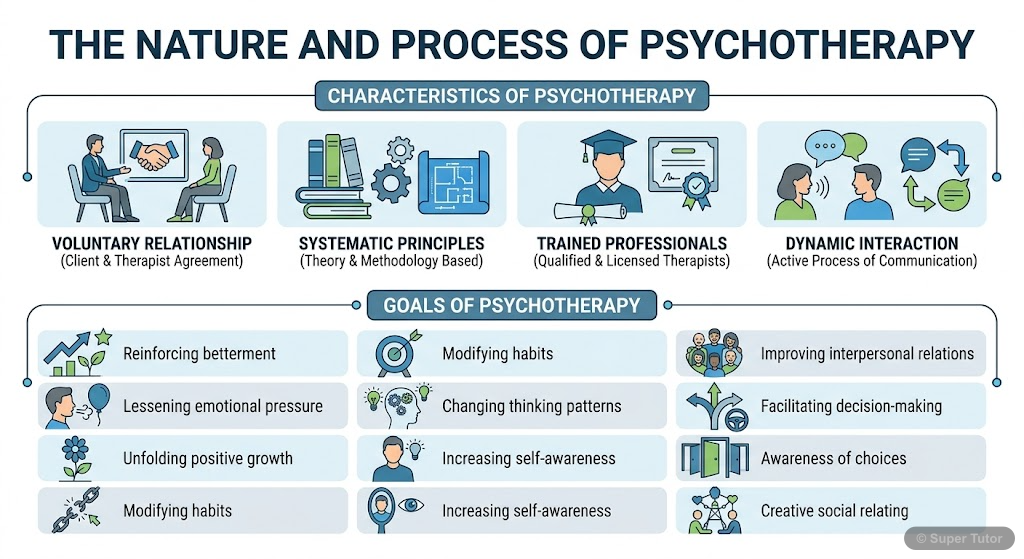
Therapeutic Approaches
Meghalaya Board · Class 12 · Psychology
NCERT Solutions for Therapeutic Approaches — Meghalaya Board Class 12 Psychology.
Interactive on Super Tutor
Studying Therapeutic Approaches? Get the full interactive chapter.
Quizzes, flashcards, AI doubt-solver and a step-by-step study plan — built for ncert solutions and more.
1,000+ Class 12 students started this chapter today

Super Tutor has 19+ illustrations like this for Therapeutic Approaches alone — flashcards, concept maps, and step-by-step visuals.
See them allReview Questions — Therapeutic Approaches
1Describe the nature and scope of psychotherapy. Highlight the importance of therapeutic relationship in psychotherapy.Show solution
Given/Concept: Psychotherapy refers to a set of techniques used by trained mental health professionals to help individuals overcome psychological distress, mental disorders, and related problems.
Nature of Psychotherapy:
- Psychotherapy is a planned, structured interaction between a trained therapist and a client (individual, couple, family, or group) aimed at bringing about positive change in the client's thoughts, feelings, and behaviour.
- It is not a single, homogenous method; there are approximately 400 different types of psychotherapy.
- It is based on a clinical formulation — a statement of the client's problem and a plan of treatment within the framework of a particular therapy.
- Major systems include: Psychoanalytic/Psychodynamic, Behavioural, Cognitive, Humanistic-Existential, and their various schools.
Scope of Psychotherapy:
- It addresses a wide range of problems: anxiety disorders, mood disorders, phobias, personality disorders, psychosomatic problems, relationship difficulties, etc.
- It can be delivered in various formats: individual therapy, group therapy, family therapy, couple therapy.
- It may be short-term (brief therapy) or long-term depending on the nature of the problem.
- Alternative therapies (yoga, meditation) also fall within its broader scope.
Importance of Therapeutic Relationship (Therapeutic Alliance):
- The therapeutic relationship, also called the therapeutic alliance, is the bond between the therapist and the client.
- It is considered one of the most critical factors in the success of psychotherapy, regardless of the type of therapy used.
- Key elements include:
- Trust: The client must feel safe enough to share personal, often painful, information.
- Empathy: The therapist must genuinely understand and share the feelings of the client.
- Unconditional Positive Regard: The therapist accepts the client without judgment.
- Genuineness/Congruence: The therapist is authentic and honest.
- Research consistently shows that a strong therapeutic alliance is a better predictor of positive outcomes than the specific techniques used.
- Without a good therapeutic relationship, even the most technically correct therapy may fail.
Conclusion: Psychotherapy is a broad, multi-faceted discipline, and the therapeutic relationship forms its very foundation, enabling healing and growth.
2What are the different types of psychotherapy? On what basis are they classified?Show solution
Psychotherapies are classified on the basis of:
1. Theoretical orientation (the underlying theory of personality and abnormality)
2. Goals of therapy (insight vs. symptom removal vs. self-growth)
3. Techniques used
4. Format (individual, group, family)
5. Duration (short-term vs. long-term)
Major Types of Psychotherapy:
1. Psychoanalytic/Psychodynamic Therapy (Freud and followers):
- Based on the idea that psychological problems arise from unconscious conflicts, repressed memories, and unresolved childhood experiences.
- Techniques: Free association, dream analysis, analysis of transference and resistance.
- Goal: To bring unconscious material to conscious awareness (insight).
2. Behaviour Therapy:
- Based on learning theory (classical and operant conditioning, social learning).
- Psychological disorders are seen as learned maladaptive behaviours.
- Techniques: Systematic desensitisation, aversion therapy, token economy, modelling, social skills training.
- Goal: To unlearn maladaptive behaviours and learn adaptive ones.
3. Cognitive Therapy / Cognitive Behaviour Therapy (CBT):
- Based on the idea that distorted thinking (cognitive distortions) leads to emotional and behavioural problems.
- Developed by Aaron Beck and Albert Ellis (REBT).
- Techniques: Identifying and challenging irrational beliefs, cognitive restructuring, thought records.
- Goal: To change maladaptive thought patterns.
4. Humanistic-Existential Therapy:
- Based on the belief that humans have free will and the capacity for self-growth and self-actualisation.
- Includes Client-Centred Therapy (Carl Rogers) and Gestalt Therapy (Fritz Perls).
- Techniques: Empathy, unconditional positive regard, genuineness, here-and-now focus.
- Goal: To facilitate personal growth and self-actualisation.
5. Alternative Therapies:
- Includes yogic practices, meditation, mindfulness-based therapies.
- Effective for stress, anxiety, and certain psychosomatic disorders.
Conclusion: Psychotherapies are diverse and are classified primarily on the basis of their theoretical foundations, goals, and techniques.
3Discuss the various techniques used in behaviour therapy.Show solution
Concept: Behaviour therapy is based on the principles of learning theory. It assumes that maladaptive behaviours are learned and can therefore be unlearned and replaced with adaptive behaviours.
Techniques:
1. Systematic Desensitisation (Wolpe):
- Used for phobias and anxiety disorders.
- The client is first taught deep muscle relaxation.
- A hierarchy of anxiety-provoking stimuli is constructed (from least to most feared).
- The client is gradually exposed (in imagination or in reality) to each level of the hierarchy while remaining relaxed.
- Based on the principle of reciprocal inhibition — relaxation and anxiety cannot coexist.
2. Aversion Therapy:
- Used to eliminate undesirable behaviours (e.g., alcoholism, smoking).
- The undesirable behaviour is paired with an unpleasant stimulus (e.g., electric shock or nausea-inducing drug).
- Based on classical conditioning — the behaviour becomes associated with discomfort.
3. Token Economy:
- Based on operant conditioning (positive reinforcement).
- Desirable behaviours are rewarded with tokens which can later be exchanged for privileges or rewards.
- Widely used in institutional settings (hospitals, schools) with children and patients with severe disorders.
4. Modelling (Bandura):
- Based on social learning theory — learning by observing others.
- The client observes a model performing the feared or desired behaviour without negative consequences.
- Effective for phobias, social skills deficits.
5. Social Skills Training:
- Teaches clients interpersonal skills through role-play, rehearsal, and feedback.
- Useful for individuals with social anxiety, schizophrenia, or poor communication skills.
6. Biofeedback:
- The client is given real-time information (feedback) about physiological processes (heart rate, muscle tension).
- Helps the client learn to control these processes voluntarily.
- Useful for stress-related disorders and psychosomatic problems.
7. Positive Reinforcement and Extinction:
- Desired behaviours are reinforced; undesired behaviours are extinguished by withdrawing reinforcement.
Conclusion: Behaviour therapy offers a range of scientifically validated, practical techniques that focus on changing observable behaviour rather than exploring unconscious processes.
4Explain with the help of an example how cognitive distortions take place.Show solution
Concept: Cognitive distortions are systematic errors in thinking that lead individuals to perceive reality inaccurately. According to Aaron Beck, these distorted thought patterns are the root cause of emotional disorders such as depression and anxiety.
Common Types of Cognitive Distortions with Examples:
1. Arbitrary Inference (Jumping to Conclusions):
- Drawing a conclusion without sufficient evidence.
- *Example:* A student does not receive a reply to a message from a friend and concludes, "My friend hates me," without any real evidence.
2. Selective Abstraction:
- Focusing on one negative detail while ignoring the broader context.
- *Example:* A student scores 85% in an exam but focuses only on the 15% marks lost and thinks, "I am a failure."
3. Overgeneralisation:
- Drawing a broad conclusion from a single incident.
- *Example:* After failing one test, a student concludes, "I always fail. I will never succeed in anything."
4. Magnification and Minimisation:
- Exaggerating the importance of negative events and minimising positive ones.
- *Example:* A person makes a small mistake at work and thinks, "This is a catastrophe," while dismissing their many successes.
5. Personalisation:
- Attributing external events to oneself without basis.
- *Example:* A teacher looks upset in class and a student thinks, "She is angry because of something I did."
6. Dichotomous (All-or-Nothing) Thinking:
- Seeing things in black and white, with no middle ground.
- *Example:* "If I am not perfect, I am a total failure."
How Distortions Lead to Distress:
*Example:* A student fails a test (event) → thinks "I am completely worthless" (distortion: overgeneralisation) → feels depressed and stops studying (consequence).
Conclusion: Cognitive distortions are automatic, habitual errors in thinking. Cognitive therapy aims to identify, challenge, and replace these distortions with more rational, balanced thoughts.
5Which therapy encourages the client to seek personal growth and actualise their potential? Write about the therapies which are based on this principle.Show solution
Answer: Humanistic-Existential Therapy encourages the client to seek personal growth and actualise their potential.
Core Principle: Human beings have an innate drive toward growth, self-fulfilment, and self-actualisation. Psychological problems arise when this natural growth process is blocked. The therapist's role is to create conditions that facilitate the client's own growth.
---
Therapies Based on This Principle:
1. Client-Centred Therapy (Carl Rogers):
- Also called Person-Centred Therapy.
- Rogers believed that every person has the capacity for self-understanding and positive change if provided with the right therapeutic environment.
- Three Core Conditions provided by the therapist:
- Unconditional Positive Regard: Accepting the client completely, without judgment or conditions.
- Empathy: Deeply understanding the client's feelings and experiences from their own perspective.
- Genuineness/Congruence: The therapist is authentic and transparent.
- The client is seen as the expert on their own life; the therapist is a facilitator, not a director.
- Goal: To help the client move toward their ideal self and reduce the gap between the real self and the ideal self.
2. Gestalt Therapy (Fritz Perls):
- Focuses on the here-and-now — present experience rather than past events.
- Emphasises personal responsibility and awareness of one's own feelings, thoughts, and actions.
- Techniques include role-play, the empty chair technique (talking to an imagined person in an empty chair), and body awareness exercises.
- Goal: To help clients achieve wholeness (Gestalt = whole) and take responsibility for their lives.
3. Existential Therapy:
- Based on existential philosophy (Sartre, Heidegger).
- Focuses on issues of meaning, freedom, responsibility, and mortality.
- Helps clients confront the fundamental anxieties of existence and find personal meaning.
- Goal: To help clients live authentically and take responsibility for their choices.
Conclusion: Humanistic-existential therapies share the belief in human potential and dignity. They shift focus from pathology to growth, empowering clients to become the best version of themselves.
6What are the factors that contribute to healing in psychotherapy? Enumerate some of the alternative therapies.Show solution
1. Therapeutic Alliance:
- A strong, trusting relationship between therapist and client is one of the most powerful predictors of positive outcomes.
- Empathy, warmth, and genuineness of the therapist are crucial.
2. Client Factors:
- The client's motivation to change, severity of the problem, and personal strengths all influence outcomes.
- Active participation and openness of the client are essential.
3. Hope and Expectancy:
- The client's belief that therapy will help (placebo effect of hope) itself contributes to improvement.
4. Specific Techniques:
- Evidence-based techniques appropriate to the disorder (e.g., systematic desensitisation for phobias, CBT for depression) contribute to healing.
5. Catharsis:
- The emotional release that comes from expressing suppressed feelings provides relief.
6. Insight:
- Understanding the root causes of one's problems (especially in psychodynamic therapy) leads to resolution.
7. Learning New Behaviours:
- Acquiring adaptive coping skills, social skills, and problem-solving abilities.
8. Corrective Emotional Experience:
- Experiencing a safe, accepting relationship with the therapist can correct past negative relational experiences.
9. Regular Practice:
- Homework assignments and practice of new skills between sessions reinforce therapeutic gains.
---
Alternative Therapies:
1. Yoga:
- Combines physical postures (asanas), breathing exercises (pranayama), and meditation.
- Effective for stress, anxiety, depression, and psychosomatic disorders.
2. Meditation:
- Techniques like Vipassana and mindfulness meditation train attention and awareness.
- Reduces stress, anxiety, and improves emotional regulation.
3. Mindfulness-Based Cognitive Therapy (MBCT):
- Combines mindfulness meditation with cognitive therapy.
- Effective in preventing relapse of depression.
4. Ayurvedic Therapies:
- Traditional Indian system using herbs, diet, and lifestyle modifications.
5. Acupuncture:
- Traditional Chinese practice; some evidence for effectiveness in stress and pain management.
Conclusion: Healing in psychotherapy is multi-determined. Both specific therapeutic techniques and common factors (like the therapeutic alliance) play important roles. Alternative therapies, especially yoga and meditation, are increasingly recognised as effective complements to conventional psychotherapy.
7What are the techniques used in the rehabilitation of the mentally ill?Show solution
Concept: Rehabilitation refers to the process of helping individuals with mental illness to restore their functioning, improve quality of life, and reintegrate into society after their acute symptoms have been reduced or controlled.
Need for Rehabilitation:
- Many mental illnesses (e.g., schizophrenia) are chronic and leave residual disabilities even after treatment.
- Patients may have lost social, occupational, and self-care skills during their illness or hospitalisation.
- Rehabilitation bridges the gap between hospital treatment and independent community living.
Techniques Used in Rehabilitation:
1. Social Skills Training:
- Teaches patients basic interpersonal and communication skills through role-play, modelling, and practice.
- Helps them interact effectively in social and work settings.
2. Vocational Rehabilitation:
- Provides training in job skills and helps patients find and maintain employment.
- Includes sheltered workshops and supported employment programmes.
3. Cognitive Retraining:
- Exercises to improve attention, memory, problem-solving, and other cognitive functions impaired by illness.
4. Daily Living Skills Training:
- Teaching self-care skills: personal hygiene, cooking, managing finances, using public transport.
- Promotes independence.
5. Psychoeducation:
- Educating the patient and their family about the nature of the illness, medication, warning signs of relapse, and coping strategies.
- Reduces stigma and improves treatment adherence.
6. Family Therapy and Support:
- Involving the family in the rehabilitation process.
- Reducing expressed emotion (criticism, hostility) in the family, which is known to trigger relapse.
7. Community-Based Rehabilitation (CBR):
- Integrating the patient back into the community through halfway houses, day-care centres, and community support groups.
8. Self-Help Groups:
- Groups of individuals with similar problems who provide mutual support, share experiences, and reduce isolation.
9. Recreational and Occupational Therapy:
- Engaging patients in creative, recreational, and occupational activities to improve functioning and well-being.
Conclusion: Rehabilitation is a holistic, multi-disciplinary process. Its goal is not just the absence of symptoms but the restoration of a meaningful, productive, and dignified life for the mentally ill person.
8How would a social learning theorist account for a phobic fear of lizards/cockroaches? How would a psychoanalyst account for the same phobia?Show solution
---
Social Learning Theory Account (Bandura):
Concept: Social learning theorists believe that behaviour, including fear responses, is learned through observation, imitation, and reinforcement — not just through direct experience.
Explanation:
- A child may observe a parent, sibling, or significant other reacting with extreme fear and disgust to a lizard or cockroach.
- Through vicarious conditioning (observational learning), the child learns to associate the creature with fear and danger, even without any direct negative experience with it.
- For example: A child sees their mother scream and run away from a cockroach → the child learns that cockroaches are dangerous/frightening → the child develops a similar fear response.
- Additionally, if the child's fear response is reinforced (e.g., parents comfort the child when they express fear, or the child avoids the creature and feels relief), the phobia is maintained through operant conditioning.
- Cultural messages, media portrayals, and peer reactions also contribute to the development and maintenance of the phobia.
Treatment (from this perspective): Modelling (watching someone handle the creature calmly) and systematic desensitisation.
---
Psychoanalytic Account (Freud):
Concept: Psychoanalysts believe that phobias are not really about the feared object itself. They are symbolic representations of unconscious conflicts, repressed wishes, or anxieties that have been displaced onto an external object.
Explanation:
- The fear of lizards/cockroaches is seen as a displacement of unconscious anxiety onto a neutral external object.
- The real source of anxiety is an unconscious conflict (often related to sexuality, aggression, or unresolved childhood experiences) that is too threatening to be consciously acknowledged.
- The ego uses the defence mechanism of displacement — the anxiety is transferred from its true (unconscious) source to the lizard/cockroach, which becomes the phobic object.
- For example, Freud's famous case of Little Hans — a boy's fear of horses was interpreted as a displacement of his castration anxiety related to his Oedipus complex.
- Similarly, a fear of lizards might symbolise repressed sexual or aggressive impulses.
Treatment (from this perspective): Psychoanalysis — free association, dream analysis, and interpretation to uncover the unconscious conflict underlying the phobia.
---
Comparison:
| Aspect | Social Learning Theory | Psychoanalytic Theory |
|---|---|---|
| Cause of phobia | Learned through observation/reinforcement | Displacement of unconscious conflict |
| Focus | Observable behaviour and environment | Unconscious mind and childhood conflicts |
| Treatment | Modelling, desensitisation | Free association, dream analysis |
Conclusion: Both perspectives offer valuable but contrasting explanations. Social learning theory focuses on environmental learning, while psychoanalysis looks inward to unconscious processes.
9What kind of problems is cognitive behaviour therapy best suited for?Show solution
Concept: Cognitive Behaviour Therapy (CBT) is an evidence-based psychotherapy that combines cognitive therapy (changing distorted thoughts) with behaviour therapy (changing maladaptive behaviours). It is based on the idea that thoughts, feelings, and behaviours are interconnected, and that changing negative thought patterns leads to changes in emotions and behaviour.
Problems for Which CBT is Best Suited:
1. Depression:
- CBT is highly effective for major depressive disorder.
- It targets negative automatic thoughts, cognitive distortions (e.g., hopelessness, worthlessness), and behavioural withdrawal.
- Techniques: Thought records, behavioural activation, cognitive restructuring.
2. Anxiety Disorders:
- Generalised Anxiety Disorder (GAD): Challenging excessive worry and catastrophic thinking.
- Panic Disorder: Correcting misinterpretations of bodily sensations.
- Social Anxiety Disorder: Challenging beliefs about social judgment and exposure exercises.
3. Phobias:
- Specific phobias and agoraphobia respond well to CBT combined with exposure therapy.
4. Obsessive-Compulsive Disorder (OCD):
- CBT with Exposure and Response Prevention (ERP) is the treatment of choice.
5. Post-Traumatic Stress Disorder (PTSD):
- Trauma-focused CBT helps process traumatic memories and correct distorted beliefs about safety and self-blame.
6. Eating Disorders:
- Effective for bulimia nervosa and binge eating disorder by addressing distorted beliefs about body image and food.
7. Insomnia:
- CBT for Insomnia (CBT-I) addresses dysfunctional beliefs about sleep.
8. Substance Use Disorders:
- Helps identify triggers, challenge beliefs that support substance use, and develop coping skills.
9. Anger Management Problems:
- Identifying cognitive triggers for anger and developing rational responses.
10. Stress-Related and Psychosomatic Problems:
- Effective for problems where stress and negative thinking play a significant role.
Why CBT is Effective:
- It is structured, time-limited, and goal-oriented.
- It is collaborative — the client and therapist work together as a team.
- It involves homework — clients practise skills between sessions.
- It is evidence-based — supported by extensive research.
Conclusion: CBT is one of the most versatile and empirically supported therapies. It is best suited for problems where distorted thinking and maladaptive behaviour play a central role, particularly mood disorders, anxiety disorders, and OCD.
Stuck on a step?
Ask Super Tutor AI to explain any solution on this page in a simpler way — free, 24x7.
Ask a Doubt FreeFrequently Asked Questions
What are the important topics in Therapeutic Approaches for Meghalaya Board Class 12 Psychology?
How to score full marks in Therapeutic Approaches — Meghalaya Board Class 12 Psychology?
Where can I get free NCERT Solutions for Therapeutic Approaches Class 12 Psychology?
Sources & Official References
Content is aligned to the official syllabus. Refer to the board website for the latest curriculum.
More resources for Therapeutic Approaches
Important Questions
Practice with board exam-style questions
Syllabus
What topics to cover
Revision Notes
Key points for last-minute revision
Study Plan
Step-by-step plan to ace this chapter
Flashcards
Quick-fire cards for active recall
Formula Sheet
All formulas in one place
Chapter Summary
Understand the chapter at a glance
Practice Quiz
Test yourself with a quick quiz
Concept Maps
See how topics connect visually
For serious students
Get the full Therapeutic Approaches chapter — for free.
Quizzes, flashcards, AI doubt-solver and a step-by-step study plan for Meghalaya Board Class 12 Psychology.