Mahatma Gandhi and the Nationalist Movement: Civil Disobedience and Beyond — Chapter Summary
Mizoram Board · Class 12 · History
Summary of Mahatma Gandhi and the Nationalist Movement: Civil Disobedience and Beyond for Mizoram Board Class 12 History.
Interactive on Super Tutor
Studying Mahatma Gandhi and the Nationalist Movement: Civil Disobedience and Beyond? Get the full interactive chapter.
Quizzes, flashcards, AI doubt-solver and a step-by-step study plan — built for chapter summary and more.
Free trial, no card needed.
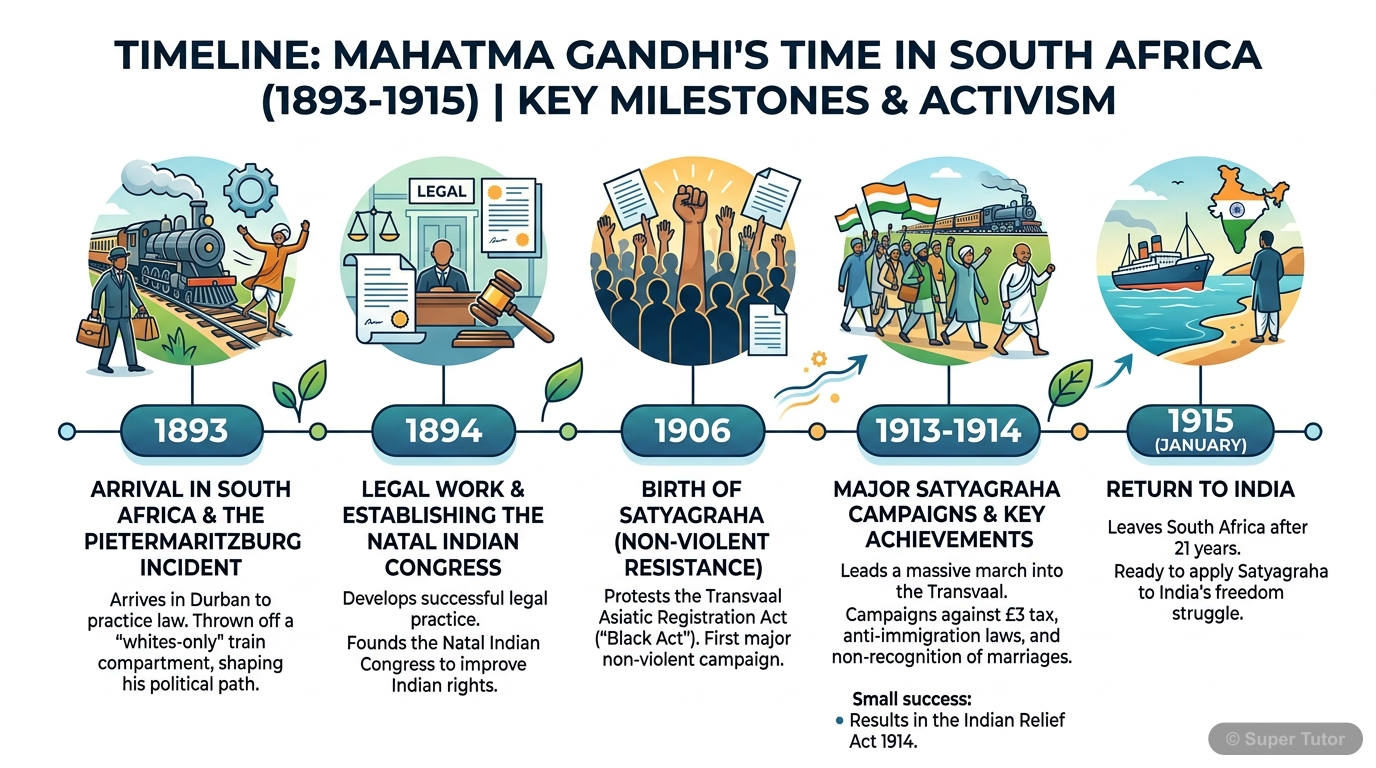
One of 11 illustrations for Mahatma Gandhi and the Nationalist Movement: Civil Disobedience and Beyond in Super Tutor — alongside flashcards, concept maps and practice questions.
Overview
Mahatma Gandhi became the central figure of Indian nationalism after returning to India in January 1915. His politics linked the national struggle with the lives of peasants, workers, women, untouchables, and ordinary people. The chapter shows how Gandhi moved from local struggles in Champaran, Ahme
Key Concepts
Gandhi returned to India in January
Gandhi returned to India in January 1915 after two decades abroad, mostly in South Africa. His first major public appearance in India was at the openi
Satyagraha was Gandhi’s method of non
Satyagraha was Gandhi’s method of non-violent protest based on truth, self-discipline, and moral force. It was first developed in South Africa and lat
In 1917 Gandhi worked in Champaran
In 1917 Gandhi worked in Champaran for peasants facing indigo planter oppression, in 1918 he intervened in the Ahmedabad textile mill workers’ dispute
The Rowlatt Act continued wartime censorship
The Rowlatt Act continued wartime censorship of the press and detention without trial. Gandhi’s protest against it spread across North and West India
Non
Non-cooperation meant renunciation of voluntary association with the British Government. Indians were asked to leave schools, colleges, and law courts
Learning Objectives
- Understand how Gandhi emerged as a national leader after 1915.
- Explain the role of satyagraha, non-cooperation, and civil disobedience in the freedom struggle.
- Trace the major movements led or inspired by Gandhi between 1917 and 1948.
- Analyse Gandhi’s relationship with peasants, workers, women, untouchables, and political leaders.
- Understand the importance of the Salt March, the Round Table Conference, Quit India, and Partition.
Frequently Asked Questions
What are the important topics in Mahatma Gandhi and the Nationalist Movement: Civil Disobedience and Beyond for Mizoram Board Class 12 History?
How should I revise Mahatma Gandhi and the Nationalist Movement: Civil Disobedience and Beyond for the Mizoram Board Class 12 board exam?
Sources & Official References
Content is aligned to the official syllabus. Refer to the board website for the latest curriculum.
More resources for Mahatma Gandhi and the Nationalist Movement: Civil Disobedience and Beyond
Practice Quiz
Test yourself with a quick quiz
Important Questions
Exam-style questions with answers
Revision Notes
Key points for last-minute revision
Concept Maps
See how topics connect
Study Plan
Step-by-step plan for this chapter
Flashcards
Quick-fire cards for active recall
Syllabus
What topics to cover
NCERT Solutions
Every textbook question solved step by step
For serious students
Get the full Mahatma Gandhi and the Nationalist Movement: Civil Disobedience and Beyond chapter — start free.
Quizzes, flashcards, an AI doubt solver and a study plan for Mizoram Board Class 12 History. Free to start, no card needed.