Social Institutions: Continuity and Change — Flashcards
Mizoram Board · Class 12 · Sociology
78 flashcards for Social Institutions: Continuity and Change (Mizoram Board Class 12 Sociology) to test yourself on key terms and facts.
Interactive on Super Tutor
Studying Social Institutions: Continuity and Change? Get the full interactive chapter.
Quizzes, flashcards, AI doubt-solver and a step-by-step study plan — built for flashcards and more.
Free trial, no card needed.
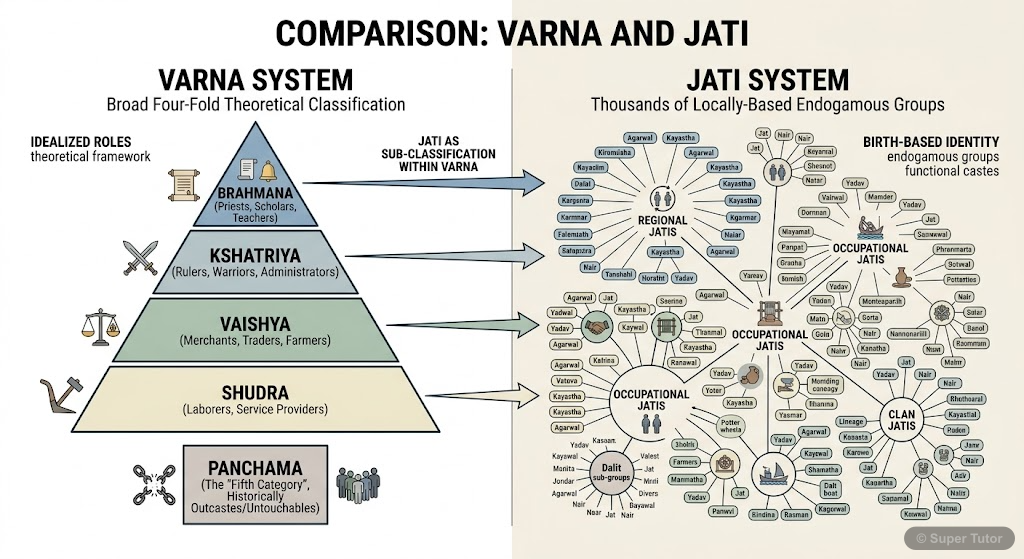
Learn better with visuals Super Tutor pairs illustrations like this with notes and quizzes for Social Institutions: Continuity and Change.
Why is caste considered a uniquely Indian social institution?
Answer
Caste is uniquely associated with the Indian sub-continent. Similar social effects have existed elsewhere, but not the exact form found in India. It is also linked mainly with Hindu society, though it…
जाति को विशिष्ट भारतीय सामाजिक संस्था क्यों माना जाता है?
Answer
जाति भारतीय उपमहाद्वीप से विशिष्ट रूप से जुड़ी हुई है। इसी तरह के सामाजिक प्रभाव अन्यत्र भी विद्यमान हैं, लेकिन भारत में पाया जाने वाला सटीक रूप नहीं। यह मुख्य रूप से हिंदू समाज से भी जुड़ा हुआ है, हा…
'जाति' शब्द का क्या अर्थ है? यह शब्द कहाँ से आया है?
Answer
अंग्रेजी का शब्द 'कास्ट' पुर्तगाली शब्द 'कास्टा' से लिया गया है जिसका अर्थ है शुद्ध नस्ल। भारतीय भाषाओं में संस्था की चर्चा प्रायः वर्ण और जाति के माध्यम से की जाती है।…
What does the word 'caste' mean, and where does it come from?
Answer
The English word 'caste' is a borrowing from the Portuguese word 'casta', meaning pure breed. In Indian languages, the institution is usually discussed through the terms varna and jati.
What is the difference between varna and jati?
Answer
Varna is the broad all-India four-fold classification into brahmana, kshatriya, vaishya, and shudra. Jati is the more complex local or regional sub-classification, usually involving hundreds or thousa…
वर्ण और जाति में क्या अन्तर है?
Answer
वर्ण ब्राह्मण, क्षत्रिय, वैश्य और शूद्र में व्यापक अखिल भारतीय चार-गुण वर्गीकरण है। जाति अधिक जटिल स्थानीय या क्षेत्रीय उप-वर्गीकरण है, जिसमें आमतौर पर सैकड़ों या हजारों जातियाँ और उपजातियाँ शामिल होत…
जाति व्यवस्था में अंतर्विवाह का क्या अर्थ है?
Answer
अंतर्विवाह का अर्थ है कि विवाह एक ही जाति समूह के सदस्यों तक सीमित है। यह जाति के मुख्य नियमों में से एक है और जाति की सीमाओं को बनाए रखने में मदद करता है।…
What does endogamy mean in the caste system?
Answer
Endogamy means marriage is restricted to members of the same caste group. It is one of the main rules of caste and helps maintain caste boundaries.
+70 more flashcards
Practise AllFrequently Asked Questions
What are the important topics in Social Institutions: Continuity and Change for Mizoram Board Class 12 Sociology?
How many flashcards are available for Social Institutions: Continuity and Change?
How should I revise Social Institutions: Continuity and Change for the Mizoram Board Class 12 board exam?
Sources & Official References
Content is aligned to the official syllabus. Refer to the board website for the latest curriculum.
More resources for Social Institutions: Continuity and Change
Practice Quiz
Test yourself with a quick quiz
Important Questions
Exam-style questions with answers
Revision Notes
Key points for last-minute revision
Chapter Summary
Understand the chapter at a glance
Concept Maps
See how topics connect
Study Plan
Step-by-step plan for this chapter
Syllabus
What topics to cover
NCERT Solutions
Every textbook question solved step by step
For serious students
Get the full Social Institutions: Continuity and Change chapter — start free.
Quizzes, flashcards, an AI doubt solver and a study plan for Mizoram Board Class 12 Sociology. Free to start, no card needed.