Chapter 5 of 15
NCERT Solutions

Social Institutions: Continuity and Change

Mizoram Board · Class 12 · Sociology

NCERT Solutions for Social Institutions: Continuity and Change — Mizoram Board Class 12 Sociology.

44 questions25 flashcards5 concepts

Interactive on Super Tutor

Studying Social Institutions: Continuity and Change? Get the full interactive chapter.

Quizzes, flashcards, AI doubt-solver and a step-by-step study plan — built for ncert solutions and more.

1,000+ Class 12 students started this chapter today

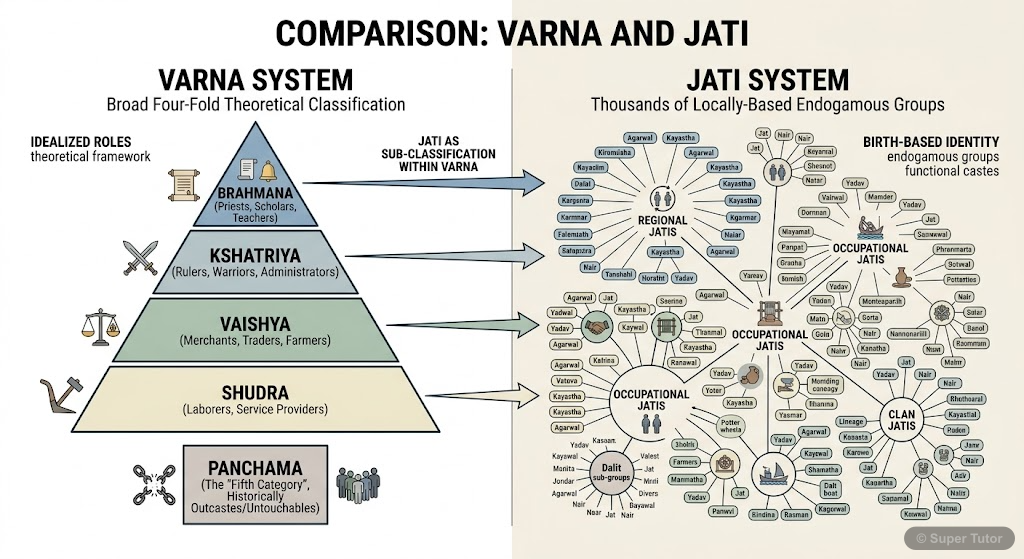
A comparison illustrating the difference between Varna (four-fold division) and Jati (local, complex sub-castes) in the Indian caste system, showing their relationship.
Super Tutor

Learn better with visuals Super Tutor has hundreds of illustrations like this across every chapter — all free to try.

Get started
10 Questions Solved · 1 Section

Exercises — Social Institutions: Continuity and Change

1What is the role of the ideas of separation and hierarchy in the caste system?Show solution
Given/Context: The caste system is a social institution unique to India that organises society into ranked groups.

Concept Used: The caste system is fundamentally based on two interrelated ideas — *separation* and *hierarchy* — as analysed by sociologists like Louis Dumont in *Homo Hierarchicus*.

Answer:

1. Separation:
The idea of separation means that each caste is kept distinct from every other caste. This separation operates at multiple levels:
- Endogamy: Marriage must take place within one's own caste group, preventing the mixing of caste identities across generations.
- Commensality rules: There are strict rules about who can eat with whom and who can accept food or water from whom. Higher castes generally refuse to accept cooked food or water from lower castes.
- Occupational separation: Each caste is traditionally associated with a specific occupation, and members are expected to follow only that occupation.
- Residential separation: In villages, different castes often lived in separate quarters (*wadas* or *paras*), reinforcing physical distance.

2. Hierarchy:
The idea of hierarchy means that castes are not merely different from each other — they are ranked in a graded order of *purity and pollution*.
- At the top of the hierarchy are Brahmins, considered ritually pure.
- At the bottom are the so-called 'untouchables' (Dalits), considered ritually impure.
- The hierarchy is not based on wealth or power alone but primarily on the concept of ritual purity.
- This hierarchy legitimises unequal access to resources, rights, and social respect.

Relationship between the two ideas:
Separation and hierarchy work together: separation ensures that the boundaries between castes are maintained, while hierarchy ensures that these separated groups are ranked unequally. Together they reproduce social inequality across generations.

Conclusion: The ideas of separation and hierarchy are the twin pillars of the caste system. They ensure that caste identities remain distinct and that social inequality is reproduced in a structured, legitimised manner.
2What are some of the rules that the caste system imposes?Show solution
Given/Context: The caste system is a hierarchical social institution that regulates the lives of its members through a set of strict rules.

Concept Used: The caste system imposes rules related to marriage, occupation, food, and social interaction, all aimed at maintaining separation and hierarchy.

Answer — Rules imposed by the Caste System:

1. Rule of Endogamy (Marriage within caste):
Members of a caste must marry within their own caste group. Marriage outside the caste (*inter-caste marriage*) was traditionally forbidden and could lead to social ostracism or punishment.

2. Rules of Commensality (Food and dining):
Strict rules govern who can share food with whom and who can accept cooked food or water from whom. Higher castes would not accept food or water from lower castes, especially from 'untouchables'.

3. Occupational Rules:
Each caste was traditionally assigned a specific occupation. For example, Brahmins were priests and scholars, Kshatriyas were warriors, Vaishyas were traders, and Shudras performed manual labour. Members were expected to follow only their hereditary occupation.

4. Rules of Untouchability:
The lowest castes (Dalits) were subjected to the practice of untouchability — they could not enter temples, use common wells, or even walk on certain roads. Physical contact with them was considered polluting.

5. Rules of Residence:
Different castes were required to live in separate areas of a village, maintaining physical distance and reinforcing social separation.

6. Rules of Ritual Status:
Only certain castes could perform religious rituals or enter the inner sanctum of temples. Lower castes were excluded from religious ceremonies.

7. Rules of Dress and Behaviour:
In some regions, lower castes were forbidden from wearing certain types of clothing, footwear, or jewellery that were reserved for higher castes.

Conclusion: The caste system imposes a comprehensive set of rules that govern almost every aspect of social life — from birth to death — ensuring that caste boundaries are maintained and social hierarchy is preserved.
3What changes did colonialism bring about in the caste system?Show solution
Given/Context: British colonial rule in India (roughly 1757–1947) had a profound impact on Indian social institutions, including the caste system.

Concept Used: Colonialism transformed the caste system through administrative, legal, and ideological interventions, sometimes rigidifying it and sometimes challenging it.

Answer — Changes brought by Colonialism:

1. Census and Documentation — Rigidification of Caste:
The British colonial administration conducted regular censuses that required every Indian to be classified by caste. This process of enumeration *froze* and *rigidified* caste identities that had previously been more fluid. Castes that were locally known by different names were grouped together or separated, often creating new identities.

2. Caste as a Legal and Administrative Category:
The British used caste as a basis for administrative decisions — for recruitment into the army, for land revenue settlements, and for legal purposes. This gave caste a new official, bureaucratic significance.

3. Spread of Education and New Occupations:
Colonial rule introduced Western education and a modern economy with new occupations (clerks, lawyers, doctors, etc.). This weakened the traditional link between caste and occupation, as people from various castes could now enter new professions.

4. Social Reform Movements:
Colonialism created conditions for social reform movements that challenged caste discrimination. Leaders like Jyotiba Phule, B.R. Ambedkar, and Periyar used the new public sphere (newspapers, associations, courts) to attack caste oppression. The colonial legal system provided new tools to challenge untouchability.

5. Urbanisation and Anonymity:
The growth of cities under colonialism created spaces where caste identity was less visible. In urban areas, people of different castes lived and worked together, weakening some traditional caste restrictions.

6. Orientalist Scholarship — Textualisation of Caste:
British scholars and administrators studied Hindu texts and presented the *varna* system as the 'real' or 'original' caste system. This textualised, Brahminic view of caste was then used to understand and administer all of Indian society, distorting the complex reality of caste.

7. Politicisation of Caste:
With the introduction of representative politics and elections, caste became a political resource. Caste groups began to organise politically to demand rights and representation, a process that continues today.

Conclusion: Colonialism had a contradictory impact on caste — it simultaneously rigidified caste identities through census and administration, and also created conditions (education, law, urbanisation) that challenged traditional caste hierarchies.
4In what sense has caste become relatively 'invisible' for the urban upper castes?Show solution
Given/Context: In contemporary India, especially in urban areas, caste is often said to have become less visible or less important in everyday life, particularly for upper-caste groups.

Concept Used: The 'invisibility' of caste for urban upper castes is a sociological phenomenon related to privilege, anonymity, and the conflation of caste advantage with individual merit.

Answer:

Caste has become relatively 'invisible' for urban upper castes in the following senses:

1. Anonymity of Urban Life:
In cities, people interact with strangers in offices, markets, and public spaces without knowing each other's caste. Unlike villages where everyone knows everyone's caste, urban anonymity makes caste less immediately visible in daily interactions.

2. New Occupational Structure:
The modern economy offers a wide range of occupations not linked to caste. Urban upper-caste individuals work as engineers, doctors, managers, etc. — occupations that are not caste-specific. This makes the caste-occupation link less obvious.

3. Privilege Mistaken for Merit:
Upper castes have historically had better access to education, land, and social networks. In the urban context, the advantages accumulated over generations are often mistaken for individual merit or hard work. The caste basis of this privilege becomes invisible.

4. Caste Practised Privately:
While caste may not be openly discussed in workplaces or public spaces, it continues to operate in private life — especially in marriage (endogamy is still widely practised even among urban upper castes). Caste is 'invisible' in public but very much alive in private.

5. Upper Castes as the 'Norm':
In a society where upper-caste culture, language, and values are treated as the standard or 'normal', upper-caste individuals do not need to think about their caste identity. It is the lower castes who are constantly reminded of their caste through discrimination. This is similar to how dominant groups in any society do not need to think about their identity.

6. Discourse of Meritocracy:
The ideology of meritocracy — the idea that success comes from talent and hard work alone — makes caste invisible by denying that caste-based advantages exist.

Conclusion: Caste is 'invisible' for urban upper castes not because it has disappeared, but because their caste privilege is so normalised and embedded in social structures that it does not need to be explicitly invoked. For lower castes, however, caste remains very visible through discrimination and disadvantage.
5How have tribes been classified in India?Show solution
Given/Context: India has a large tribal population spread across different regions. The government and scholars have used various criteria to identify and classify tribal communities.

Concept Used: Tribes in India have been classified using geographical, administrative, and socio-cultural criteria.

Answer — Classification of Tribes in India:

1. Constitutional/Administrative Classification — Scheduled Tribes (STs):
The Indian Constitution (Article 342) empowers the President to specify which communities are to be recognised as Scheduled Tribes. This is the most important official classification. Communities listed as STs are entitled to reservations in education, employment, and political representation. The criteria used include:
- Primitive traits
- Distinctive culture
- Geographical isolation
- Shyness of contact with the community at large
- Backwardness

2. Geographical Classification:
Tribes are often classified by the region they inhabit:
- North-East India: Nagas, Mizos, Khasis, Bodos, etc. — these tribes have a strong sense of territorial identity and have been involved in movements for autonomy.
- Central India (the 'tribal belt'): Gonds, Santhals, Mundas, Bhils, Oraons — these are the most numerous tribal groups, spread across Jharkhand, Chhattisgarh, Odisha, Madhya Pradesh, and Maharashtra.
- Andaman and Nicobar Islands: Jarawas, Sentinelese, Onge — these are among the most isolated tribal communities.
- South India: Todas, Kodavas, etc.

3. Linguistic Classification:
Tribes can be classified by the language family they belong to:
- Austro-Asiatic (e.g., Mundas, Santhals)
- Dravidian (e.g., Gonds, Oraons)
- Tibeto-Burman (e.g., Nagas, Mizos)
- Indo-Aryan (some tribes in Rajasthan and Gujarat)

4. Classification by Mode of Livelihood:
- Hunting and gathering communities
- Shifting cultivators (*jhum* cultivation)
- Settled agriculturalists
- Pastoral communities

Conclusion: Tribes in India are classified using a combination of administrative, geographical, linguistic, and cultural criteria. The Scheduled Tribe classification is the most significant for policy purposes, though it has been criticised for being inconsistent and politically influenced.
6What evidence would you offer against the view that 'tribes are primitive communities living isolated lives untouched by civilisation'?Show solution
Given/Context: A common but mistaken view holds that tribal communities are 'primitive', isolated, and untouched by mainstream civilisation. This view needs to be critically examined.

Concept Used: Sociological and historical evidence shows that tribal communities have always been in contact with non-tribal societies and have been deeply affected by historical processes.

Answer — Evidence against the 'primitive and isolated' view:

1. Long History of Interaction with Non-Tribal Societies:
Tribal communities have never been completely isolated. Historical records show that tribes traded with, fought against, and were administered by non-tribal kingdoms for centuries. For example, the Gonds established powerful kingdoms in central India during the medieval period.

2. Impact of Colonialism:
British colonial rule profoundly transformed tribal life. Colonial forest laws (e.g., the Forest Act of 1878) took away tribal rights over forests and land. Tribal communities were forced into wage labour in mines, plantations, and construction projects. This shows they were very much part of the colonial economy.

3. Tribal Revolts and Political Consciousness:
Far from being passive and isolated, tribal communities actively resisted colonial rule and exploitation. Major tribal uprisings include:
- The Santhal Rebellion (Hul) of 1855–56
- The Munda Rebellion (Ulgulan) led by Birsa Munda in 1899–1900
- The Rampa Rebellion in Andhra Pradesh
These revolts demonstrate political awareness and engagement with the wider world.

4. Integration into the National Economy:
Tribal regions are rich in natural resources — forests, minerals, and rivers. Tribal communities have been integrated (often forcibly) into the national economy as labourers in mines (e.g., coal in Jharkhand), as forest produce collectors, and as agricultural workers. They are far from economically isolated.

5. Adoption of New Religions and Cultures:
Many tribal communities have converted to Christianity (especially in North-East India and Jharkhand) or have adopted elements of Hinduism. This shows cultural exchange and interaction, not isolation.

6. Tribal Participation in Modern Politics:
Tribal communities actively participate in elections, have their own political parties (e.g., Jharkhand Mukti Morcha), and have produced national leaders (e.g., Jaipal Singh Munda, who also led India's hockey team at the 1928 Olympics).

7. Diversity within Tribal Communities:
Tribal communities are not a homogeneous, unchanging group. They are internally diverse in terms of language, religion, occupation, and social organisation, just like any other community.

Conclusion: The view that tribes are primitive and isolated is a colonial stereotype that does not match historical or sociological reality. Tribal communities have always been dynamic, politically conscious, and connected to the wider world, even as they have faced exploitation and marginalisation.
7What are the factors behind the assertion of tribal identities today?Show solution
Given/Context: In contemporary India, tribal communities are increasingly asserting their distinct identities through political movements, cultural revivals, and demands for rights.

Concept Used: The assertion of tribal identity is a response to historical marginalisation, displacement, and the desire for political recognition and cultural dignity.

Answer — Factors behind the assertion of tribal identities:

1. Land Alienation and Displacement:
Tribal communities have historically lost their lands to non-tribal settlers, moneylenders, and the state (for dams, mines, and industries). The loss of land — which is central to tribal identity, livelihood, and culture — has generated strong movements to reclaim land rights. The demand for a separate state of Jharkhand, for example, was partly rooted in the issue of land alienation.

2. Forest Rights and Livelihood:
Colonial and post-colonial forest laws denied tribal communities their traditional rights over forests. The struggle to reclaim these rights has been a major factor in tribal mobilisation. The Forest Rights Act (2006) was a result of sustained tribal assertion.

3. Development-Induced Displacement:
Large development projects — dams (e.g., Sardar Sarovar), mines, and industrial plants — have displaced millions of tribal people. The Narmada Bachao Andolan and other movements have been led significantly by tribal communities protesting displacement without adequate rehabilitation.

4. Political Mobilisation and Reservations:
The constitutional provision of reservations for Scheduled Tribes in education, employment, and politics has created a new tribal middle class and political leadership. This educated leadership has been instrumental in articulating tribal demands and asserting tribal identity.

5. Cultural Revival:
There is a growing movement to revive and celebrate tribal languages, music, dance, and traditions. Tribal communities are asserting that their cultures are not inferior to mainstream culture but are distinct and valuable. This cultural assertion is linked to demands for recognition and respect.

6. Demand for Separate States:
The creation of Jharkhand (2000), Chhattisgarh (2000), and Uttarakhand (2000) was partly a response to tribal and regional demands for political autonomy and better governance. The demand for separate states reflects the assertion of distinct regional and tribal identities.

7. Influence of Education and Awareness:
Spread of education among tribal communities has created awareness about rights, exploitation, and the possibilities of political action. Educated tribal youth have played a key role in organising communities.

8. Reaction to Discrimination and Marginalisation:
Despite constitutional protections, tribal communities continue to face discrimination, poverty, and social exclusion. This ongoing marginalisation has strengthened the sense of a shared tribal identity and the need to assert it collectively.

Conclusion: The assertion of tribal identities today is a complex response to centuries of exploitation, displacement, and cultural suppression. It combines demands for land rights, political autonomy, cultural recognition, and economic justice.
8What are some of the different forms that the family can take?Show solution
Given/Context: The family is a universal social institution, but it takes many different forms across societies and cultures.

Concept Used: Families can be classified on the basis of size/structure, rules of residence, rules of descent/inheritance, and authority patterns.

Answer — Different Forms of the Family:

1. Based on Size and Structure:

(a) Nuclear Family:
Consists of a married couple and their unmarried children. This is the most common family form in modern industrial societies. It is small, mobile, and relatively independent.

(b) Joint/Extended Family:
Consists of multiple generations living together — grandparents, parents, children, and sometimes uncles, aunts, and cousins. This is common in India and other agrarian societies. It provides economic cooperation and social support.

2. Based on Rules of Residence:

(a) Patrilocal Family:
After marriage, the couple lives with or near the husband's parents. This is the most common pattern in India.

(b) Matrilocal Family:
After marriage, the couple lives with or near the wife's parents. This is found among some communities like the Khasis of Meghalaya.

(c) Neolocal Family:
The couple sets up a new, independent household separate from both sets of parents. Common in urban, industrial societies.

3. Based on Rules of Descent and Inheritance:

(a) Patrilineal Family:
Property and family name are passed from father to son. This is the most common pattern in India.

(b) Matrilineal Family:
Property is inherited through the female line — from mother to daughter (or from a man to his sister's son). Found among the Nairs of Kerala and the Khasis of Meghalaya.

4. Based on Authority Patterns:

(a) Patriarchal Family:
The father/husband is the head of the family and exercises authority over other members. This is the most widespread form historically.

(b) Matriarchal Family:
In theory, a family where the mother/woman exercises authority. However, as noted in the chapter, true matriarchy (where women exercise dominance) has no historical or anthropological evidence. It remains a theoretical concept.

5. Based on Number of Spouses:

(a) Monogamous Family: One husband and one wife.
(b) Polygamous Family: One person has multiple spouses — either polygyny (one husband, multiple wives) or polyandry (one wife, multiple husbands, as among the Todas of Nilgiris).

Conclusion: The family is not a single, fixed institution but takes diverse forms depending on cultural, economic, and social contexts. This diversity shows that the family is a social construction that adapts to the needs of different societies.
9In what ways can changes in social structure lead to changes in the family structure?Show solution
Given/Context: The family does not exist in isolation — it is embedded in a larger social structure. Changes in economy, politics, culture, and law can transform family forms.

Concept Used: The family is a social institution that both shapes and is shaped by the wider social structure. Changes in industrialisation, urbanisation, law, and gender relations affect family structure.

Answer — Ways in which changes in social structure lead to changes in family structure:

1. Industrialisation and Urbanisation:
The shift from an agrarian to an industrial economy is one of the most important factors changing family structure.
- In agrarian societies, the joint family was functional because land was the main resource and required collective labour and management.
- Industrialisation created factory jobs in cities. Workers migrated to cities, leaving behind the joint family. The nuclear family became more suitable for the mobile, urban, industrial lifestyle.
- Urbanisation also brought anonymity, reducing the social pressure to conform to traditional family norms.

2. Changes in the Economy and Occupational Structure:
- When the economy shifts from agriculture to industry and services, the family loses its function as a unit of production. Members earn individual wages rather than working together on family land.
- This economic individualism weakens the joint family and strengthens the nuclear family.
- Women's entry into the paid workforce gives them economic independence, which can change power relations within the family.

3. Legal Changes:
- Laws relating to marriage, divorce, inheritance, and property rights directly affect family structure.
- For example, the Hindu Succession Act (1956, amended 2005) gave daughters equal rights in ancestral property, challenging the patrilineal joint family structure.
- Laws permitting divorce have made it easier to dissolve marriages, leading to new family forms like single-parent families.

4. Changes in Gender Relations:
- The women's movement and changing ideas about gender equality have challenged patriarchal family structures.
- Women's education and employment have given them greater autonomy, reducing their dependence on the family and changing the traditional division of labour within the household.
- Decisions about marriage, childbearing, and residence are increasingly made by individuals rather than families.

5. Demographic Changes:
- Declining birth rates (due to family planning) mean smaller families.
- Increased life expectancy means more elderly people, creating new family arrangements (e.g., elderly parents living with adult children or in old-age homes).

6. Cultural and Ideological Changes:
- The spread of individualism as a value — the idea that individuals have the right to choose their own partners, careers, and lifestyles — has weakened the authority of the joint family.
- Media, education, and globalisation spread new ideas about romantic love, individual rights, and personal freedom that challenge traditional family norms.

7. Migration:
- Both internal migration (rural to urban) and international migration separate family members, leading to the breakdown of joint families and the emergence of transnational families.

Conclusion: Changes in social structure — economic, legal, demographic, and cultural — have a profound impact on family structure. The family adapts to these changes, sometimes slowly and with conflict, but it is never static. The shift from joint to nuclear families in India is a clear example of how broader social changes reshape the family.
10Explain the difference between matriliny and matriarchy.Show solution
Given/Context: The terms 'matriliny' and 'matriarchy' are often confused, but they refer to very different concepts in sociology and anthropology.

Concept Used: Matriliny is a system of descent and inheritance, while matriarchy refers to a system of authority and dominance. The two do not necessarily go together.

Answer:

| Basis of Difference | Matriliny | Matriarchy |
|---|---|---|
| Definition | A system in which descent, family membership, and inheritance of property are traced through the female line (mother to daughter). | A system in which women exercise authority, dominance, and control over public and private affairs. |
| What it involves | Rules about who inherits property and who belongs to which family group. | Rules about who holds power and makes decisions. |
| Does it give women power? | Not necessarily. Women may inherit property but may not control it or make decisions about it. | Yes, by definition — women are the dominant authority figures. |
| Empirical existence | Yes — matrilineal societies exist. Examples: Khasis and Garos of Meghalaya, Nairs of Kerala. | No confirmed historical or anthropological evidence of true matriarchal societies. It remains a theoretical concept. |
| Nature of concept | Empirical — actually found in real societies. | Theoretical — no society has been found where women exercise dominance in the way men do in patriarchal societies. |

Detailed Explanation:

Matriliny:
- In a matrilineal society, a child belongs to the mother's clan/family, not the father's.
- Property (land, house, valuables) passes from mother to daughter (or from a man to his sister's son, not his own son).
- Example: Among the Khasis of Meghalaya, the youngest daughter inherits the family property and the family name passes through women. Among the Nairs of Kerala, the traditional *taravad* (joint family) was matrilineal.
- However, even in matrilineal societies, it is often men (brothers, maternal uncles) who manage and control the property. Women inherit but do not necessarily exercise power.

Matriarchy:
- Matriarchy would mean a society where women are the dominant authority — in the family, in politics, in religion, and in public life — just as men are dominant in patriarchal societies.
- Despite many claims and myths, no society has been found where women exercise this kind of systematic dominance over men.
- Sociologists and anthropologists therefore treat matriarchy as a theoretical or hypothetical concept, not an empirical reality.

Key Distinction (in one sentence):
Matriliny is about *inheritance and descent through women*, while matriarchy is about *power and authority exercised by women*. A society can be matrilineal without being matriarchal — and in practice, all known matrilineal societies are still largely controlled by men.

Conclusion: The difference between matriliny and matriarchy is crucial: matriliny is a real, documented social practice found in several Indian communities, while matriarchy remains an unproven theoretical concept. The existence of matrilineal societies does not mean that women hold power — it only means that property and identity are traced through the female line.

Stuck on a step?

Ask Super Tutor AI to explain any solution on this page in a simpler way — free, 24x7.

Ask a Doubt Free

Frequently Asked Questions

What are the important topics in Social Institutions: Continuity and Change for Mizoram Board Class 12 Sociology?
Key topics in Social Institutions: Continuity and Change include Chapter Concept Map — Social Institutions: Continuity and Change, Common Misconceptions About Caste — Correct vs Incorrect Understanding, Chapter 3 Overview: Social Institutions. These are the concepts Mizoram Board Class 12 examiners draw on most — study them first, then practise related questions.
How to score full marks in Social Institutions: Continuity and Change — Mizoram Board Class 12 Sociology?
Understand the core concepts first, then work through the 44 practice questions available for this chapter. Revise formulas and definitions regularly, and use flashcards for quick recall before the exam.
Where can I get free NCERT Solutions for Social Institutions: Continuity and Change Class 12 Sociology?
This page has free step-by-step NCERT Solutions for every exercise question in Social Institutions: Continuity and Change (Mizoram Board Class 12 Sociology) — written the way examiners award marks: given, formula, working, answer.

Sources & Official References

Content is aligned to the official syllabus. Refer to the board website for the latest curriculum.

For serious students

Get the full Social Institutions: Continuity and Change chapter — for free.

Quizzes, flashcards, AI doubt-solver and a step-by-step study plan for Mizoram Board Class 12 Sociology.