Analysis of Financial Statements — Practice Quiz
Madhya Pradesh Board · Class 12 · Accountancy
Try a 4-question quiz on Analysis of Financial Statements for Madhya Pradesh Board Class 12 Accountancy: tap an answer to check it and see why.
Interactive on Super Tutor
Studying Analysis of Financial Statements? Get the full interactive chapter.
Quizzes, flashcards, AI doubt-solver and a step-by-step study plan — built for practice quiz and more.
Free trial, no card needed.
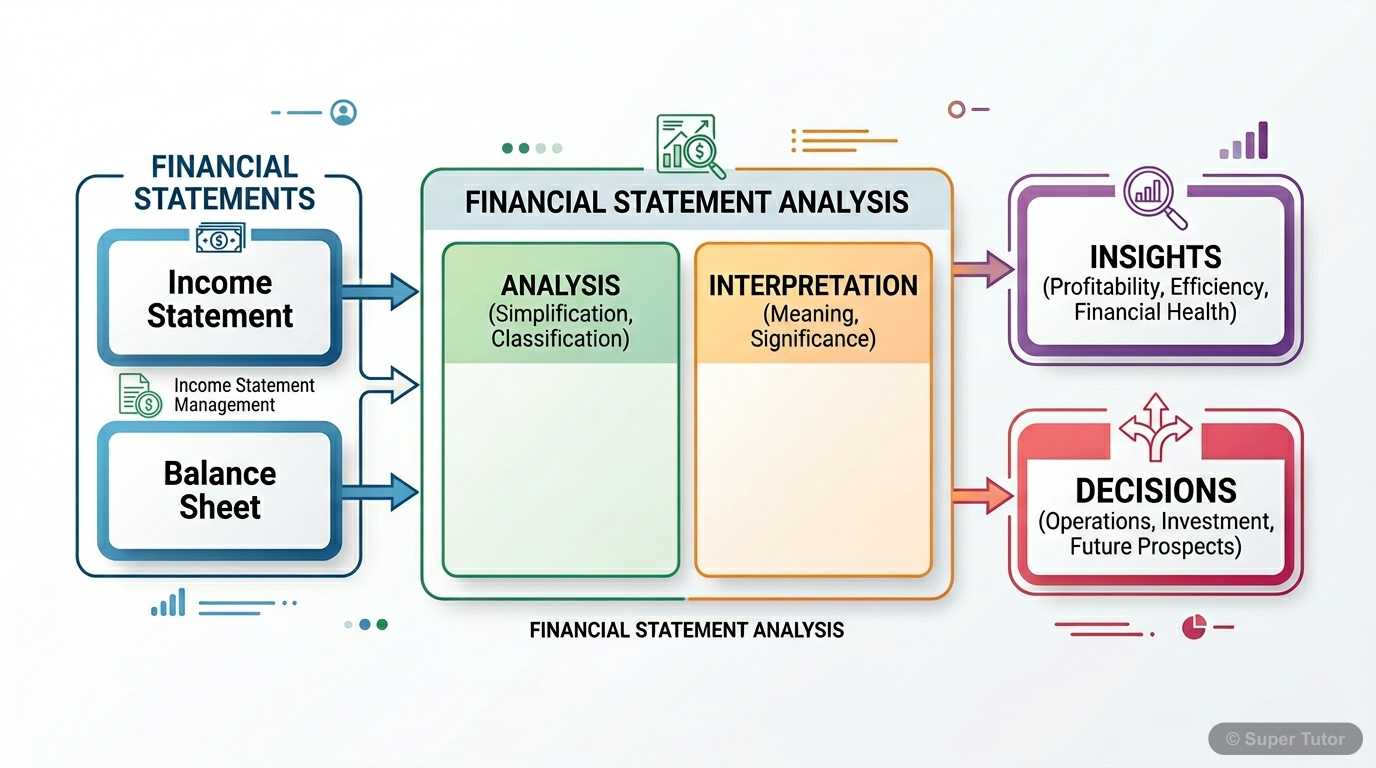
Learn better with visuals Super Tutor pairs illustrations like this with notes and quizzes for Analysis of Financial Statements.
Quick Quiz: Analysis of Financial Statements
0/4Tap an answer to check it instantly. No sign-up needed for these 4.
What is the primary purpose of financial statement analysis?
Comparative statements are also known as:
In common size statements, each item is expressed as a percentage of:
Which users of financial analysis are primarily interested in the firm's ability to meet short-term obligations?
Sample Questions
Which of the following are techniques of financial analysis?
Show answer
Comparative Statements, Common Size Statements, Trend Analysis, Ratio Analysis, Cash Flow Analysis
The five main techniques of financial analysis are: Comparative Statements, Common Size Statements, Trend Analysis, Ratio Analysis, and Cash Flow Analysis. Balance Sheet Preparation is not an analysis technique but a process of creating financial statements.
The formula for calculating percentage change in comparative statements is:
Show answer
(Current Year - Previous Year) / Previous Year × 100
The percentage change is calculated by taking the difference between current and previous year, dividing by the previous year (base year), and multiplying by 100. This shows the percentage increase or decrease from the base year.
Which of the following are limitations of financial analysis?
Show answer
Does not consider price level changes, Ignores non-monetary aspects, May be affected by window dressing, Based on historical data
Financial analysis has several limitations: it doesn't consider inflation/price changes, ignores qualitative factors, can be misleading due to window dressing, and is based on historical data. It does not provide 100% accurate predictions.
Common size analysis is particularly useful for:
Show answer
Comparing companies of different sizes
Common size analysis is particularly useful for comparing companies of different sizes because it converts all figures to percentages, making it possible to compare the relative importance of different items regardless of company size.
+107 more questions on Analysis of Financial Statements (Madhya Pradesh Board Class 12 Accountancy)
Practise AllFrequently Asked Questions
What are the important topics in Analysis of Financial Statements for Madhya Pradesh Board Class 12 Accountancy?
How many practice questions are there for Analysis of Financial Statements?
Sources & Official References
Content is aligned to the official syllabus. Refer to the board website for the latest curriculum.
More resources for Analysis of Financial Statements
Important Questions
Exam-style questions with answers
Revision Notes
Key points for last-minute revision
Chapter Summary
Understand the chapter at a glance
Concept Maps
See how topics connect
Study Plan
Step-by-step plan for this chapter
Flashcards
Quick-fire cards for active recall
Syllabus
What topics to cover
NCERT Solutions
Every textbook question solved step by step
For serious students
Get the full Analysis of Financial Statements chapter — start free.
Quizzes, flashcards, an AI doubt solver and a study plan for Madhya Pradesh Board Class 12 Accountancy. Free to start, no card needed.