Ecosystem — Chapter Summary
Madhya Pradesh Board · Class 12 · Biology
Summary of Ecosystem for Madhya Pradesh Board Class 12 Biology. Part of the Madhya Pradesh Board Class 12 Biology syllabus.
Interactive on Super Tutor
Studying Ecosystem? Get the full interactive chapter.
Quizzes, flashcards, AI doubt-solver and a step-by-step study plan — built for chapter summary and more.
Free trial, no card needed.
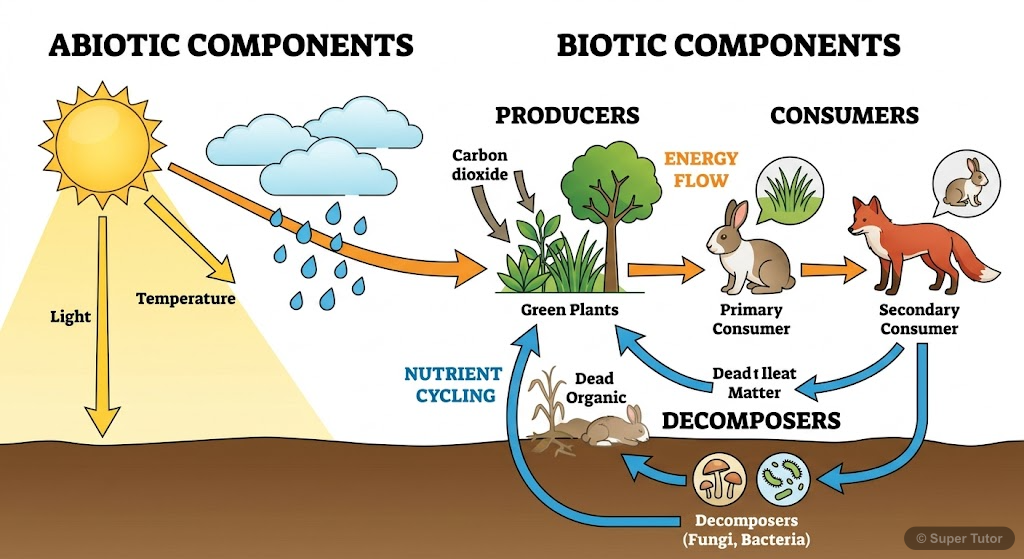
One of 18 illustrations for Ecosystem in Super Tutor — alongside flashcards, concept maps and practice questions.
Overview
An ecosystem is a functional unit of nature in which living organisms interact among themselves and with the physical environment. It includes biotic components such as producers, consumers and decomposers, and abiotic components such as air, water, soil and climatic factors. Ecosystems vary in size
Key Concepts
An ecosystem is formed by interaction
An ecosystem is formed by interaction between biotic and abiotic components. Species composition and stratification are important structural features.
Ecosystems are broadly of two types
Ecosystems are broadly of two types: terrestrial and aquatic. Forest, grassland and desert are terrestrial ecosystems. Pond, lake, wetland, river and
Primary productivity is the amount
Primary productivity is the amount of biomass or organic matter produced per unit area per unit time by plants during photosynthesis. It depends on pl
Gross primary productivity is the total
Gross primary productivity is the total organic matter produced during photosynthesis. Net primary productivity is the remaining biomass after respira
Less than 50 per cent
Less than 50 per cent of incident solar radiation is photosynthetically active radiation. Plants capture only 2-10 per cent of PAR for photosynthesis,
Learning Objectives
- Understand the meaning of ecosystem and its structural features
- Identify biotic and abiotic components in different ecosystems
- Explain primary productivity, GPP and NPP
- Describe decomposition and the steps involved in it
- Trace the flow of energy through food chains and food webs
Frequently Asked Questions
What are the important topics in Ecosystem for Madhya Pradesh Board Class 12 Biology?
How should I revise Ecosystem for the Madhya Pradesh Board Class 12 board exam?
Sources & Official References
Content is aligned to the official syllabus. Refer to the board website for the latest curriculum.
More resources for Ecosystem
Practice Quiz
Test yourself with a quick quiz
Important Questions
Exam-style questions with answers
Revision Notes
Key points for last-minute revision
Concept Maps
See how topics connect
Study Plan
Step-by-step plan for this chapter
Flashcards
Quick-fire cards for active recall
Syllabus
What topics to cover
NCERT Solutions
Every textbook question solved step by step
For serious students
Get the full Ecosystem chapter — start free.
Quizzes, flashcards, an AI doubt solver and a study plan for Madhya Pradesh Board Class 12 Biology. Free to start, no card needed.