Ecosystem — NCERT Solutions
Madhya Pradesh Board · Class 12 · Biology
NCERT Solutions for Ecosystem, Madhya Pradesh Board Class 12 Biology: 16 textbook questions solved step by step.
Interactive on Super Tutor
Studying Ecosystem? Get the full interactive chapter.
Quizzes, flashcards, AI doubt-solver and a step-by-step study plan — built for NCERT solutions and more.
Free trial, no card needed.
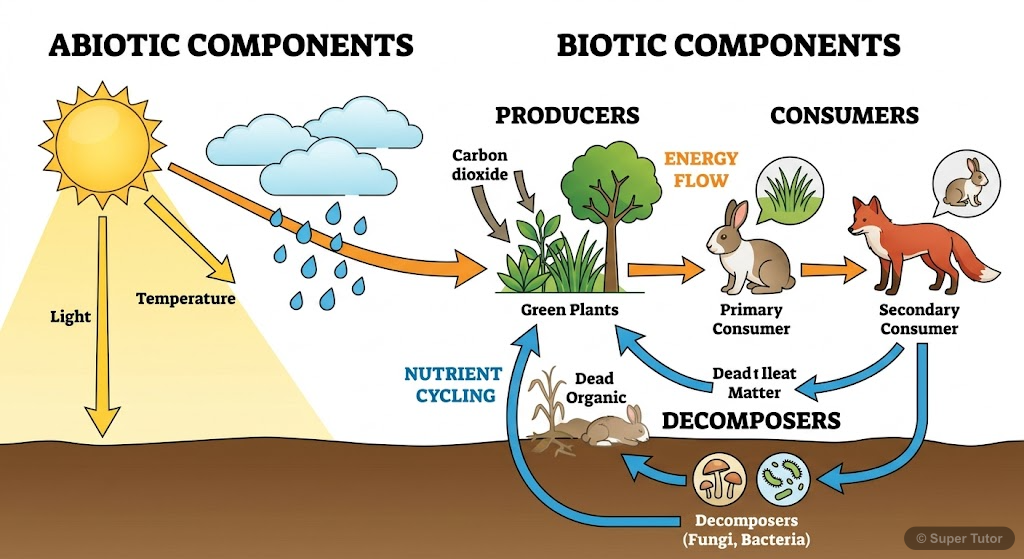
One of 18 illustrations for Ecosystem in Super Tutor — alongside flashcards, concept maps and practice questions.
The first 8 solutions are open to read. The other 8 are free with a Super Tutor account.
EXERCISES — Chapter: Ecosystem (Class 12 Biology)
1Fill in the blanks.
(a) Plants are called as ______ because they fix carbon dioxide.
(b) In an ecosystem dominated by trees, the pyramid (of numbers) is ______ type.
(c) In aquatic ecosystems, the limiting factor for the productivity is _______.
(d) Common detritivores in our ecosystem are _______.
(e) The major reservoir of carbon on earth is _______.Show solution
(a) Plants are called as producers (autotrophs) because they fix carbon dioxide through the process of photosynthesis, converting inorganic into organic compounds.
(b) In an ecosystem dominated by trees, the pyramid of numbers is of inverted type. This is because a single large tree (one producer) supports a very large number of herbivorous insects (primary consumers), which in turn support fewer secondary consumers, making the base narrow and the middle wide — giving an inverted shape.
(c) In aquatic ecosystems, the limiting factor for productivity is light (and sometimes nutrients like nitrogen and phosphorus). Light penetration decreases rapidly with depth, restricting photosynthesis to the photic zone.
(d) Common detritivores in our ecosystem are earthworms, millipedes, woodlice (isopods), and certain insects (e.g., beetles). They fragment dead organic matter (detritus) into smaller particles.
(e) The major reservoir of carbon on earth is the ocean (hydrosphere) / sedimentary rocks (fossil fuels and limestone). Among these, the oceans hold the largest active reservoir of carbon, while sedimentary rocks hold the largest overall geological reservoir.
2Which one of the following has the largest population in a food chain?
(a) Producers
(b) Primary consumers
(c) Secondary consumers
(d) DecomposersShow solution
Correct option: (d) Decomposers
Justification: Decomposers (bacteria and fungi) are present at every trophic level, breaking down dead organic matter from all organisms in the food chain. Their population is therefore the largest in any ecosystem. Although producers form the base of the food chain and are numerous, decomposers, being ubiquitous and acting on all levels, have the largest total population.
3The second trophic level in a lake is
(a) Phytoplankton
(b) Zooplankton
(c) Benthos
(d) FishesShow solution
Correct option: (b) Zooplankton
Justification: In a lake ecosystem, phytoplankton are the primary producers occupying the first trophic level. Zooplankton feed on phytoplankton and hence occupy the second trophic level (primary consumers). Fishes occupy higher trophic levels, and benthos are bottom-dwelling organisms.
4Secondary producers are
(a) Herbivores
(b) Producers
(c) Carnivores
(d) None of the aboveShow solution
Correct option: (d) None of the above
Justification: The term 'secondary producers' is not a standard ecological term. In ecology, only green plants/autotrophs are called producers (primary producers). Herbivores are primary consumers and carnivores are secondary/tertiary consumers. There is no recognised category called 'secondary producers,' hence the answer is none of the above.
5What is the percentage of photosynthetically active radiation (PAR) in the incident solar radiation?
(a) 100%
(b) 50%
(c) 1-5%
(d) 2-10%Show solution
Correct option: (b) 50%
Justification: Of the total incident solar radiation reaching the earth's surface, approximately 50% constitutes Photosynthetically Active Radiation (PAR), which falls in the wavelength range of 400–700 nm. The remaining 50% is in the form of infrared, ultraviolet, and other wavelengths that cannot be used for photosynthesis.
6(a)Distinguish between Grazing food chain and Detritus food chain.Show solution
| Feature | Grazing Food Chain (GFC) | Detritus Food Chain (DFC) |
|---|---|---|
| Starting point | Begins with living green plants (producers) | Begins with dead organic matter (detritus/litter) |
| Energy source | Solar energy fixed by photosynthesis | Chemical energy stored in dead organic matter |
| First trophic level | Green plants / phytoplankton | Dead plant and animal remains (detritus) |
| Organisms involved | Herbivores → Carnivores | Detritivores (earthworms, millipedes) → their predators |
| Dependency on sunlight | Directly dependent on sunlight | Not directly dependent on sunlight |
| Example | Grass → Grasshopper → Frog → Snake → Hawk | Leaf litter → Earthworm → Robin → Hawk |
| Significance | Major energy pathway in most terrestrial ecosystems | Major energy pathway in aquatic and forest floor ecosystems |
Key point: In most ecosystems, the DFC accounts for a greater fraction of energy flow than the GFC, especially in forests.
6(b)Distinguish between Production and Decomposition.Show solution
| Feature | Production (Productivity) | Decomposition |
|---|---|---|
| Definition | Rate of synthesis/accumulation of organic matter (biomass) by producers | Breakdown of complex organic matter (detritus) into simpler inorganic substances |
| Carried out by | Producers (autotrophs/green plants) | Decomposers (bacteria, fungi) and detritivores |
| Process | Anabolic — building up of complex molecules from simple inorganic substances | Catabolic — breaking down of complex organic molecules |
| Energy | Solar energy is fixed/stored | Energy is released |
| Products | Organic compounds (glucose, proteins, etc.) | , , inorganic nutrients (mineralisation) |
| Types | Primary productivity (GPP, NPP) and Secondary productivity | Fragmentation, leaching, catabolism, humification, mineralisation |
| Role in ecosystem | Builds up biomass; entry point of energy into ecosystem | Recycles nutrients; returns minerals to the abiotic environment |
6(c)Distinguish between Upright and Inverted pyramid.Show solution
| Feature | Upright Pyramid | Inverted Pyramid |
|---|---|---|
| Shape | Base is broad and apex is narrow (triangular, upright) | Base is narrow and apex is broad (inverted triangle) |
| Representation | Number/biomass/energy decreases from lower to higher trophic levels | Number/biomass increases from lower to higher trophic levels |
| Example (Numbers) | Grassland ecosystem: Grass (millions) → Insects → Frogs → Snakes | Tree ecosystem: 1 tree → thousands of insects → fewer birds |
| Example (Biomass) | Terrestrial ecosystem: Producers have maximum biomass | Aquatic ecosystem: Phytoplankton (less biomass) → Zooplankton (more biomass) |
| Example (Energy) | Always upright — energy decreases at each successive trophic level | Never inverted — pyramid of energy is always upright |
| Significance | Indicates normal decrease in number/biomass/energy up the food chain | Indicates a situation where consumers outweigh producers at a given time |
Important note: The pyramid of energy is always upright and can never be inverted, as energy is always lost at each trophic level (10% law).
Free with a Super Tutor account
Free with a Super Tutor account
Free with a Super Tutor account
Free with a Super Tutor account
Free with a Super Tutor account
Free with a Super Tutor account
Free with a Super Tutor account
Free with a Super Tutor account
8 more solved questions in Ecosystem
They are free with a Super Tutor account, along with practice quizzes and flashcards for this chapter. Free to start, no card needed.
Frequently Asked Questions
What are the important topics in Ecosystem for Madhya Pradesh Board Class 12 Biology?
Are these NCERT Solutions for Ecosystem free?
How should I revise Ecosystem for the Madhya Pradesh Board Class 12 board exam?
Sources & Official References
Content is aligned to the official syllabus. Refer to the board website for the latest curriculum.
More resources for Ecosystem
Practice Quiz
Test yourself with a quick quiz
Important Questions
Exam-style questions with answers
Revision Notes
Key points for last-minute revision
Chapter Summary
Understand the chapter at a glance
Concept Maps
See how topics connect
Study Plan
Step-by-step plan for this chapter
Flashcards
Quick-fire cards for active recall
Syllabus
What topics to cover
For serious students
Get the full Ecosystem chapter — start free.
Quizzes, flashcards, an AI doubt solver and a study plan for Madhya Pradesh Board Class 12 Biology. Free to start, no card needed.