Indigo
Madhya Pradesh Board · Class 12 · English
NCERT Solutions for Indigo — Madhya Pradesh Board Class 12 English.
Interactive on Super Tutor
Studying Indigo? Get the full interactive chapter.
Quizzes, flashcards, AI doubt-solver and a step-by-step study plan — built for ncert solutions and more.
1,000+ Class 12 students started this chapter today
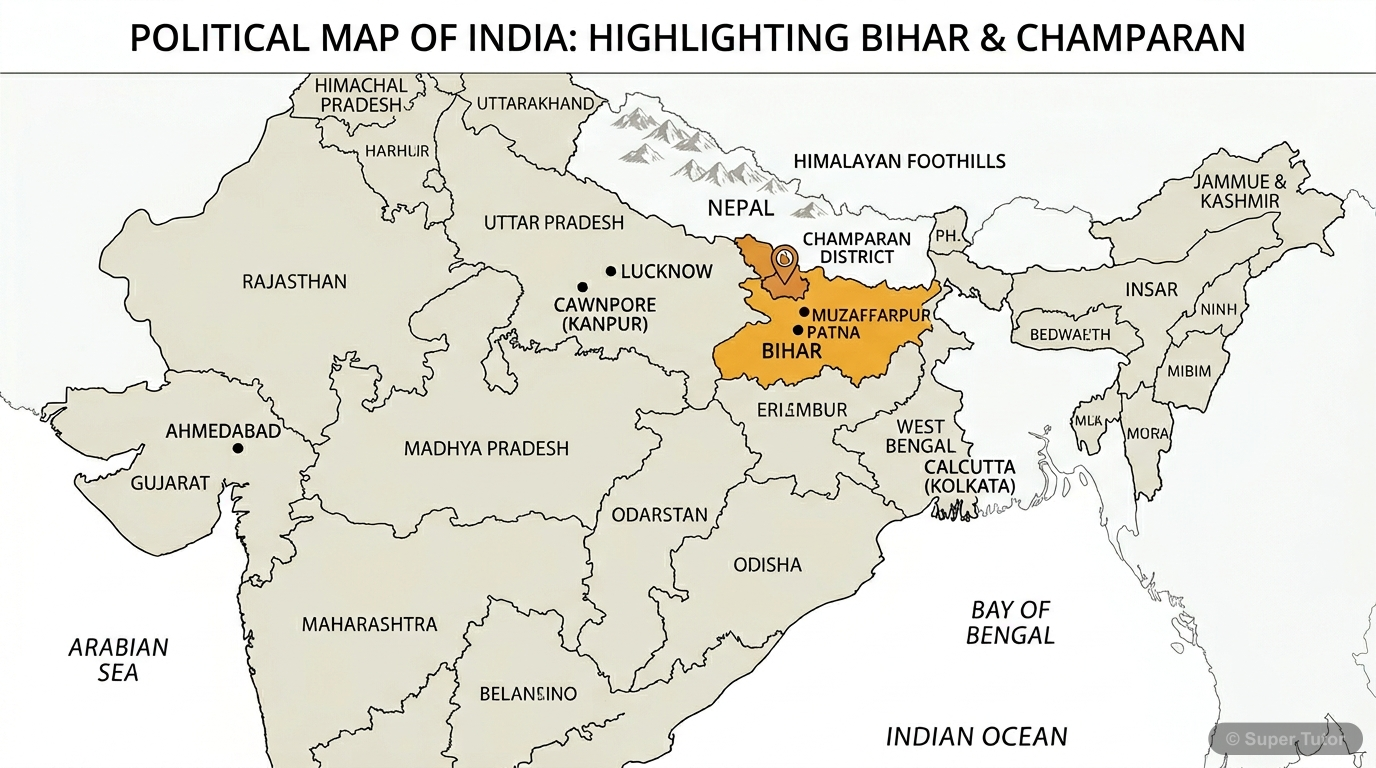
Learn better with visuals Super Tutor has hundreds of illustrations like this across every chapter — all free to try.
Get startedThink as you read (Page 46 — Shukla meets Gandhi)
1Strike out what is not true in the following.
a. Rajkumar Shukla was
(i) a sharecropper.
(ii) a politician.
(iii) delegate.
(iv) a landlord.
b. Rajkumar Shukla was
(i) poor.
(ii) physically strong.
(iii) illiterate.Show solution
Strike out: (ii) a politician and (iv) a landlord.
Rajkumar Shukla was (i) a sharecropper and (iii) a delegate (he came as a delegate to the Congress session to plead the cause of the Champaran peasants). He was neither a politician nor a landlord.
b. Rajkumar Shukla was:
Strike out: (ii) physically strong.
He was (i) poor and (iii) illiterate. The text describes him as an 'unlettered peasant' and a poor yeoman. There is no evidence in the text that he was physically strong.
2Why is Rajkumar Shukla described as being 'resolute'?Show solution
Answer: Rajkumar Shukla is described as 'resolute' because of his extraordinary determination and single-minded persistence in persuading Gandhi to visit Champaran. He followed Gandhi from the Congress session in Lucknow to Cawnpore, then to other parts of India, and finally to Gandhi's ashram near Ahmedabad. For weeks he never left Gandhi's side. Despite being poor and illiterate, he refused to give up until Gandhi agreed to accompany him to Champaran. This unwavering tenacity and firm resolve in the face of repeated delays and disappointments justifies the description 'resolute'.
3Why do you think the servants thought Gandhi to be another peasant?Show solution
Answer: The servants at Rajendra Prasad's house thought Gandhi to be another peasant for the following reasons:
1. Company he kept: Gandhi arrived in the company of Rajkumar Shukla, whom the servants already knew as a poor yeoman — a simple, low-status peasant who frequently pestered their master.
2. Appearance: Gandhi dressed simply, like a common man, without any outward signs of status or distinction.
3. Lack of prior information: The servants had no prior knowledge of Gandhi or his stature. To them, any companion of a poor peasant would naturally be assumed to be of a similar background.
This is further confirmed by the fact that Gandhi was not permitted to draw water from the well, lest he be an untouchable — a treatment no distinguished person would receive.
Think as you read (Page 48 — Gandhi arrives in Champaran)
1List the places that Gandhi visited between his first meeting with Shukla and his arrival at Champaran.Show solution
List of places visited:
1. Lucknow — where Gandhi first met Shukla at the Congress session.
2. Cawnpore (Kanpur) — where Gandhi had a prior appointment.
3. Other parts of India — Gandhi was committed to visits across India (mentioned generally).
4. Ahmedabad (Sabarmati Ashram) — Gandhi returned to his ashram; Shukla followed him here.
5. Calcutta (Kolkata) — the appointed meeting point from where both boarded a train.
6. Patna (Bihar) — where Shukla led Gandhi to Rajendra Prasad's house.
7. Muzzafarpur — Gandhi went here first to gather more complete information about conditions in Champaran.
8. Champaran (Motihari) — the final destination.
Thus, the journey covered Lucknow → Cawnpore → various parts of India → Ahmedabad → Calcutta → Patna → Muzzafarpur → Champaran.
2What did the peasants pay the British landlords as rent? What did the British now want instead and why? What would be the impact of synthetic indigo on the prices of natural indigo?Show solution
Part 1 — What the peasants paid as rent:
The peasants were sharecroppers who were compelled to plant indigo on 15 per cent of their land and surrender the entire indigo harvest to the landlords as rent. This was known as the 'tinkathia' system.
Part 2 — What the British now wanted instead and why:
When the landlords learned that Germany had developed synthetic indigo, natural indigo lost its commercial value. The British landlords no longer needed the peasants to grow indigo. They therefore wanted the peasants to pay them monetary compensation in exchange for being released from the 15 per cent arrangement. In other words, they wanted money instead of the indigo crop.
Part 3 — Impact of synthetic indigo on prices of natural indigo:
The development of synthetic indigo by Germany would cause the prices of natural indigo to fall sharply, making its cultivation economically unviable. The landlords, foreseeing this collapse in value, rushed to get money from the peasants before the peasants realised that the indigo they were forced to grow was now worthless. This is why many peasants who had already signed the compensation agreements later wanted their money back when they learned about synthetic indigo.
Think as you read (Page 50 — Civil Disobedience and Gandhi's method)
1The events in this part of the text illustrate Gandhi's method of working. Can you identify some instances of this method and link them to his ideas of satyagraha and non-violence?Show solution
Gandhi's method — instances linked to Satyagraha and Non-violence:
1. Refusal to leave Champaran despite official orders: When the British commissioner bullied him and asked him to leave Tirhut, Gandhi did not comply. When served an official notice to quit Champaran, he signed the receipt and wrote that he would disobey the order. This is a direct instance of civil disobedience (Satyagraha) — peacefully but firmly refusing to obey an unjust law.
2. Appearing in court willingly: Gandhi received a summons and appeared in court without resistance. He did not flee or use force. This reflects non-violence — accepting legal consequences without aggression.
3. Moral courage over legal protection: Gandhi told the court he could not leave Champaran as it was his duty to the peasants. He was willing to go to prison. This shows that truth (Satya) and moral duty were more important to him than personal safety.
4. Inspiring the lawyers through example: The lawyers, who had initially planned to go home if Gandhi was arrested, were moved by Gandhi's willingness to go to prison for strangers. They decided to follow him into jail. Gandhi did not command them — he led by example, a core principle of Satyagraha.
5. Organised, peaceful inquiry: Rather than inciting the peasants to revolt, Gandhi conducted a systematic, non-violent inquiry — collecting depositions, gathering evidence — to fight injustice through truth and facts, not force.
Conclusion: All these actions embody the Gandhian principles of Satyagraha (truth-force), civil disobedience, and non-violence — achieving justice through moral courage rather than physical confrontation.
Think as you read (Page 52 — Settlement and its impact)
1Why did Gandhi agree to a settlement of 25 per cent refund to the farmers?Show solution
Answer: Gandhi agreed to a settlement of only 25 per cent refund for the following reasons:
1. The amount was less important than the principle: Gandhi explained that the exact percentage mattered less than the fact that the landlords had been made to surrender a portion of the money. The moral victory — compelling the landlords to admit they were wrong and to pay back even a part — was what counted.
2. Demonstrating that landlords were not all-powerful: By forcing the landlords to make any refund at all, Gandhi showed the peasants that the British landlords could be challenged. This broke the psychological hold of fear that the landlords had over the peasants.
3. Practical wisdom: Demanding 100 per cent might have prolonged the legal battle indefinitely, causing more suffering to the already poor peasants. A 25 per cent settlement gave them immediate, tangible relief.
4. Long-term impact over short-term gain: Gandhi's goal was not merely financial compensation but the liberation of the peasants from fear and oppression. Even a partial refund achieved this larger purpose.
2How did the episode change the plight of the peasants?Show solution
The Champaran episode changed the plight of the peasants in the following ways:
1. Abolition of the tinkathia system: The sharecropping arrangement that forced peasants to grow indigo on 15 per cent of their land was abolished. The peasants were freed from this exploitative obligation.
2. Financial compensation: The landlords were made to refund a portion (25 per cent) of the money they had illegally extracted from the peasants, giving them some economic relief.
3. Freedom from fear: Most importantly, the peasants realised that the British landlords were not invincible. Gandhi's courage in defying official orders showed them that injustice could be resisted peacefully. This broke the climate of fear.
4. Educational improvement: Gandhi opened primary schools in six villages to educate the children of peasants. Volunteers, including Gandhi's wife Kasturbai, came to teach.
5. Health improvement: A doctor volunteered for six months. Basic medicines — castor oil, quinine, and sulphur ointment — were made available to treat common ailments.
6. Social improvement: Kasturbai taught the women about personal cleanliness and community sanitation, improving living conditions.
7. Self-reliance and dignity: The episode instilled a sense of self-respect and self-reliance in the peasants and the lawyers who worked with Gandhi, teaching them that they could fight their own battles without depending on outside help.
Understanding the Text
1Why do you think Gandhi considered the Champaran episode to be a turning-point in his life?Show solution
Answer: Gandhi considered the Champaran episode a turning-point in his life for the following reasons:
1. First act of civil disobedience in India: Champaran was the first successful experiment with Satyagraha on Indian soil. When Gandhi defied the official notice to quit Champaran and was prepared to go to prison, the Lieutenant-Governor was forced to drop the case. This was the first triumph of civil disobedience in modern India.
2. Assertion of dignity and rights: Gandhi declared that the British could not order him about in his own country. This was a powerful statement of Indian self-respect and sovereignty — a turning point from submission to resistance.
3. Politics linked to the people's problems: Champaran showed Gandhi that true political work must be rooted in the day-to-day suffering of ordinary people. His politics became intertwined with the practical problems of millions, not abstract ideologies.
4. Moulding a new India: Through Champaran, Gandhi began his mission of creating a self-reliant, fearless Indian citizen — one who could stand on his own feet. This became the foundation of the freedom movement.
5. Proof of method: The success at Champaran validated the method of Satyagraha — that truth, non-violence, and moral courage could defeat an unjust and powerful authority.
Thus, Champaran was not merely a local victory; it was the beginning of Gandhi's larger national mission.
2How was Gandhi able to influence lawyers? Give instances.Show solution
Answer: Gandhi influenced the lawyers through the power of his personal example, moral courage, and clear reasoning rather than through authority or command.
Instances:
1. Willingness to go to prison: When Gandhi was summoned to court and faced arrest, the lawyers who had accompanied him — from Bihar — initially planned to return home if Gandhi was imprisoned, as they were strangers to Champaran. However, when they saw that Gandhi, a total stranger to the region, was prepared to go to jail for the sake of the peasants, they felt ashamed of their own hesitation. They told Gandhi they were ready to follow him into jail. Gandhi's personal courage shamed them into action.
2. Lesson in self-reliance (C.F. Andrews episode): When the lawyers suggested that C.F. Andrews, an English pacifist and Gandhi's follower, should stay back to help them, Gandhi firmly refused. He told them: *'This shows the weakness of your heart. The cause is just and you must rely upon yourselves to win the battle.'* Rajendra Prasad later acknowledged: *'He had read our minds correctly, and we had no reply.'* Gandhi thus taught the lawyers a lesson in self-reliance and confidence in their own abilities.
3. Organised civil disobedience: Gandhi took a piece of paper and divided the lawyers into pairs, assigning the order in which each pair would court arrest. This calm, organised approach in the face of danger inspired the lawyers with discipline and resolve.
Conclusion: Gandhi influenced the lawyers not through speeches but through living example, moral clarity, and the force of truth.
3What was the attitude of the average Indian in smaller localities towards advocates of 'home rule'?Show solution
Answer: The attitude of the average Indian in smaller localities towards advocates of 'home rule' was one of fear and extreme caution.
Gandhi himself noted that it was 'an extraordinary thing in those days for a government professor to harbour a man like me.' This remark reveals that:
1. Fear of British authority: Government employees and ordinary people in small towns were afraid of the consequences of associating with anyone who challenged British rule. Hosting a known advocate of home rule could cost a government servant his job or invite official harassment.
2. Timidity and self-preservation: The average Indian in smaller localities preferred to stay away from political activists to avoid trouble with the colonial administration.
3. Lack of open support: While people may have privately sympathised with the cause of home rule, they were unwilling to openly support or shelter its advocates.
Thus, the prevailing atmosphere in smaller localities was one of fear, caution, and reluctant neutrality rather than active support for the independence movement.
4How do we know that ordinary people too contributed to the freedom movement?Show solution
Answer: The text provides several instances that show ordinary people — not just famous leaders — contributed significantly to the freedom movement:
1. Rajkumar Shukla: An illiterate, poor sharecropper who had the determination to travel across India, follow Gandhi for weeks, and persuade him to visit Champaran. His persistence set the entire Champaran movement in motion.
2. Professor Malkani: A teacher in a government school who risked his job and official displeasure by sheltering Gandhi in Muzzafarpur — 'an extraordinary thing in those days.'
3. Professor J.B. Kripalani and students: Kripalani came to the station at midnight with a large body of students to receive Gandhi, showing that young, ordinary people were ready to support the cause.
4. Ten thousand peasants: About ten thousand peasants gave depositions about their grievances, contributing crucial evidence that built the case against the landlords.
5. Volunteers for schools and health: Ordinary people volunteered to teach in the six village schools Gandhi opened. A doctor volunteered his services for six months to treat the sick.
6. Kasturbai Gandhi: She taught women about cleanliness and sanitation — a grassroots contribution to social reform.
Conclusion: The freedom movement was not the work of a few great leaders alone. It was sustained by the courage, sacrifice, and participation of countless ordinary Indians — peasants, teachers, students, and volunteers — who contributed in their own humble ways.
Talking about the Text
1"Freedom from fear is more important than legal justice for the poor." Do you think that the poor of India are free from fear after Independence?Show solution
Explanation of the statement: The statement means that even if laws exist to protect the poor, those laws are useless if the poor are too afraid to use them. True justice begins when a person is free from the fear of those who oppress them. Gandhi demonstrated this in Champaran — by breaking the peasants' fear of the landlords, he achieved more than any court verdict could.
Are the poor of India free from fear after Independence?
Arguments that they are NOT fully free from fear:
1. Despite constitutional guarantees, the rural poor often fear landlords, moneylenders, and local power structures.
2. Dalits and marginalised communities continue to face social intimidation and violence in many parts of India.
3. The poor are often afraid to approach courts or police due to lack of money, education, and fear of retaliation.
4. Bonded labour, though illegal, still exists in some areas, indicating that fear-based exploitation persists.
5. Whistleblowers and RTI activists from poor backgrounds have faced threats and violence.
Arguments that there has been progress:
1. Constitutional rights, free legal aid, and the Right to Information Act have empowered the poor.
2. Social movements, NGOs, and media have given voice to the voiceless.
3. Panchayati Raj institutions have brought governance closer to ordinary people.
Conclusion: While India has made significant legal and constitutional progress, true freedom from fear for the poor remains an unfinished task. Economic inequality, social discrimination, and weak law enforcement continue to make the poor vulnerable. The spirit of Champaran — that the poor must be freed from fear before justice can reach them — remains as relevant today as it was in 1917.
2The qualities of a good leader.Show solution
The Champaran episode provides an excellent model of leadership. The following qualities emerge:
1. Empathy and concern for the suffering of others: Gandhi responded to the distress of poor peasants even though it was not his personal problem. A good leader feels the pain of those they lead.
2. Courage and personal example: Gandhi was willing to go to prison himself. He did not ask others to do what he was not prepared to do himself. Leadership by example is the most powerful form of leadership.
3. Commitment to truth and justice: Gandhi refused to leave Champaran because he believed the cause was just. A good leader does not compromise on principles.
4. Practical wisdom: Gandhi accepted a 25 per cent settlement because he understood that the moral victory mattered more than the exact amount. Good leaders know when to be flexible without abandoning their goals.
5. Ability to inspire self-reliance: Gandhi refused to let C.F. Andrews stay, insisting the lawyers must win the battle themselves. A good leader builds the capacity and confidence of followers rather than creating dependence.
6. Organisational ability: Gandhi systematically collected depositions, organised civil disobedience in pairs, and maintained the ashram from a distance. Good leaders are also good organisers.
7. Humility: Gandhi said, 'What I did was a very ordinary thing.' True leaders do not seek personal glory.
Conclusion: A good leader combines moral courage, empathy, practical wisdom, humility, and the ability to inspire others — all qualities that Gandhi demonstrated at Champaran.
Working with Words
1List the words used in the text that are related to legal procedures. For example: deposition. List other words that you know that fall into this category.Show solution
1. Deposition
2. Summons
3. Court
4. Judgment
5. Notice (official notice)
6. Case (the case was dropped)
7. Commission of inquiry
8. Civil disobedience
9. Receipt (signed a receipt for the notice)
10. Lieutenant-Governor's order
11. Magistrate
Other words related to legal procedures (from general knowledge):
1. Affidavit
2. Plaintiff
3. Defendant
4. Verdict
5. Bail
6. Warrant
7. Petition
8. Acquittal
9. Conviction
10. Prosecution
11. Advocate / Counsel
12. Hearing
13. Injunction
14. Subpoena
15. Testimony
16. Jurisdiction
17. Appeal
18. Decree
19. Writ
20. Charge sheet
Thinking about Language
1Notice the sentences in the text which are in 'direct speech'. Why does the author use quotations in his narration?Show solution
1. *'Fix a date,' he begged.*
2. *'I have to be in Calcutta on such-and-such a date. Come and meet me and take me from there.'*
3. *'It was an extraordinary thing in those days for a government professor to harbour a man like me.'* — Gandhi
4. *'The commissioner proceeded to bully me and advised me forthwith to leave Tirhut.'* — Gandhi
5. *'The battle of Champaran is won,'* he exclaimed.
6. *'You think that in this unequal fight it would be helpful if we have an Englishman on our side...'* — Gandhi
7. *'He had read our minds correctly, and we had no reply.'* — Rajendra Prasad
8. *'What I did was a very ordinary thing. I declared that the British could not order me about in my own country.'* — Gandhi
Why does the author use direct speech / quotations?
The author, Louis Fischer, uses direct quotations for several important reasons:
1. Authenticity and credibility: Direct quotes from Gandhi, Rajendra Prasad, and others make the account more historically accurate and trustworthy. The reader feels they are hearing the actual words of the participants.
2. Bringing characters to life: Quotations reveal the personality, thinking, and voice of the individuals. Gandhi's words show his clarity of thought, humility, and moral firmness in a way that paraphrase cannot.
3. Emotional impact: Direct speech creates a more vivid and immediate effect. For example, 'The battle of Champaran is won!' conveys Gandhi's joy and relief far more powerfully than 'Gandhi said that the battle had been won.'
4. Preserving the historical record: As a biographer, Fischer wants to record what was actually said, not just what happened. This gives the narrative the quality of a primary historical document.
5. Engaging the reader: Direct speech makes the narrative dramatic and engaging, drawing the reader into the events as if they were present.
2Notice the use or non-use of the comma in the following sentences.
(a) When I first visited Gandhi in 1942 at his ashram in Sevagram, he told me what happened in Champaran.
(b) He had not proceeded far when the police superintendent's messenger overtook him.
(c) When the court reconvened, the judge said he would not deliver the judgment for several days.Show solution
- When a subordinate clause comes BEFORE the main clause, it is followed by a comma.
- When a subordinate clause comes AFTER the main clause, no comma is used.
Analysis of the sentences:
(a) *When I first visited Gandhi in 1942 at his ashram in Sevagram,* [subordinate clause — comes first] *he told me what happened in Champaran.* [main clause]
→ Comma is used after the subordinate clause because it precedes the main clause. ✓
(b) *He had not proceeded far* [main clause — comes first] *when the police superintendent's messenger overtook him.* [subordinate clause]
→ No comma is used because the subordinate clause follows the main clause. ✓
(c) *When the court reconvened,* [subordinate clause — comes first] *the judge said he would not deliver the judgment for several days.* [main clause]
→ Comma is used after the subordinate clause because it precedes the main clause. ✓
Conclusion:
The rule is: Subordinate clause + comma + Main clause (when subordinate clause comes first).
Main clause + Subordinate clause (no comma when subordinate clause comes after).
Things to Do
1-4Choose an issue that has provoked a controversy like the Bhopal Gas Tragedy or the Narmada Dam Project in which the lives of the poor have been affected. Find out the facts of the case. Present your arguments. Suggest a possible settlement.Show solution
---
Issue Chosen: The Bhopal Gas Tragedy (1984)
---
Facts of the Case:
1. On the night of 2–3 December 1984, a deadly gas — methyl isocyanate (MIC) — leaked from the Union Carbide India Limited (UCIL) pesticide plant in Bhopal, Madhya Pradesh.
2. The leak was caused by water entering a storage tank, triggering a chemical reaction.
3. Approximately 3,787 people died immediately (official figure); estimates of total deaths range from 15,000 to 20,000.
4. Over 500,000 people were exposed to the toxic gas, suffering blindness, respiratory damage, and other long-term illnesses.
5. The plant had safety violations and inadequate emergency systems.
6. Warren Anderson, CEO of Union Carbide, was declared an absconder by Indian courts but was never extradited from the USA.
7. In 1989, Union Carbide paid $470 million as compensation — widely considered grossly inadequate.
8. In 2010, eight Indian employees were convicted but received only two years' imprisonment — seen as a travesty of justice.
9. The site remains contaminated to this day, continuing to affect groundwater and health.
---
Arguments:
1. The compensation paid was far too low given the scale of suffering — averaging only a few thousand rupees per victim.
2. The failure to extradite Warren Anderson showed that powerful corporations could evade accountability.
3. The continuing contamination of the site is an ongoing crime against the survivors and their children.
4. The tragedy exposed the vulnerability of the poor who lived near industrial sites without knowledge of the risks or power to demand safety.
5. It highlighted the need for strict corporate liability laws and better enforcement of industrial safety standards.
---
Suggested Settlement:
1. Adequate compensation: A fresh, independent assessment of all victims — including those affected by long-term illness and second-generation health impacts — and payment of fair compensation.
2. Site clean-up: The Indian government and Dow Chemical (which acquired Union Carbide) must be held jointly responsible for complete remediation of the contaminated site.
3. Strict corporate liability law: Parliament should enact a law making corporations criminally and financially liable for industrial disasters, with no cap on compensation.
4. Medical support: Permanent, free medical facilities for survivors and their children in Bhopal.
5. International accountability: India should pursue diplomatic channels to ensure that corporate executives cannot escape justice by fleeing to other countries.
---
*Students are encouraged to research other issues such as the Narmada Dam Project, the displacement of tribal communities, or environmental pollution cases and present similar fact-based arguments.*
Stuck on a step?
Ask Super Tutor AI to explain any solution on this page in a simpler way — free, 24x7.
Ask a Doubt FreeFrequently Asked Questions
What are the important topics in Indigo for Madhya Pradesh Board Class 12 English?
How to score full marks in Indigo — Madhya Pradesh Board Class 12 English?
Where can I get free NCERT Solutions for Indigo Class 12 English?
Sources & Official References
Content is aligned to the official syllabus. Refer to the board website for the latest curriculum.
More resources for Indigo
Important Questions
Practice with board exam-style questions
Syllabus
What topics to cover
Revision Notes
Key points for last-minute revision
Study Plan
Step-by-step plan to ace this chapter
Flashcards
Quick-fire cards for active recall
Formula Sheet
All formulas in one place
Chapter Summary
Understand the chapter at a glance
Practice Quiz
Test yourself with a quick quiz
Concept Maps
See how topics connect visually
For serious students
Get the full Indigo chapter — for free.
Quizzes, flashcards, AI doubt-solver and a step-by-step study plan for Madhya Pradesh Board Class 12 English.