The Tiger King — NCERT Solutions
Madhya Pradesh Board · Class 12 · English
NCERT Solutions for The Tiger King, Madhya Pradesh Board Class 12 English: 5 textbook questions solved step by step.
Interactive on Super Tutor
Studying The Tiger King? Get the full interactive chapter.
Quizzes, flashcards, AI doubt-solver and a step-by-step study plan — built for NCERT solutions and more.
Free trial, no card needed.
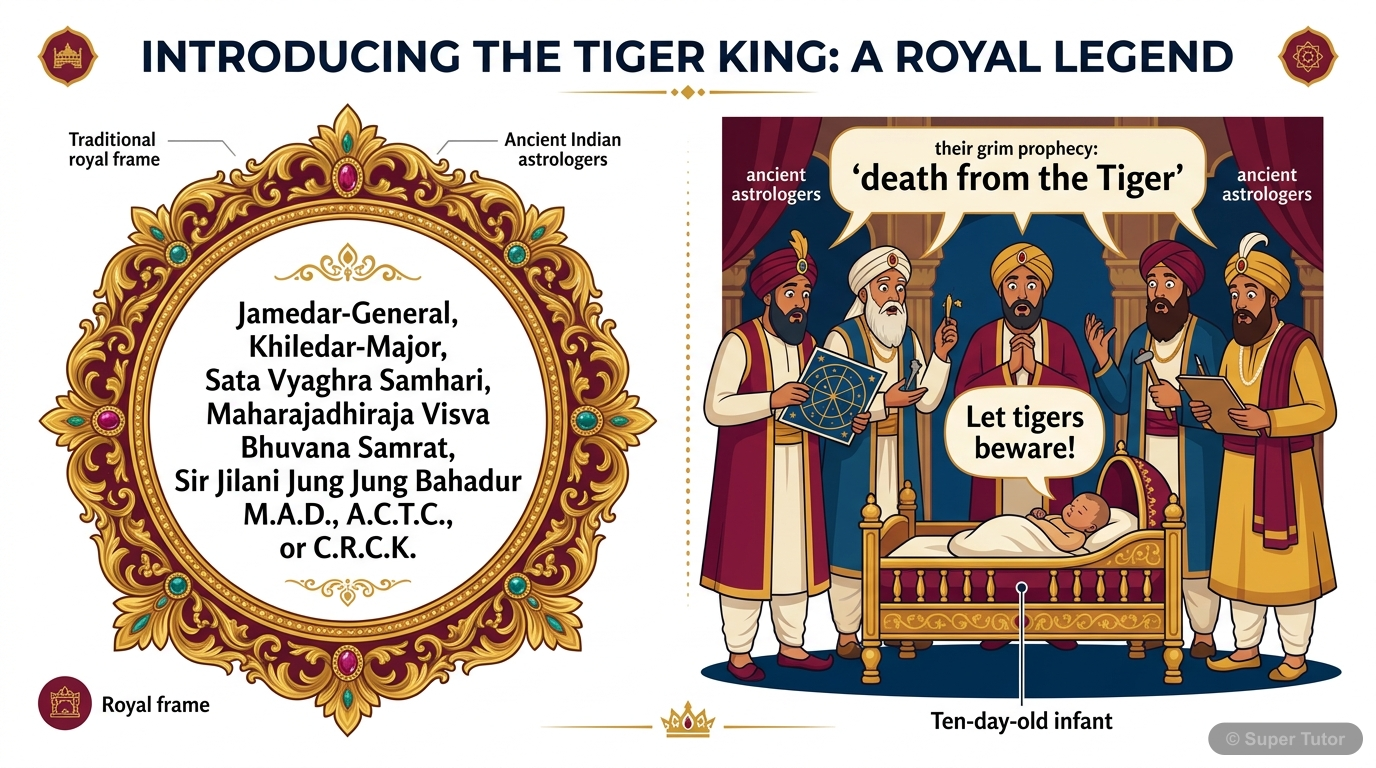
Learn better with visuals Super Tutor pairs illustrations like this with notes and quizzes for The Tiger King.
The first 3 solutions are open to read. The other 2 are free with a Super Tutor account.
Reading with Insight — The Tiger King (Chapter 2, Vistas, Class 12)
1The story is a satire on the conceit of those in power. How does the author employ the literary device of dramatic irony in the story?Show solution
Given / Context:
The story 'The Tiger King' by Kalki is a satirical tale about the Maharaja of Pratibandapuram who is obsessed with killing a hundred tigers to defy an astrological prophecy that he would be killed by a tiger.
Concept — Dramatic Irony:
Dramatic irony occurs when the reader/audience knows something that the character does not, or when the outcome is the opposite of what the character intends or expects.
How the author employs dramatic irony:
- The prophecy itself: The astrologer predicts that the Maharaja will be killed by a tiger. The Maharaja spends his entire life hunting tigers, believing that by killing a hundred of them he can cheat fate. The reader, however, senses from the very beginning (the narrator tells us at the outset that the Tiger King is dead) that the Maharaja cannot escape his destiny. His very efforts to avoid death bring him closer to it — a classic irony.
- The hundredth tiger: The Maharaja believes he has killed the hundredth tiger and is overjoyed. The reader, however, learns that the bullet actually missed the tiger; it was a hunter who killed it. The Maharaja's triumphant sense of having fulfilled his vow is entirely misplaced — he never actually killed the hundredth tiger.
- The wooden tiger: The final and most powerful instance of dramatic irony is the cause of the Maharaja's death. He buys a cheap wooden toy tiger for his son's birthday. A splinter from this toy tiger pierces his hand, causes an infection, and ultimately kills him. The man who survived real tiger hunts all his life is killed by a toy tiger — the very symbol of what he sought to conquer. The reader sees the poetic justice even as the Maharaja remains unaware of the danger.
- The surgeons' announcement: The surgeons declare, 'The operation was successful. The Maharaja is dead.' This is a darkly ironic statement — success and death are presented as simultaneous outcomes, mocking the incompetence of those in power and the hollow grandeur surrounding the king.
Conclusion:
Through these layers of dramatic irony, Kalki satirises the arrogance and conceit of those in power who believe they can bend fate, nature, and truth to their will. The Maharaja's obsession with power and control ultimately leads to his own undoing, making the irony both sharp and effective.
2What is the author's indirect comment on subjecting innocent animals to the willfulness of human beings?Show solution
Given / Context:
The Maharaja of Pratibandapuram kills tigers — not out of necessity or genuine self-defence, but purely to fulfil a personal vow driven by superstition and ego. He hunts tigers across his own state and his father-in-law's state, depleting tiger populations entirely.
Author's Indirect Comment:
- Senseless slaughter for personal glory: The Maharaja kills ninety-nine tigers merely to satisfy his own ego and defy a prophecy. The tigers pose no real threat to him; he goes out of his way to hunt them. The author shows that powerful human beings often subject innocent animals to their whims without any moral justification.
- Depletion of wildlife: The story shows that tiger populations in multiple states are wiped out because of one man's obsession. The author subtly points out how the unchecked willfulness of those in power can lead to the destruction of entire species.
- The tiger brought from the People's Park: When no wild tigers remain, the dewan secretly procures a tiger from a zoo in Madras. This aged, tame tiger is dragged out at midnight and pushed into a forest — a deeply undignified and cruel act. The author uses this episode to show how animals are reduced to mere props for human entertainment and ambition.
- Poetic justice: The author's ultimate comment comes through the ending. The Maharaja is killed not by a real tiger but by a toy one. Nature, in a sense, has the last word. The author implies that human beings cannot subjugate nature and wildlife indefinitely without consequences.
Conclusion:
Kalki's indirect comment is that the willful destruction of innocent animals for human ego, sport, or superstition is morally wrong and ultimately self-destructive. The story is a critique of the callousness with which those in power treat wildlife, treating living creatures as objects to be used and discarded at will.
3How would you describe the behaviour of the Maharaja's minions towards him? Do you find them truly sincere towards him or are they driven by fear when they obey him? Do we find a similarity in today's political order?Show solution
Given / Context:
The story depicts several characters — the dewan, the hunters, the surgeons, and other officials — who serve the Maharaja and carry out his orders.
Behaviour of the Maharaja's minions:
- The Dewan: The dewan is the most prominent minion. He is clearly terrified of the Maharaja. When the Maharaja brandishes his gun, the dewan cries out in fear. When the Maharaja threatens to double land taxes and dismisses the dewan's sensible advice about public discontent, the dewan simply obeys. Most tellingly, the dewan secretly procures a tiger from Madras and drags it to the forest at midnight — not out of loyalty or love for the king, but out of sheer fear of the consequences if the Maharaja does not find his hundredth tiger.
- The Hunters: When the Maharaja's bullet misses the hundredth tiger, the hunters are afraid to tell him the truth. Instead of being honest, they shoot the tiger themselves and allow the Maharaja to believe he killed it. Their obedience is entirely fear-driven — they are worried about losing their jobs.
- The Surgeons: Three famous surgeons are brought from Madras. Their announcement — 'The operation was successful. The Maharaja is dead' — suggests incompetence hidden behind pompous language, another form of hollow service.
Are they truly sincere or driven by fear?
The minions are clearly driven by fear, not sincere loyalty. True sincerity would have meant telling the Maharaja the truth — that he missed the hundredth tiger, that his policies were harming the people, that his obsession was irrational. Instead, they enable his delusions to protect themselves.
Similarity in today's political order:
Yes, this situation has a strong parallel in contemporary politics. Even today, advisors, bureaucrats, and officials often tell those in power only what they want to hear, rather than the truth. Sycophancy is common in political systems where speaking truth to power can cost one their position or safety. The result, as the story shows, is that the powerful leader is ultimately harmed by the very yes-men who surround him.
Conclusion:
The minions in the story are not sincere; they are servile out of fear. This is a timeless and universal feature of authoritarian power structures, and Kalki's satire remains relevant to the political realities of today.
Free with a Super Tutor account
Free with a Super Tutor account
2 more solved questions in The Tiger King
They are free with a Super Tutor account, along with practice quizzes and flashcards for this chapter. Free to start, no card needed.
Frequently Asked Questions
What are the important topics in The Tiger King for Madhya Pradesh Board Class 12 English?
Are these NCERT Solutions for The Tiger King free?
How should I revise The Tiger King for the Madhya Pradesh Board Class 12 board exam?
Sources & Official References
Content is aligned to the official syllabus. Refer to the board website for the latest curriculum.
More resources for The Tiger King
Practice Quiz
Test yourself with a quick quiz
Important Questions
Exam-style questions with answers
Revision Notes
Key points for last-minute revision
Chapter Summary
Understand the chapter at a glance
Concept Maps
See how topics connect
Study Plan
Step-by-step plan for this chapter
Flashcards
Quick-fire cards for active recall
Syllabus
What topics to cover
For serious students
Get the full The Tiger King chapter — start free.
Quizzes, flashcards, an AI doubt solver and a study plan for Madhya Pradesh Board Class 12 English. Free to start, no card needed.