The Interview — NCERT Solutions
Madhya Pradesh Board · Class 12 · English
NCERT Solutions for The Interview, Madhya Pradesh Board Class 12 English: 15 textbook questions solved step by step.
Interactive on Super Tutor
Studying The Interview? Get the full interactive chapter.
Quizzes, flashcards, AI doubt-solver and a step-by-step study plan — built for NCERT solutions and more.
Free trial, no card needed.
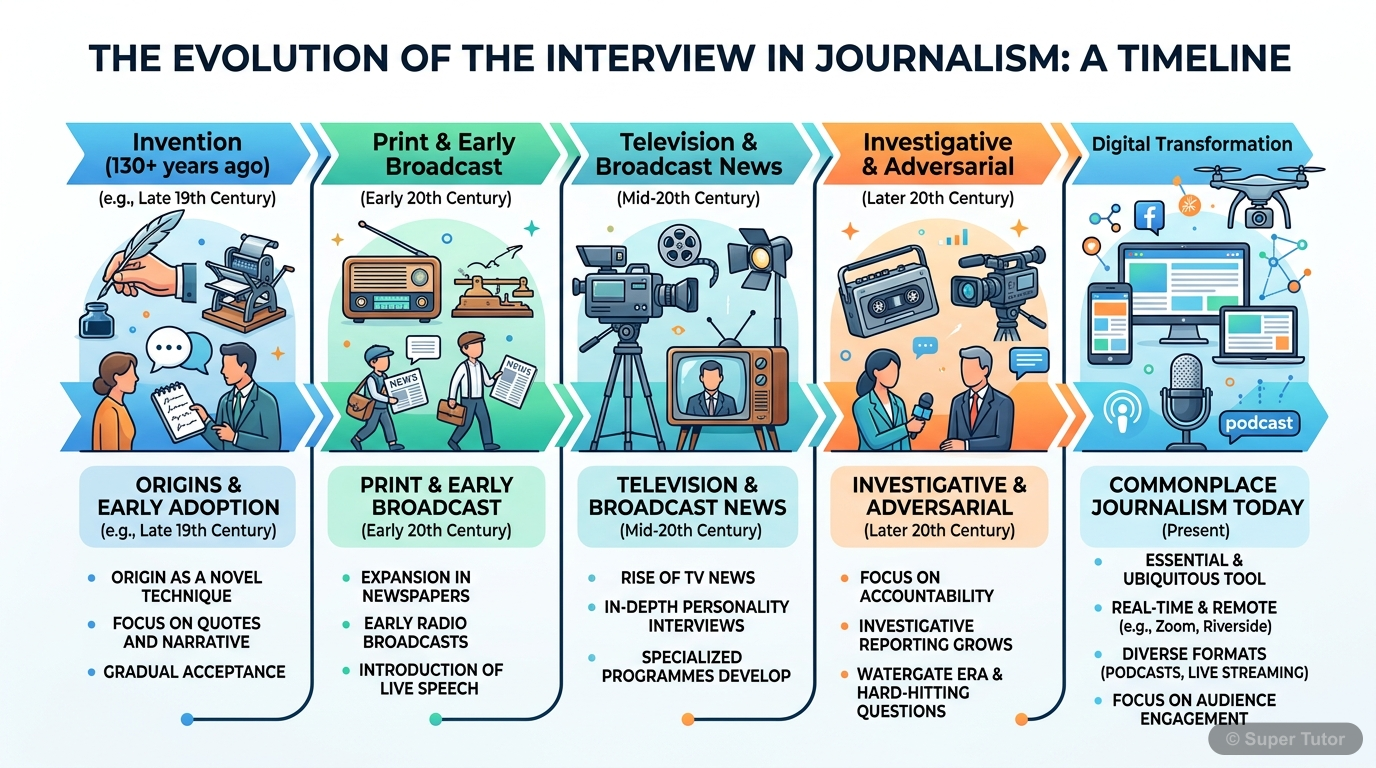
Learn better with visuals Super Tutor pairs illustrations like this with notes and quizzes for The Interview.
The first 8 solutions are open to read. The other 7 are free with a Super Tutor account.
Think as you read
1What are some of the positive views on interviews?Show solution
Given: The passage discusses both negative and positive views on interviews.
Answer:
Despite the many criticisms levelled against interviews, there are significant positive views on them:
- Denis Brian describes the interview as "a supremely serviceable medium of communication."
- He further writes: "These days, more than at any other time, our most vivid impressions of our contemporaries are through interviews."
- According to Brian, "Almost everything of moment reaches us through one man asking questions of another."
- The interviewer is said to hold "a position of unprecedented power and influence" in today's world.
Thus, the positive view is that interviews are the most effective and powerful means of conveying information about people and events to the public.
2Why do most celebrity writers despise being interviewed?Show solution
Given: The passage mentions the reactions of several famous writers to being interviewed.
Answer:
Most celebrity writers despise being interviewed for the following reasons:
- Invasion of privacy: They feel that an interview is an intrusion into their personal lives. Rudyard Kipling called it "immoral" and compared it to "a crime" and "an assault on his person."
- Loss of dignity: Kipling further described it as "cowardly and vile" and said no respectable man would ask for or give an interview.
- Distortion of personality: V. S. Naipaul felt that interviews left a "permanent dent" on his personality, suggesting that the image projected through interviews is not always accurate.
- Feeling of violation: Saul Bellow described interviews as being like "thumbprints on his windpipe" — a feeling of being choked or suffocated, implying a loss of freedom and comfort.
In short, celebrity writers feel that interviews expose them to unwanted scrutiny, misrepresentation, and a sense of violation of their private selves.
3What is the belief in some primitive cultures about being photographed?Show solution
Given: The passage refers to beliefs in primitive cultures regarding photography.
Answer:
In some primitive cultures, it is believed that if someone takes your photograph, they capture a part of your soul. In other words, being photographed is seen as a spiritual threat — the photographer is thought to steal or permanently possess a fragment of the subject's inner self or identity.
This belief is used in the passage as an analogy to explain why some people, including celebrity writers, feel uncomfortable or violated when they are interviewed, as if a part of their true self is being taken away or exposed without their full consent.
4What do you understand by the expression "thumbprints on his windpipe"?Show solution
Given: Saul Bellow used this expression to describe his feeling about interviews.
Answer:
The expression "thumbprints on his windpipe" is a vivid and powerful metaphor used by Saul Bellow to convey his deep discomfort with being interviewed.
- Literally, a thumbprint on the windpipe suggests someone pressing their thumb against your throat — an act that restricts breathing and causes suffocation.
- Figuratively, Bellow means that interviews make him feel choked, constrained, and violated. Just as a thumbprint on the windpipe would leave a mark and restrict free breathing, interviews leave a lasting impression on his personality and restrict his freedom of expression.
- The expression also suggests that interviews are intrusive and oppressive — they do not allow the subject to breathe freely or express himself naturally.
In essence, Bellow felt that interviews were a form of subtle but real suppression of his authentic self.
5Who, in today's world, is our chief source of information about personalities?Show solution
Given: Denis Brian's views are quoted in the passage.
Answer:
According to Denis Brian, in today's world, the interviewer is our chief source of information about personalities and contemporaries.
Brian writes: "These days, more than at any other time, our most vivid impressions of our contemporaries are through interviews." He further states that "Almost everything of moment reaches us through one man asking questions of another."
Thus, it is the interviewer — the person who asks questions — who holds a position of unprecedented power and influence and serves as the primary medium through which we learn about famous personalities, their thoughts, opinions, and lives.
Understanding the text
1Do you think Umberto Eco likes being interviewed? Give reasons for your opinion.Show solution
Given: The excerpt is from an interview of Umberto Eco conducted by Mukund Padmanabhan.
Answer:
Yes, it appears that Umberto Eco does not mind being interviewed and, in fact, seems to enjoy it to a considerable extent. The following reasons support this opinion:
- He is forthcoming and elaborate: Eco does not give curt or evasive answers. He responds at length, sharing personal anecdotes, philosophical reflections, and humorous observations.
- He uses storytelling: He says, "let me tell you another story, because I often tell stories like a Chinese wise man." This shows he is comfortable and even enthusiastic in the interview setting.
- He is self-aware and reflective: He speaks candidly about his academic writing, his novels, and his use of time, suggesting he is at ease discussing himself.
- He has consented to many interviews: The fact that this interview exists and that Eco engages so openly suggests he does not share the hostility towards interviews that writers like Kipling or Bellow expressed.
- He laughs during the interview: The stage direction (Laughs) indicates he is relaxed and enjoying the conversation.
Conclusion: Unlike many celebrity writers who despise interviews, Umberto Eco appears to welcome them as an opportunity to share his ideas and stories with a wider audience.
2How does Eco find the time to write so much?Show solution
Given: Eco is a prolific writer — both an academic scholar and a novelist.
Answer:
Umberto Eco explains his extraordinary productivity by revealing that he utilises the empty spaces or interstices of time that most people waste.
He explains that he has a secret — he calls these gaps "empty spaces." While most people wait idly during small intervals — for example, waiting for an elevator to travel from the first to the third floor — Eco uses that time productively. He says:
"While waiting for your elevator to come up from the first to the third floor, I have already written an article!"
Eco suggests that there are thousands of such empty spaces in a day — waiting for someone, riding in a vehicle, pausing between tasks — and by filling these spaces with productive work, he is able to write a great deal without needing extra hours.
In summary: Eco's secret to prolific writing is the disciplined and creative use of every small fragment of free time that others typically let go to waste.
3What was distinctive about Eco's academic writing style?Show solution
Given: Eco is known both as an academic scholar and as a novelist.
Answer:
Umberto Eco's academic writing style was distinctive because it was narrative and story-like, rather than dry and purely theoretical as is typical of academic writing.
Key features of his distinctive style:
- Narrative approach: Even in his academic essays and scholarly works, Eco always told a story. He did not simply present abstract arguments; he wove them into a narrative framework.
- Accessibility with depth: His writing managed to be intellectually rigorous while also being engaging and readable.
- Personal voice: He brought a personal, almost conversational tone to academic subjects, which made his work stand out.
Eco himself acknowledged this when he said: "I am convinced I am always doing the same thing" — meaning that whether writing academic texts or novels, his fundamental approach (narrative, story-driven) remained the same.
This distinctive style is what eventually led him naturally to novel-writing, as the narrative impulse that characterised his academic work found its fullest expression in fiction.
Free with a Super Tutor account
Free with a Super Tutor account
Talking about the text
Free with a Super Tutor account
Free with a Super Tutor account
Free with a Super Tutor account
Writing
Free with a Super Tutor account
Things to do
Free with a Super Tutor account
7 more solved questions in The Interview
They are free with a Super Tutor account, along with practice quizzes and flashcards for this chapter. Free to start, no card needed.
Frequently Asked Questions
What are the important topics in The Interview for Madhya Pradesh Board Class 12 English?
Are these NCERT Solutions for The Interview free?
How should I revise The Interview for the Madhya Pradesh Board Class 12 board exam?
Sources & Official References
Content is aligned to the official syllabus. Refer to the board website for the latest curriculum.
More resources for The Interview
Practice Quiz
Test yourself with a quick quiz
Important Questions
Exam-style questions with answers
Revision Notes
Key points for last-minute revision
Chapter Summary
Understand the chapter at a glance
Concept Maps
See how topics connect
Study Plan
Step-by-step plan for this chapter
Flashcards
Quick-fire cards for active recall
Syllabus
What topics to cover
For serious students
Get the full The Interview chapter — start free.
Quizzes, flashcards, an AI doubt solver and a study plan for Madhya Pradesh Board Class 12 English. Free to start, no card needed.