Application of Derivatives — Formula Sheet
Madhya Pradesh Board · Class 12 · Mathematics
18 formulas from Application of Derivatives (Madhya Pradesh Board Class 12 Mathematics) on one page, grouped by topic.
Interactive on Super Tutor
Studying Application of Derivatives? Get the full interactive chapter.
Quizzes, flashcards, AI doubt-solver and a step-by-step study plan — built for formula sheet and more.
Free trial, no card needed.
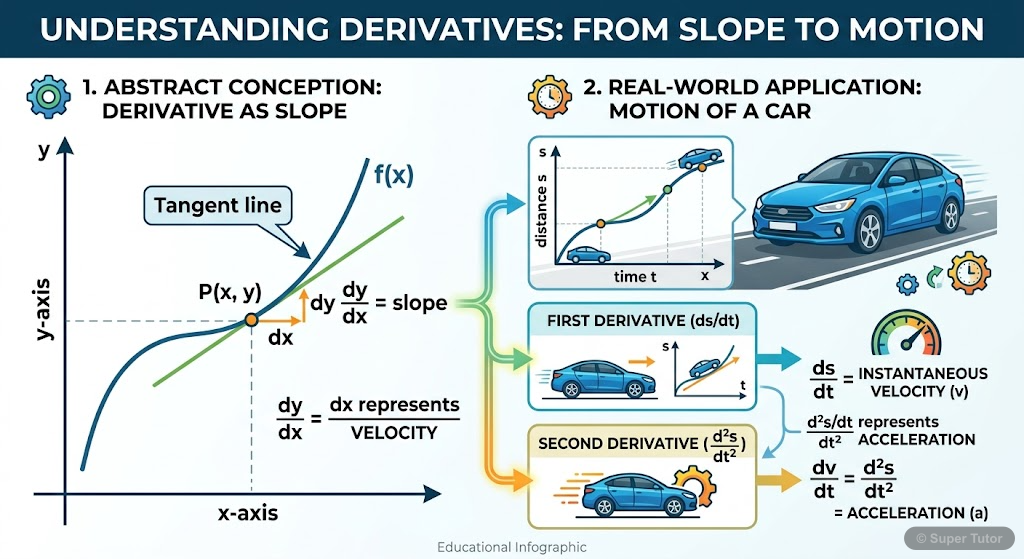
Learn better with visuals Super Tutor pairs illustrations like this with notes and quizzes for Application of Derivatives.
Formulas and Key Relations
1) Rate of Change of Quantities
\frac{dy}{dx} = \frac{dy}{dt} / \frac{dx}{dt}, \text{ if } \frac{dx}{dt} \neq 0
\frac{dA}{dr} = \frac{d}{dr}(\pi r^2) = 2\pi r
V = x^3, S = 6x^2
P = 2(x + y), A = x \cdot y
2) Increasing and Decreasing Functions
A function f is increasing on I if x1 < x2 in I implies f(x1) \le f(x2).
A function f is decreasing on I if x1 < x2 in I implies f(x1) \ge f(x2).
A function f is constant on I if f(x) = c for all x in I.
A function f is strictly increasing on I if x1 < x2 implies f(x1) < f(x2).
A function f is strictly decreasing on I if x1 < x2 implies f(x1) > f(x2).
3) Local Maxima, Local Minima, Critical Points, Point of Inflexion
If f has a local maxima or a local minima at x=c, then either f'(c)=0 or f is not differentiable at c.
First Derivative Test: f'(x) > 0 left of c, f'(x) < 0 right of c implies c is local maxima.
First Derivative Test: f'(x) < 0 left of c, f'(x) > 0 right of c implies c is local minima.
Second Derivative Test: f'(c)=0, f''(c)<0 implies local maxima; f''(c)>0 implies local minima; f''(c)=0 means test fails.
4) Absolute Maximum and Absolute Minimum on Closed Interval
If f is continuous on [a,b], then f has an absolute maximum and an absolute minimum value, each attained at least once in [a,b].
If f is differentiable on closed interval I and c is an interior point where f attains absolute max or min, then f'(c)=0.
Rate of Change of Quantities
If a quantity y varies with x by a rule y = f(x), then dy/dx represents the rate of change of y with respect to x.
Key relations
Marginal cost is the instantaneous rate of change of total cost, MC = dC/dx.
Marginal revenue is the rate of change of total revenue, MR = dR/dx.
Full sheet with units and worked examples
View AllFrequently Asked Questions
What are the important topics in Application of Derivatives for Madhya Pradesh Board Class 12 Mathematics?
How many formulas are in Application of Derivatives?
How should I revise Application of Derivatives for the Madhya Pradesh Board Class 12 board exam?
Sources & Official References
Content is aligned to the official syllabus. Refer to the board website for the latest curriculum.
More resources for Application of Derivatives
Practice Quiz
Test yourself with a quick quiz
Important Questions
Exam-style questions with answers
Revision Notes
Key points for last-minute revision
Chapter Summary
Understand the chapter at a glance
Concept Maps
See how topics connect
Study Plan
Step-by-step plan for this chapter
Flashcards
Quick-fire cards for active recall
Syllabus
What topics to cover
NCERT Solutions
Every textbook question solved step by step
For serious students
Get the full Application of Derivatives chapter — start free.
Quizzes, flashcards, an AI doubt solver and a study plan for Madhya Pradesh Board Class 12 Mathematics. Free to start, no card needed.