Structured Query a Language (SQL) — Chapter Summary
Nagaland Board · Class 12 · Computer Science
Summary of Structured Query a Language (SQL) for Nagaland Board Class 12 Computer Science. Part of the Nagaland Board Class 12 Computer Science syllabus.
Interactive on Super Tutor
Studying Structured Query a Language (SQL)? Get the full interactive chapter.
Quizzes, flashcards, AI doubt-solver and a step-by-step study plan — built for chapter summary and more.
Free trial, no card needed.
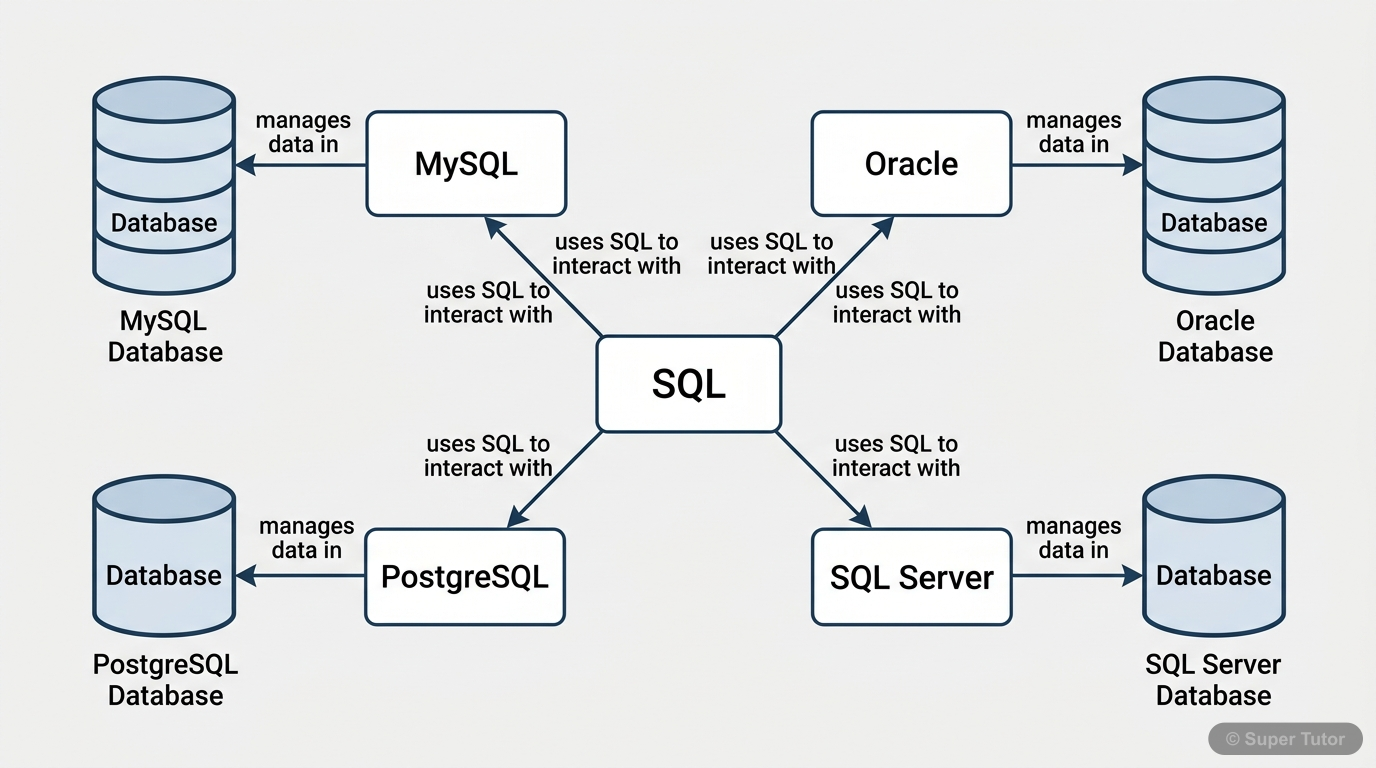
One of 17 illustrations for Structured Query a Language (SQL) in Super Tutor — alongside flashcards, concept maps and practice questions.
Overview
Structured Query Language is the standard way to define, store, manipulate, and retrieve data in a relational database management system. It uses descriptive English-like statements and is case insensitive for SQL keywords and column names, while database and table names are case-sensitive in Linux
Key Concepts
SQL is the most popular query
SQL is the most popular query language used by relational database management systems such as MySQL, Oracle, SQL Server, and PostgreSQL. It allows dat
Common MySQL data types include CHAR
Common MySQL data types include CHAR, VARCHAR, INT, FLOAT, and DATE. CHAR is fixed-length, VARCHAR is variable-length, INT uses 4 bytes, FLOAT uses 4
Important constraints include NOT NULL
Important constraints include NOT NULL, UNIQUE, DEFAULT, PRIMARY KEY, and FOREIGN KEY. By default, attributes can take NULL values except the primary
CREATE
CREATE, ALTER, and DROP are Data Definition Language statements. CREATE is used to create databases and tables, ALTER changes structure, and DROP remo
INSERT
INSERT, SELECT, UPDATE, and DELETE are Data Manipulation Language statements. They are used to add, retrieve, modify, and remove data in tables.
Learning Objectives
- Understand the role of SQL in relational database management systems
- Identify common MySQL data types and constraints
- Create and modify databases and tables using DDL statements
- Insert, query, update, and delete records using DML statements
- Use SELECT with WHERE, DISTINCT, ORDER BY, IN, BETWEEN, LIKE, and NULL checks
Frequently Asked Questions
What are the important topics in Structured Query a Language (SQL) for Nagaland Board Class 12 Computer Science?
How should I revise Structured Query a Language (SQL) for the Nagaland Board Class 12 board exam?
Sources & Official References
Content is aligned to the official syllabus. Refer to the board website for the latest curriculum.
More resources for Structured Query a Language (SQL)
Practice Quiz
Test yourself with a quick quiz
Important Questions
Exam-style questions with answers
Revision Notes
Key points for last-minute revision
Concept Maps
See how topics connect
Study Plan
Step-by-step plan for this chapter
Flashcards
Quick-fire cards for active recall
Syllabus
What topics to cover
NCERT Solutions
Every textbook question solved step by step
For serious students
Get the full Structured Query a Language (SQL) chapter — start free.
Quizzes, flashcards, an AI doubt solver and a study plan for Nagaland Board Class 12 Computer Science. Free to start, no card needed.