My Vision For India — Flashcards
NIOS · Class 10 · English
37 flashcards for My Vision For India (NIOS Class 10 English) to test yourself on key terms and facts. Part of the NIOS Class 10 English syllabus.
Interactive on Super Tutor
Studying My Vision For India? Get the full interactive chapter.
Quizzes, flashcards, AI doubt-solver and a step-by-step study plan — built for flashcards and more.
Free trial, no card needed.
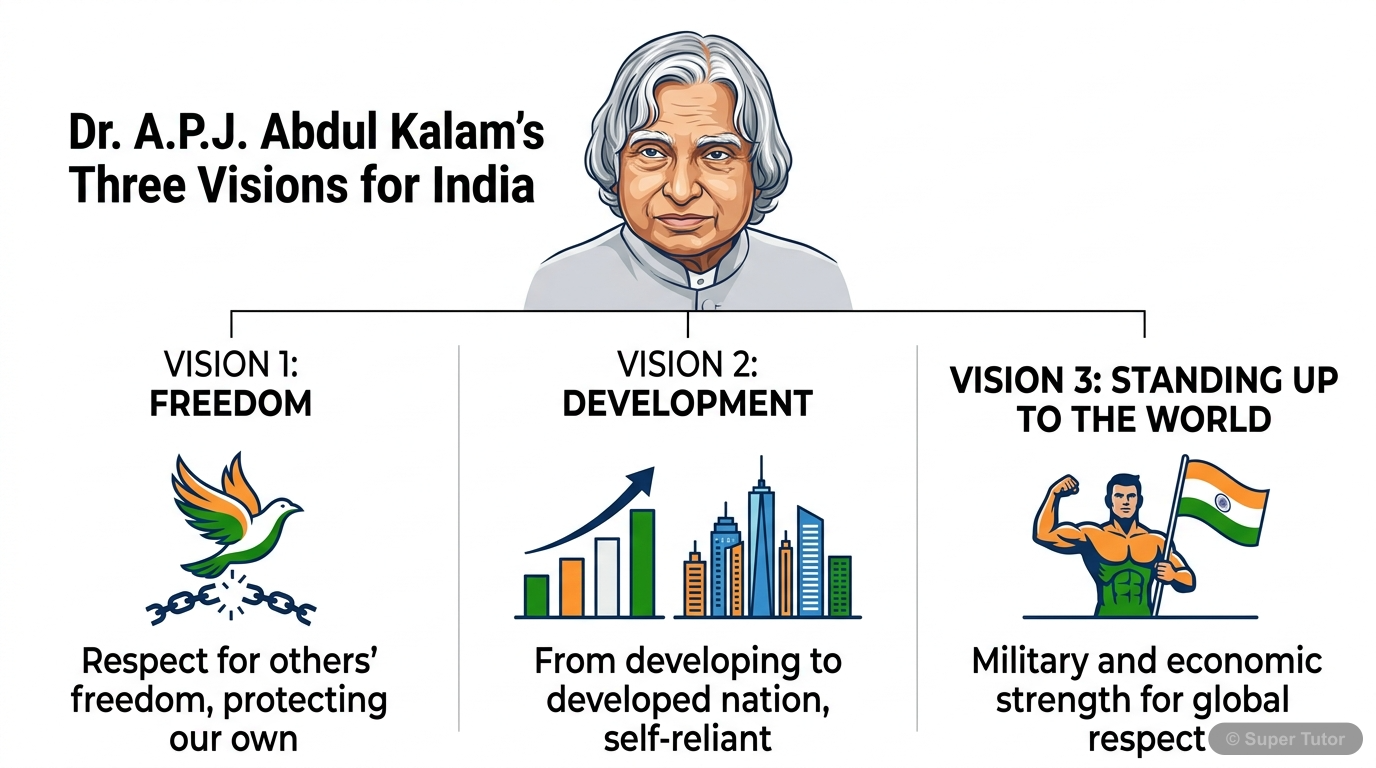
Learn better with visuals Super Tutor pairs illustrations like this with notes and quizzes for My Vision For India.
What are the three visions of India mentioned in the speech?
Answer
The three visions are: 1) Freedom, 2) Development, and 3) Military and economic strength. They appear in this exact order and form the central idea of the speech.
Why is freedom called the first vision for India?
Answer
Freedom is called the first vision because India respected the freedom of others and did not invade other nations. The speech connects freedom with the idea that a nation must protect and nurture its …
What does Dr. Kalam mean by "protect, nurture and build on" freedom?
Answer
He means that freedom should not be taken for granted. It should be guarded, supported, and used to make the nation stronger and more respected.
What historical event is linked to India's first vision of freedom?
Answer
The year 1857 is linked with the first war of Indian Independence. It is mentioned as the beginning of India's first vision of freedom.
What is the second vision for India?
Answer
The second vision is development. Dr. Kalam says that India should see itself as a developed, self-reliant, and self-assured nation, not only as a developing one.
Why does Dr. Kalam say India needs development along with growth?
Answer
India has a 10 percent growth rate in most areas, but growth alone is not enough. Development also means confidence, self-reliance, and recognition as a developed nation.
What positive facts about India are mentioned before the second vision?
Answer
India has a 10 percent growth rate in most areas, poverty levels are falling, achievements are being globally recognised, and India is among the top five nations in terms of GDP.
What does self-confidence mean in the context of the speech?
Answer
Self-confidence means believing in the nation's own ability and value. Dr. Kalam says India should stop doubting itself and should think of itself as a developed nation.
+29 more flashcards
Practise AllFrequently Asked Questions
What are the important topics in My Vision For India for NIOS Class 10 English?
How many flashcards are available for My Vision For India?
How should I revise My Vision For India for the NIOS Class 10 board exam?
Sources & Official References
Content is aligned to the official syllabus. Refer to the board website for the latest curriculum.
More resources for My Vision For India
Practice Quiz
Test yourself with a quick quiz
Important Questions
Exam-style questions with answers
Revision Notes
Key points for last-minute revision
Chapter Summary
Understand the chapter at a glance
Concept Maps
See how topics connect
Study Plan
Step-by-step plan for this chapter
Syllabus
What topics to cover
For serious students
Get the full My Vision For India chapter — start free.
Quizzes, flashcards, an AI doubt solver and a study plan for NIOS Class 10 English. Free to start, no card needed.