My Vision For India — Practice Quiz
NIOS · Class 10 · English
Try a 4-question quiz on My Vision For India for NIOS Class 10 English: tap an answer to check it and see why. 44 questions in the full chapter test.
Interactive on Super Tutor
Studying My Vision For India? Get the full interactive chapter.
Quizzes, flashcards, AI doubt-solver and a step-by-step study plan — built for practice quiz and more.
Free trial, no card needed.
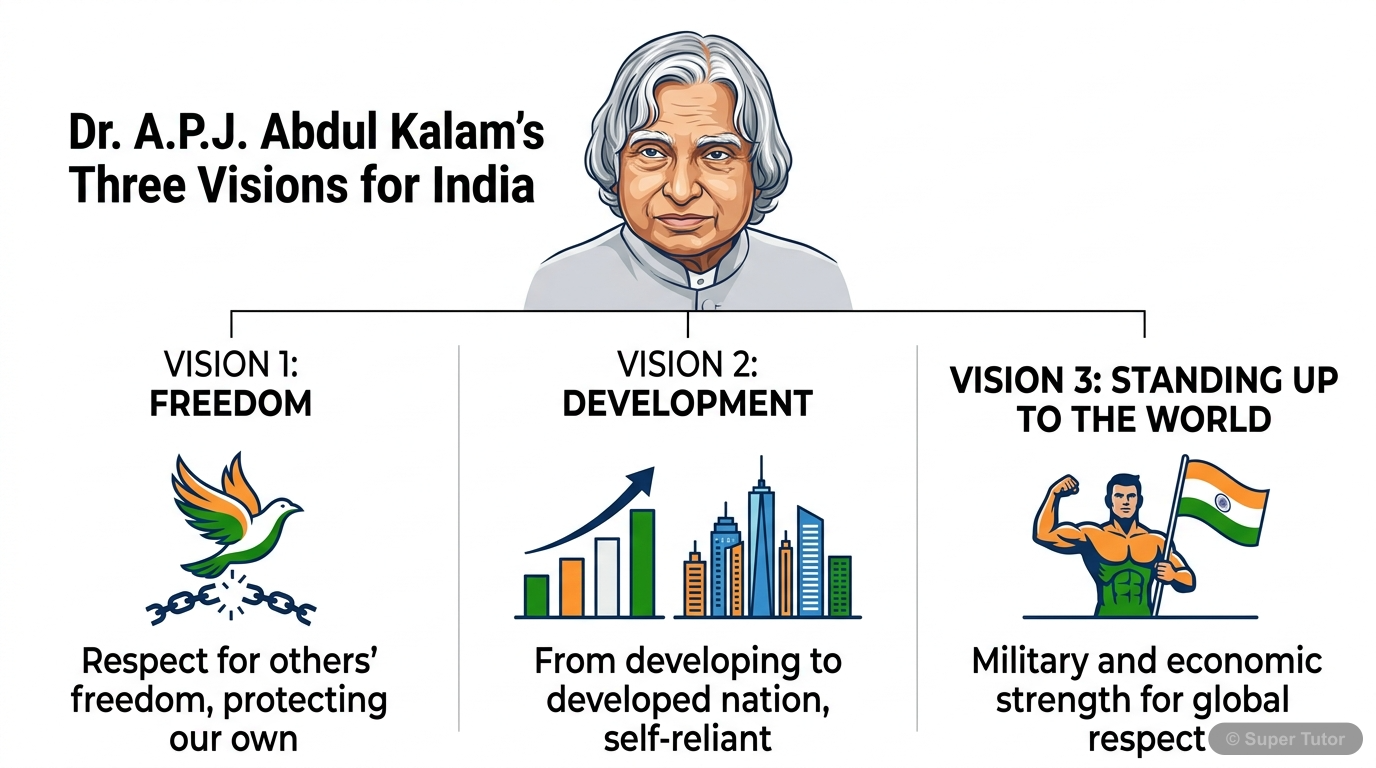
Learn better with visuals Super Tutor pairs illustrations like this with notes and quizzes for My Vision For India.
Quick Quiz: My Vision For India
0/4Tap an answer to check it instantly. No sign-up needed for these 4.
Who delivered the speech 'My Vision For India'?
What is Dr. Kalam's FIRST vision for India?
According to Dr. Kalam, when did India get its first vision of freedom?
What is Dr. Kalam's SECOND vision for India?
Sample Questions
Complete the famous quote: 'Ask what we can do for India and do what has to be done to make India what _______ are today.'
Show answer
America and other Western countries
Dr. Kalam echoes J.F. Kennedy's words to Americans, adapting them for Indians. The complete quote is: 'Ask what we can do for India and do what has to be done to make India what America and other Western countries are today.' This shows his vision of India reaching the development level of advanced Western nations. He specifically mentions America and Western countries as examples of developed nations that India should aspire to match. This quote emphasizes personal responsibility and action rather than just complaints.
What does Dr. Kalam mean by 'Only strength respects strength'?
Show answer
Strong nations respect other strong nations
When Dr. Kalam says 'Only strength respects strength', he means that strong nations respect other strong nations. He emphasizes that India must be strong both as a military power and as an economic power - both must go hand-in-hand. This strength will make other countries respect India. It's not about physical fitness or military power alone, but about overall national strength including economic development. He believes that without this comprehensive strength, India won't get the respect it deserves on the world stage.
Which three great scientists did Dr. Kalam work with closely?
Show answer
Dr. Vikram Sarabhai, Prof. Satish Dhawan, Dr. Brahm Prakash
Dr. Kalam specifically mentions working with three great minds: Dr. Vikram Sarabhai (Department of Space), Professor Satish Dhawan (who succeeded Dr. Sarabhai), and Dr. Brahm Prakash (father of nuclear material). He considers working with these three scientists as the great opportunity of his life. Dr. Sarabhai founded ISRO, Prof. Dhawan was also associated with ISRO, and Dr. Prakash was involved in nuclear technology. The other scientists mentioned in incorrect options are also renowned Indian scientists but were not specifically mentioned by Dr. Kalam in this speech.
What was the goal of the 14-year-old girl who asked for Dr. Kalam's autograph?
Show answer
To live in a developed India
When Dr. Kalam was in Hyderabad giving a lecture, a 14-year-old girl asked for his autograph. When he asked about her goal in life, she replied: 'I want to live in a developed India.' Dr. Kalam was inspired by her response and said that for her, and for all of us, we must build this developed India. This anecdote shows how young people dream of a better India and motivates Dr. Kalam to emphasize that we must work together to make India a developed nation.
+40 more questions on My Vision For India (NIOS Class 10 English)
Practise AllFrequently Asked Questions
What are the important topics in My Vision For India for NIOS Class 10 English?
How many practice questions are there for My Vision For India?
Sources & Official References
Content is aligned to the official syllabus. Refer to the board website for the latest curriculum.
More resources for My Vision For India
Important Questions
Exam-style questions with answers
Revision Notes
Key points for last-minute revision
Chapter Summary
Understand the chapter at a glance
Concept Maps
See how topics connect
Study Plan
Step-by-step plan for this chapter
Flashcards
Quick-fire cards for active recall
Syllabus
What topics to cover
For serious students
Get the full My Vision For India chapter — start free.
Quizzes, flashcards, an AI doubt solver and a study plan for NIOS Class 10 English. Free to start, no card needed.