Quadratic Equations and Linear Inequalities — Flashcards
NIOS · Class 12 · Mathematics
25 flashcards for Quadratic Equations and Linear Inequalities (NIOS Class 12 Mathematics) to test yourself on key terms and facts.
Interactive on Super Tutor
Studying Quadratic Equations and Linear Inequalities? Get the full interactive chapter.
Quizzes, flashcards, AI doubt-solver and a step-by-step study plan — built for flashcards and more.
Free trial, no card needed.
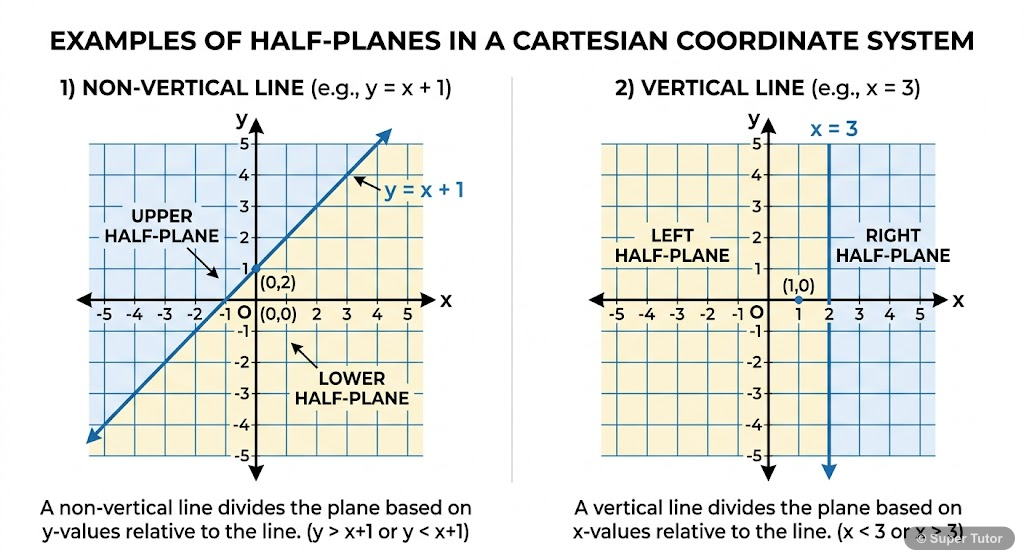
One of 4 illustrations for Quadratic Equations and Linear Inequalities in Super Tutor — alongside flashcards, concept maps and practice questions.
Solve the quadratic equation: 6x² + 5x - 6 = 0 using factorization method
Answer
Step 1: Write the equation: 6x² + 5x - 6 = 0 Step 2: Split middle term 5x into two parts whose product = 6 × (-6) = -36 and sum = 5. Use +9x and -4x Step 3: 6x² + 9x - 4x - 6 = 0 Step 4: Factor by gro…
When should you use the Quadratic Formula instead of factorization? Give an example where factorization is difficult.
Answer
Use the Quadratic Formula when: (1) The quadratic expression doesn't factor easily over integers, (2) Coefficients are large, (3) Roots are irrational or complex, (4) You need to verify the nature of …
Find the discriminant and nature of roots for: 9y² - 6√2y + 2 = 0
Answer
Step 1: Identify coefficients: a = 9, b = -6√2, c = 2 Step 2: Apply discriminant formula D = b² - 4ac Step 3: D = (-6√2)² - 4(9)(2) Step 4: D = 36(2) - 72 = 72 - 72 = 0 Step 5: Since D = 0, the equati…
What is the relationship between the roots (α, β) and coefficients (a, b, c) of ax² + bx + c = 0? Give a quick example.
Answer
Relationships (Vieta's Formulas): (1) Sum of roots: α + β = -b/a (2) Product of roots: αβ = c/a Example: For 3x² - 5x + 9 = 0 where a=3, b=-5, c=9: α + β = -(-5)/3 = 5/3 αβ = 9/3 = 3 Why it matters:…
Form a quadratic equation whose roots are α² and β², given that α and β are roots of 3y² + 4y + 1 = 0
Answer
Step 1: From 3y² + 4y + 1 = 0, find sum and product of original roots: α + β = -4/3 αβ = 1/3 Step 2: Calculate new sum (α² + β²): α² + β² = (α + β)² - 2αβ = (-4/3)² - 2(1/3) = 16/9 - 2/3 = 16/9 - 6/9…
Solve: √2t² - 3t + 3√2 = 0. Determine the nature of roots WITHOUT solving completely.
Answer
Step 1: Identify coefficients: a = √2, b = -3, c = 3√2 Step 2: Calculate discriminant D = b² - 4ac Step 3: D = (-3)² - 4(√2)(3√2) = 9 - 4(3)(2) = 9 - 24 = -15 Step 4: Since D = -15 < 0, roots are COMP…
Solve the inequality: (3x - 4)/2 ≥ (x + 1)/4 - 1. Show the solution on a number line.
Answer
Step 1: Simplify RHS: (x + 1)/4 - 1 = (x + 1)/4 - 4/4 = (x + 1 - 4)/4 = (x - 3)/4 So inequality becomes: (3x - 4)/2 ≥ (x - 3)/4 Step 2: Multiply both sides by 4 (positive, no sign change): 2(3x - 4) …
A student has marks 62 and 48 in two exams. What minimum marks in the annual exam to get an average of at least 60?
Answer
Step 1: Let x = marks in annual exam Step 2: Set up the inequality for average ≥ 60: (62 + 48 + x)/3 ≥ 60 Step 3: Simplify: (110 + x)/3 ≥ 60 Step 4: Multiply both sides by 3 (positive): 110 + x ≥ 18…
+17 more flashcards
Practise AllFrequently Asked Questions
What are the important topics in Quadratic Equations and Linear Inequalities for NIOS Class 12 Mathematics?
How many flashcards are available for Quadratic Equations and Linear Inequalities?
How should I revise Quadratic Equations and Linear Inequalities for the NIOS Class 12 board exam?
Sources & Official References
Content is aligned to the official syllabus. Refer to the board website for the latest curriculum.
More resources for Quadratic Equations and Linear Inequalities
Practice Quiz
Test yourself with a quick quiz
Important Questions
Exam-style questions with answers
Revision Notes
Key points for last-minute revision
Formula Sheet
The chapter's formulas in one place
Chapter Summary
Understand the chapter at a glance
Concept Maps
See how topics connect
Syllabus
What topics to cover
For serious students
Get the full Quadratic Equations and Linear Inequalities chapter — start free.
Quizzes, flashcards, an AI doubt solver and a study plan for NIOS Class 12 Mathematics. Free to start, no card needed.