Quadratic Equations and Linear Inequalities — Syllabus
NIOS · Class 12 · Mathematics
What Quadratic Equations and Linear Inequalities covers in NIOS Class 12 Mathematics: 4 topics, for the 2026-27 session.
Interactive on Super Tutor
Studying Quadratic Equations and Linear Inequalities? Get the full interactive chapter.
Quizzes, flashcards, AI doubt-solver and a step-by-step study plan — built for syllabus and more.
Free trial, no card needed.
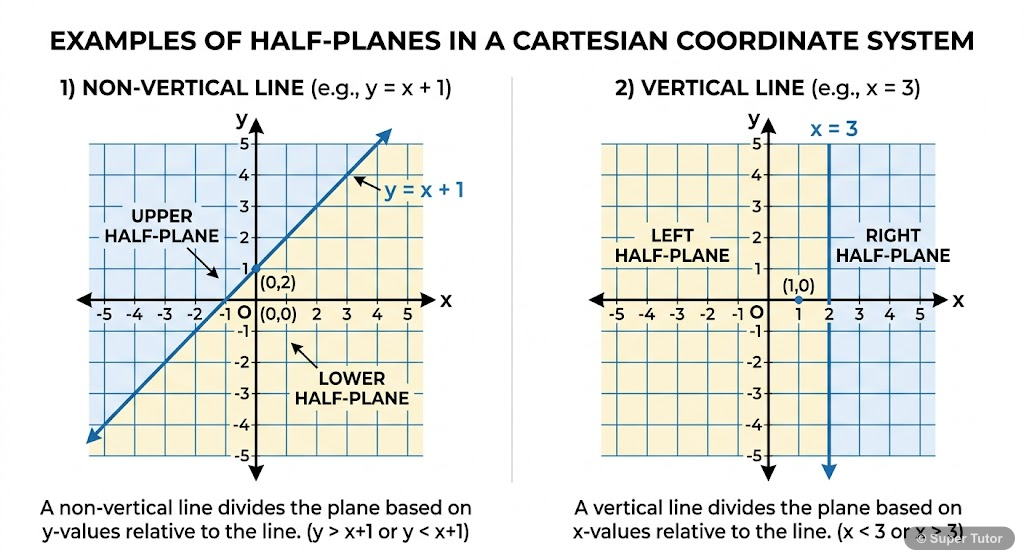
One of 4 illustrations for Quadratic Equations and Linear Inequalities in Super Tutor — alongside flashcards, concept maps and practice questions.
Topics in Quadratic Equations and Linear Inequalities
1. Quadratic Equations — Basics and Roots
- A quadratic equation has the standard form ax² + bx + c = 0, where a ≠ 0. Here 'a' is the leading coefficient, 'b' is the middle coefficient, and 'c' is the constant term.
- A root (or solution) is a value of x that satisfies the equation when substituted into it.
- Every quadratic equation has EXACTLY 2 roots (counting multiplicity) — this follows from the Fundamental Theorem of Algebra.
2. Solving Quadratic Equations by Factorization
- Factorization method involves splitting the middle term (bx) into two parts whose product equals a × c and whose sum equals b.
- After splitting, group the terms, take common factors, and express as a product of two linear factors.
- Set each factor equal to zero and solve — this gives the two roots.
3. Solving Quadratic Equations by Quadratic Formula (Sridharacharya's Formula)
- The quadratic formula gives the roots of ax² + bx + c = 0 directly using the coefficients a, b, c.
- The discriminant D = b² - 4ac determines the NATURE of roots BEFORE actually computing them.
- If D > 0: two distinct real roots. If D = 0: two equal real roots (each equal to -b/2a). If D < 0: two complex conjugate roots.
4. Relation Between Roots and Coefficients
- For the quadratic equation ax² + bx + c = 0 with roots α and β: Sum of roots = α + β = -b/a, Product of roots = αβ = c/a.
- These relations allow us to find expressions involving α and β WITHOUT actually solving for α and β separately.
- To form a new quadratic equation with given roots p and q: x² - (p + q)x + pq = 0.
Key Concepts
Work through every topic in Quadratic Equations and Linear Inequalities with notes and quizzes
Start This ChapterFrequently Asked Questions
What are the important topics in Quadratic Equations and Linear Inequalities for NIOS Class 12 Mathematics?
How should I revise Quadratic Equations and Linear Inequalities for the NIOS Class 12 board exam?
Sources & Official References
Content is aligned to the official syllabus. Refer to the board website for the latest curriculum.
More resources for Quadratic Equations and Linear Inequalities
Practice Quiz
Test yourself with a quick quiz
Important Questions
Exam-style questions with answers
Revision Notes
Key points for last-minute revision
Formula Sheet
The chapter's formulas in one place
Chapter Summary
Understand the chapter at a glance
Concept Maps
See how topics connect
Flashcards
Quick-fire cards for active recall
For serious students
Get the full Quadratic Equations and Linear Inequalities chapter — start free.
Quizzes, flashcards, an AI doubt solver and a study plan for NIOS Class 12 Mathematics. Free to start, no card needed.