The Market as a Social Institution
Odisha Board · Class 12 · Sociology
Flashcards for The Market as a Social Institution — Odisha Board Class 12 Sociology. Quick Q&A cards covering key concepts, definitions, and formulas.
Interactive on Super Tutor
Studying The Market as a Social Institution? Get the full interactive chapter.
Quizzes, flashcards, AI doubt-solver and a step-by-step study plan — built for flashcards and more.
1,000+ Class 12 students started this chapter today
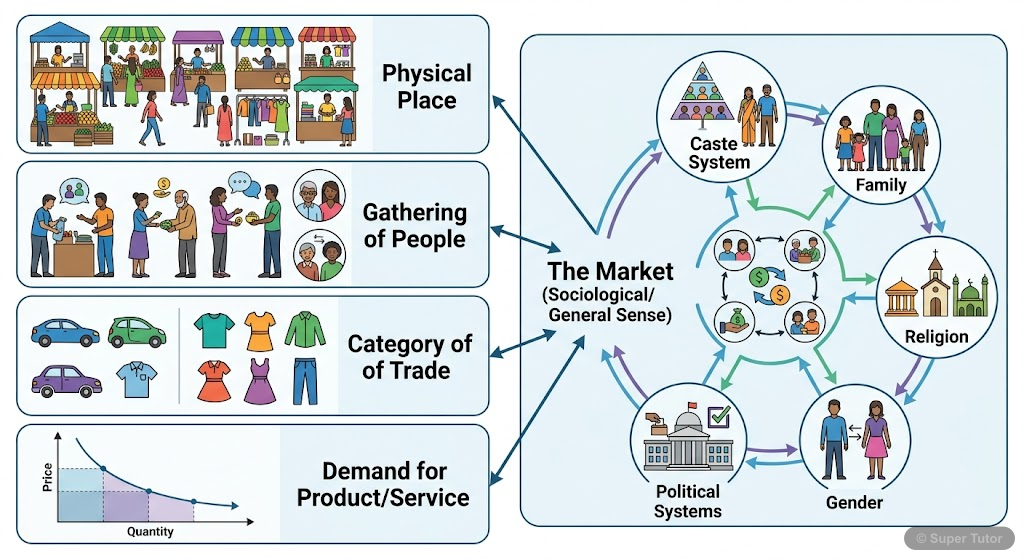
This is just one of 12+ visuals inside Super Tutor's The Market as a Social Institution chapter
Explore the full setWhat are the different meanings of 'market' discussed in the chapter?
Answer
1. Physical places where buying/selling occurs (railway station market, fruit market) 2. Gathering of buyers and sellers (weekly vegetable market) 3. Area of trade/business (car market, readymade clot…
How do sociologists view markets differently from economists?
Answer
Economists study markets as separate economic entities operating according to their own laws, leaving out social/political context. Sociologists view markets as social institutions that are: - Cultura…
Who was Adam Smith and what was his contribution to understanding markets?
Answer
Adam Smith (1723-90) was a famous early political economist who wrote 'The Wealth of Nations'. He argued that: - Market economy consists of individual exchanges/transactions - These automatically crea…
What is a weekly tribal haat and what functions does it serve?
Answer
A weekly tribal haat is a periodic market in rural/tribal areas that serves both economic and social functions: Economic: Exchange of agricultural/forest produce for manufactured goods, salt, implemen…
How did colonialism transform tribal markets and economies?
Answer
Colonial transformation included: - Building roads and 'pacifying' local people - Influx of traders, moneylenders from plains - Forest produce sold to outsiders - Introduction of money and new goods -…
Describe the social organization of the weekly market in Bastar district.
Answer
Participants: Local tribals and non-tribals (Hindus), outside Hindu traders, Forest officials Goods exchanged: Manufactured goods (jewelry, pots), non-local foods (salt, turmeric), local agricultural …
What does recent historical research reveal about pre-colonial Indian economy?
Answer
Contrary to earlier assumptions of unchanging village communities: - Much of India's economy was already extensively monetised - Sophisticated trading networks existed - Villages were incorporated int…
What was the hundi system and how did it work?
Answer
Hundi was a bill of exchange (like a credit note) used by traditional trading communities: - Allowed merchants to engage in long-distance trade - Worked within caste and kinship networks - A merchant …
+12 more flashcards available
Practice AllFrequently Asked Questions
What are the important topics in The Market as a Social Institution for Odisha Board Class 12 Sociology?
How to score full marks in The Market as a Social Institution — Odisha Board Class 12 Sociology?
How many flashcards are available for The Market as a Social Institution?
Sources & Official References
Content is aligned to the official syllabus. Refer to the board website for the latest curriculum.
More resources for The Market as a Social Institution
Important Questions
Practice with board exam-style questions
Syllabus
What topics to cover
Revision Notes
Key points for last-minute revision
Study Plan
Step-by-step plan to ace this chapter
Formula Sheet
All formulas in one place
Chapter Summary
Understand the chapter at a glance
Practice Quiz
Test yourself with a quick quiz
Concept Maps
See how topics connect visually
NCERT Solutions
Every textbook question solved step by step
For serious students
Get the full The Market as a Social Institution chapter — for free.
Quizzes, flashcards, AI doubt-solver and a step-by-step study plan for Odisha Board Class 12 Sociology.