Complex Numbers and Quadratic Equations — Chapter Summary
Punjab Board · Class 11 · Mathematics
Summary of Complex Numbers and Quadratic Equations for Punjab Board Class 11 Mathematics. Part of the Punjab Board Class 11 Mathematics syllabus.
Interactive on Super Tutor
Studying Complex Numbers and Quadratic Equations? Get the full interactive chapter.
Quizzes, flashcards, AI doubt-solver and a step-by-step study plan — built for chapter summary and more.
Free trial, no card needed.
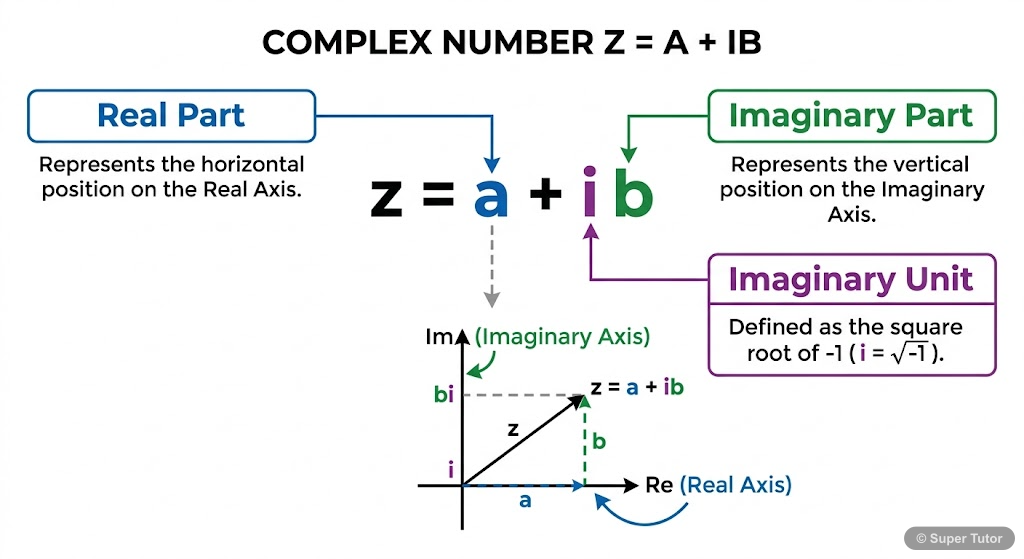
Learn better with visuals Super Tutor pairs illustrations like this with notes and quizzes for Complex Numbers and Quadratic Equations.
Overview
Complex numbers extend the real number system to solve equations that have no real solutions, such as x² + 1 = 0. This chapter introduces the imaginary unit i (where i² = -1) and develops the complete algebra of complex numbers. Complex numbers are essential in mathematics, physics, and engineering,
Key Concepts
The imaginary unit i is defined
The imaginary unit i is defined as a solution to x² = -1, so i² = -1. This extends the real number system to include solutions to equations that previ
A complex number is any number
A complex number is any number of the form z = a + ib, where a and b are real numbers. Here, a is the real part (Re z = a) and b is the imaginary part
For complex numbers z₁ =
For complex numbers z₁ = a + ib and z₂ = c + id, the sum is z₁ + z₂ = (a + c) + i(b + d). Addition combines real parts separately and imaginary parts
Subtraction is defined as z₁
Subtraction is defined as z₁ - z₂ = z₁ + (-z₂), where -z₂ is the additive inverse of z₂. For z₁ = a + ib and z₂ = c + id, we get z₁ - z₂ = (a - c) + i
For z₁ = a + ib
For z₁ = a + ib and z₂ = c + id, multiplication is defined as z₁z₂ = (ac - bd) + i(ad + bc). This follows from treating complex numbers algebraically
Learning Objectives
- Understand the concept of imaginary unit i and complex numbers in the form a + ib
- Perform arithmetic operations (addition, subtraction, multiplication, division) with complex numbers
- Apply properties of complex number operations including closure, commutativity, and associativity
- Calculate the modulus and conjugate of complex numbers and apply their properties
- Find multiplicative inverses of non-zero complex numbers
Frequently Asked Questions
What are the important topics in Complex Numbers and Quadratic Equations for Punjab Board Class 11 Mathematics?
How should I revise Complex Numbers and Quadratic Equations for Class 11 exams?
Sources & Official References
Content is aligned to the official syllabus. Refer to the board website for the latest curriculum.
More resources for Complex Numbers and Quadratic Equations
For serious students
Get the full Complex Numbers and Quadratic Equations chapter — start free.
Quizzes, flashcards, an AI doubt solver and a study plan for Punjab Board Class 11 Mathematics. Free to start, no card needed.