Complex Numbers and Quadratic Equations — Flashcards
Punjab Board · Class 11 · Mathematics
27 flashcards for Complex Numbers and Quadratic Equations (Punjab Board Class 11 Mathematics) to test yourself on key terms and facts.
Interactive on Super Tutor
Studying Complex Numbers and Quadratic Equations? Get the full interactive chapter.
Quizzes, flashcards, AI doubt-solver and a step-by-step study plan — built for flashcards and more.
Free trial, no card needed.
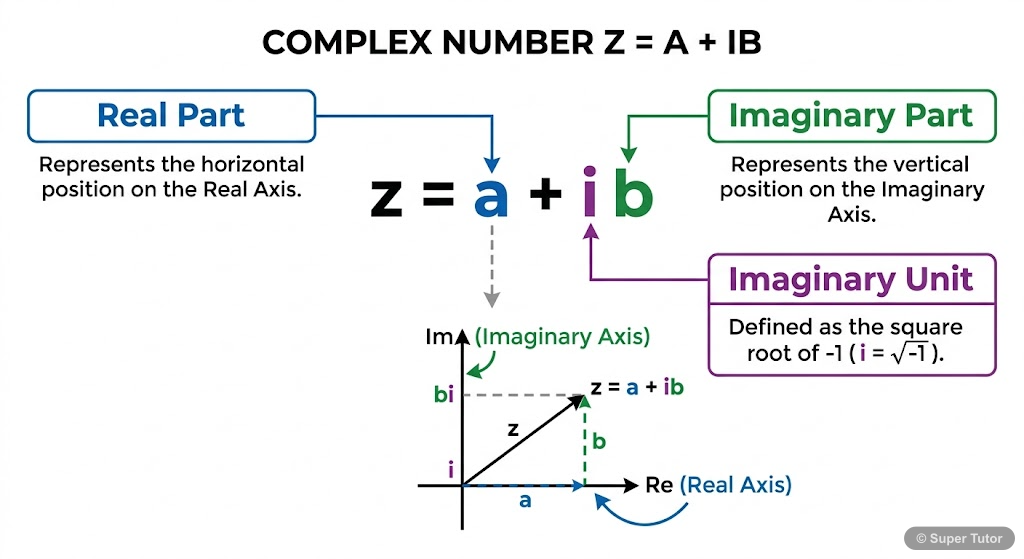
Learn better with visuals Super Tutor pairs illustrations like this with notes and quizzes for Complex Numbers and Quadratic Equations.
Find x and y if 4x + i(3x - y) = 3 + i(-6), where x and y are real numbers.
Answer
Step 1: Equate real parts: 4x = 3 → x = 3/4 Step 2: Equate imaginary parts: 3x - y = -6 Step 3: Substitute x = 3/4 into 3x - y = -6 → 3(3/4) - y = -6 → 9/4 - y = -6 Step 4: Solve for y: -y = -6 - 9/4 …
Add the complex numbers: (2 + 3i) + (-6 + 5i). Express in the form a + ib.
Answer
Step 1: Identify real parts: 2 and -6 Step 2: Identify imaginary parts: 3 and 5 Step 3: Add real parts: 2 + (-6) = -4 Step 4: Add imaginary parts: 3 + 5 = 8 Step 5: Combine: -4 + 8i Answer: -4 + 8i Ke…
Subtract: (6 + 3i) - (2 - i). Express in the form a + ib.
Answer
Step 1: Rewrite subtraction as addition of negative: (6 + 3i) + (-(2 - i)) Step 2: Find negative of (2 - i): -(2 - i) = -2 + i Step 3: Add: (6 + 3i) + (-2 + i) Step 4: Add real parts: 6 + (-2) = 4 Ste…
Multiply: (3 + 5i)(2 + 6i). Express in the form a + ib.
Answer
Step 1: Use formula (a + ib)(c + id) = (ac - bd) + i(ad + bc) Step 2: Identify: a = 3, b = 5, c = 2, d = 6 Step 3: Calculate ac - bd: (3)(2) - (5)(6) = 6 - 30 = -24 Step 4: Calculate ad + bc: (3)(6) +…
Divide: (6 + 3i) ÷ (2 - i). Express in the form a + ib.
Answer
Step 1: Write as fraction: (6 + 3i)/(2 - i) Step 2: Multiply numerator and denominator by conjugate of denominator (2 + i): Step 3: Numerator: (6 + 3i)(2 + i) = 12 + 6i + 6i + 3i² = 12 + 12i - 3 = 9 +…
Calculate i⁹ + i¹⁹. Express in the form a + ib.
Answer
Step 1: Use the pattern: i¹ = i, i² = -1, i³ = -i, i⁴ = 1, then repeats every 4 powers Step 2: For i⁹: 9 = 4(2) + 1, so i⁹ = i¹ = i Step 3: For i¹⁹: 19 = 4(4) + 3, so i¹⁹ = i³ = -i Step 4: Add: i + (-…
Calculate i⁻³⁹. Express in the form a + ib.
Answer
Step 1: Recognize that i⁻³⁹ = 1/i³⁹ Step 2: Find i³⁹: 39 = 4(9) + 3, so i³⁹ = i³ = -i Step 3: Therefore i⁻³⁹ = 1/(-i) Step 4: Rationalize: 1/(-i) × (i/i) = i/(-i²) = i/(-(-1)) = i/1 = i Alternatively:…
Express (-5i)(1/8 i) in the form a + ib.
Answer
Step 1: Multiply: (-5i)(1/8 i) = (-5 × 1/8) × (i × i) Step 2: Simplify: = -5/8 × i² Step 3: Substitute i² = -1: = -5/8 × (-1) = 5/8 Step 4: Write in standard form: 5/8 + 0i Answer: 5/8 + 0i…
+19 more flashcards
Practise AllFrequently Asked Questions
What are the important topics in Complex Numbers and Quadratic Equations for Punjab Board Class 11 Mathematics?
How many flashcards are available for Complex Numbers and Quadratic Equations?
How should I revise Complex Numbers and Quadratic Equations for Class 11 exams?
Sources & Official References
Content is aligned to the official syllabus. Refer to the board website for the latest curriculum.
More resources for Complex Numbers and Quadratic Equations
Practice Quiz
Test yourself with a quick quiz
Important Questions
Exam-style questions with answers
Revision Notes
Key points for last-minute revision
Formula Sheet
The chapter's formulas in one place
Chapter Summary
Understand the chapter at a glance
Concept Maps
See how topics connect
Syllabus
What topics to cover
For serious students
Get the full Complex Numbers and Quadratic Equations chapter — start free.
Quizzes, flashcards, an AI doubt solver and a study plan for Punjab Board Class 11 Mathematics. Free to start, no card needed.